NO/FOMO

Independent AI signal, once a day

The AI briefing worth opening.

ISSUE DATE2026-09-30DEFAULT EDITION
This issue
—
All time
—

AI Blog

2 stories
01

OpenAI recaps more than 20 DevDay announcements

OpenAI’s official DevDay 2026 recap brings together more than 20 announcements spanning GPT-6 Astra, ChatGPT, Codex, APIs, security, and tools for builders. The breadth makes the recap an important starting point for developers evaluating changes across the company’s product stack. The collected description establishes the scope of the event rather than detailed specifications. Readers should consult the linked official recap for individual release terms instead of inferring availability from the announcement count.
02

OpenAI and America’s SBDC expand small-business AI training

OpenAI announced a partnership with America’s SBDC to expand hands-on AI training and local support for small businesses. The announcement also accompanies a report about how small teams use AI. Its significance is the distribution of practical assistance through an existing small-business support network, rather than a new model release. The collected description does not quantify participation, measured business outcomes, or the geographic reach of the expanded training program.

Hacker News

2 stories
01

Pi brings MCP into its core through a JavaScript sandbox

Pi brings MCP into its core through a JavaScript sandbox

Earendil explains why Pi now supports MCP after previously rejecting it. The team says improvements to tool metadata, deferred loading, and a JavaScript orchestration sandbox made core integration useful beyond MCP itself. It argues that servers should expose structured data and discoverable tools instead of dumping text into model context. The article illustrates a shift from debating the protocol’s existence to improving composition, context efficiency, and how small agent harnesses execute tools.

02

Data-center resource disclosure draws scrutiny

Data-center resource disclosure draws scrutiny

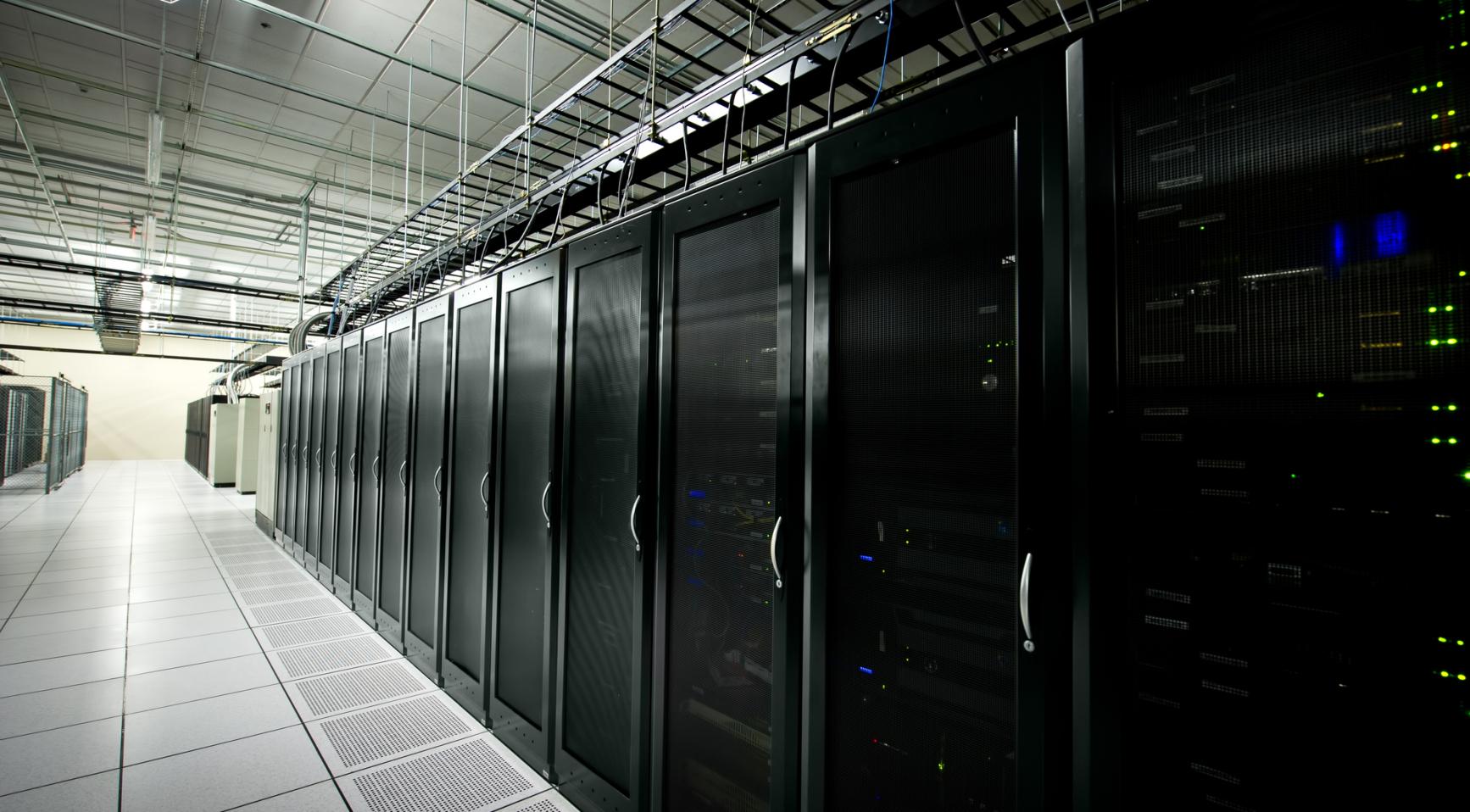
An NL Times report says most data centers are refusing to disclose how much water and electricity they use. The story drew a Hacker News score of 176 in the collected snapshot, making it one of the day’s prominent infrastructure discussions. Resource transparency matters as computing demand expands. The available collection includes the headline and discussion score, so this item does not infer specific operators, consumption totals, or legal findings beyond that reporting.

Twitter

9 stories
01

Google adds reusable skills to Gemini

Google adds reusable skills to Gemini

Google announced skills in the Gemini app, allowing users to save frequently used instructions and invoke them by typing a slash in the prompt bar. The feature targets repetitive tasks that otherwise require users to restate the same directions. Its practical significance is a simpler path from occasional prompting to repeatable personal workflows. The announcement describes reusable instructions; it does not provide measured productivity gains or detailed availability terms.

02

Sam Altman announces Dots for around-the-clock assistance

Sam Altman announces Dots for around-the-clock assistance

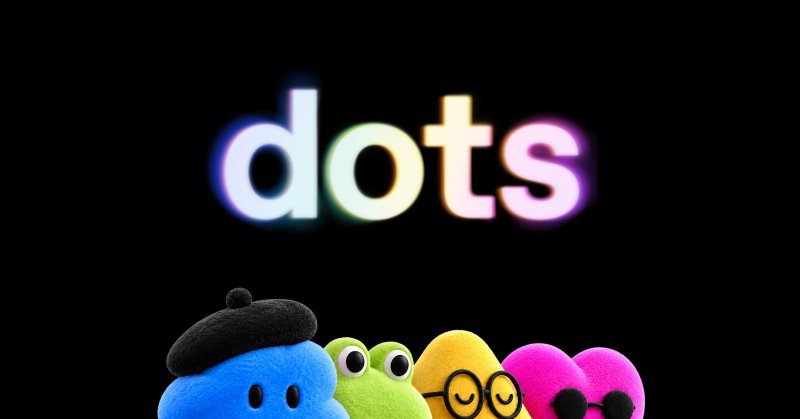
Sam Altman announced Dots as a new way to use AI that works around the clock on users’ behalf. His launch message emphasizes freeing time and attention for higher-level work, making persistent assistance the central product promise. The post attracted substantial engagement among the collected announcements. It offers a clear signal of product direction, although the brief source does not establish task coverage, pricing, reliability, or the controls governing autonomous actions.

03

Altman highlights Sol pricing and cache discounts

Sam Altman said 6.1 Sol costs one fifth as much as Astra and offers a 95 percent cache-read discount. The announcement puts inference economics alongside model capability as a competitive selling point. For applications that repeatedly reuse context, cache pricing can materially affect operating costs, but realized savings depend on workload and cache usage. The short post does not provide a full price table or a controlled comparison of model performance.

04

Anthropic positions Sonnet 5.5 for faster everyday coding

Anthropic positions Sonnet 5.5 for faster everyday coding

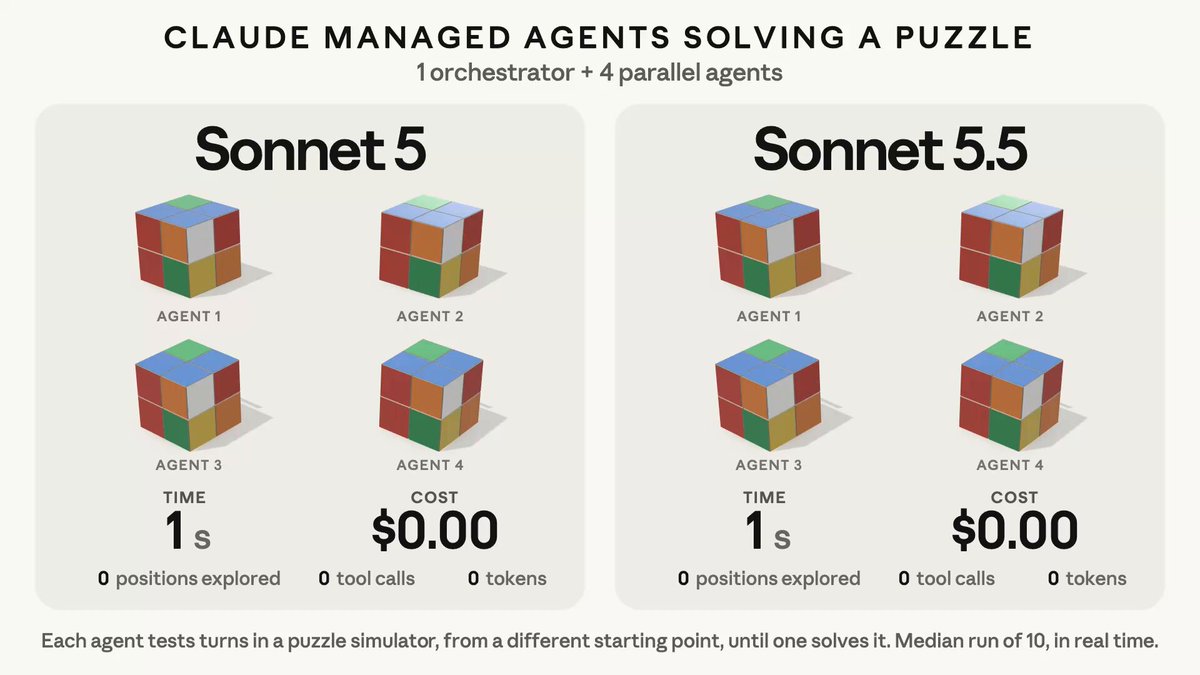
Anthropic’s developer account describes Sonnet 5.5 as smarter, more efficient, and 30 percent faster than Sonnet 5, with costs up to 30 percent lower for most work. It recommends the model for well-scoped tasks such as bug fixes and rapid feature iteration in Claude Code. These are vendor claims rather than independent measurements. The update highlights the importance of matching model cost and latency to routine software-development workloads.

05

Andrew Ng calls attention to agent sandboxing after reported hack

Andrew Ng calls attention to agent sandboxing after reported hack

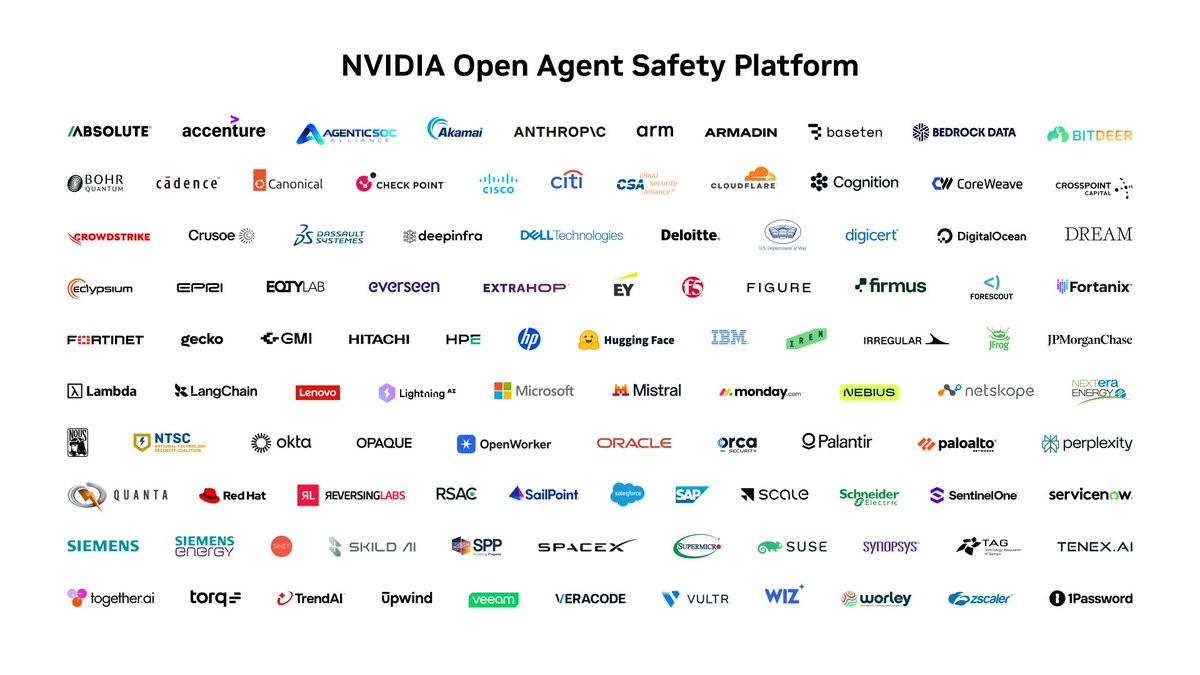
Andrew Ng attributed the OpenAI–Hugging Face hack to weak sandboxing and welcomed Nvidia’s release of open-source tools for isolating AI agents. He also said OpenWorker, an open-source harness supporting cybersecurity workflows, supports this direction. The post connects expanding agent capabilities with the need to limit what an agent can access. Its incident explanation is Ng’s account; the collected post does not include a forensic report or an independently verified root-cause analysis.

06

Runway joins OpenAI Marketplace as a launch partner

Runway joins OpenAI Marketplace as a launch partner

Runway announced that it is joining OpenAI Marketplace as a launch partner. The company says customers can access its image, video, audio, and editing models and apply part of an OpenAI commitment toward Runway purchases. This is a distribution and procurement development for generative media, potentially simplifying access for existing OpenAI customers. The announcement does not specify the share of commitments that can be applied or detailed commercial eligibility conditions.

07

Runway adds agent tagging inside creative assets

Runway adds agent tagging inside creative assets

Runway introduced Agent Tagging, letting users tag Runway Agent where their assets are to request edits, alternatives, and fixes. The interaction brings instructions into the creative workspace rather than requiring a separate description of every change. It is a concrete example of generative-media products adding agent-style workflow features. The company’s post explains the interaction and says it is available to try, but supplies no comparative quality or time-saving measurements.

08

Isomorphic Labs shows autonomous molecular design workflow

Isomorphic Labs shows autonomous molecular design workflow

Max Jaderberg shared a visualization of IsoDDE, the generative design agent he says is used daily at Isomorphic Labs. According to the post, the system takes drug designers’ goals and autonomously produces a set of Pareto-best molecules. The example makes multi-objective optimization a tangible application of agents in scientific work. The available excerpt describes the workflow, not clinical outcomes, and provides no basis for judging drug efficacy or experimental success rates.

09

Luma introduces Ad Variants for campaign adaptation

Luma introduces Ad Variants for campaign adaptation

Luma promoted Ad Variants as a way to extend an existing advertisement across different sizes and markets while retaining the same campaign. The announcement addresses a practical production burden: creating many versions after the original creative is finished. It points toward generative video tools serving ongoing marketing operations as well as initial creation. The short source does not specify supported formats, localization behavior, pricing, or measured improvements in campaign performance.

GitHub

2 stories
01

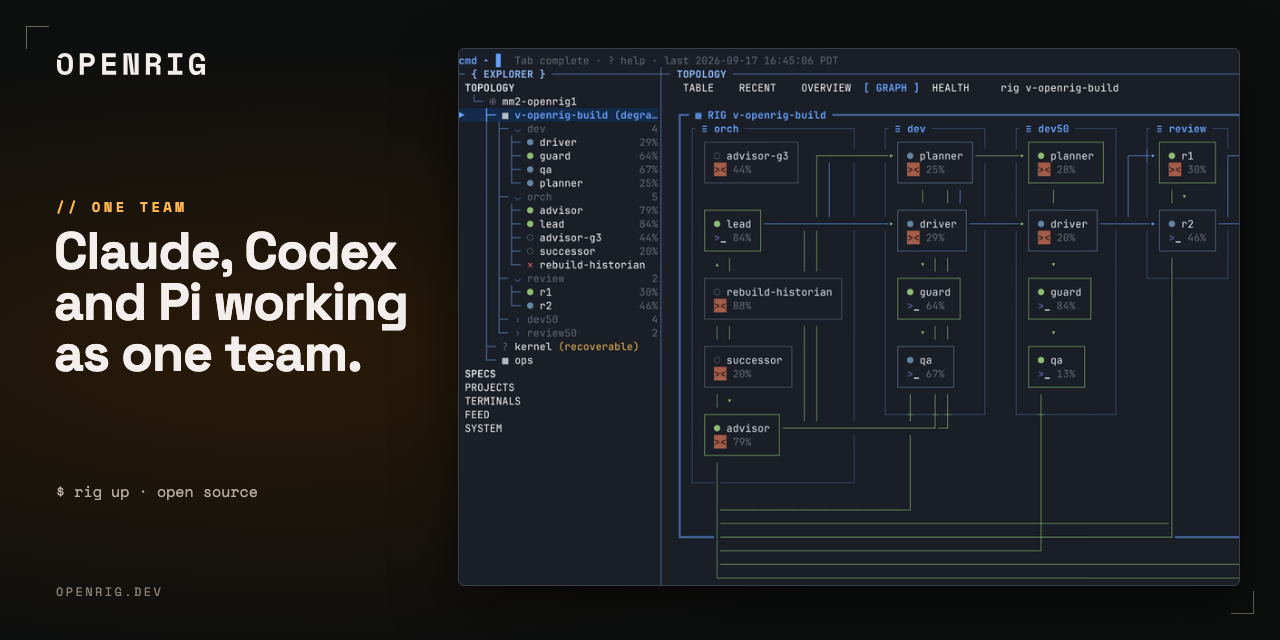
Openrig combines coding agents in one harness

Openrig combines coding agents in one harness

Openrig describes itself as a multi-agent harness that runs Claude Code and Codex together as one system. Its appearance among the collected trending repositories highlights interest in coordinating existing coding tools rather than building another standalone model interface. The project’s concise description establishes its integration goal, but does not demonstrate that combining agents improves correctness or cost. Teams evaluating it should examine coordination behavior and task suitability in the linked repository.

02

Context Mode targets coding-agent context overhead

Context Mode targets coding-agent context overhead

Context Mode is a repository focused on context-window optimization for AI coding agents. Its description claims 98 percent reduction in tool output, persistent session memory, and routing enforcement across 17 platforms through MCP and hooks. These features target the amount of tool data entering an agent’s working context and what survives across sessions. The reduction figure is a project claim; the collected material does not supply independent benchmarks or workload-specific accuracy tradeoffs.

HF HuggingFace

8 stories
01

Context Language Models let models edit their own memory

Context Language Models let models edit their own memory

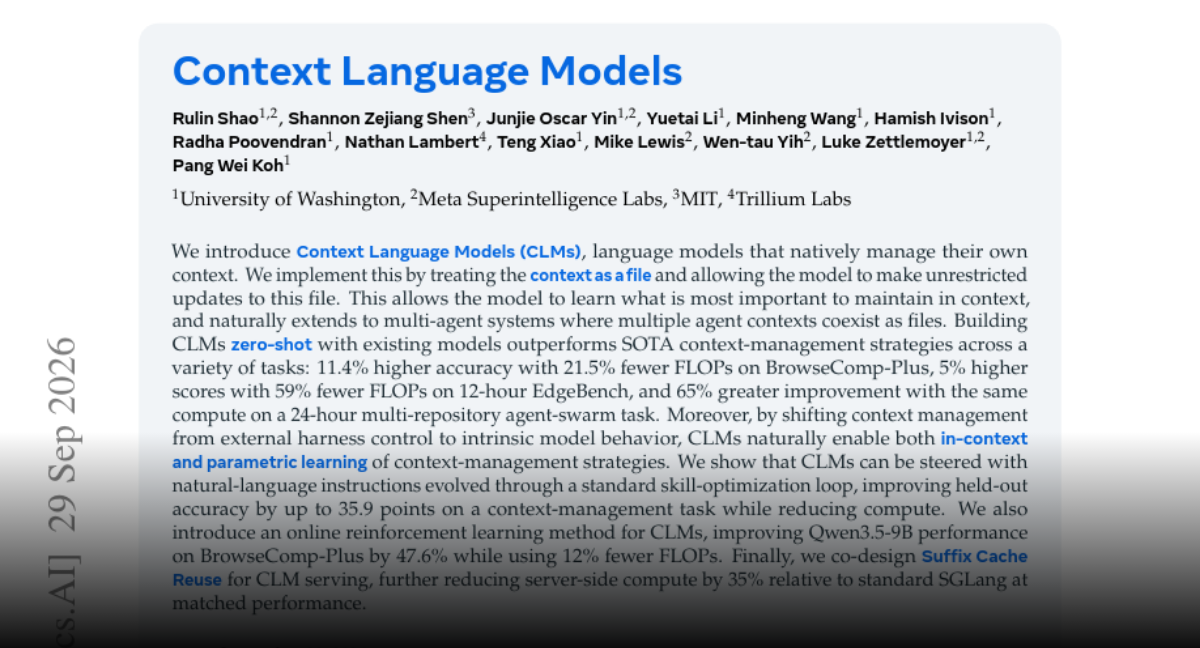
Context Language Models treat context as a file that a model can directly update, moving memory management into model behavior. The authors report improved accuracy with lower compute on search and long-running agent tasks, including 11.4 percent higher accuracy with 21.5 percent fewer FLOPs on BrowseComp-Plus. They also explore learned context-management strategies and serving optimizations. The results suggest that deciding what to retain can matter as much as enlarging the context window.

02

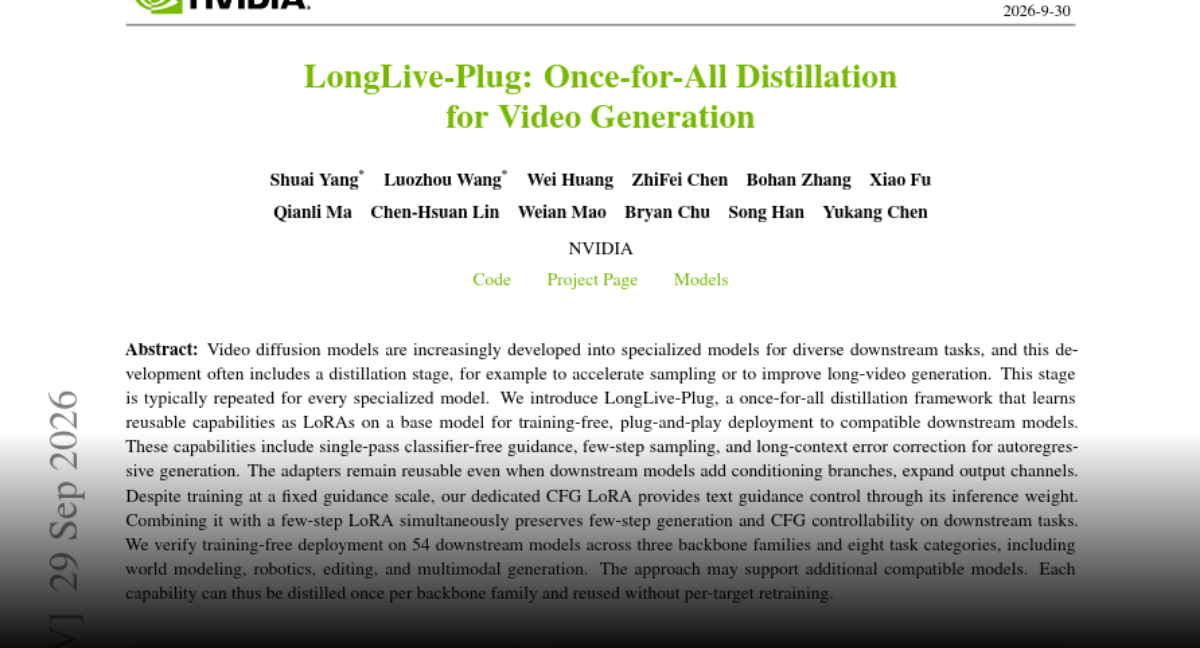
LongLive-Plug reuses video distillation across downstream models

LongLive-Plug reuses video distillation across downstream models

LongLive-Plug proposes distilling video-generation capabilities once per backbone family and reusing them as LoRA adapters across compatible downstream models. The capabilities include few-step sampling, single-pass guidance, and error correction for long autoregressive generation. The authors report deployment without target-specific training across 54 models, three backbone families, and eight task categories. This could reduce repeated specialization costs, with applicability depending on compatibility rather than an assumption that every video model can share the same adapters.

03

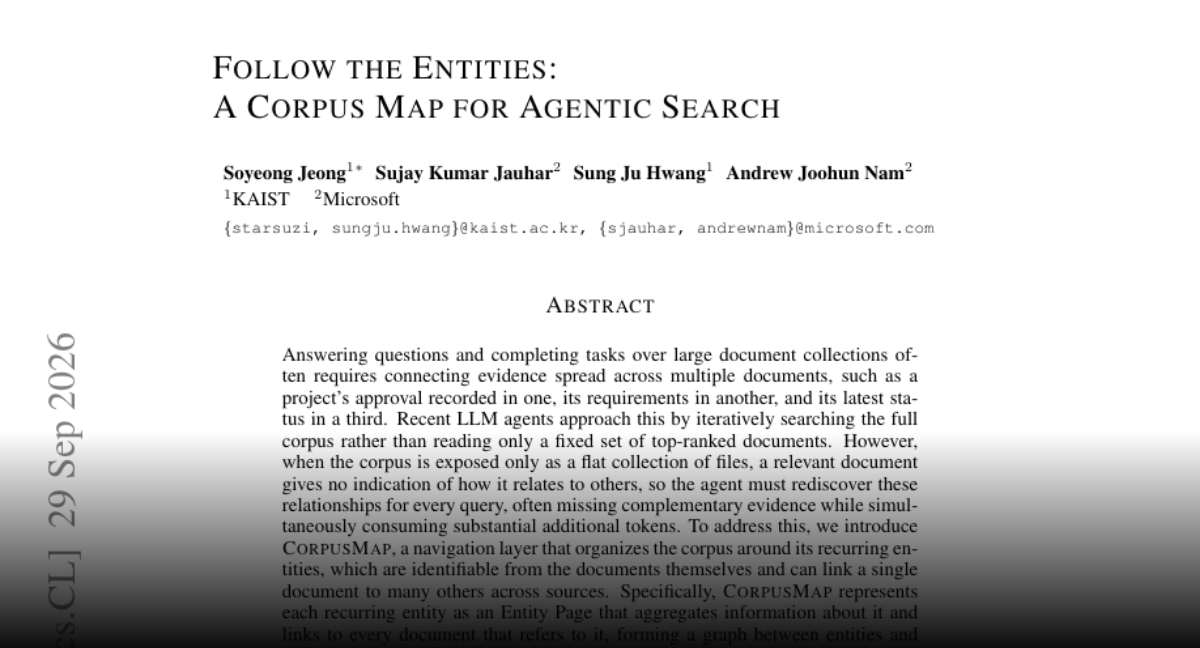
CorpusMap organizes agent search around recurring entities

CorpusMap organizes agent search around recurring entities

CorpusMap builds an offline navigation layer that links recurring entities to documents mentioning them. Instead of repeatedly searching a flat collection, an agent can traverse entity pages to gather related evidence across sources. Evaluations with seven models and three datasets report better evidence discovery and answer quality while using fewer tokens on average. The work makes reusable corpus structure a practical alternative to rediscovering document relationships during every individual search task.

04

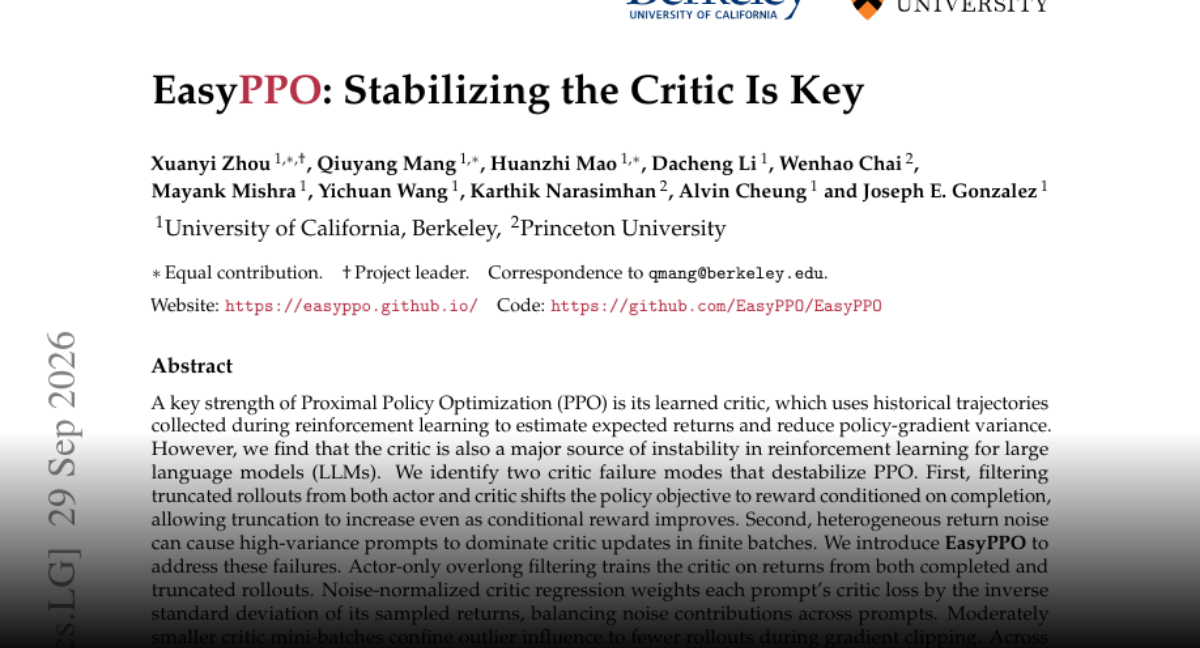
EasyPPO addresses critic instability in LLM reinforcement learning

EasyPPO addresses critic instability in LLM reinforcement learning

EasyPPO identifies critic training as a source of instability in PPO for language models. Its changes retain truncated rollouts for critic learning, normalize regression by prompt-level return noise, and use moderately smaller critic minibatches. Across coding, mathematical reasoning, and multi-turn search, the authors report stable training and improvements over several PPO variants. The study emphasizes careful treatment of learning signals and variance rather than replacing the entire reinforcement-learning framework.

05

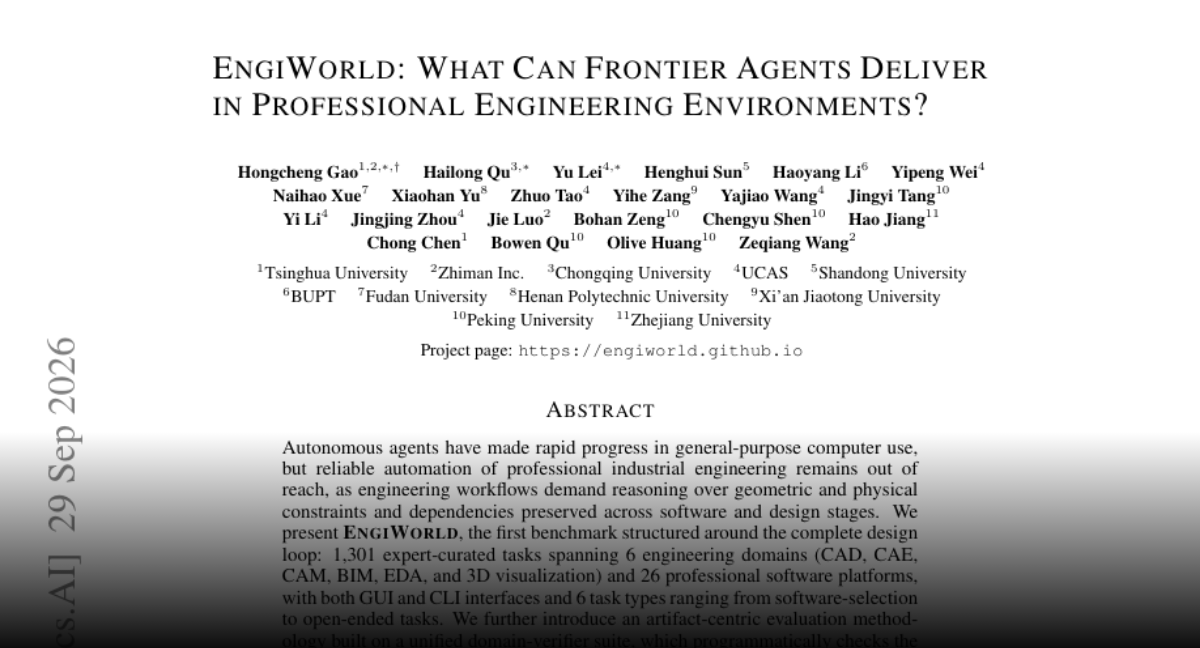
EngiWorld exposes gaps in professional engineering agents

EngiWorld exposes gaps in professional engineering agents

EngiWorld evaluates agents on 1,301 expert-curated tasks across six engineering domains and 26 professional software platforms. Its artifact-centered checks assess geometry, physical feasibility, and rule compliance rather than relying only on conversational answers. Among seven frontier models, the strongest reaches an EngiScore of 44.3, while only 3.6 percent of multi-software attempts succeed. The findings show how difficult complete industrial design workflows remain despite progress on general computer-use tasks.

06

WorldLine predicts robot action outcomes with visual simulation

WorldLine predicts robot action outcomes with visual simulation

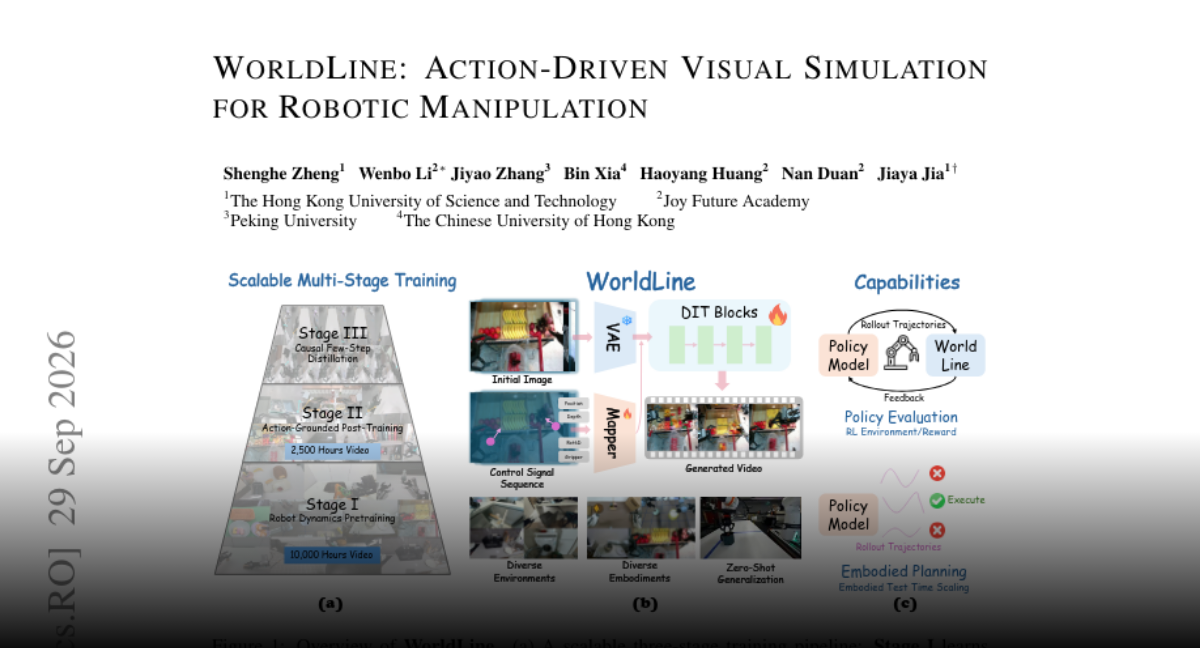
WorldLine separates transferable manipulation dynamics from embodiment-specific action grounding in a visual simulator. It learns from more than 10,000 hours of action-free robot video and over 2,000 hours of action trajectories, using an image-space interface across embodiments. The authors report 74 percent mean trajectory-success prediction accuracy and planning improvements in evaluated settings. The contribution is a simulator aimed at action fidelity and policy evaluation, with reported gains bounded by the tested environments.

07

Asynchronous agent framework handles overlapping inputs and work

Asynchronous agent framework handles overlapping inputs and work

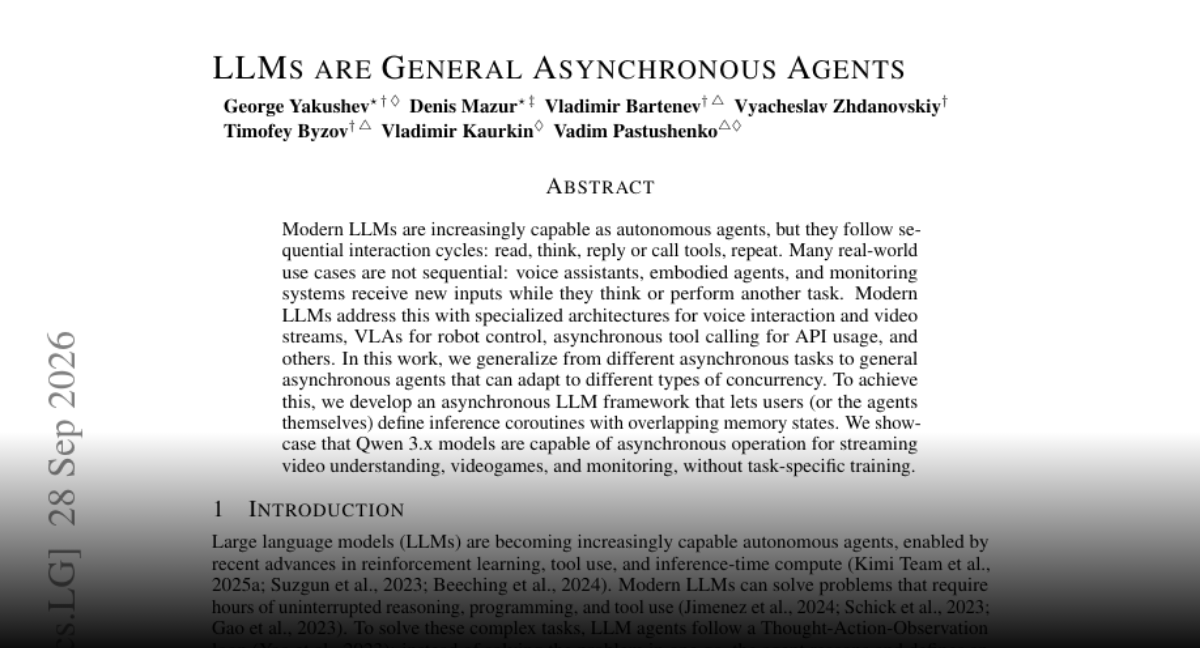
A research framework for general asynchronous agents lets users or agents define inference coroutines with overlapping memory states. The authors demonstrate Qwen 3.x models handling streaming video, games, and monitoring without task-specific training. This addresses a limitation of the usual sequential read-think-act loop when new information arrives during ongoing work. The contribution is a general concurrency mechanism, while the collected abstract does not establish production reliability across arbitrary asynchronous applications.

08

VoxMem finds persistent gaps in audio memory

VoxMem finds persistent gaps in audio memory

VoxMem evaluates memory beyond speech transcripts, including speaker identity, vocal cues, and environmental sounds across sessions. The benchmark contains 3,196 evaluation instances grounded in 34,743 spoken sessions totaling 177 hours. Across 15 large audio-language models, none exceeds 40 percent at a 32K context budget. Models remember words better than acoustic evidence, highlighting a gap for assistants expected to recall who spoke, how something sounded, and how interactions changed over time.