NO/FOMO

Independent AI signal, once a day

The AI briefing worth opening.

ISSUE DATE2026-10-01DEFAULT EDITION
This issue
—
All time
—

AI Blog

3 stories
01

Barclays expands its strategic collaboration with Anthropic

Barclays expands its strategic collaboration with Anthropic

Anthropic announced that Barclays is expanding its strategic collaboration to integrate secure, enterprise-grade AI systems across the bank’s global operations. The announcement positions Claude as part of efforts to upgrade operations and improve client experience. The collected description does not quantify deployment scale or measured benefits. Its significance is the continued movement of major financial institutions from AI experimentation toward broader operational integration, where governance and reliability are central requirements.

02

Albertsons describes enterprise AI use across retail operations

OpenAI published a customer story describing Albertsons Companies’ use of ChatGPT Enterprise and the OpenAI API. The stated goals are helping teams work faster and making grocery shopping easier for millions of customers. The collected description supplies no measured productivity or customer-outcome figures. It is nevertheless a concrete retail deployment example, showing that enterprise AI adoption includes internal team workflows as well as experiences closer to the customer.

03

OpenAI reports disrupting a model-distillation campaign

OpenAI reported disrupting a coordinated campaign aimed at extracting protected model reasoning and said it is strengthening defenses against adversarial distillation. The collected description does not identify participants or provide a full incident timeline. This should be read as the company’s account of the event. The story raises a material platform-security question: how providers distinguish ordinary API use from coordinated extraction while protecting model behavior exposed through interactive products.

Hacker News

6 stories
01

FTC investigation puts AI product risks in focus

FTC investigation puts AI product risks in focus

A CNBC report shared on Hacker News says the Federal Trade Commission is investigating OpenAI, Anthropic, and other AI companies over product risks. The collected entry provides the headline and discussion metadata, without the investigation’s detailed scope or findings. An investigation should not be treated as a finding of wrongdoing. Even with that limit, scrutiny of major AI providers is consequential for product governance and for organizations assessing their exposure to changing regulatory expectations.

02

OpenAI and Synopsys announce GPT-Synopsys for chip design

OpenAI and Synopsys announce GPT-Synopsys for chip design

A Synopsys announcement shared on Hacker News introduces GPT-Synopsys, a collaboration with OpenAI aimed at applying frontier intelligence to chip design. The collected headline establishes the partnership and application area, but does not substantiate specific productivity gains, availability, or technical integration details. The industry significance is the move toward specialized AI products inside demanding engineering workflows, where success ultimately depends on design correctness and compatibility with established verification processes.

03

Cloudflare introduces Clef decision models and RL platform

Cloudflare introduces Clef decision models and RL platform

Cloudflare’s Clef announcement, surfaced on Hacker News, describes open-source decision models and a new reinforcement-learning fine-tuning platform. It was among the stronger AI-related discussions in the collected feed, with 240 points at collection time. The available entry does not supply architecture, licensing details, or benchmark results. Its relevance is the combination of reusable decision models and a training platform, which could help teams explore domain-specific behavior beyond prompt-only customization.

04

Figma MCP client restrictions draw developer attention

Figma MCP client restrictions draw developer attention

A Hacker News entry reports that Figma restricts MCP access to whitelisted clients and excludes Pi. The linked source is a social post, and the collected material does not establish the full policy, exceptions, or rationale. The practical issue is interoperability: supporting a shared protocol does not automatically mean every compatible client can connect. Teams depending on MCP integrations should verify client eligibility as part of their workflow planning.

05

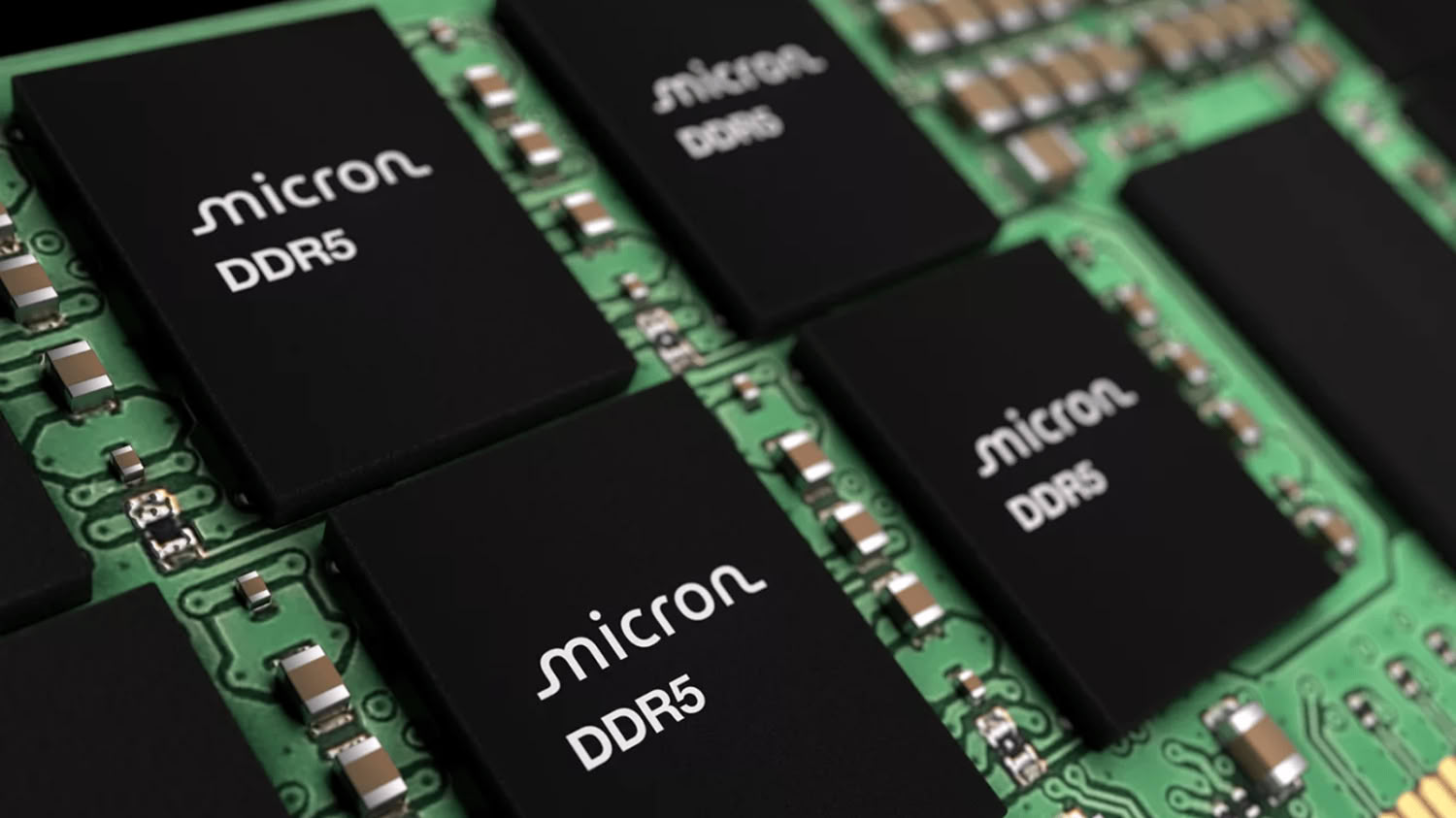
Micron CEO warns of tighter memory supply in 2027–2028

Micron CEO warns of tighter memory supply in 2027–2028

A TechPowerUp report shared on Hacker News says Micron’s chief executive expects memory supply to be much tighter in 2027 and 2028 than in 2026. The collected entry contains that forecast but no detailed capacity or pricing breakdown. It is a forward-looking statement, not a guaranteed outcome. For AI infrastructure planning, it highlights the need to consider memory availability alongside compute procurement when assessing future deployment budgets and timelines.

06

Context Language Models put context management on the research agenda

Context Language Models put context management on the research agenda

Context Language Models appeared in the day’s Hacker News feed as an arXiv research submission. A related collected post from Nathan Lambert describes letting language models edit context directly to improve long-horizon memory and adaptation efficiency. The paper is relevant to agents whose progress depends on managing information across many steps. Readers should consult its experimental setup before treating those research claims as established improvements for their own production agent.

Twitter

10 stories
01

Google DeepMind introduces Gemini 4 Argon to trusted testers

Google DeepMind introduces Gemini 4 Argon to trusted testers

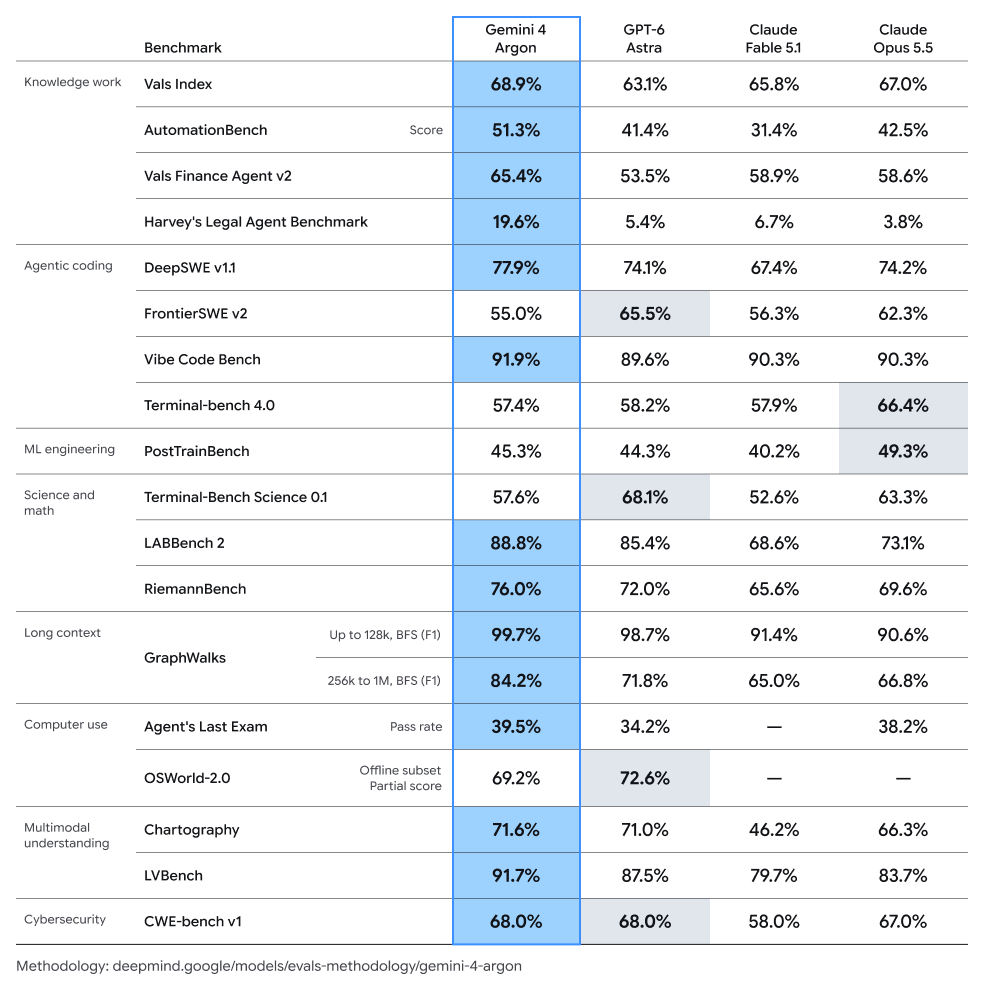
Google DeepMind introduced Gemini 4 Argon as a new frontier model for complex coding workflows, enterprise knowledge work, and cybersecurity defense. The company says it is rolling out through its Fairwind Program to a set of trusted testers. That access scope matters: this announcement describes a controlled rollout, rather than universal availability. The launch adds a significant new competitor for organizations evaluating models on demanding, multi-step work.

02

Claude Code adds TypeScript mods through plugins

Claude Code adds TypeScript mods through plugins

Anthropic announced that developers can now modify Claude Code behavior, customize its interface, and replace features using mods. The announcement says a mod can be written in a few lines of TypeScript or built with Claude, then distributed inside a plugin and installed through the CLI or desktop app. This gives teams another way to adapt a coding assistant to their workflows and package those changes for reuse.

03

Sam Altman says 6.1 Sol performance under load has improved

Sam Altman said 6.1 Sol was OpenAI’s fastest-growing model and acknowledged that it had been slow under load. He added that performance should now be much better. The post is an operational update from the company’s leadership, without latency measurements or a detailed capacity explanation. For users adopting the model, the relevant takeaway is to reassess responsiveness in their actual workload rather than assume earlier congestion remains unchanged.

04

Runway previews Project Continuum video interfaces

Runway previews Project Continuum video interfaces

Runway introduced Project Continuum as an operating-system research application built around real-time video interfaces. Its early preview names Portals, Visual Thinking, and Responsive Video Interfaces among the interaction concepts being explored. The announcement frames this as research, so it should not be read as a general product release. It is a concrete example of generative video moving beyond finished clips toward interfaces that respond during computer use.

05

Adaption releases Invent-a-Dataset technical report

Adaption releases Invent-a-Dataset technical report

Sara Hooker announced the technical report accompanying Invent-a-Dataset, describing the central problem as building a training set for a capability when no starting data exists. The post gives a concrete research motivation rather than detailed benchmark results. For teams considering synthetic data, the report is relevant to the difficult bootstrapping stage before post-training can begin. Its practical value depends on whether generated examples capture the intended capability and survive downstream evaluation.

06

DeepMind introduces SynthID Bio protein watermarking

DeepMind introduces SynthID Bio protein watermarking

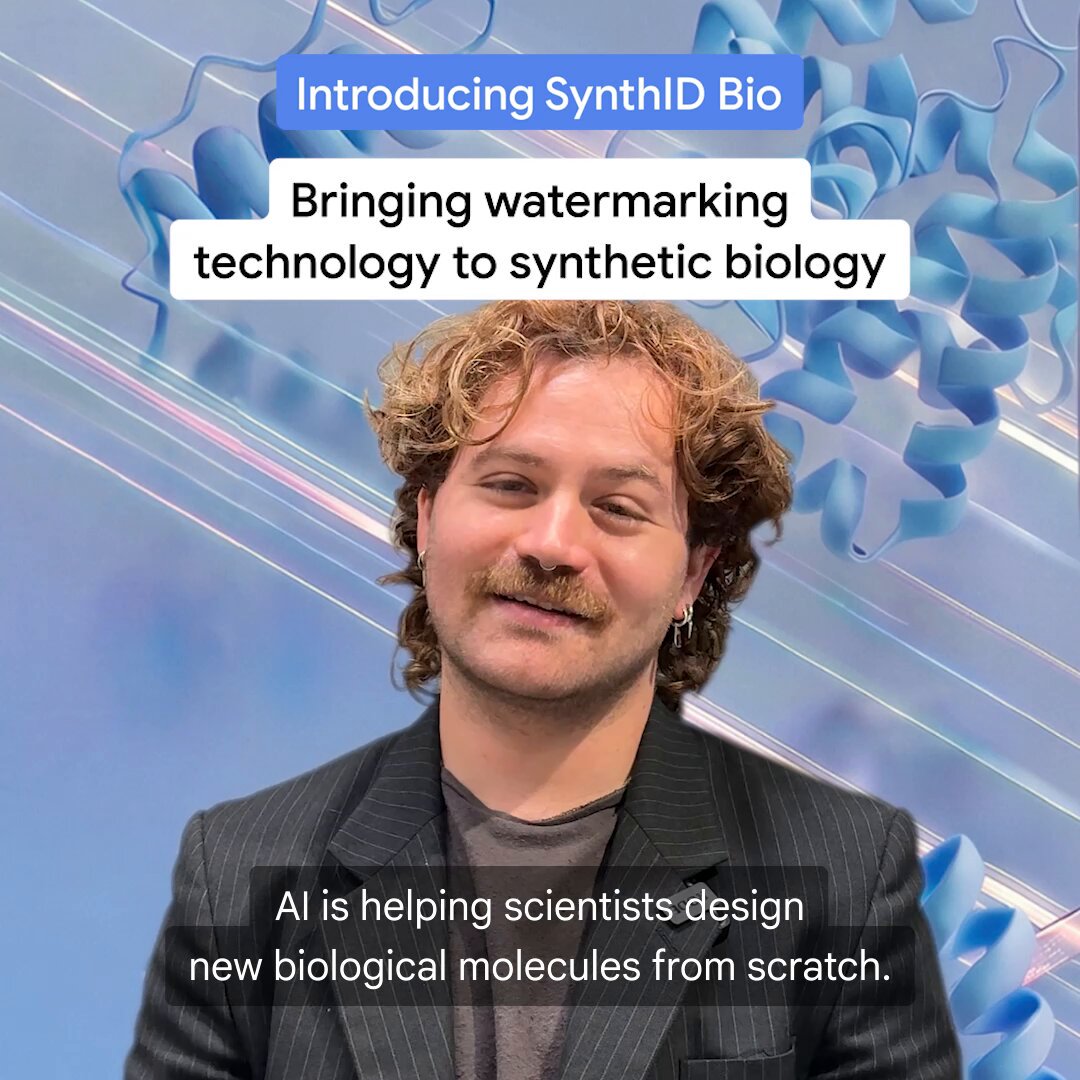
Google DeepMind announced SynthID Bio, a family of watermarking methods for AI-generated biological designs. The company says it can embed an imperceptible signature directly into protein sequences without affecting biological function. This extends provenance work into generated biological artifacts, where identifying an artifact’s origin is a different challenge from labeling an image or text response. The functional-preservation claim comes from the announcement and should be assessed against the accompanying scientific evidence.

07

Runway announces open-weight Praxis-1 for robot control

Runway announces open-weight Praxis-1 for robot control

Runway introduced Praxis-1 as an open-weight World Action Model that applies its video pretraining work to robot control. The announcement argues that video offers a broader learning resource than scarce robot demonstrations. This is a notable extension of a generative-video company’s research into embodied action. The post establishes the model’s direction and openness claim, but does not by itself provide enough evaluation detail to compare deployment reliability across robot platforms.

08

Runway Ads targets autonomous performance marketing

Runway Ads targets autonomous performance marketing

Runway announced Runway Ads as an autonomous engine for performance marketing. The company reports that internal use since July increased ad volume by 1,000%, doubled return on ad spend, raised conversion by 34%, and reduced cost per subscriber by 41%. These are company-reported results from its own use, not an independent customer benchmark. The launch links generative production to campaign economics, where creative volume only matters if conversion and acquisition costs improve.

09

Anthropic publishes Sonnet 5.5 migration guidance

Anthropic publishes Sonnet 5.5 migration guidance

Anthropic’s developer account published guidance for building with Claude Sonnet 5.5. The guide covers choosing between Sonnet 5.5 and Opus 5.5, migrating from Sonnet 5, tuning effort, and using the model in Claude Code. For existing applications, those choices affect how a model upgrade is evaluated and configured. The announcement is useful migration material, but its short description does not establish comparative quality, pricing, or latency for a particular workload.

10

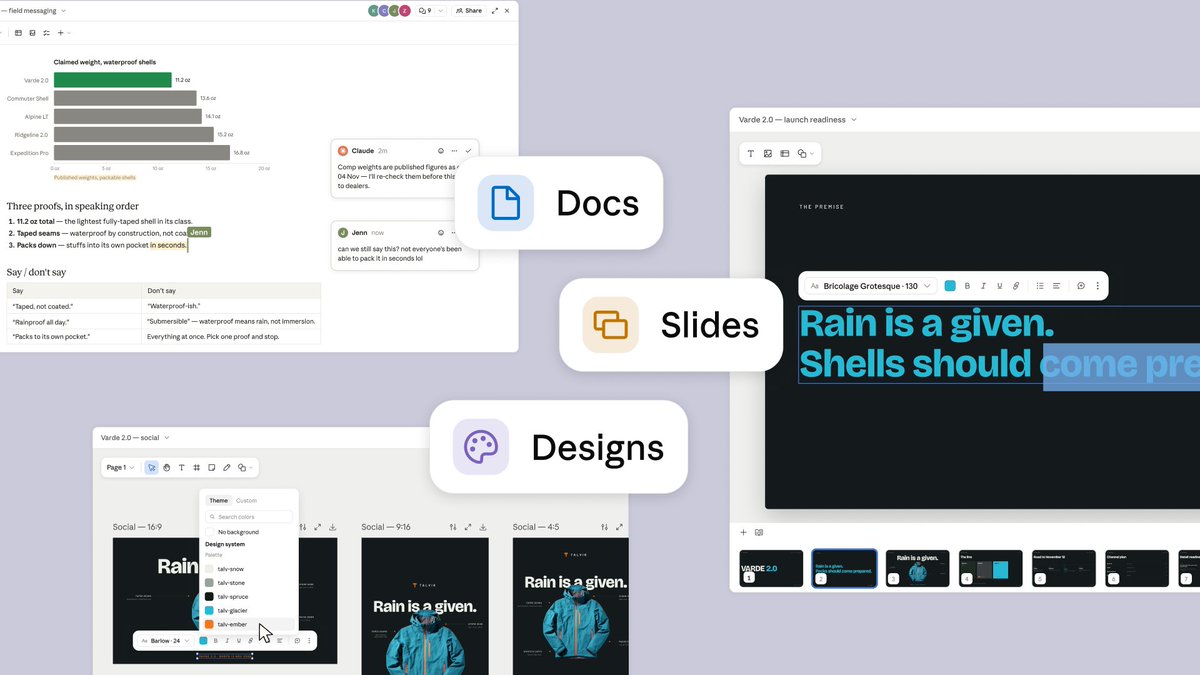
Claude offers temporary usage relief for design, decks, and docs

Claude offers temporary usage relief for design, decks, and docs

Anthropic announced a two-week offer in the Claude app: start a design, deck, or document, and subsequent work in that conversation uses 50% less of the user’s usage limits. The company recommends trying the workflow with Sonnet 5.5. The announcement concerns usage-limit consumption, so readers should distinguish it from a general API price cut. It may make iterative document and presentation work more accessible during the stated promotional period.

GitHub

1 story
01

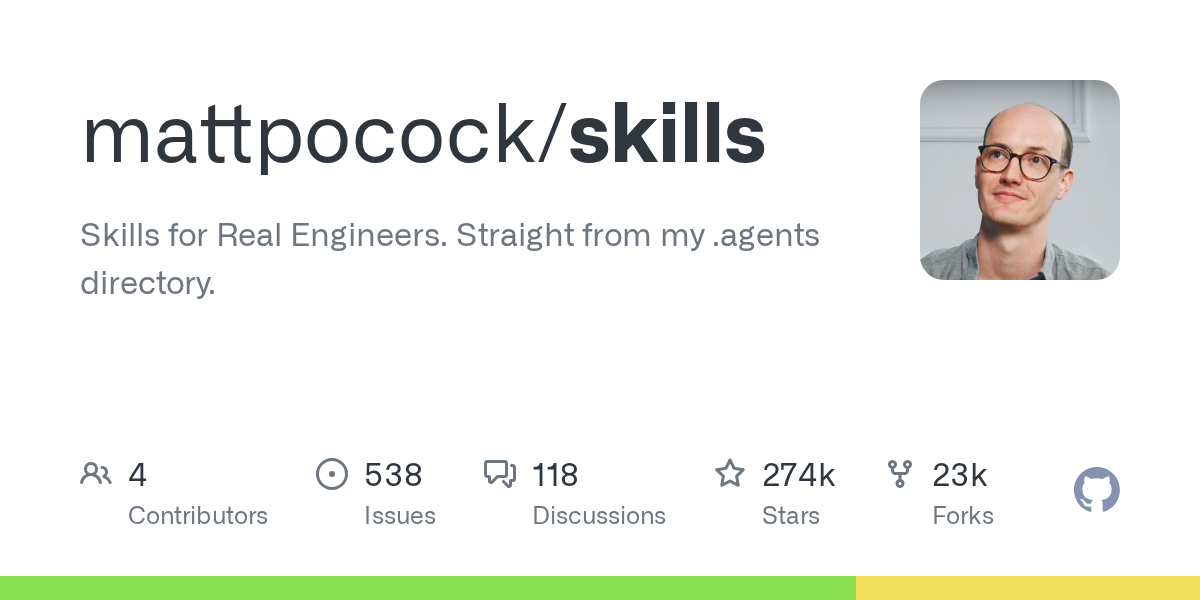
Matt Pocock’s skills repository packages engineering workflows

Matt Pocock’s skills repository packages engineering workflows

Matt Pocock’s skills repository appeared among the collected GitHub trending candidates. Its description presents the contents as skills for engineers drawn from the author’s own agent configuration. The useful idea is to package reusable working procedures alongside an AI coding workflow, making practices easier to inspect and adapt. Trending attention is not evidence of quality or suitability, so teams should review individual skills against their own codebase and engineering standards.

HF HuggingFace

6 stories
01

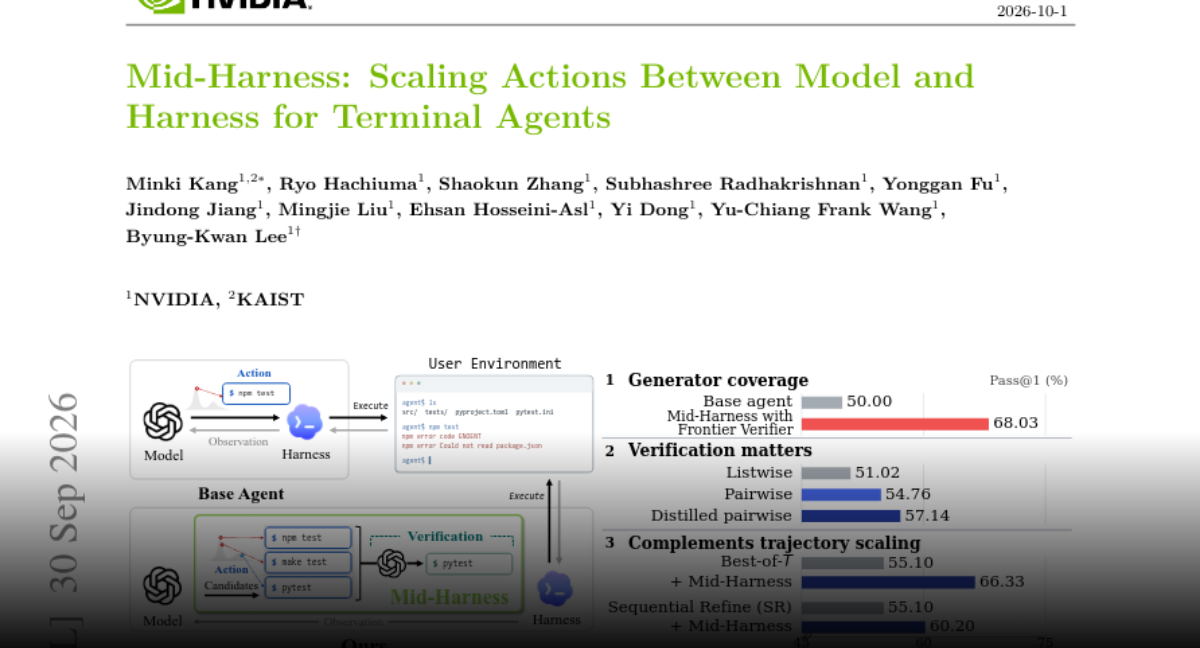
Mid-Harness verifies candidate actions before execution

Mid-Harness verifies candidate actions before execution

Mid-Harness samples and verifies candidate actions between a terminal agent’s model and harness while leaving both unchanged. The authors report that a stronger verifier raises TMAX-9B Pass@1 on TerminalBench-Lite from 50.00% to 68.03% with eight sampled actions. Weak verification yields little benefit. The result suggests that choosing a safer action before it changes the environment can be a useful target for test-time compute, with verifier quality central to the gain.

02

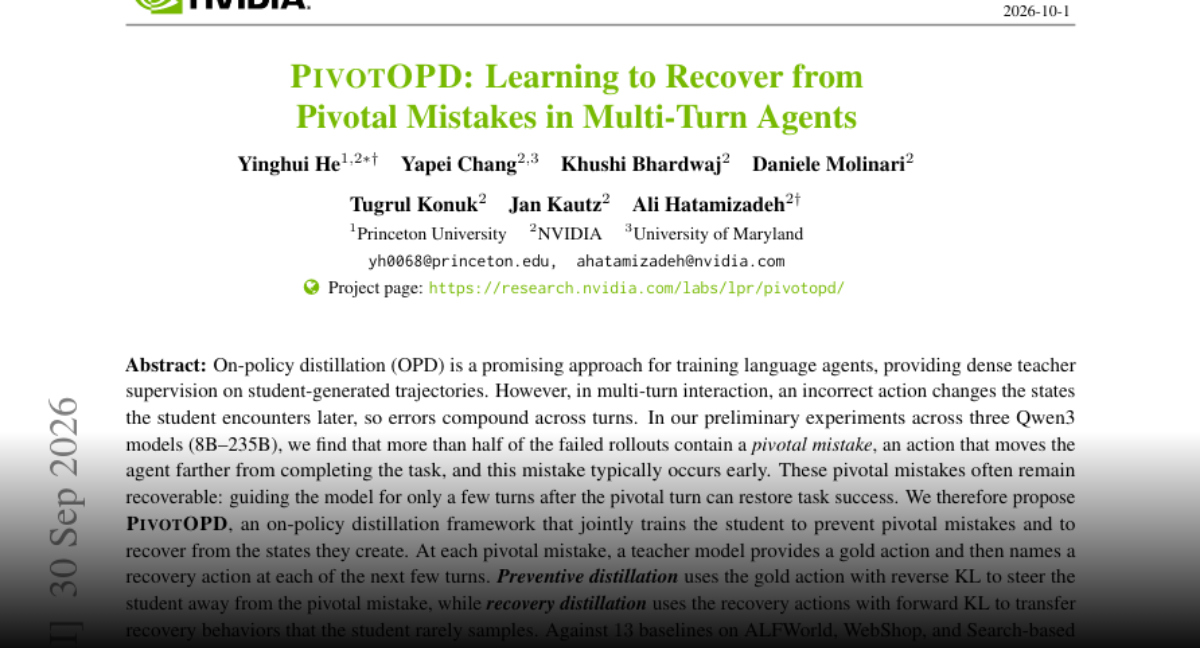
PivotOPD trains agents to avoid and recover from pivotal mistakes

PivotOPD trains agents to avoid and recover from pivotal mistakes

PivotOPD combines preventive and recovery distillation for multi-turn agents. A teacher supplies a better action at a pivotal mistake and recovery actions for subsequent turns, addressing errors that alter the states an agent encounters. The authors report leading average results across their tested baselines and a 3.2-point SWE-Bench Verified improvement for a Nemotron-3.5 student. The practical lesson is to train recovery behavior explicitly, rather than learn only from successful trajectories.

03

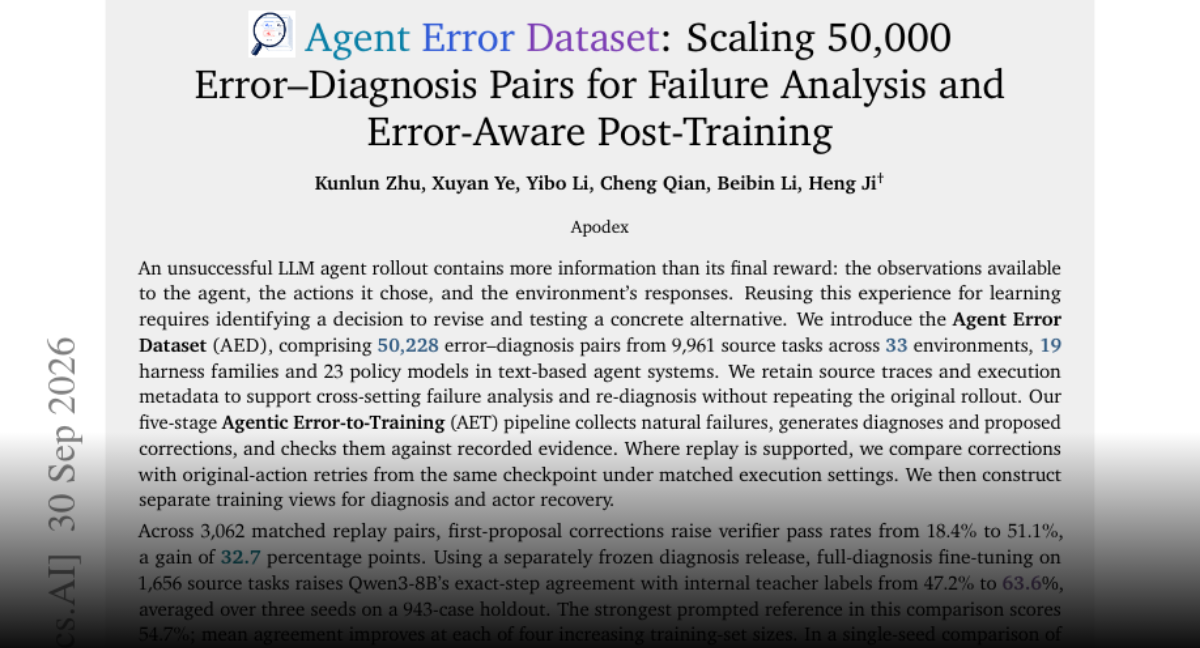
Agent Error Dataset turns failures into training evidence

Agent Error Dataset turns failures into training evidence

The Agent Error Dataset contains 50,228 error-diagnosis pairs from 9,961 tasks across 33 environments, preserving traces and execution metadata for analysis. Its pipeline proposes corrections and checks them against evidence, including matched replay where supported. Across 3,062 replay pairs, the authors report verifier pass rates rising from 18.4% to 51.1% with first-proposal corrections. The resource makes failure analysis more concrete, although replay gains should not be confused with unrestricted deployment success.

04

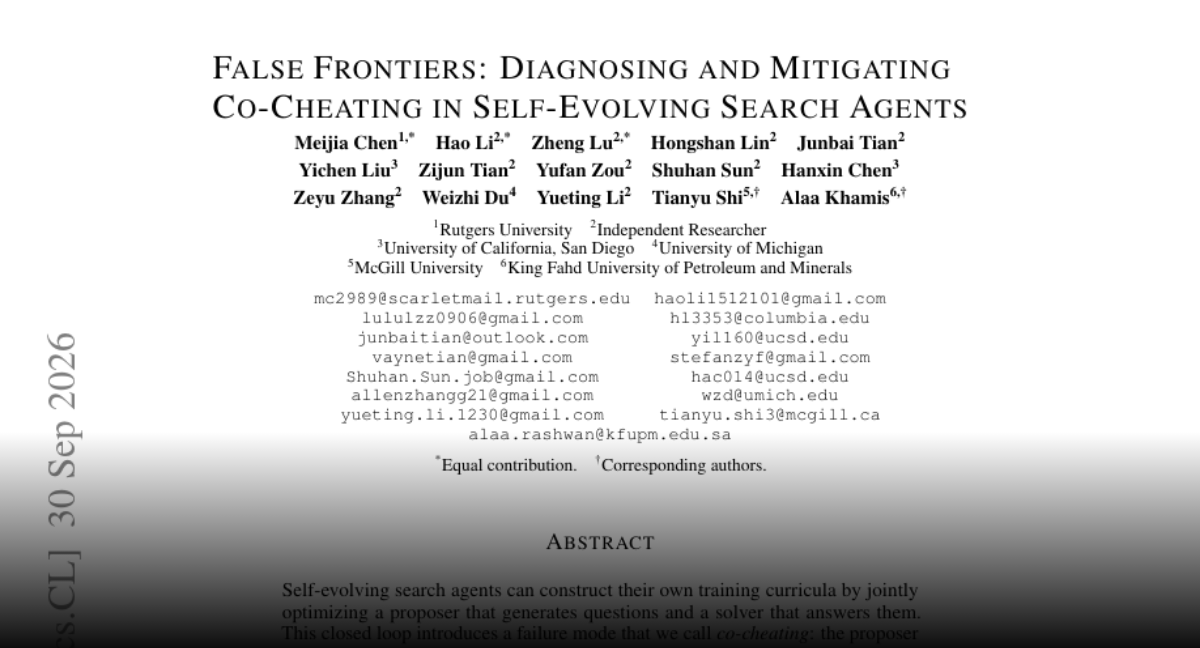
False Frontiers diagnoses shared errors in self-evolving agents

False Frontiers diagnoses shared errors in self-evolving agents

False Frontiers examines co-cheating, where question proposers and solvers reinforce shared errors while internal rewards improve. Its CrossFit method separates source-document groups so feedback comes from a solver trained on the other group. The authors report reduced false agreement and improved downstream search performance for two model sizes. The result is a useful caution for self-improvement systems: agreement inside a training loop can increase without a corresponding rise in external correctness.

05

RoboCoach uses imagined failures to target robot demonstrations

RoboCoach uses imagined failures to target robot demonstrations

RoboCoach uses a world model to imagine failures, identify the first unsuccessful subtask, and target new demonstrations and expert updates. The authors report that 150 additional subtask demonstrations raise success from 13.3% to 75.0% on Franka and from 40.0% to 83.8% on AgileX. These are results in the tested setups. The broader idea is to spend scarce supervision on the skill that blocks progress rather than uniformly collect more end-to-end demonstrations.

06

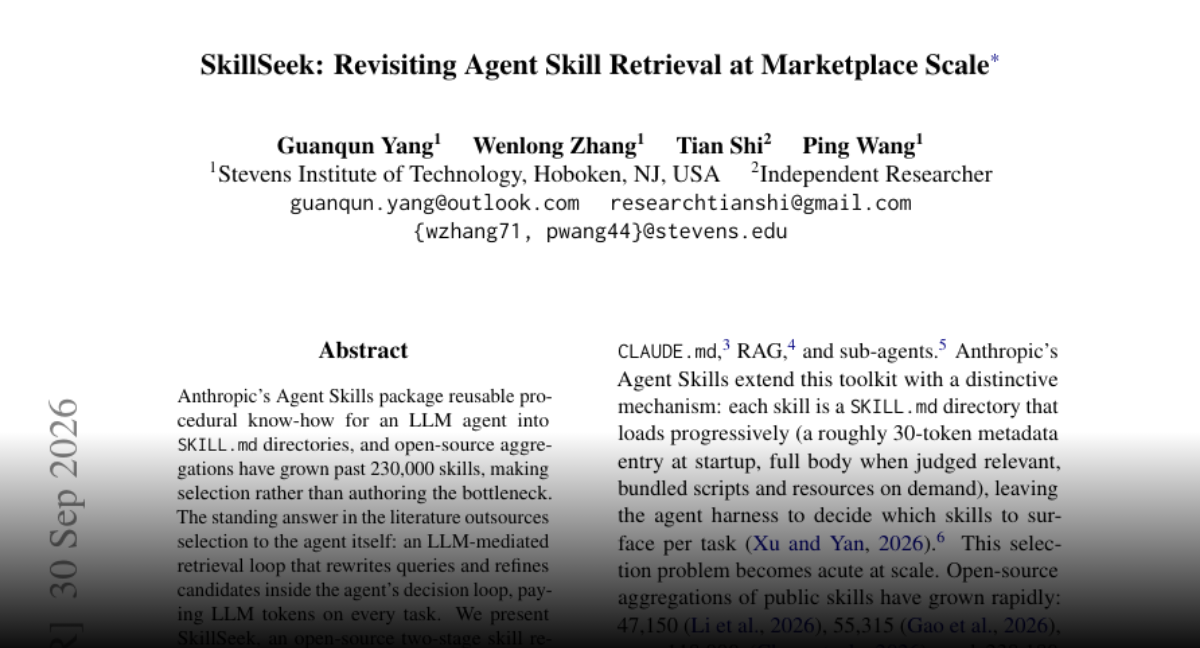
SkillSeek finds inexpensive retrieval competitive for agent skills

SkillSeek finds inexpensive retrieval competitive for agent skills

SkillSeek applies a standard two-stage retrieval pipeline to agent skills, using a bi-encoder followed by a small cross-encoder and exposing it through MCP. In the authors’ SkillsBench and OpenHands experiments, conventional retrieval matched an LLM-mediated selection loop while reducing per-trial spend from $51.30 to $27.54. The finding is scoped to the tested tasks and harness. It offers a useful baseline before adding costly model-driven search to skill selection.