NO/FOMO

Independent AI signal, once a day

The AI briefing worth opening.

ISSUE DATE2026-10-02DEFAULT EDITION
This issue
—
All time
—

AI Blog

2 stories
01

OpenAI publishes a practical guide to the GPT-6 family

OpenAI published a guide aimed at startups choosing among GPT-6 models and preparing AI workflows for production. The collected description covers model selection, reasoning effort, prompts and skills, and tool coordination. Its practical emphasis is the surrounding workflow as well as the model itself: teams need to match task requirements with how reasoning and tools are configured. The item is a vendor guide, rather than a new model announcement or independent comparison.


02

OpenAI argues execution may be AI’s enduring complement

OpenAI's essay The Eternal Complement argues that advanced AI may have its greatest significance in the routine execution surrounding breakthrough ideas. The collected description frames execution as a determinant of economic progress and the pace of discovery. For teams building agents, the implication is to examine the work required to turn a promising idea into a completed outcome. This is an economic and product thesis, not evidence of a measured productivity gain.

Hacker News

4 stories
01

Stillwet gives AI models a simulated oil-painting studio

Stillwet gives AI models a simulated oil-painting studio

Stillwet lets language models paint by writing programs against a simulation of oil paint, brushes, drying, and layered glazes. The project shows Claude Opus 5.5 alongside other models, with some painting in stages and inspecting the canvas between actions. Its gallery also documents recurring compositions and context-related mistakes. The experiment is notable as a visible tool-use workflow: images emerge from programmed brushstrokes rather than a separate image generator, making process and failure modes inspectable.

02

Stratego result draws attention to reasoning under hidden information

Stratego result draws attention to reasoning under hidden information

A report shared on Hacker News describes AI overcoming a longstanding challenge in Stratego, where much of the game state is hidden from the opponent. The linked story emphasizes a result against top human play and a constrained budget. The collected item also points readers toward scientific papers. The broader relevance is decision-making with incomplete information; the available candidate does not supply enough methodological detail to infer comparable performance in real-world planning tasks.

03

Greg Kroah-Hartman discusses security in the LLM age

A video titled Security in the LLM Age, featuring Linux maintainer Greg Kroah-Hartman, attracted substantial discussion on Hacker News. The topic is directly relevant to software teams assessing how language models affect security work and code review. The collected candidate contains the talk title and discussion metrics, rather than a transcript or detailed recommendations. It is therefore presented as a primary talk to watch, without attributing specific security claims that the available material cannot establish.

04

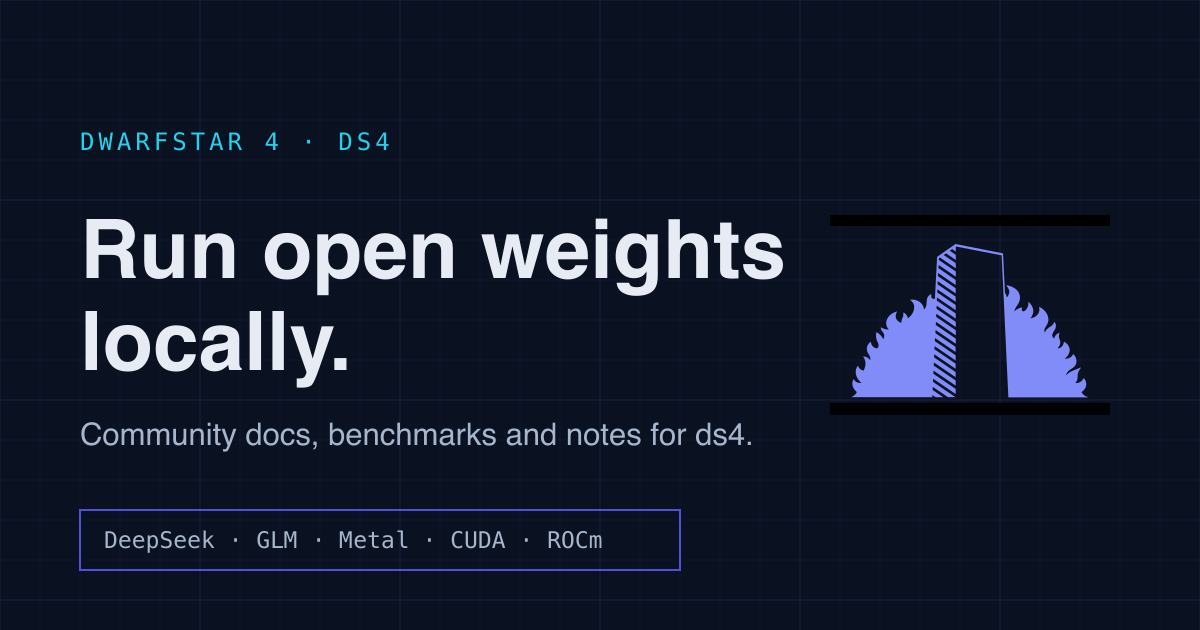
Dwarfstar draws attention as a local LLM project

Dwarfstar draws attention as a local LLM project

A Hacker News submission introduces Dwarfstar as a way to run an LLM locally and associates the project with the creator of Redis. The title specifically mentions ds4, but the collected candidate does not include hardware requirements, model specifications, or benchmark results. The project is relevant to developers exploring local inference and greater control over deployment. Its presence here is a discovery pointer, with technical suitability requiring inspection of the project's own documentation.

Twitter

10 stories
01

Nathan Lambert launches Trillium Labs for open frontier AI

Nathan Lambert launches Trillium Labs for open frontier AI

Nathan Lambert announced Trillium Labs, a nonprofit focused on the open science of frontier AI. Its initial work centers on open post-training recipes, with plans to expand infrastructure for studying recursive self-improvement, reward hacking, and multi-agent systems. The announcement matters because reproducible training methods can give researchers access to capabilities and failure modes otherwise concentrated inside frontier laboratories. These are the organization's stated plans, rather than completed research results.

02

Google introduces Gemini 4 Argon with a 1M-token output limit

Google introduces Gemini 4 Argon with a 1M-token output limit

Google introduced Gemini 4 Argon in a September 30 announcement, positioning it for complex software engineering, knowledge work, and cybersecurity defense. The company highlights a one-million-token output limit and claims frontier performance across these workflows. The unusually large output budget is relevant to developers generating extensive artifacts, but this announcement alone does not establish reliability, latency, or cost at that length. Performance claims here are Google's, without an independent benchmark comparison.

03

Google launches a prototype satellite carrying four TPUs

Google launches a prototype satellite carrying four TPUs

Google says it launched a prototype satellite carrying four TPUs with Planet on SpaceX's Transporter-18 rideshare mission. The company describes the launch as the first step in Project Suncatcher, a long-term research effort exploring compute in space. This is a concrete hardware milestone for an unconventional AI infrastructure proposal. It establishes an orbital prototype, while leaving the economics, operating reliability, and prospects for larger deployments as questions for subsequent research.

04

NYC AI validation proposal enters the policy debate

NYC AI validation proposal enters the policy debate

Gary Marcus reports that New York City Council Speaker Julie Menin introduced legislation that would require third-party validation of AI models. His post argues that self-policing is insufficient and welcomes local intervention. The distinction between a proposal and enacted law is essential: this source describes proposed legislation, without supplying the bill's detailed scope or implementation rules. Independent model evaluation remains the substantive policy issue for organizations following possible local AI requirements.

05

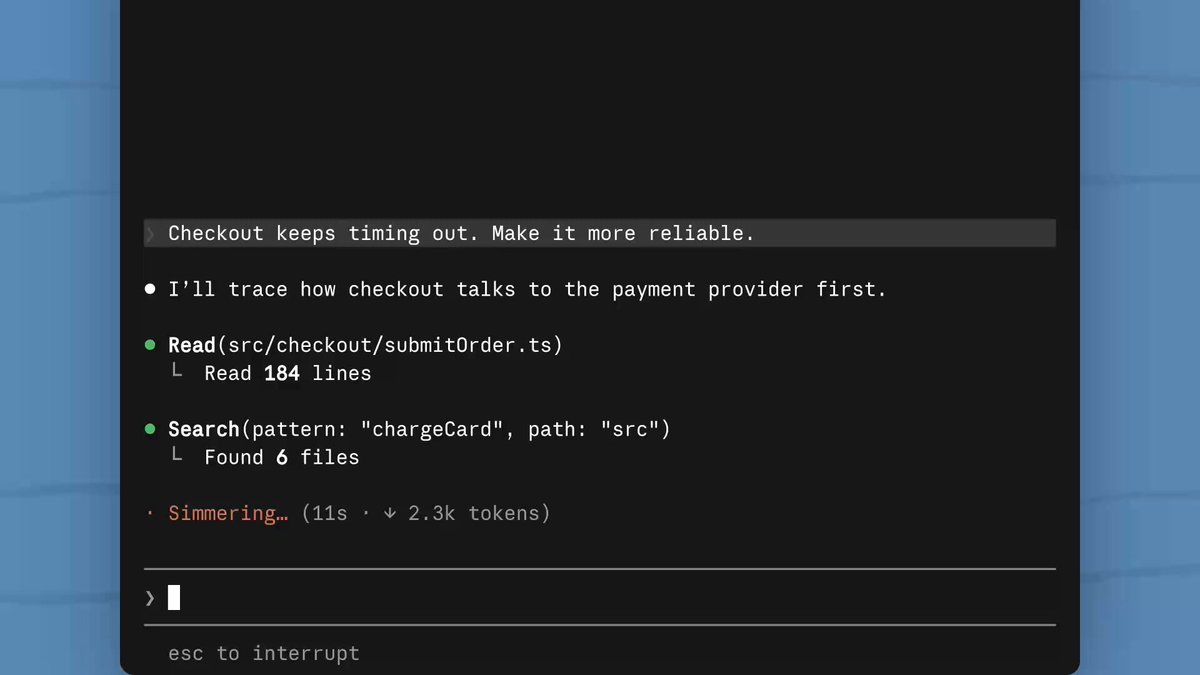
Claude Code adds the You Should Know plugin

Claude Code adds the You Should Know plugin

Claude's developer account announced a new Claude Code plugin called You Should Know. It scans Claude's output for important information that a user might otherwise miss, aiming to keep the person supervising the session informed. The feature addresses a practical issue in coding-agent workflows: useful warnings and decisions can be buried in lengthy output. The announcement describes its purpose and enablement command, but provides no measured improvement in oversight or error detection.

06

Sam Altman describes dot adapting to his workflow

Sam Altman says OpenAI's dot feels more useful as it learns his workflow and style, particularly for routine tasks he tends to postpone. His post is a firsthand product endorsement rather than a launch specification or controlled evaluation. It nevertheless illustrates the product direction toward assistants that accumulate useful personal context over time. Readers should separate that reported experience from broader claims about autonomous task completion, which the post does not quantify.

07

Keras outlines pluggable backends and upcoming MLX support

François Chollet shared a Keras community-call summary outlining a pluggable backend plan, with MLX and PaddlePaddle backends forthcoming as add-on libraries. The plan also reduces the operations needed to ship a backend by adding backend-agnostic implementations of secondary operations. This could lower the engineering burden of supporting additional execution environments. The source describes an upcoming architecture direction, so it should not be read as confirmation that all named backends are already released.

08

Runway presents Continuum at its AI Summit

Runway presents Continuum at its AI Summit

Runway says its AI Summit closed with cofounder and co-CEO Cristóbal Valenzuela introducing Continuum, the latest project from Runway Labs. Related remarks describe the research direction as an operating system built around real-time video. The announcement extends generative video beyond producing standalone clips toward interactive interfaces. The summit post offers a project introduction and a way to follow the talks, rather than evidence of a generally available operating system or measured application performance.

09

Runway announces the open-weight Praxis-1 world-action model

Runway announces the open-weight Praxis-1 world-action model

Runway cofounder Cristóbal Valenzuela announced Praxis-1 as an open-weight world-action model that can adapt to new robot embodiments with light fine-tuning. The claim connects the company's video modeling work with physical control and transfer between robotic platforms. For robotics teams, the relevant question is how much new data and adaptation each embodiment requires. The announcement states the intended capability, but does not provide enough experimental detail to independently assess transfer performance.

10

Research lets language models edit their own context

Research lets language models edit their own context

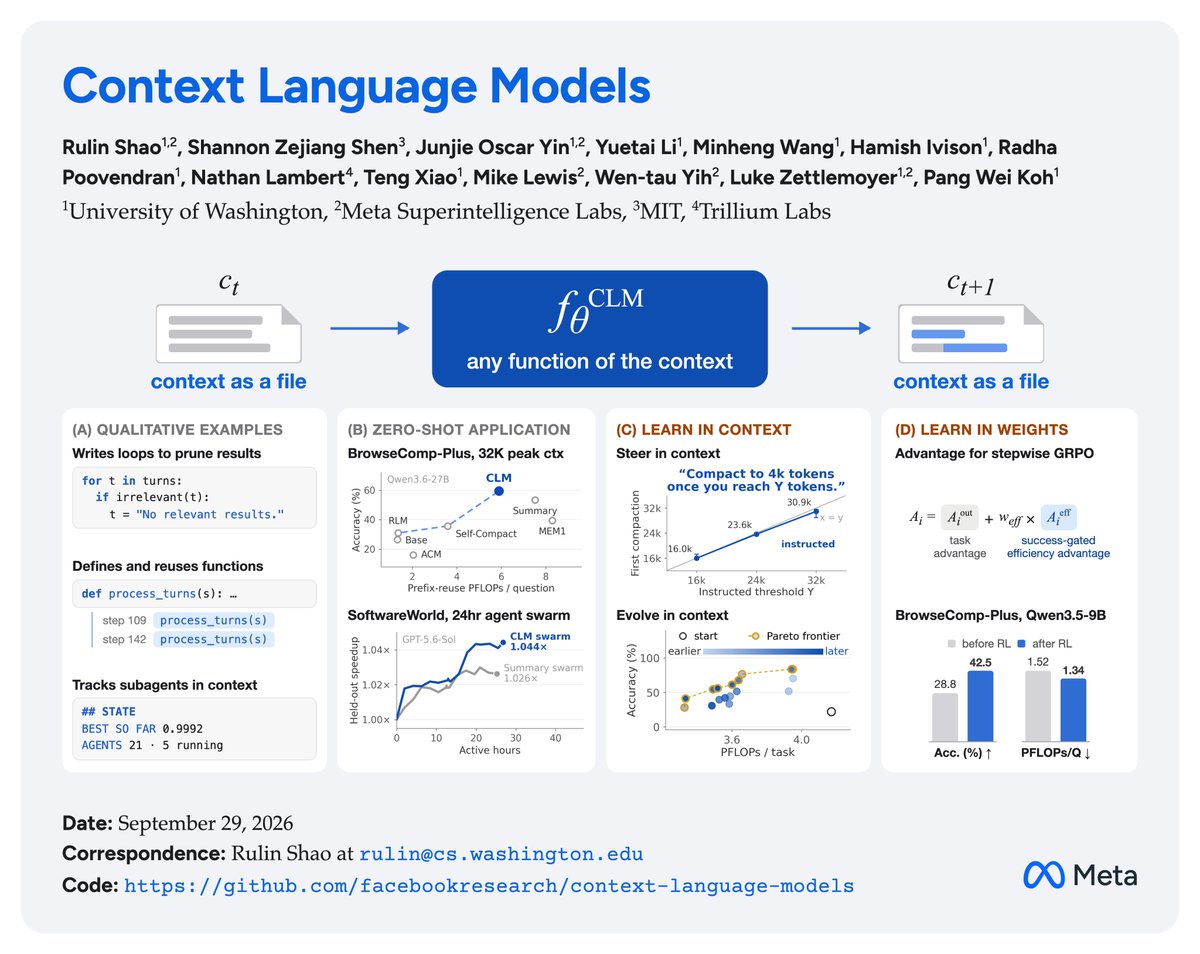
Nathan Lambert highlighted work that lets language models edit context directly, instead of restricting them to rigid context-management rules in an agent harness. The reported goals include better long-horizon memory and more compute-efficient adaptation. This is relevant to agents that must retain useful state while repeatedly compressing a growing interaction history. The post sketches the approach and claimed benefits, but offers no quantitative results in the collected text, so those benefits remain attributed claims.

GitHub

1 story
01

Impeccable packages design guidance for AI harnesses

The Impeccable repository describes itself as a design language intended to make an AI harness better at design. Its appearance among the collected GitHub projects points to interest in improving the guidance surrounding coding models, especially when they produce user interfaces. The repository description establishes that goal but does not itself demonstrate better design quality. Teams considering it should evaluate its guidance against their existing design system and the interfaces they actually need to build.

HF HuggingFace

7 stories
01

ActiveSaddler adapts training curricula for agent harnesses

ActiveSaddler adapts training curricula for agent harnesses

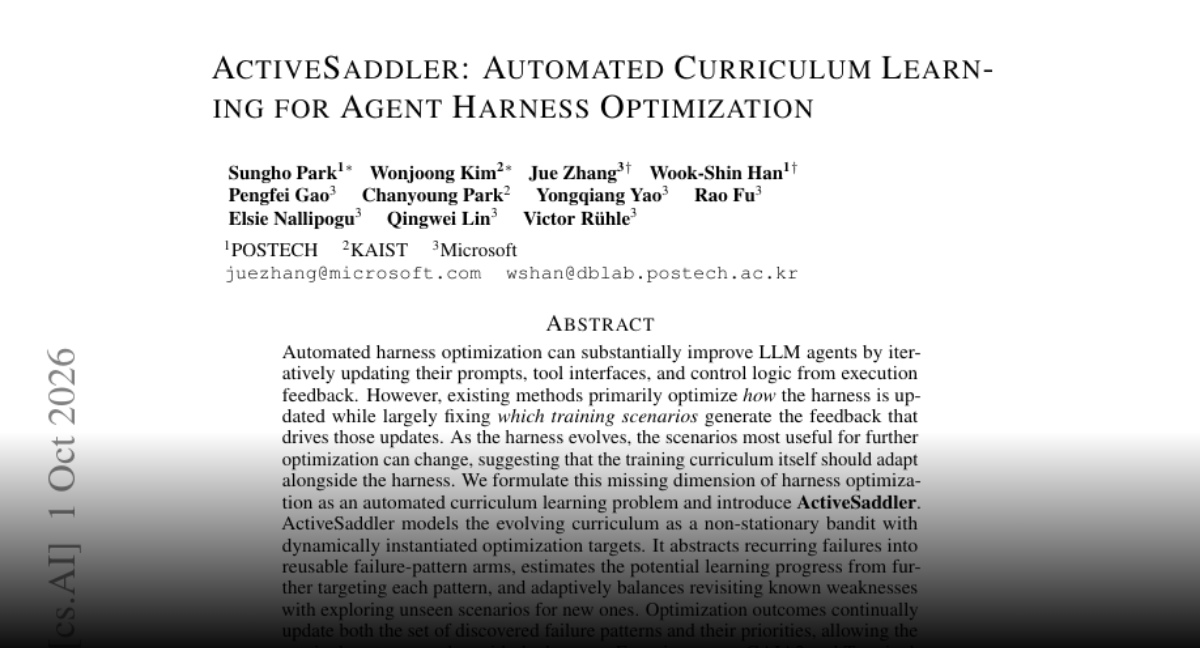
ActiveSaddler makes the choice of training scenarios part of agent-harness optimization. It groups recurring failures into reusable patterns, estimates where further practice can help, and balances known weaknesses against new failure discovery. The authors report Pass@1 gains of 4.4 points on GAIA2 and 7.5 points on Terminal-Bench 2.0 over the same optimizer with a fixed scenario order. The result suggests curriculum selection can matter alongside changes to prompts, tools, and control logic.

02

Explicit belief states help agents detect stalled progress

Explicit belief states help agents detect stalled progress

The PoS framework maintains an explicit estimate of the current world together with unresolved task requirements. It checks that state for consistency and detects situations where an agent keeps acting without meaningful progress, then selects a recovery strategy. The authors report the strongest overall performance across four benchmarks and three model backbones. The contribution is a structured way to manage current understanding, extending beyond storing or compressing the history of a long-running interaction.

03

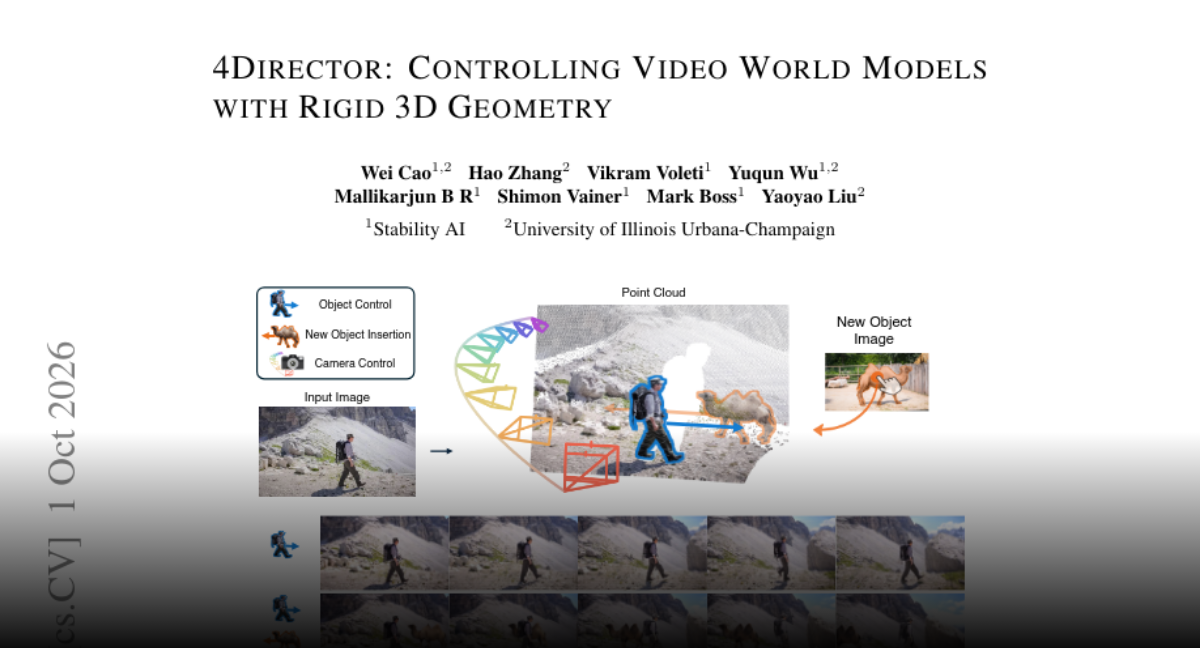
4Director controls generated video through rigid 3D geometry

4Director controls generated video through rigid 3D geometry

4Director reconstructs objects from an input image as canonical meshes, then uses prescribed rigid transformations to control their movement over time. A depth-video scaffold and Motion Adapter translate this geometry into generated video while preserving appearance across views. The authors introduce a 20,774-clip training dataset and a metric that jointly measures motion adherence and identity preservation. Their reported improvements address a practical production challenge: predictable camera and object control without repeatedly reinventing hidden geometry.

04

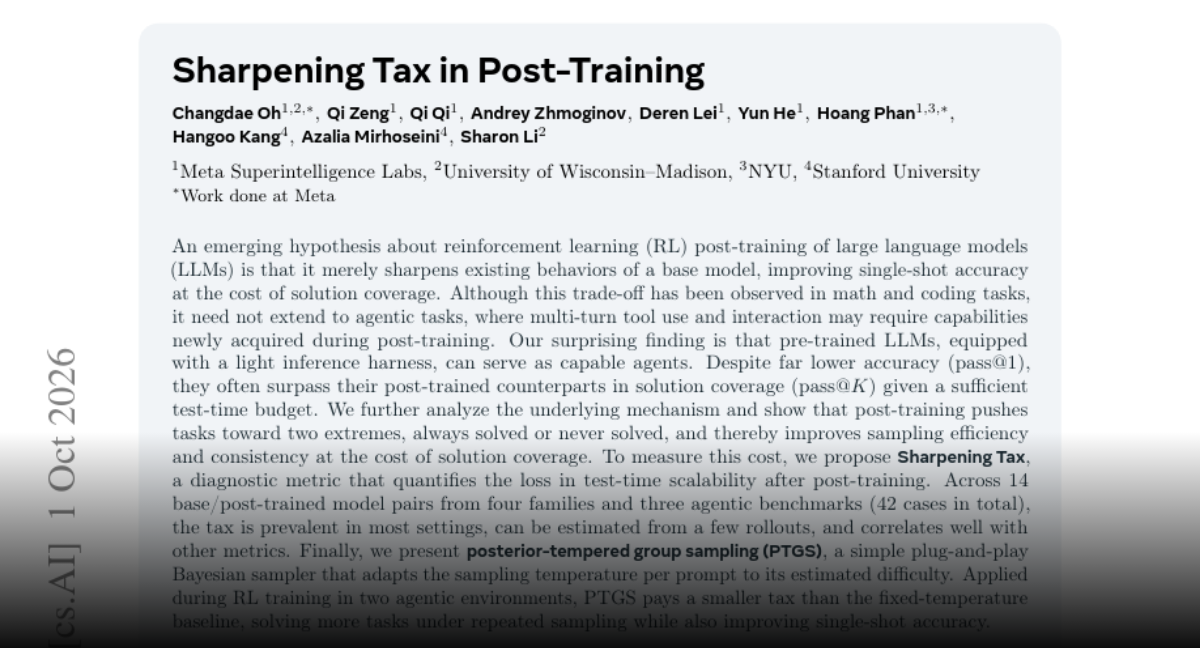
Post-training can trade solution coverage for consistency

Post-training can trade solution coverage for consistency

Sharpening Tax examines whether post-training improves single-attempt success while reducing the range of problems solvable through repeated sampling. Across fourteen base and post-trained model pairs, four families, and three agent benchmarks, the authors find this trade-off in many settings. They propose a diagnostic metric and posterior-tempered group sampling to reduce the cost. The practical lesson is to evaluate both single-shot accuracy and test-time scaling when choosing or training models for repeated agent attempts.

05

Argo-Bench tests enterprise data agents by consequences

Argo-Bench tests enterprise data agents by consequences

Argo-Bench evaluates data agents on 210 tasks in a simulated food-delivery business backed by 235 tables and 7.5 billion rows. Agents must reconstruct business facts and take actions, such as allocating incentives or banning fraudulent accounts; grading uses the consequences inside the simulator. The strongest of fourteen evaluated models averages 59.5 points and reaches at least 95 on only 34.8 percent of tasks. This exposes limitations beyond generating a syntactically correct database query.

06

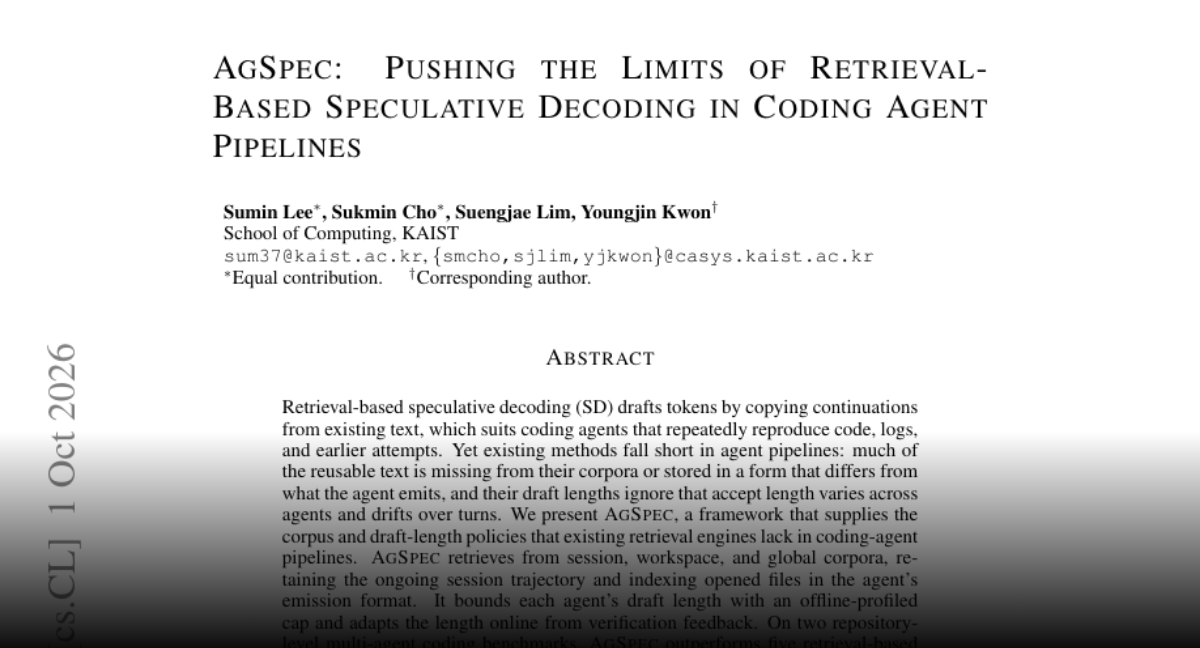
AgSpec reuses coding context for faster speculative decoding

AgSpec reuses coding context for faster speculative decoding

AgSpec improves retrieval-based speculative decoding for coding agents by assembling reusable text from sessions, workspaces, and global corpora. It indexes files in the format agents emit and adjusts draft length using verification feedback. On two repository-level coding benchmarks, the authors report throughput gains up to 4.37 times at batch size one and 4.76 times at batch size sixteen over autoregressive decoding. These are generation-throughput results in the evaluated settings, rather than guaranteed end-to-end task speedups.

07

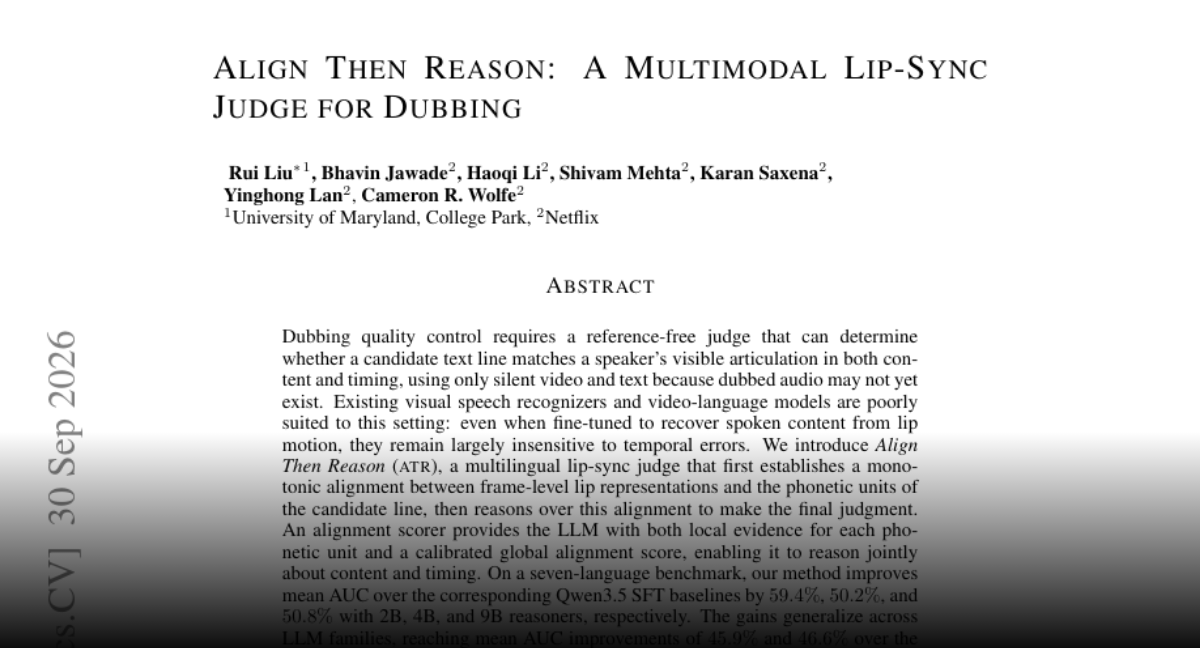
Align Then Reason evaluates lip sync before dubbed audio exists

Align Then Reason evaluates lip sync before dubbed audio exists

Align Then Reason judges whether a candidate dubbing line matches visible articulation using silent video and text. It first aligns lip representations with phonetic units, then supplies local and global alignment evidence to a language model. The authors report substantial AUC improvements across model sizes on a seven-language benchmark, plus gains on real dubbing reranking and script-to-clip assignment. The approach targets both content and timing, a useful distinction for automated multilingual video production.