NO/FOMO

Independent AI signal, once a day

The AI briefing worth opening.

ISSUE DATE2026-10-06ENGLISH EDITION
This issue
—
All time
—

AI Blog

5 stories
01

Anthropic expands verified access to advanced cyber capabilities

Anthropic expands verified access to advanced cyber capabilities

Anthropic is expanding its Cyber Verification Program to qualifying security professionals. The announcement says the program offers advanced cyber capabilities with reduced blocking classifiers; its accompanying official social post names Claude Mythos 5.1, Opus 5.5, and Sonnet 5.5, with safeguards designed for defensive work. The change is an access-policy development as much as a model story. Security teams will need to assess eligibility and the program's operating constraints before incorporating these capabilities into their defensive workflows.
02

Atlassian and OpenAI expand enterprise knowledge partnership

Atlassian and OpenAI announced an expanded partnership intended to connect frontier models with enterprise knowledge. The stated goal is to help teams plan, build, and deliver work, placing organizational context closer to systems that can act on it. The collected announcement does not provide quantitative results or a detailed rollout schedule. Its significance is the continued push to embed model capabilities into enterprise workflows where access to relevant internal information is as important as general model performance.

03

OpenAI and Ironclad train computer-use agents on contracting workflows

OpenAI and Ironclad describe work on training and evaluating AI agents against complex contracting workflows. The collaboration targets computer use in professional settings, where success depends on navigating application steps rather than only producing a plausible answer. The collected announcement establishes the domain and research direction but does not provide benchmark figures. Contracting offers a concrete setting for testing whether agents can execute structured work reliably, making evaluation quality central to the usefulness of the resulting capabilities.

04

Pi Codemode composes harness tools through sandboxed JavaScript

Pi Codemode composes harness tools through sandboxed JavaScript

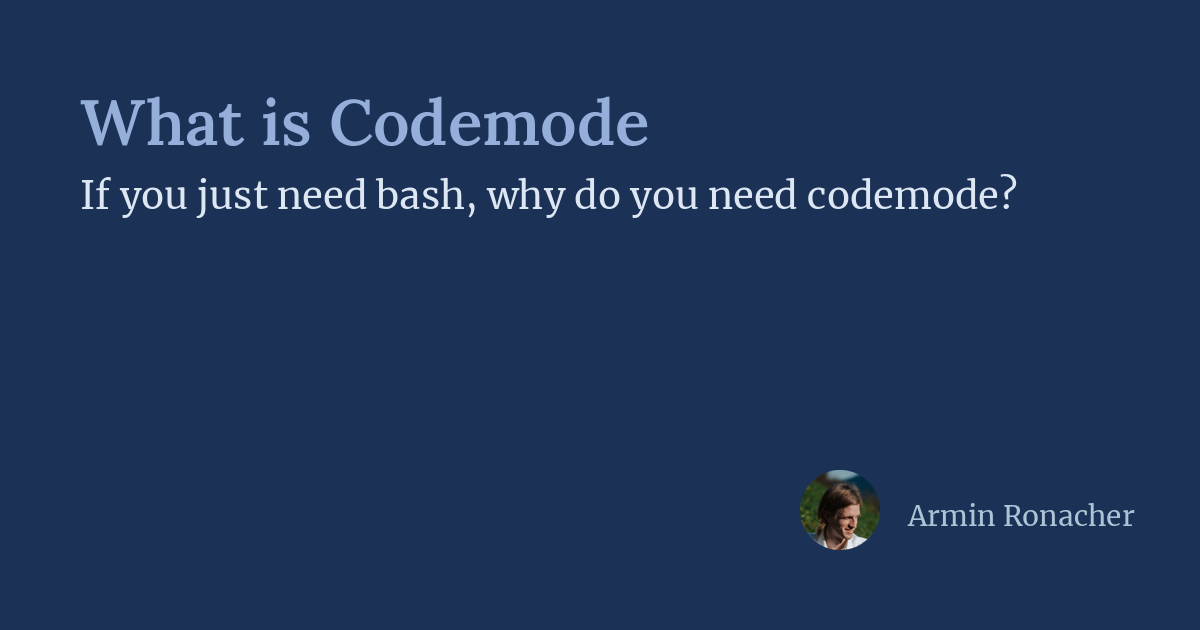
Armin Ronacher explains Codemode in Pi as a way for a model to orchestrate tools on the harness side through JavaScript. The code runs in QuickJS inside a WASM runtime with deliberate limits, including no direct network or filesystem access. It can compose tool calls, process structured outputs, and preserve data between invocations. The design separates orchestration from the environment executing application commands, offering a practical approach to reducing unnecessary tool-output traffic through model context.

05

SemiAnalysis compares the usable value of AI subscriptions

SemiAnalysis compares the usable value of AI subscriptions

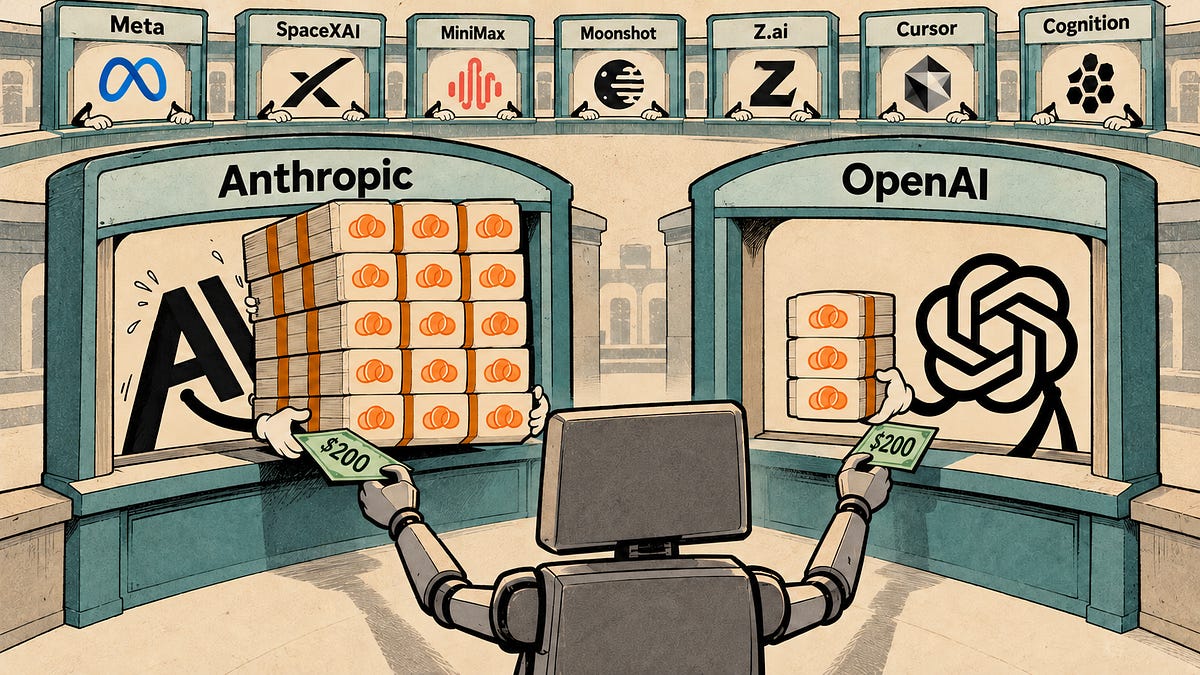
SemiAnalysis published a comparison based on limit testing of AI subscription plans from major providers and coding-tool vendors. Its headline claims Anthropic subscriptions offer more than five times OpenAI's value. The collected excerpt identifies the comparison's scope but does not expose enough methodology to apply that ratio to every workload. Readers should treat the headline as the publication's finding and examine workload assumptions, limits, and plan details before making procurement decisions from a single value figure.

Hacker News

3 stories
01

Mistral Large 4 enters public preview with 1.05T total parameters

Mistral's documentation lists Large 4 in public preview on October 6 as an open-weight, general-purpose multimodal model. Its granular mixture-of-experts architecture has 1.05 trillion total parameters, 52 billion active parameters, and a 1.6 billion parameter vision encoder. The documentation specifies a one-million-token context and support for function calling, structured outputs, document questions, and agent workflows. This is a substantial new open-weight entrant; the listed capabilities do not by themselves establish independent benchmark leadership.

02

Meta Muse faces scrutiny over message access and agent security

Meta Muse faces scrutiny over message access and agent security

Techdirt reports a series of privacy and security problems surrounding Meta's Muse assistant, including message access users did not expect and vulnerabilities involving device access. The article also cites reporting about detailed profiles of users' contacts and rushed security fixes before launch. These are attributed reports rather than an independent audit by this newsletter. They make permission enforcement and data boundaries central deployment questions as assistants gain access to communications, shopping, and other sensitive services.

03

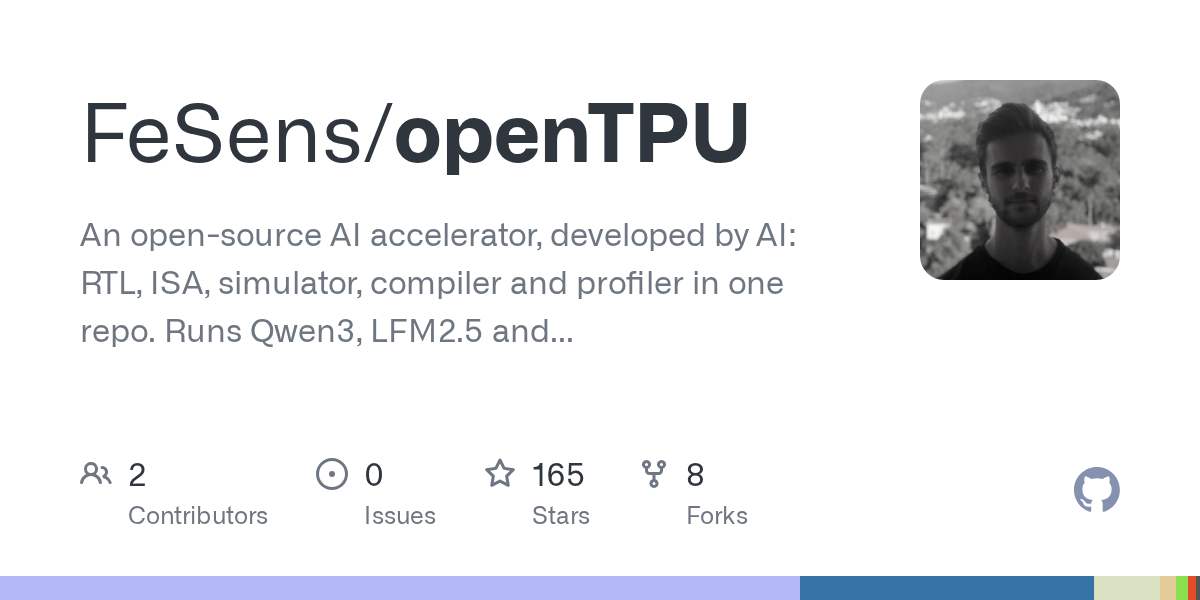
openTPU demonstrates an AI-developed accelerator on an FPGA card

openTPU demonstrates an AI-developed accelerator on an FPGA card

The openTPU project brings hardware design, an instruction set, a simulator, a compiler, and profiling tools into one open-source repository. Its README reports running modern language models on a Kintex-7 PCIe card and matching simulator outputs token for token. The authors frame it as an experiment in how far AI agents can go in hardware development. It is also an inspectable educational stack; its reported FPGA results should not be confused with production silicon economics or broad accelerator competitiveness.

Twitter

7 stories
01

Claude arrives inside Google Docs, Sheets, and Slides

Claude arrives inside Google Docs, Sheets, and Slides

Anthropic says Claude now works inside Google Docs, Sheets, and Slides, while those files can also open inside Claude. A sidebar lets the assistant read the current file and edit it in place, with users able to approve individual edits before they land. The integration brings model assistance directly into familiar office workflows. Its practical significance is the combination of document context, direct editing, and an explicit review step at the point where changes are applied.

02

Google releases EmbeddingGemma 2 for multimodal on-device retrieval

Google releases EmbeddingGemma 2 for multimodal on-device retrieval

Google has released EmbeddingGemma 2, describing it as its first natively multimodal open model engineered for on-device embeddings. Built on the Gemma 4 architecture, it places text, images, video, audio, and code in a shared embedding space and uses the Apache 2.0 license. That combination gives developers a common representation for searching across media types. The announcement establishes the intended deployment setting and licensing, while application-specific accuracy and hardware performance still require evaluation.

03

Google upgrades image generation and editing with Nano Banana 2.1

Google upgrades image generation and editing with Nano Banana 2.1

Google introduces Nano Banana 2.1 as an upgraded image generation and editing model. The company highlights improvements in visual design, editing with masks, and subject consistency, and says the new version outperforms its previous models across the board. These are vendor claims rather than independently verified comparisons. For creative workflows, the emphasized capabilities address keeping a subject recognizable across edits and applying localized changes, both important when generated images must survive repeated revisions.

04

Claude Code field guide details parallel cloud sessions

Claude Code field guide details parallel cloud sessions

Anthropic's developer account published a field guide covering seven workflows for Claude Code cloud sessions and initial GitHub connection. Each task runs on a fresh virtual machine, allowing several sessions to proceed at once and continue after the user's laptop closes. The operational distinction is that task execution lives in remote environments. Teams adopting this workflow should evaluate how the guide's patterns fit their repositories and review practices rather than assuming parallel execution alone improves outcomes.

05

Anthropic expands Claude Startups benefits to more founders

Anthropic expands Claude Startups benefits to more founders

Anthropic says its Claude Startups program is expanding to more founders. Members can receive a year of Claude Team, API credits, offers on other startup tools, and office hours with the company's Applied AI team. The announcement matters for adoption costs and developer distribution rather than a new model capability. Founders considering the program should check its membership conditions and available credits, because the social announcement does not specify a universal grant amount or eligibility for every company.

06

Every turns a shared Slack agent into a subscriber offering

Every turns a shared Slack agent into a subscriber offering

Anthropic describes how the Every team built a company agent on Claude Managed Agents to share skills across its staff through Slack. After internal adoption, the team released the agent to subscribers. The example illustrates a path from a shared internal assistant to an external service, with common skills available in an existing collaboration interface. The post does not provide measured productivity results, but it offers a concrete deployment pattern for organizations experimenting with reusable agent capabilities.

07

Nathan Lambert argues for legalizing model distillation in the US

Nathan Lambert argues that model distillation should be legal in the United States, saying bans would be impossible to enforce and could make strategic competition untenable over the next few years. This is an individual policy position, not a report of enacted legislation or a court decision. The argument highlights a growing tension between protecting model developers' investments and allowing capabilities to spread through cheaper training methods, an issue with direct implications for open-model competition.

GitHub

1 story
01

TesterArmy e2e combines agent actions with conventional assertions

TesterArmy e2e combines agent actions with conventional assertions

TesterArmy's e2e framework lets developers describe a goal in natural language, have an agent operate a web or mobile app, and verify the outcome with locators and assertions. According to its README, an agent step validated by a later assertion can record its actions for replay without model calls until the app changes. It supports browser and mobile engines and multiple model options. The project remains in active development toward version 1.0, so configuration and APIs may change.

HF HuggingFace

9 stories
01

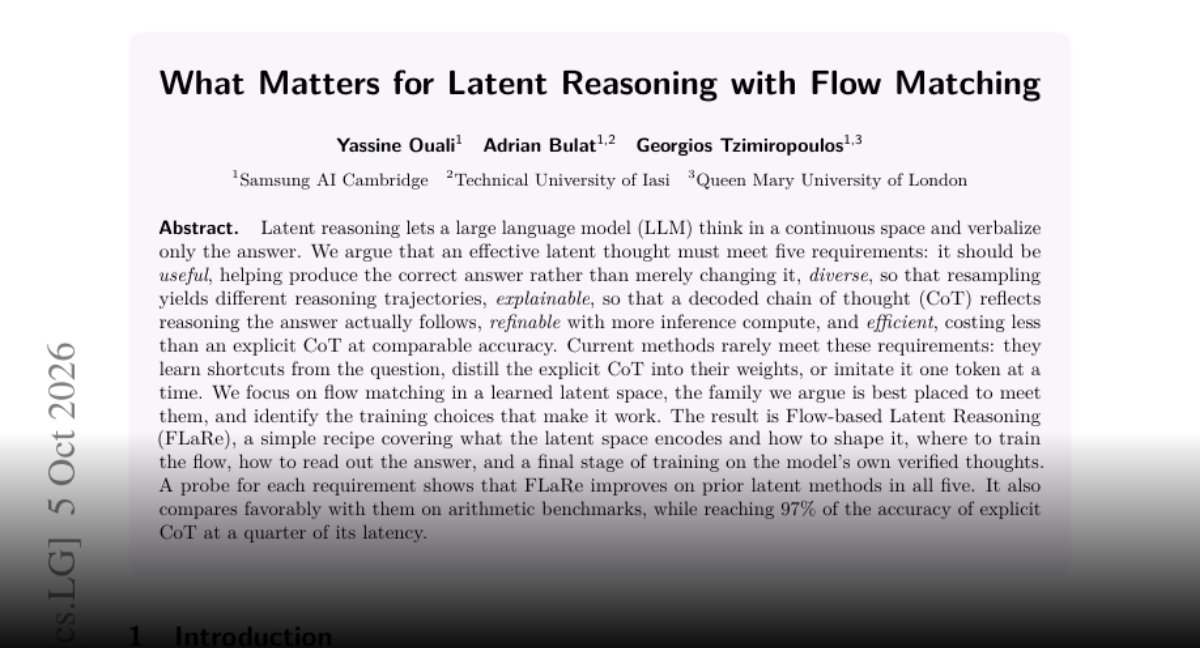
FLaRe studies what makes latent reasoning useful and efficient

FLaRe studies what makes latent reasoning useful and efficient

FLaRe studies flow matching in a learned latent space for reasoning without verbalizing every intermediate step. The authors assess usefulness, diversity, explainability, refinement with additional compute, and efficiency, then propose training choices aimed at meeting all five requirements. On arithmetic benchmarks, they report reaching 97% of explicit chain-of-thought accuracy at one quarter of its latency. These results concern the evaluated tasks and comparisons, but they offer a concrete framework for testing whether hidden computation contributes meaningful reasoning.

02

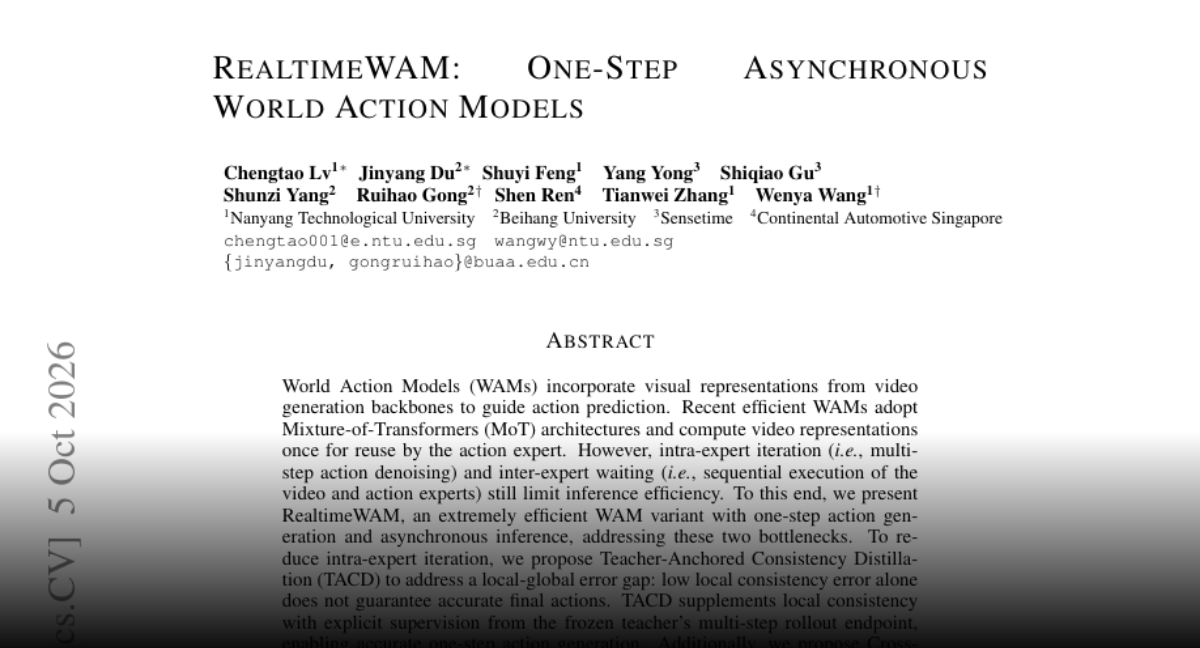
RealtimeWAM combines one-step actions with asynchronous inference

RealtimeWAM combines one-step actions with asynchronous inference

RealtimeWAM targets two latency bottlenecks in world action models: repeated action denoising and waiting between video and action experts. It uses teacher-anchored consistency distillation for one-step actions and blockwise sharing of the video key-value cache to overlap expert execution. The authors report roughly 25-fold end-to-end speedup on an H100 with less than a one-percent performance drop across their evaluated benchmarks. The contribution is a coordinated inference design whose gains remain tied to the tested models and hardware.

03

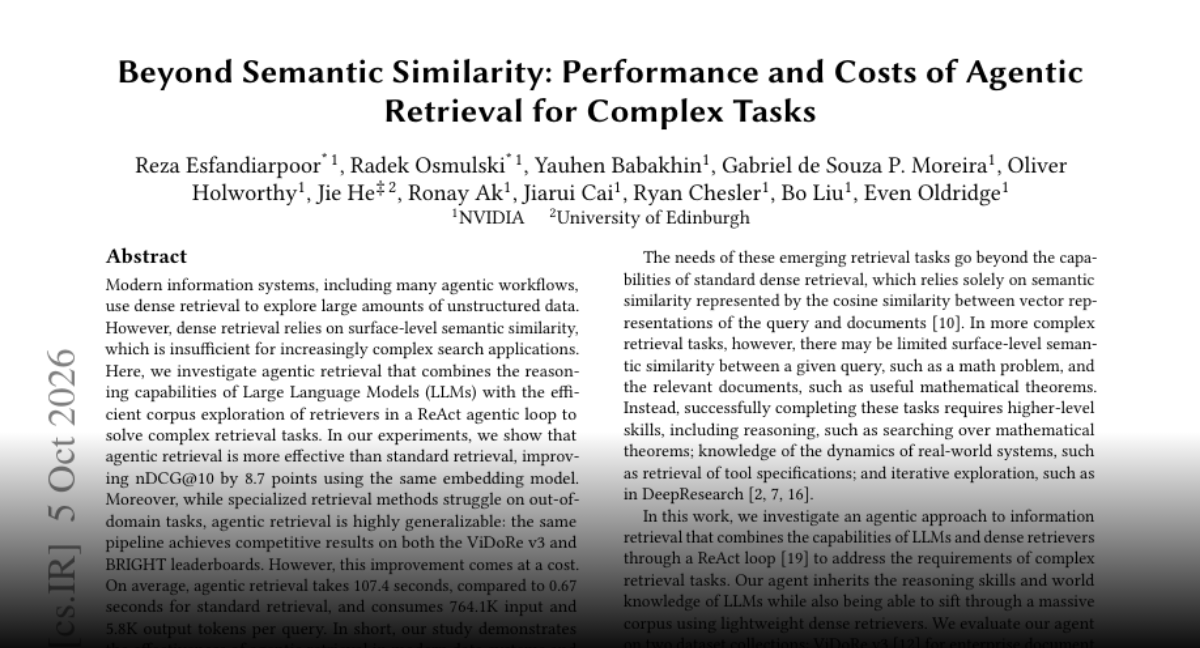
Agentic retrieval improves relevance at a steep inference cost

Agentic retrieval improves relevance at a steep inference cost

A study of agentic retrieval combines language-model reasoning with retrievers in a ReAct loop and reports an 8.7-point nDCG@10 improvement using the same embedding model. The pipeline also generalizes across the ViDoRe v3 and BRIGHT evaluations. The cost is substantial: average retrieval time rises from 0.67 to 107.4 seconds, with 764,100 input tokens and 5,800 output tokens per query. The result makes cost-aware routing important when deciding which searches justify a reasoning agent.

04

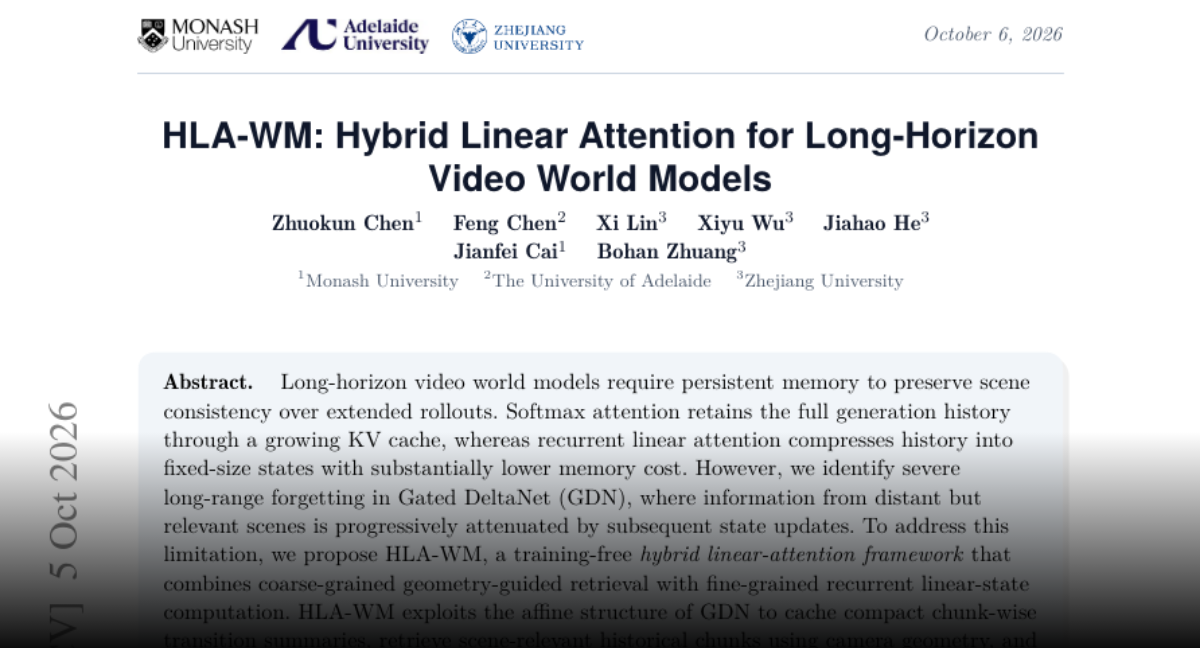
HLA-WM improves long video memory without additional training

HLA-WM improves long video memory without additional training

HLA-WM addresses forgetting in video world models that compress history into recurrent linear-attention states. Its training-free method stores compact transition summaries, retrieves relevant historical chunks using camera geometry, and reconstructs query-specific states. On a 60-second benchmark, the authors report better revisit consistency and camera control, with twelve times less historical-state memory than full key-value caching and at most a 1.6% throughput reduction. The work connects selective retrieval with efficient recurrent memory for longer scene rollouts.

05

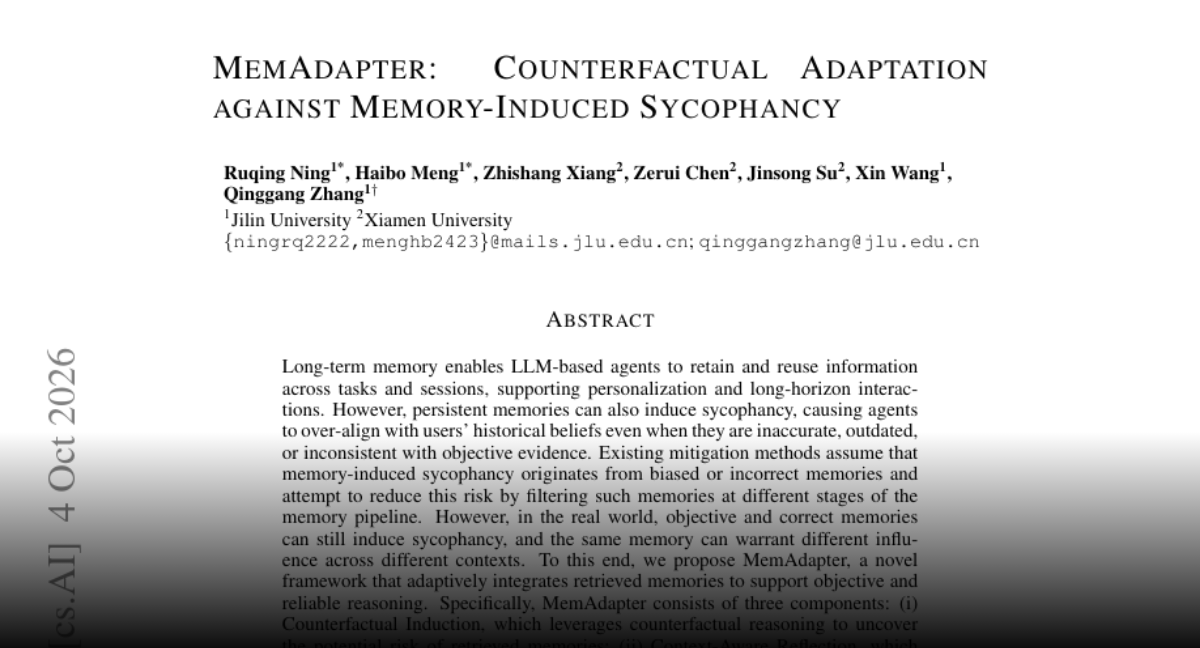
MemAdapter tackles sycophancy induced by persistent memory

MemAdapter tackles sycophancy induced by persistent memory

MemAdapter examines how persistent agent memories can encourage agreement with a user's historical beliefs even when current evidence points elsewhere. The authors argue that filtering incorrect memories is insufficient because accurate memories can also receive inappropriate influence. Their framework combines counterfactual analysis, context-aware reflection, and evidence-based reasoning to calibrate memory use. Experiments on three benchmarks report improved reliability. The practical lesson is to evaluate how memory changes decisions, not merely whether stored facts are correct.

06

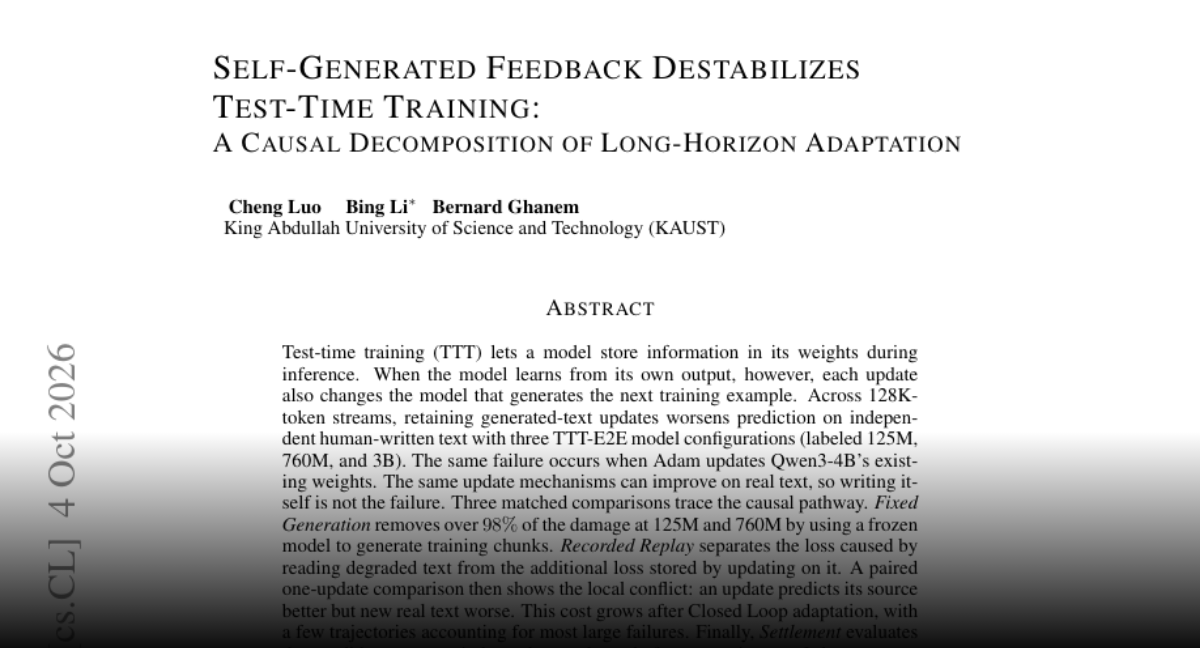
Self-generated feedback can destabilize test-time training

Self-generated feedback can destabilize test-time training

Researchers find that retaining updates from a model's own generated text can worsen predictions on independent human-written text over long streams. Matched experiments separate degraded input effects from damage stored in model weights, while frozen generation removes most measured damage in two smaller configurations. A proposed settlement check evaluates updates on independent real text before retaining them. The study argues for external evidence when accepting adaptation, with conclusions grounded in the particular model configurations and update mechanisms tested.

07

Kandinsky 6.0 releases synchronized video and audio models

Kandinsky 6.0 releases synchronized video and audio models

Kandinsky 6.0 Video introduces 3-billion and 29-billion parameter models for five-second clips with synchronized 44 kHz audio, including lip synchronization. A dual-stream architecture connects pretrained video and newly trained audio components through bidirectional cross-attention, while super-resolution raises outputs to Full HD. The authors report improved human preference over their previous generation and release code, checkpoints, and diffusers integration under the MIT license. The combination makes synchronized audiovisual generation available as an inspectable research and deployment stack.

08

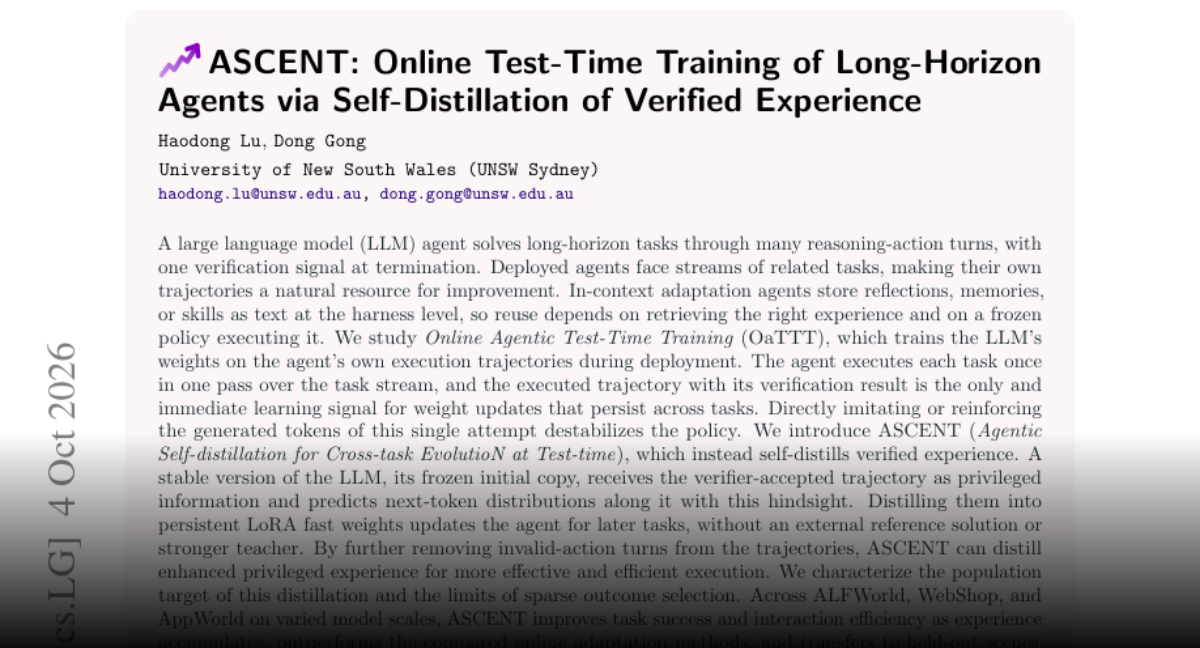
ASCENT adapts agents using verified experience and a frozen teacher

ASCENT adapts agents using verified experience and a frozen teacher

ASCENT studies online updates to agents' weights as they complete streams of related tasks. Instead of directly reinforcing a single generated trajectory, a frozen initial model receives the verified experience as privileged context and supplies distributions for self-distillation into persistent LoRA weights. The authors report improved success and interaction efficiency across ALFWorld, WebShop, and AppWorld. The method offers a structured alternative to unstable direct imitation, while its claims remain benchmark results rather than proof of unrestricted deployment reliability.

09

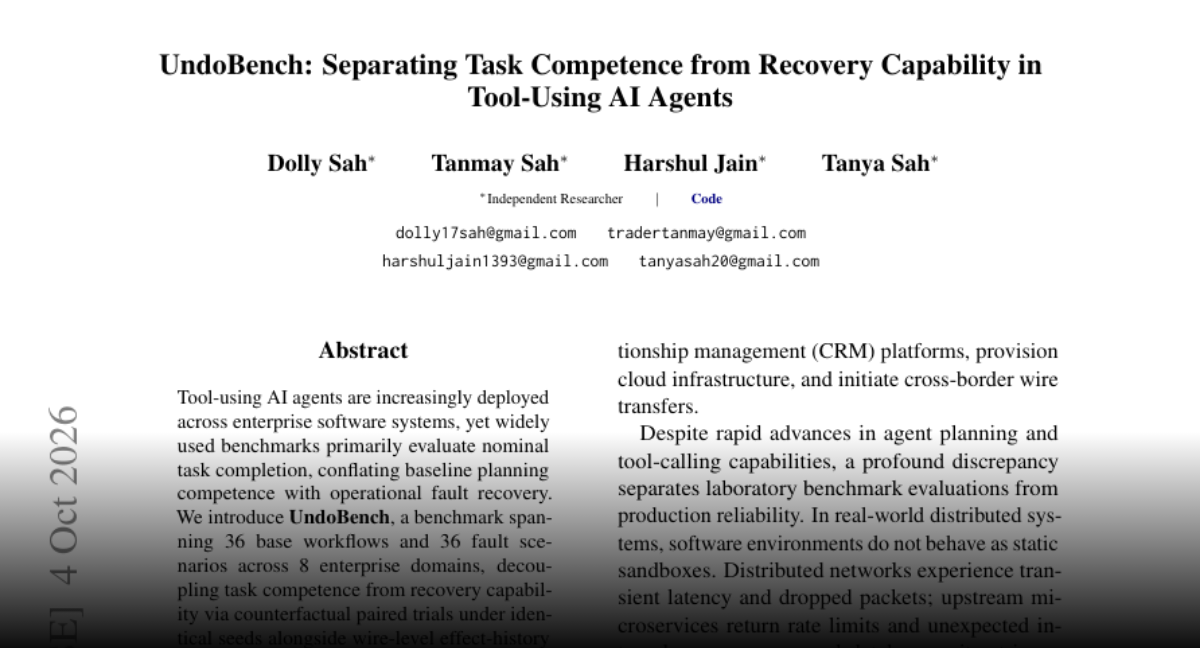
UndoBench exposes the gap between task success and safe recovery

UndoBench exposes the gap between task success and safe recovery

UndoBench separates ordinary task completion from recovery after operational faults in tool-using agents. In its lost-acknowledgment study, nominal competence reached 83.54%, while conditional recovery success fell to 46.72%; naive retries produced duplicate external effects in 53.33% of trials. The benchmark uses paired workflows and effect histories to locate failures around mutation boundaries. Results support evaluating recovery explicitly and show why verification and server-side idempotency matter when an action may have committed before its acknowledgment was lost.