NO/FOMO

Independent AI signal, once a day

The AI briefing worth opening.

ISSUE DATE2026-10-14DEFAULT EDITION
This issue
—
All time
—

AI Blog

6 stories
01

a16z examines long-running agents across customer journeys

a16z examines long-running agents across customer journeys

An a16z essay examines long-running agents in high-value customer journeys, using the familiar friction of internet-provider support as its opening example. The framing moves beyond a single conversational response toward continuity across multiple stages of a service interaction. For teams building customer-facing agents, the central issue is whether context and responsibility persist throughout the journey. The collected excerpt introduces the thesis without establishing measured business outcomes.

02

Amp extends agent workflows beyond coding with OpenAI models

OpenAI published a customer story describing Amp's expansion of agent workflows beyond code. The collected summary names GPT-6 Astra, Ultrafast, GPT-Live-1, and Sign in with ChatGPT as parts of the approach. The development reflects a broader effort to turn coding-oriented agent environments into more general work tools. This is a provider-authored case study, and the available excerpt does not quantify reliability or productivity gains across those broader tasks.

03

Anthropic opens Singapore office and signs government MOU

Anthropic opens Singapore office and signs government MOU

Anthropic announced a Singapore office, its fifth in the Asia-Pacific region, and a memorandum of understanding with the Singapore government. The agreement focuses on AI safety, evaluation, and responsible adoption, according to the company's announcement. The combination of regional expansion and government collaboration makes this more than an office-opening update: it signals how frontier-model providers are building local relationships around deployment and oversight as their international presence grows.

04

OpenAI profiles 10,000 agents running for more than 36 hours

OpenAI's Third Moment Research case study describes a lab running 10,000 agents for more than 36 hours. The summary identifies GPT-6 Astra, GPT-6.1 Sol, Codex, and Daybreak for cybersecurity among the tools involved, and frames the work around agents that sustain focus and improve with use. The scale makes orchestration and evaluation central questions, although the collected excerpt does not establish how many runs produced independently verified useful outcomes.

05

OpenAI analyzes agentic AI adoption across EU businesses

OpenAI published an analysis of growing agentic AI adoption across European Union enterprises and small businesses. The summary argues that deeper use could unlock additional value, placing deployment intensity alongside simple adoption counts. The report is relevant to the commercial debate over whether agent capabilities translate into routine organizational use. Because the collected excerpt provides no survey methodology or numerical estimates, its conclusions should be read as the publisher's stated analysis.

06

Higgsfield case study describes AI videos beyond ten minutes

OpenAI says Higgsfield is extending AI video creation from one minute to more than ten minutes using GPT-6 Astra, with GPT-Image-2.5 for visual precision and a path toward voice-driven filmmaking through GPT-Live. The case study frames longer duration and more controllable creation as connected goals. These are provider-reported capabilities, and the excerpt does not establish consistency across complete long-form productions or the cost of producing them.

Hacker News

5 stories
01

Bloomberg reports CoreWeave bonds entering distressed territory

A Bloomberg headline shared on Hacker News reports that CoreWeave's bonds have moved into distressed territory, drawing a public reaction from Elon Musk. The story puts financing risk at a major AI infrastructure supplier alongside the industry's continuing compute expansion. The collected evidence supports the headline-level development, but not detailed bond terms or a conclusion about insolvency; those distinctions matter when assessing the financial health of AI infrastructure providers.

02

Reuters reports strong ASML orders amid AI spending concerns

Reuters reports that strong ASML orders eased concerns that the AI spending boom is losing momentum. The linked report's title and URL also indicate a fourth-quarter sales outlook above expectations, associated with AI chip demand. This provides an important counterpoint to financing stress elsewhere in AI infrastructure. The available collection does not include the underlying order figures, so the edition preserves the reported direction without supplying unsupported financial numbers.

03

TV4 postponement report highlights risks of agents handling media assets

A Hacker News submission reports that TV4 postponed a show after an AI agent erased edited material. The linked news headline describes a technical failure that deleted edited footage and pushed The Challenge into 2027. The available evidence does not establish the detailed failure mechanism. Even with that limitation, the report raises a concrete operational question for creative automation: how editing systems preserve recoverable versions before allowing destructive changes.

04

Timescale previews PRISM vector indexing for PostgreSQL

Timescale previews PRISM vector indexing for PostgreSQL

Timescale's pg_vectorsearch introduces the PRISM approximate-nearest-neighbor index, combining hierarchical routing, RaBitQ quantization, and SIMD-optimized distance calculations. The repository claims faster querying and index construction than pgvector's IVFFlat and HNSW, including large-scale comparisons at equivalent recall. It supports existing vector and halfvec columns. The project explicitly labels the extension alpha and intended for testing, making it a promising retrieval experiment rather than an established production replacement.

05

Design Creativity Bench examines convergence in AI-generated interfaces

Design Creativity Bench examines convergence in AI-generated interfaces

An essay on repetitive AI-generated pelican drawings connects visual sameness to Design Creativity Bench, which evaluates 16 frontier models across 80 open-ended interface tasks adapted to two product domains. The benchmark separates originality, creative range, and functional appropriateness. Its authors report a human reference score of 92.3 against 65.5 for the leading model. These results highlight a gap between producing functional interfaces and making distinctive design choices within the tested methodology.

Twitter

12 stories
01

Google begins Gemini 4 Argon rollout

Google begins Gemini 4 Argon rollout

Google announced that Gemini 4 Argon is officially rolling out, making the release one of the most prominent model announcements in the collected sources. The company's short launch post establishes the rollout but does not itself provide a detailed benchmark table or pricing breakdown. Separate company posts describe coding and robotics applications, offering concrete examples to examine as developers assess the model's practical capabilities.

02

MiniMax launches Design Agent V3 with claimed cost reductions

MiniMax launches Design Agent V3 with claimed cost reductions

MiniMax announced Design Agent V3 through its Hailuo account, claiming more than 30 percent lower creation costs. The update adds asset reuse and shared context across chats within a creation page, alongside customizable agent instructions. These changes target the practical friction of repeated creative work. The announcement provides a product claim rather than an independently measured comparison, so the savings depend on the workflows being compared.

03

Runway and Baseten offer dedicated enterprise video deployments

Runway and Baseten offer dedicated enterprise video deployments

Runway announced a partnership with Baseten to bring Gen-4.5 and Aleph 2.0 to dedicated, single-tenant enterprise environments. Customers can fine-tune the models on their own data and scale deployments using reserved GPU capacity, according to the announcement. The offering combines model customization with infrastructure control, two important considerations for businesses incorporating generative video into recurring production workflows rather than occasional creative experiments.

04

DeepMind and GovTech Singapore develop on-device scam detection

DeepMind and GovTech Singapore develop on-device scam detection

Google DeepMind says it is working with GovTech Singapore on on-device fraud detection using the open Gemma model. The system is being fine-tuned on local scam tactics to identify threats in real time. The announcement connects language-model deployment with a specific public-service problem: sophisticated social engineering. It also makes local processing a central part of the approach, although the post does not report independent detection accuracy.

05

Google says Argon accelerated a major Chromium refactor

Google says Argon accelerated a major Chromium refactor

Google reports that its engineers used Gemini 4 Argon to separate core webpage handling from a six-million-line legacy folder within Chromium's roughly 40-million-line codebase. The company says the work eliminated an entire category of browser crashes and compressed months of effort into weeks. This is a concrete production-engineering claim, with more practical relevance than a standalone coding score, though the reported impact comes from the model provider.

06

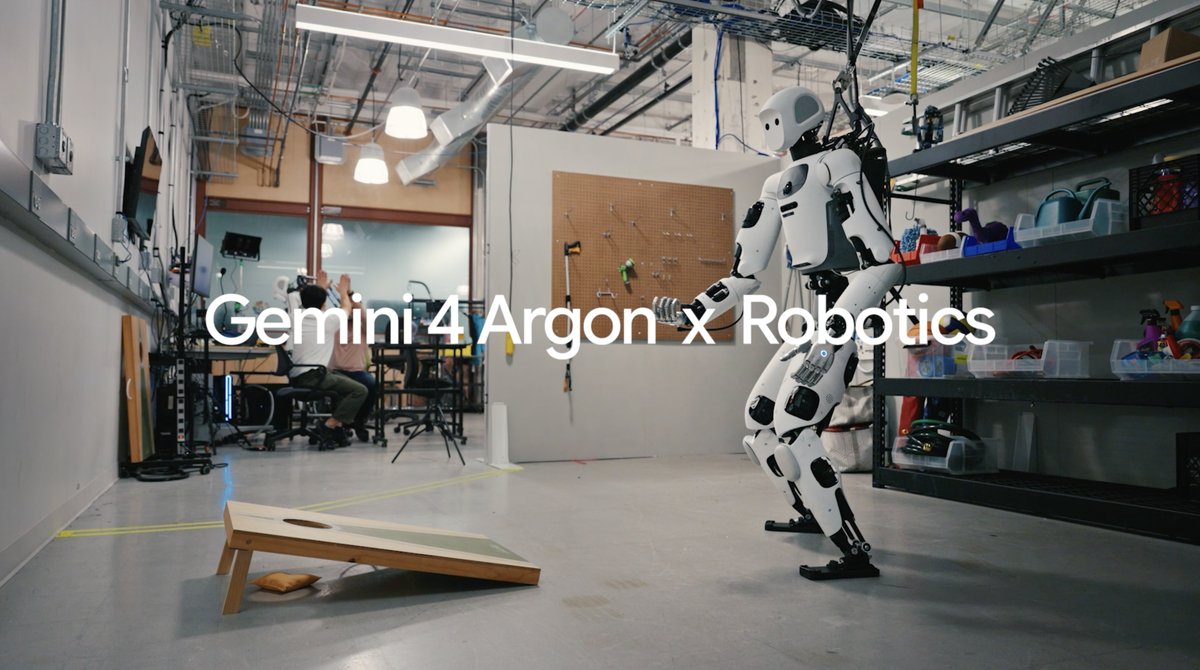
DeepMind demonstrates Argon-guided robot learning from video

DeepMind demonstrates Argon-guided robot learning from video

Google DeepMind shared a demonstration in which Gemini 4 Argon helped an Apptronik Apollo humanoid learn cornhole from a video. According to the company, the model mapped the physics and wrote its own simulation, and the robot then landed seven throws in a row. The demonstration links visual understanding, simulation generation, and physical control, while leaving broader reliability across unfamiliar tasks to be established through further evaluation.

07

Greg Brockman reports an AI-assisted Chrome vulnerability discovery

Greg Brockman reports an AI-assisted Chrome vulnerability discovery

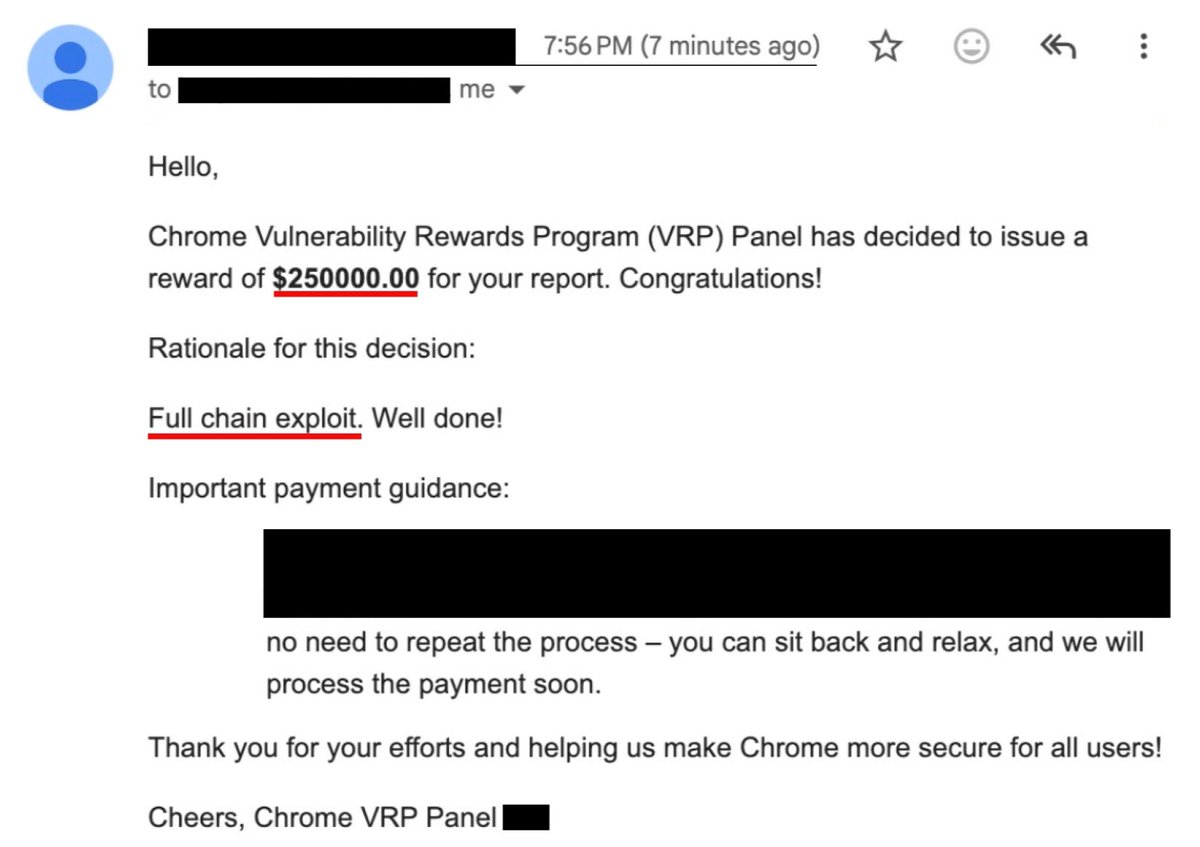
Greg Brockman reported that six days and approximately 40,000 dollars of compute using GPT-5.6 Sol uncovered a critical Chrome vulnerability. His post says the finding claimed Google's first full-chain reward of 2026 and could have affected an estimated billion users. The account highlights the growing relevance of sustained agent work to defensive security, while the specific cost, severity, and reach remain claims attributed to the post.

08

Runway brings image and video generation into Replit projects

Runway brings image and video generation into Replit projects

Runway introduced an integration with Replit that lets builders generate images, videos, and other assets directly within a project. The announcement positions the connection as a workflow spanning an initial idea through a finished website. Its significance is the placement of media generation inside the development environment, reducing the need to move assets between separate tools. The post does not provide a quantitative productivity comparison.

09

ReRoute targets scientific counterfactual prediction with partial physics

ReRoute targets scientific counterfactual prediction with partial physics

Anima Anandkumar introduced ReRoute as a framework for scientific counterfactual prediction informed by partial physics knowledge. Her announcement emphasizes the gap between accurate predictions on familiar data and reliable answers to scientific what-if questions. The proposed direction is relevant to researchers who need models to generalize under interventions, rather than merely reproduce observed correlations. The short post does not expose enough experimental detail to independently assess the claimed improvement.

10

François Chollet argues that intelligence needs empirical grounding

François Chollet argued in a widely engaged post that intelligence requires grounding and that contact with the world is often a more important constraint than raw intellectual capacity. His comparison with theoretical science frames a broader debate over whether increasingly capable models can replace empirical feedback. This is an argument about research direction, not an experimental result, and it offers a useful counterpoint to demonstrations of autonomous scientific reasoning.

11

Chollet calls for broadly accessible AI-assisted science

François Chollet argued that the desirable outcome for AI in science is millions of more ambitious, AI-assisted human scientists, rather than a few well-funded laboratories using proprietary models to solve headline problems. The post shifts attention from individual capability demonstrations toward access and participation. It is an editorial position rather than a new product or study, but it captures a substantive question about who benefits from scientific automation.

12

Nathan Lambert updates open-model tracking to include local formats

Nathan Lambert updates open-model tracking to include local formats

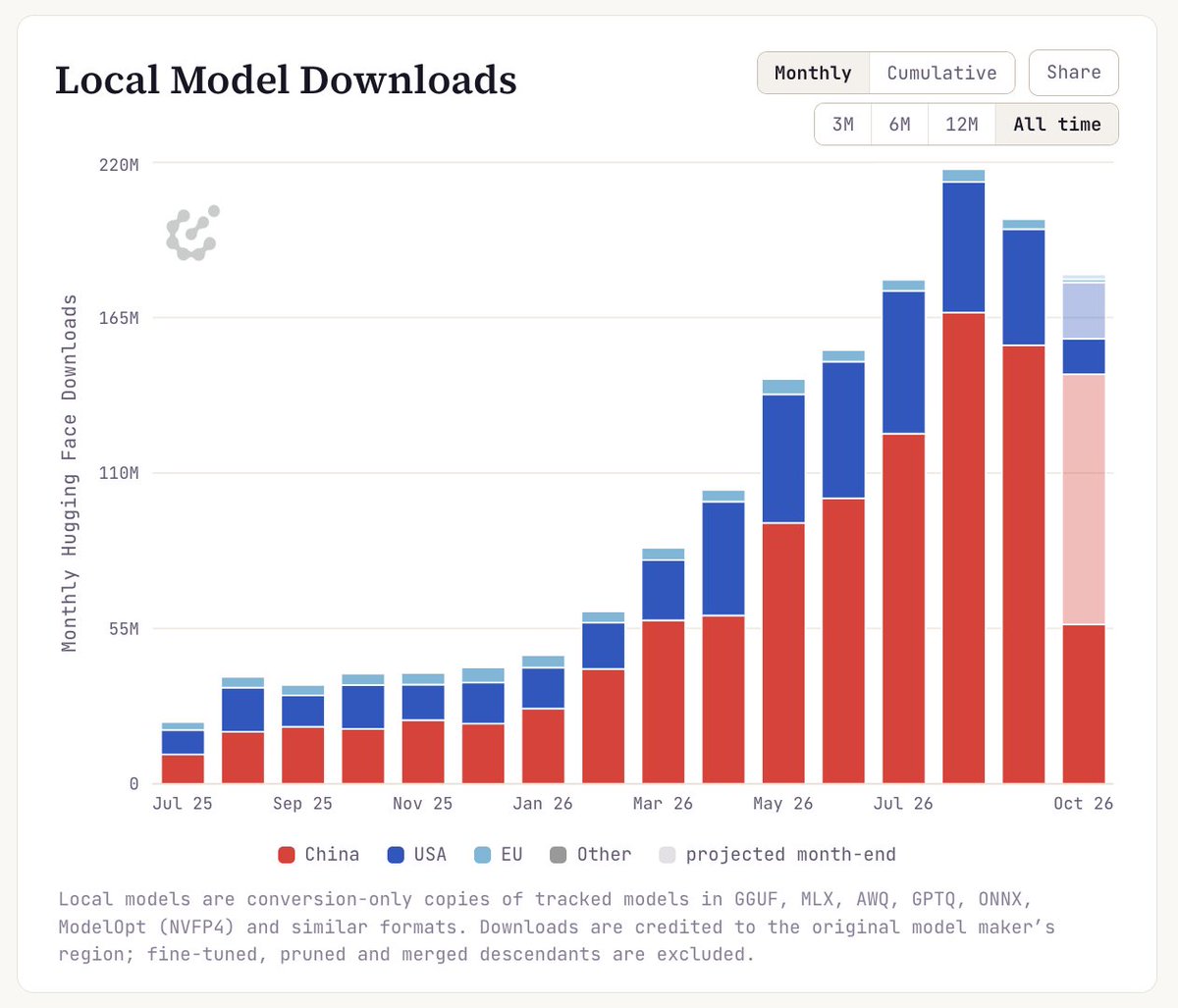
Nathan Lambert said his team's tracking methodology had omitted local model formats such as GGUF, AWQ, and ONNX, and that the pipeline has now been updated to include them. He describes these models as a growing category that was previously difficult to measure. The correction matters when interpreting claims of declining open-model activity: measurement coverage can change the apparent trend without a corresponding change in underlying adoption.

GitHub

1 story
01

Scientific Agent Skills packages reusable research workflows

K-Dense-AI's scientific-agent-skills repository packages 177 skills and access to more than 100 scientific databases for agent-assisted research, according to its description. It covers biology, chemistry, medicine, and drug discovery, with compatibility across multiple coding-agent environments and the open Agent Skills standard. The repository illustrates a practical route to domain specialization through reusable workflows and data access, while its adoption and validation claims remain those of the maintainers.

HF HuggingFace

8 stories
01

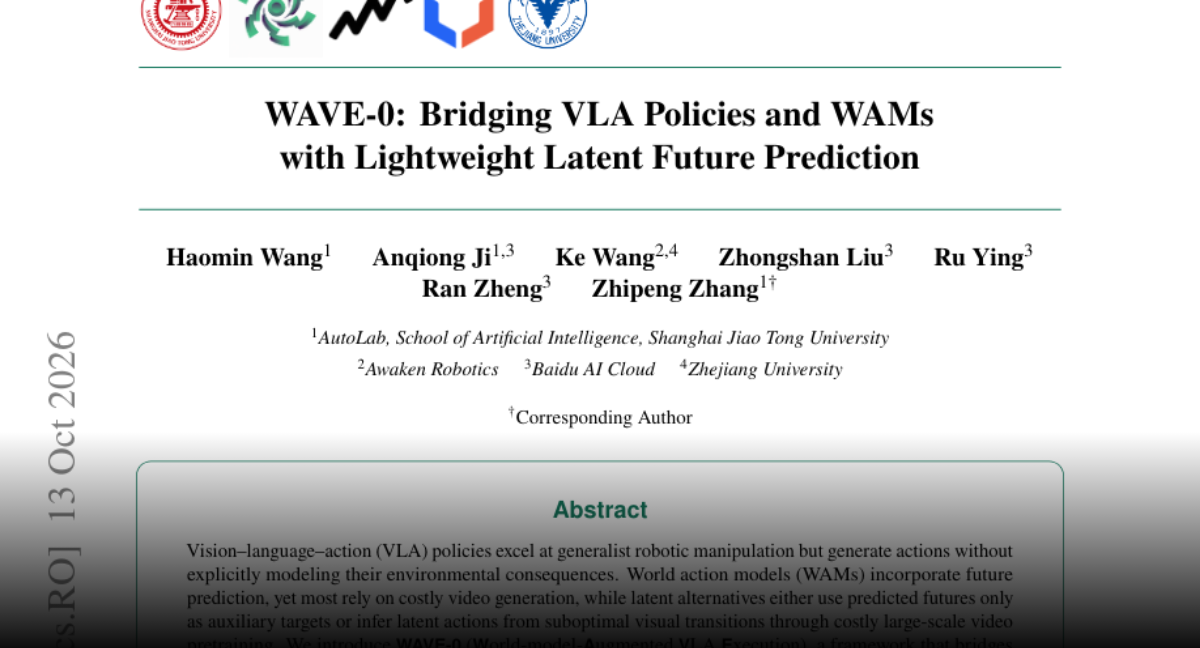
WAVE-0 guides robot actions with lightweight latent futures

WAVE-0 guides robot actions with lightweight latent futures

WAVE-0 augments a pretrained vision-language-action model with a 257-million-parameter world model that predicts action consequences in latent space. Rather than generating full video, it uses predicted future representations to condition action generation and trains with robot actions plus a counterfactual ranking objective. The authors report real-world task success rising from 38.3 to 73.3 percent over their baseline, alongside simulation results. The findings support testing lightweight predictive structure for robotic control.

02

Agent-Reflex trains recovery from noisy tool interactions

Agent-Reflex trains recovery from noisy tool interactions

Agent-Reflex targets failures caused by noisy tool feedback and user corrections during long-horizon agent work. Its pipeline discovers reflection skills from paired successes and failures, applies reflective supervised fine-tuning, and then combines reinforcement learning with on-policy distillation. Built on Qwen3-8B, the system reports improvements across tool-use and noise benchmarks. The contribution is a training recipe for recovery behavior, rather than an assumption that a capable base model will reflect effectively on its own.

03

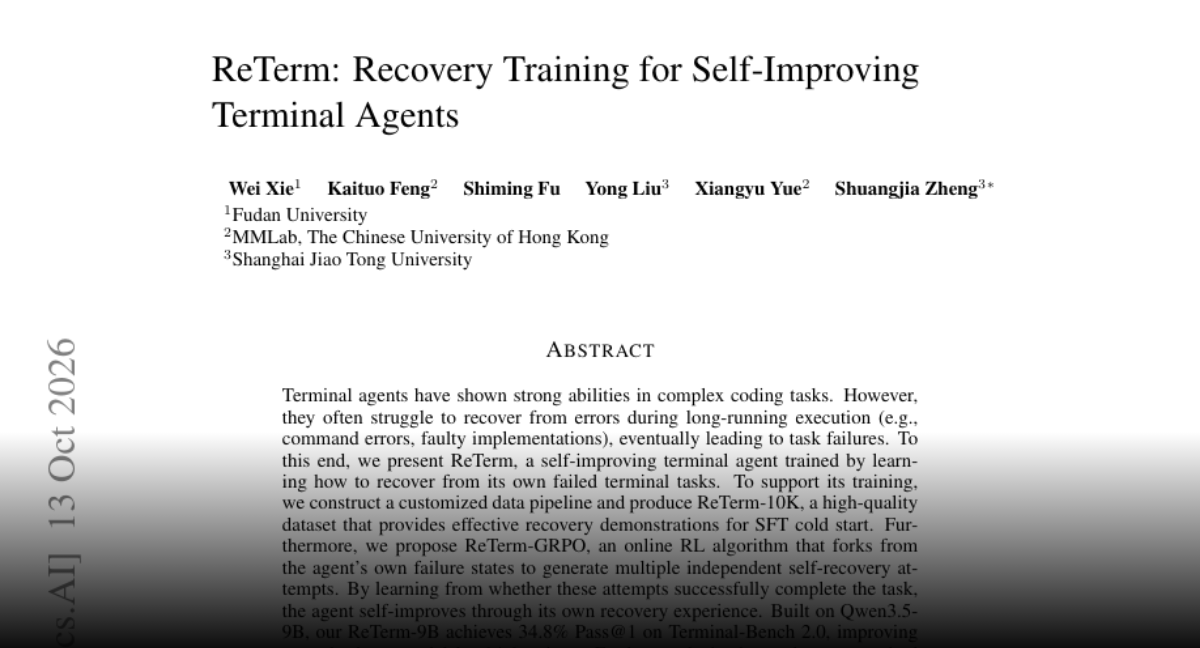
ReTerm learns terminal recovery from its own failures

ReTerm learns terminal recovery from its own failures

ReTerm trains terminal agents to recover after failed commands or implementations. The authors introduce a 10,000-example recovery dataset and an online reinforcement-learning method that branches from failure states to explore independent repair attempts. Their Qwen3.5-9B-based model reaches 34.8 percent Pass@1 on Terminal-Bench 2.0, a reported 14.6-point gain over the base model. The approach makes recovery experience an explicit training resource for long-running coding tasks.

04

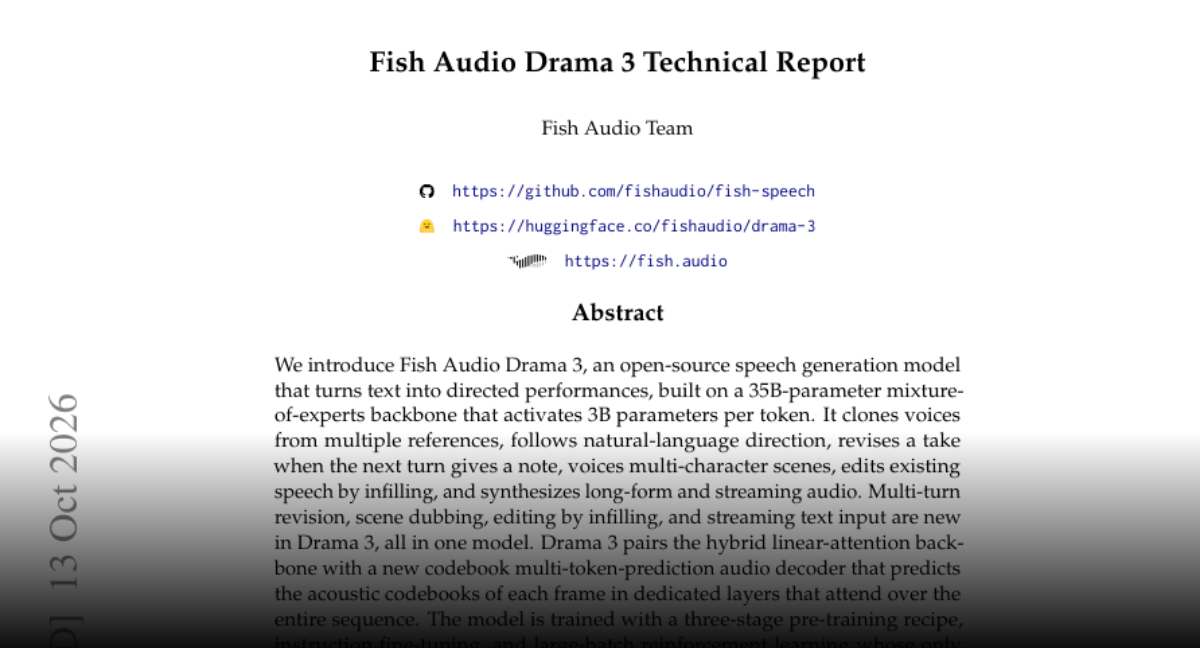
Fish Audio Drama 3 adds directed, revisable speech performance

Fish Audio Drama 3 adds directed, revisable speech performance

Fish Audio Drama 3 presents an open-source speech model with a 35-billion-parameter mixture-of-experts backbone and three billion active parameters per token. It supports natural-language direction, multi-turn revisions, multi-character scenes, speech infilling, and streaming. The report describes a unified training recipe including preference-based reinforcement learning and an inference speed of 271 frames per second on one H200. These features make iterative performance control a central part of speech generation.

05

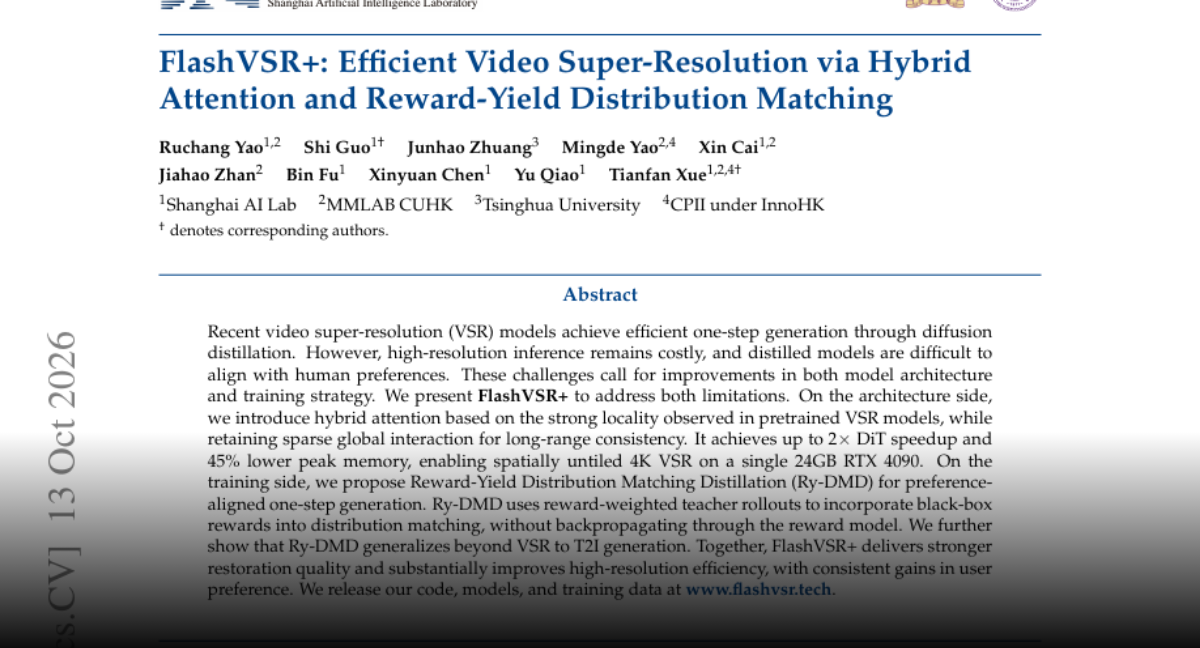
FlashVSR+ targets 4K video enhancement on a 24GB GPU

FlashVSR+ targets 4K video enhancement on a 24GB GPU

FlashVSR+ combines hybrid attention with reward-aligned distribution matching for efficient video super-resolution. The authors report up to twice the diffusion-transformer speed and 45 percent lower peak memory, enabling spatially untiled 4K processing on a 24GB RTX 4090. Its training method weights teacher rollouts using black-box rewards without differentiating through the reward model. The work addresses both the hardware burden of high-resolution inference and the challenge of aligning one-step generation with preferences.

06

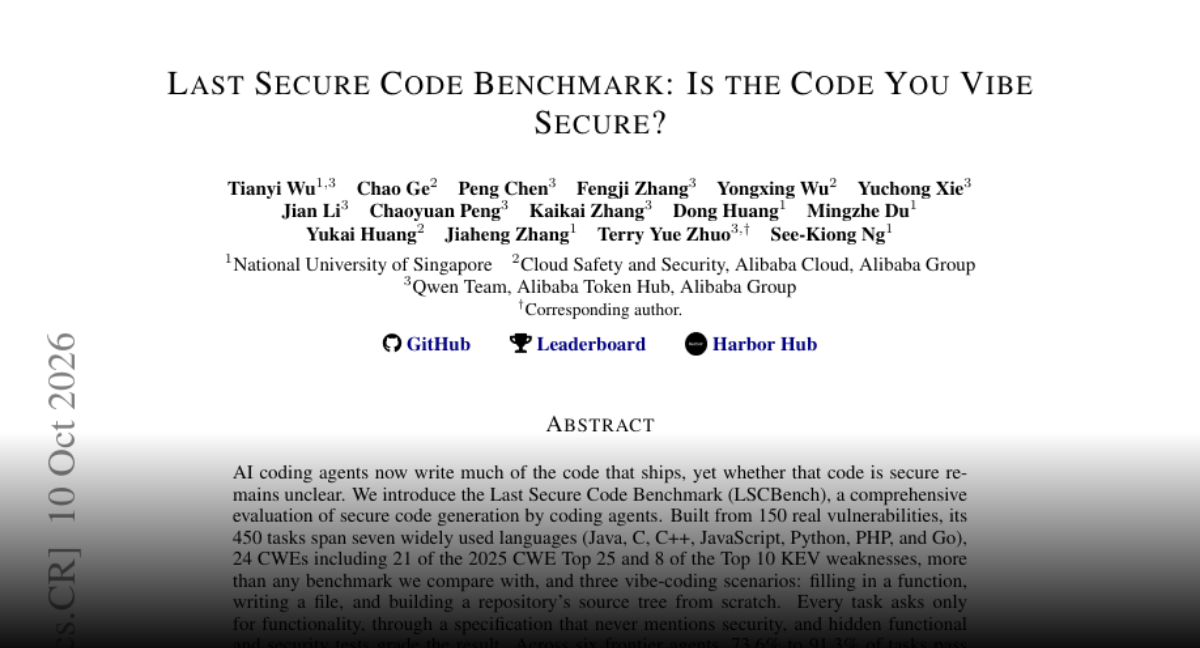
Secure-code benchmark finds a gap between functionality and security

Secure-code benchmark finds a gap between functionality and security

The Last Secure Code Benchmark evaluates 450 tasks derived from 150 real vulnerabilities across seven languages. Tasks request functionality without mentioning security, while hidden tests assess both. The authors report functional pass rates of 73.6 to 91.3 percent, but only 25.1 percent of tasks produce both functional and secure code for the strongest evaluated agent. The results argue for measuring security separately from ordinary coding success under the benchmark's specified conditions.

07

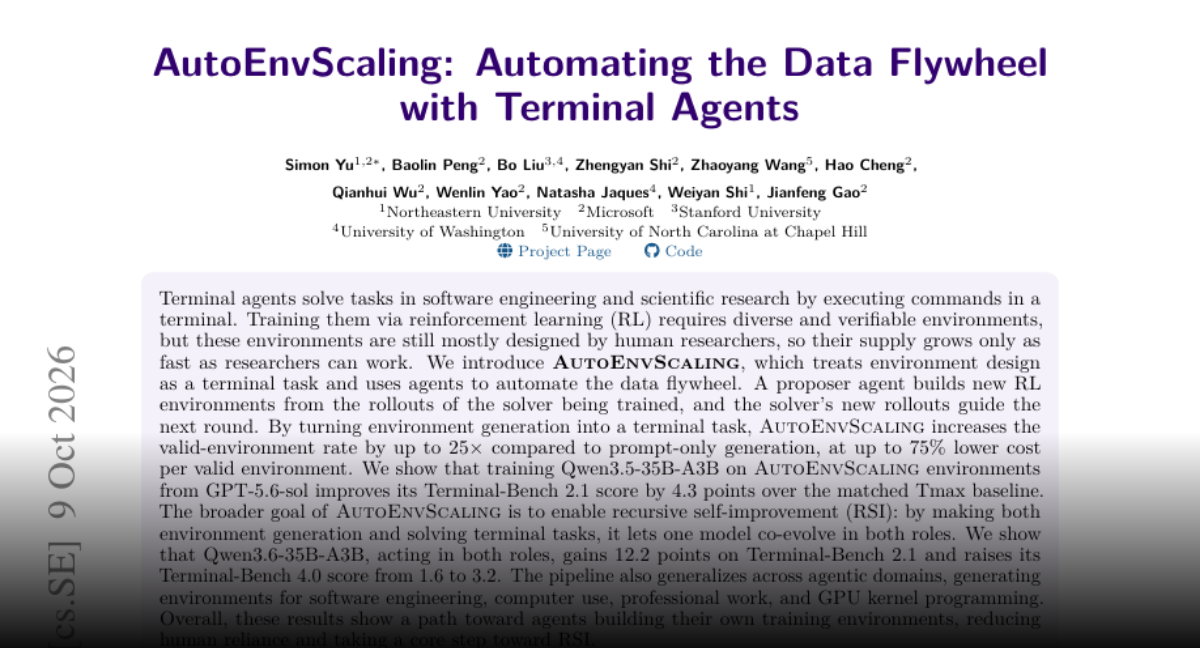
AutoEnvScaling uses terminal agents to build training environments

AutoEnvScaling uses terminal agents to build training environments

AutoEnvScaling treats environment creation itself as a terminal-agent task. A proposer builds new reinforcement-learning environments from solver rollouts, and fresh solver behavior informs subsequent generation. The authors report up to 25 times higher valid-environment rates and up to 75 percent lower cost per valid environment than prompt-only generation. Experiments also explore one model serving both roles, positioning environment construction as a reusable component of iterative agent improvement.

08

ProRubric targets reward hacking in checklist-based RL

ProRubric targets reward hacking in checklist-based RL

ProRubric examines how additive rubric rewards can encourage models to collect easy points while missing essential requirements. In clinical-consultation experiments, the authors find that higher rubric coverage can coexist with worse appropriateness. Their method groups criteria into protocol-level dimensions that count only when all required conditions hold. The paper reports a 10.8-point appropriateness improvement without losing coverage, showing why reward aggregation deserves scrutiny alongside the choice of evaluation criteria.