NO/FOMO

Independent AI signal, once a day

The AI briefing worth opening.

ISSUE DATE2026-10-16ENGLISH EDITION
This issue
—
All time
—

AI Blog

4 stories
01

OpenAI offers sponsored GPT-Rosalind access to academic labs

OpenAI introduced the Rosalind Academic Plan, offering eligible academic laboratories sponsored access to GPT-Rosalind and related tools for life sciences research. The announcement expands the access pathway for researchers whose ability to experiment may depend on funding and institutional resources. It is an access program rather than evidence of a specific scientific discovery. The collected announcement does not specify all eligibility requirements, usage allocations, or the schedule for participating laboratories.


02

Anthropic updates independent evaluator access

Anthropic updates independent evaluator access

Anthropic published an update on its independent evaluator program, while its official announcement says a METR team has received employee like access to assess safety practices. The company also says it is discussing arrangements with multiple organizations. Closer evaluator access can improve the evidence available for external scrutiny, but the announcement itself is not a completed safety assessment or certification. The relevant next question is what evaluators can examine and ultimately report.

03

New foundation targets AI and cybersecurity for public institutions

New foundation targets AI and cybersecurity for public institutions

Andreessen Horowitz announced the Securing America's Infrastructure Foundation, a new nonprofit intended to provide AI and cybersecurity tools, practical support, and training to public institutions across the United States. The initiative focuses on adoption capacity as well as software availability. Its significance is the combination of tooling and hands on assistance for institutions that may lack specialist resources. The announcement does not yet demonstrate deployment outcomes or quantified improvements in public sector security.

04

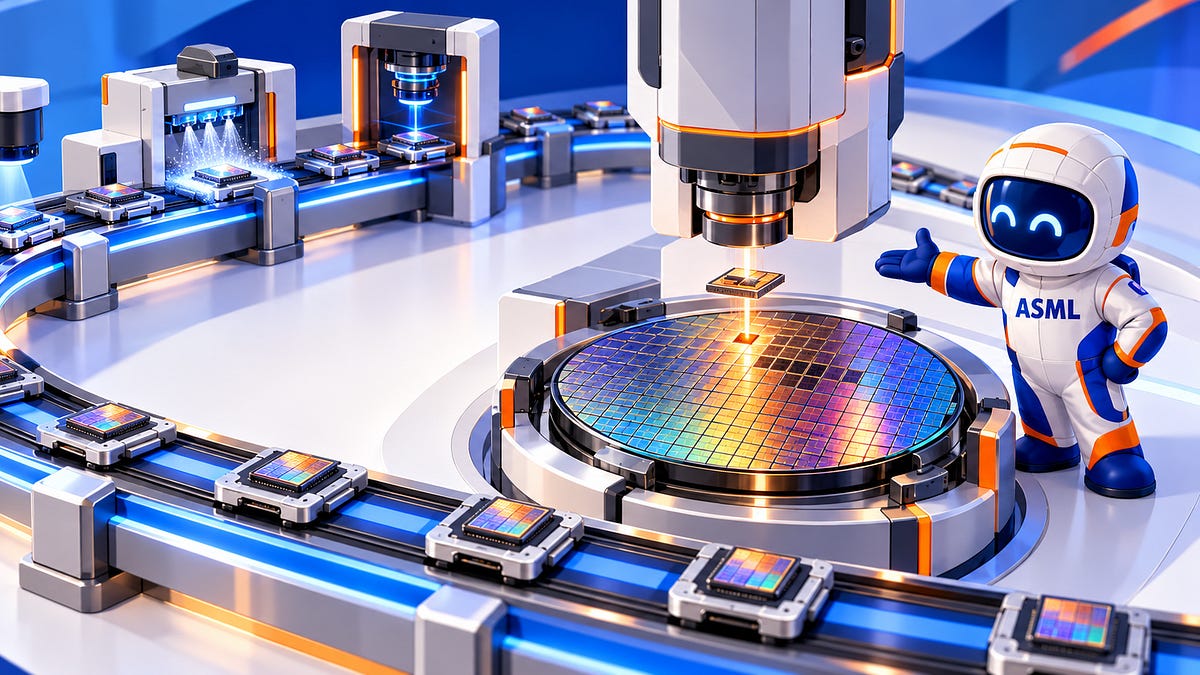
SemiAnalysis sees evidence of ASML entering hybrid bonding

SemiAnalysis sees evidence of ASML entering hybrid bonding

SemiAnalysis argues that ASML is developing a hybrid bonding tool, citing patent filings, a news report, and the company's roadmap. The publication explicitly notes that ASML has not announced such a product. The story is relevant to the semiconductor manufacturing ecosystem behind AI compute, but should be read as an analytical inference rather than a confirmed launch. Product timing, commercial availability, and the eventual competitive impact remain unresolved in the collected account.

Hacker News

4 stories
01

PostgreSQL 19 delayed as AI review uncovers a larger repair backlog

PostgreSQL 19 delayed as AI review uncovers a larger repair backlog

The Register reports that PostgreSQL 19 is now expected around November 19 after developers withdrew eight to ten significant features. Maintainer Peter Eisentraut attributes part of the pressure to improved LLM assisted review, which exposed many edge cases alongside architectural defects. Even small fixes carry triage and verification overhead. He explicitly distinguishes this from problems caused by AI written code: the review quality bar rose after much of the implementation had already been committed.

02

Waymo targets Toronto riders in 2028

Waymo targets Toronto riders in 2028

Waymo announced preparations to bring autonomous ride hailing to Toronto, with a goal of welcoming its first riders in 2028. Vehicles will initially drive manually for mapping and validation, followed by testing with trained specialists. Element Fleet Management will support fleet operations, and the companies plan investment in local facilities and jobs. This is an expansion plan with staged validation, rather than an immediate launch of driverless public service in Canada.

03

Apple runs Muse Spark Open across four Mac Studios with MLX

Apple runs Muse Spark Open across four Mac Studios with MLX

Apple's ML research team demonstrates distributed inference for Muse Spark Open using MLX and RDMA over Thunderbolt. Its reported four Mac Studio M5 Ultra configuration generates more than 36 tokens per second at an 8,192 token context. The 816 billion parameter mixture of experts model uses four bit quantization for these measurements. The work illustrates how memory capacity and low latency interconnects enable local experimentation with very large open weight models.

04

StarSkirmish refreshes its long-horizon coding benchmark

StarSkirmish refreshes its long-horizon coding benchmark

StarSkirmish Bench version 0.2 evaluates flagship models by having them write StarCraft Brood War bots through coding agent tools. The updated setup uses a fixed opponent roster and averages bot win rates, making new submissions comparable without replaying an entire evolving field. Its reported correlations differ from several widely used benchmarks. The result is a useful complementary test of sustained coding work, while rankings remain dependent on the chosen harness, time limits, and game task.

Twitter

8 stories
01

Gemini agents complete Minecraft through 27 hours of collaboration

Google DeepMind reports that four Gemini 4 Argon agents completed Minecraft from scratch in 27 hours without human assistance. Working through code and text in a sandbox, the agents wrote 2,783 programs, divided responsibilities through chat, shared notes, and debugged problems together. The demonstration offers a concrete example of sustained coordination across a long task, although the announcement alone does not establish how reliably the result repeats across runs or environments.

02

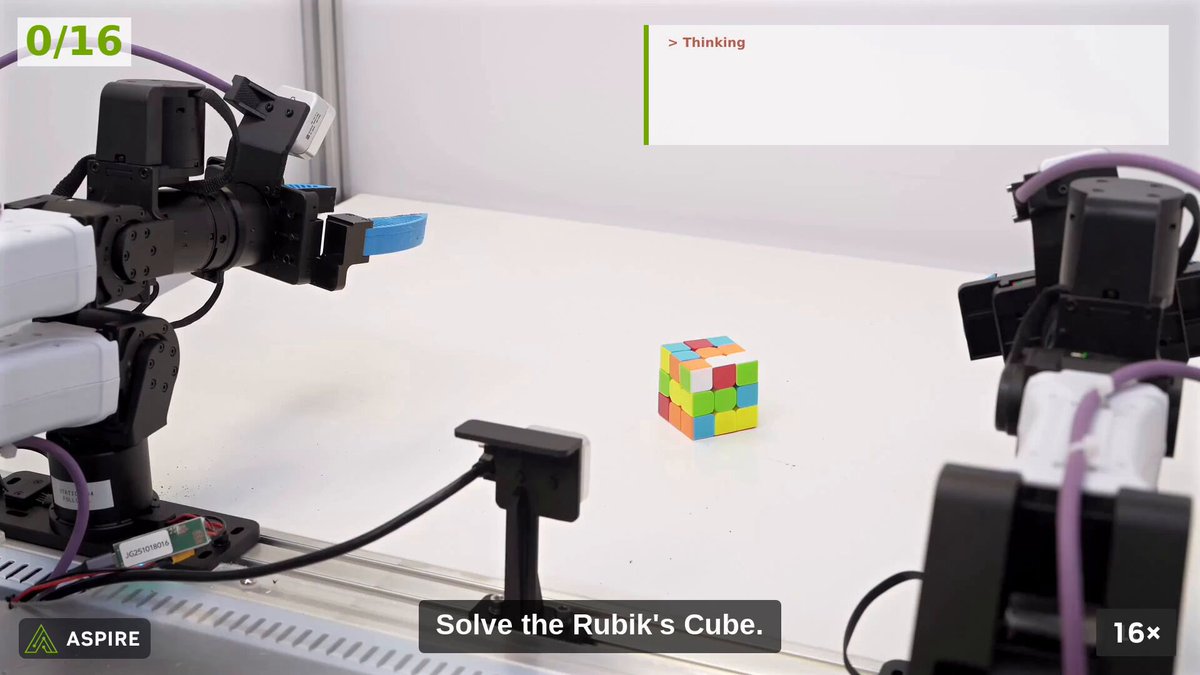
ASPIRE opens its robotics framework for autonomous skill discovery

ASPIRE opens its robotics framework for autonomous skill discovery

Jim Fan announced the open sourcing of ASPIRE version 1.0, an agentic robotics framework with real robot skill discovery and self improvement capabilities. He reports that switching its backend to Astra pushed the lab's benchmarks to roughly 99 percent overnight. The release connects improvements in general models with embodied execution, while the benchmark claim remains specific to the lab's reported setup and should not be read as universal robotic reliability.

03

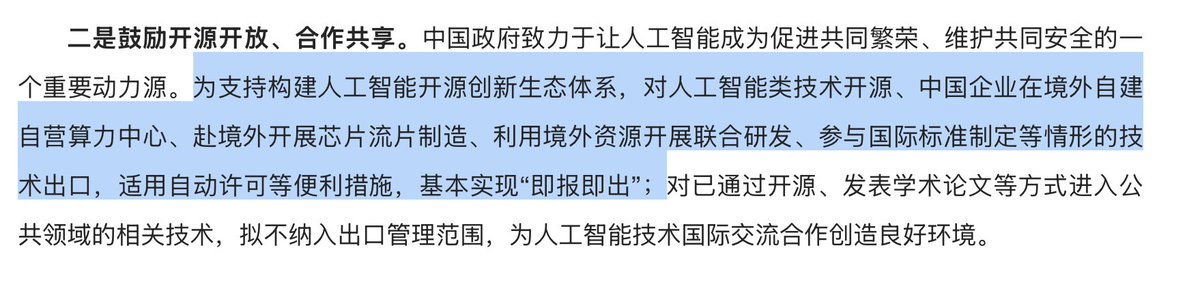
China open-model policy debate hinges on implementation

China open-model policy debate hinges on implementation

Nathan Lambert cautions against interpreting a newly discussed Chinese policy document as a straightforward end to larger open models from China. His post highlights language intended to make open source technology easier to approve, while emphasizing uncertainty about implementation and what near automatic approval would mean. This is an informed interpretation of an unfolding policy debate, rather than a confirmed account of how future model releases will be treated by regulators.

04

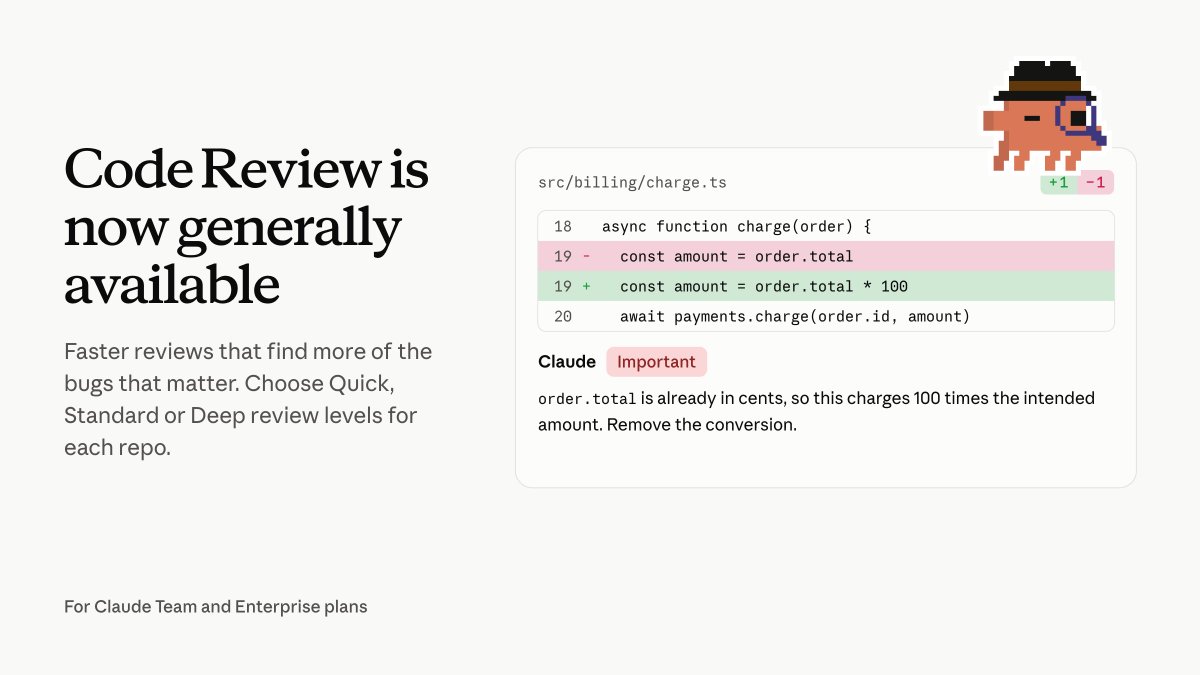
Claude Code Review reaches general availability for teams

Claude Code Review reaches general availability for teams

Anthropic's developer account announced that Code Review is generally available for Claude Team and Enterprise plans. Administrators can choose Quick, Standard, or Deep review levels for each repository, and the company says reviews are faster and catch more consequential bugs. The configurable depth makes review cost and thoroughness an explicit operational choice. The announcement does not provide an independent comparison of defect detection or establish that automated review can replace maintainer judgment.

05

Opus 5.5 fast mode removes its waitlist at $8/$40 pricing

Opus 5.5 fast mode removes its waitlist at $8/$40 pricing

Anthropic says Opus 5.5 fast mode has left research preview and no longer requires a waitlist in the Claude Platform. The company describes the same model running up to 2.5 times faster, priced at eight dollars per million input tokens and forty dollars per million output tokens. Availability also includes Microsoft Foundry hosted on Azure, with Google Cloud planned. The change gives latency sensitive deployments a clearer production purchasing option.

06

Kling 4.0 becomes fully available

Kling 4.0 becomes fully available

Kling's official account announced that Kling 4.0 is fully available, accompanying the release with KING CARD, a generated film built around a magical card world. The post establishes availability and provides a creative demonstration, but does not specify pricing, access limits, or quantitative improvements over earlier models. For video creators, the immediate news is broader access to the release; production suitability still depends on testing control, consistency, and output requirements.

07

Anthropic commits $5 million to support mathematics research

Anthropic commits $5 million to support mathematics research

Anthropic announced a five million dollar funding commitment in support of mathematicians exploring how AI can contribute to research. The company frames progress in mathematics and science as work requiring time, effort, and resources, with researchers helping define how the technology should be used. The announcement signals investment in the scientific ecosystem alongside model development. The collected post does not establish grant eligibility, allocation details, or any particular mathematical result.

08

Sarah Hooker argues product interaction data is the next constraint

Sarah Hooker argues that the current value of data companies reflects a gap in frontier labs' access to product interaction surfaces. Her post places the context of actual user interaction at the center of the next phase of model development, rather than treating all training data as interchangeable. This is an industry thesis, not a measured result, but it raises a practical question about who controls the feedback needed to improve deployed assistants.

GitHub

1 story
01

CLI-Anything builds command-line access for software agents

HKUDS's CLI-Anything project focuses on making software accessible to agents through command line interfaces, with a linked CLI-Hub for its ecosystem. It is the remaining unseen repository from today's GitHub collection after historical deduplication. The project addresses a practical integration problem: agents need usable action interfaces for existing software. Its popularity signals developer interest, but repository stars alone do not establish tool coverage, execution reliability, or suitability for sensitive workflows.

HF HuggingFace

7 stories
01

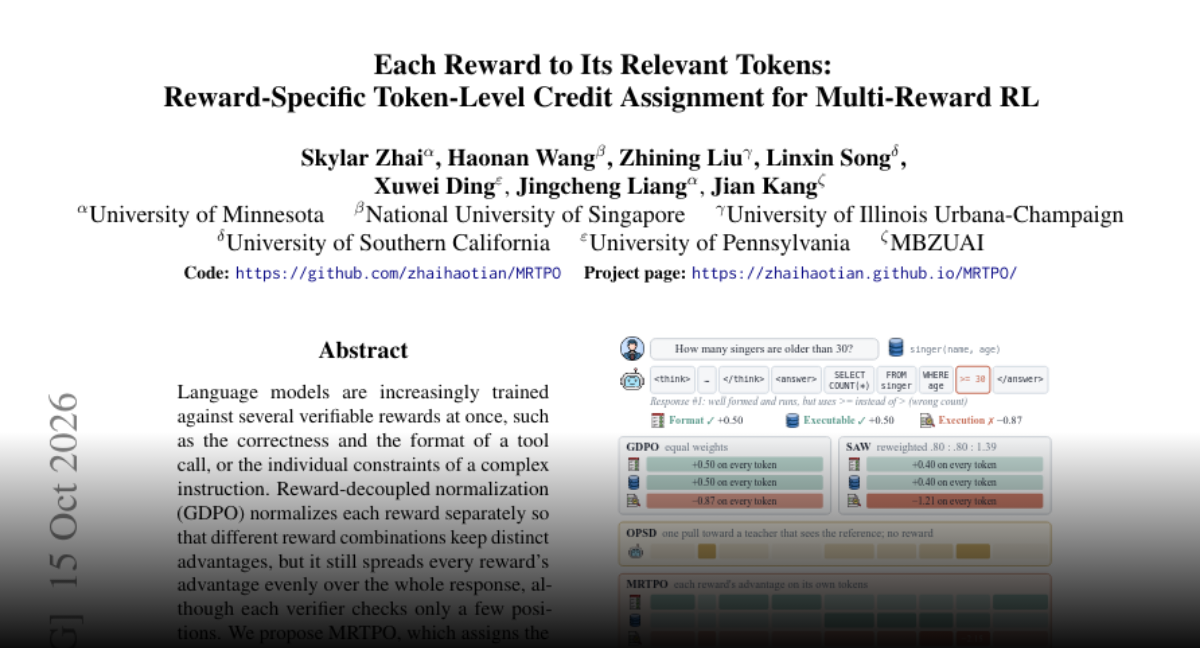
MRTPO assigns each RL reward to the tokens it evaluates

MRTPO assigns each RL reward to the tokens it evaluates

MRTPO proposes more precise credit assignment when language models optimize several verifiable rewards at once. Instead of spreading each reward across an entire response, it uses the information inspected by that reward's verifier to estimate token relevance. The method compares distributions with and without verifier information, requiring neither auxiliary models nor token labels. The authors report faster convergence and better results on text to SQL, instruction constraints, and tool calling than their comparison methods.

02

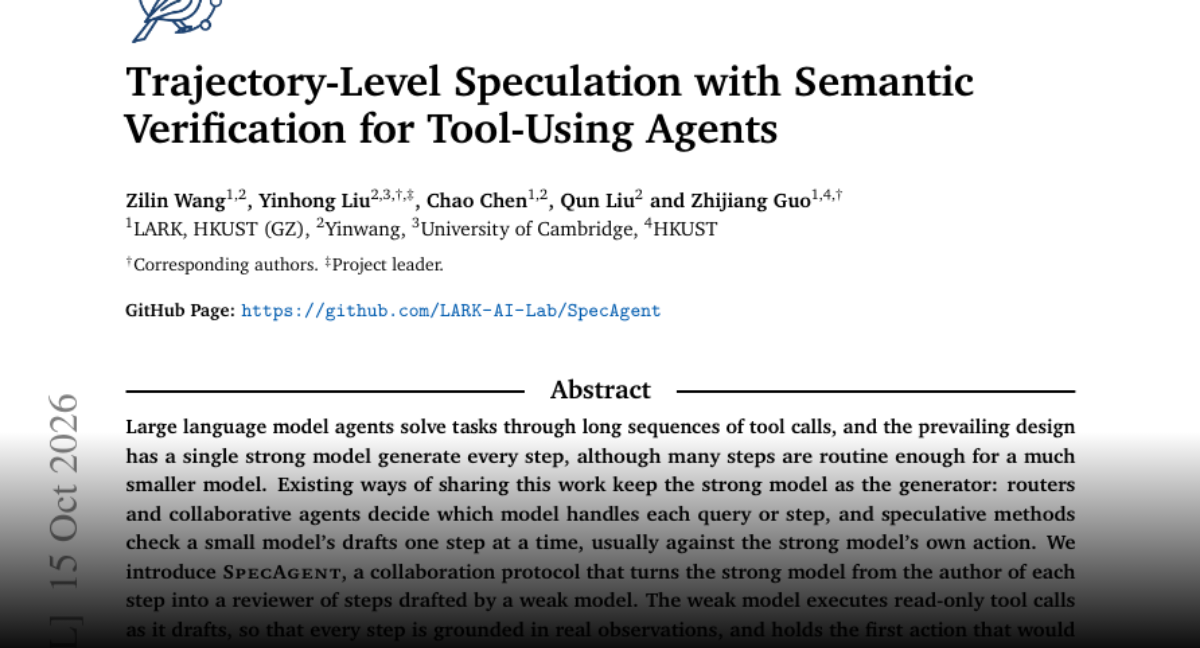
SpecAgent makes strong models review grounded tool trajectories

SpecAgent makes strong models review grounded tool trajectories

SpecAgent uses a smaller model to draft sequences of tool operations and a stronger model to review them together. The draft model may execute read only calls, but holds actions that would change the environment for verification. The stronger model accepts the valid prefix and repairs the first rejected step. The authors report near strong model success on one benchmark while roughly halving wall time and memory traffic, suggesting a practical efficiency route for tool agents.

03

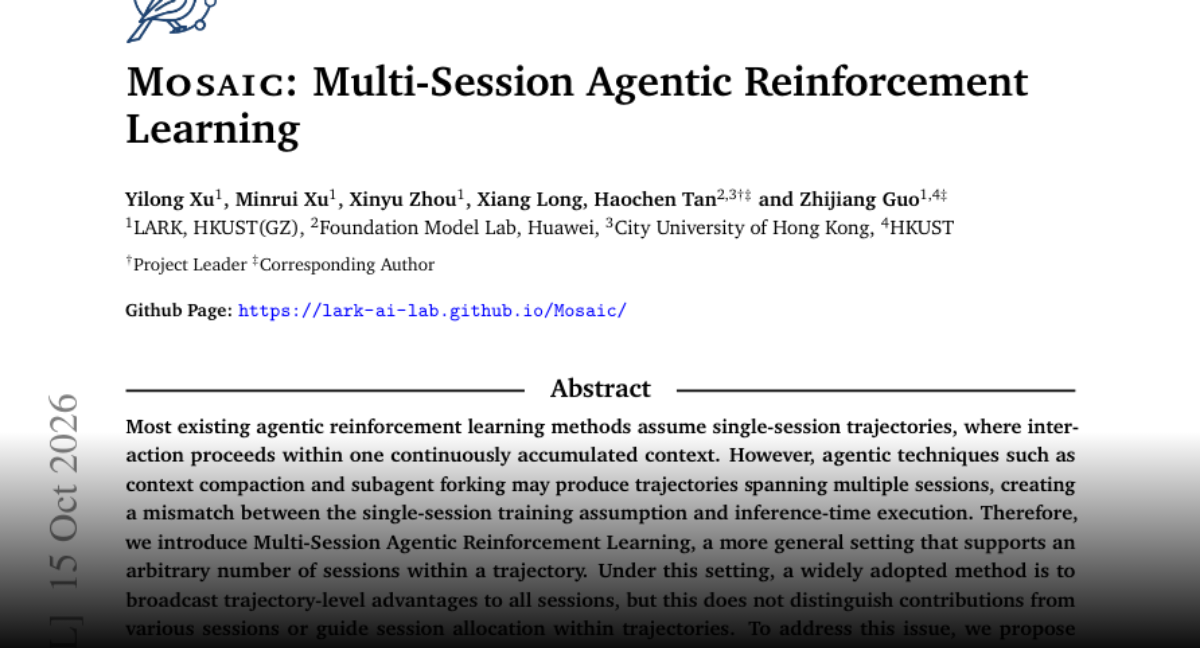
Mosaic trains agents across compaction and subagent sessions

Mosaic trains agents across compaction and subagent sessions

Mosaic addresses the mismatch between single session reinforcement learning and agents that compact context or fork subagents. Its hierarchical optimization accounts for session usage at the trajectory level and estimates each session's marginal contribution when assigning advantages. In BrowseComp experiments with Qwen3.5 4B, the authors report better performance than broadcasting the same trajectory advantage to every session, while using fewer sessions. The work treats context management and delegation as trainable resource allocation decisions.

04

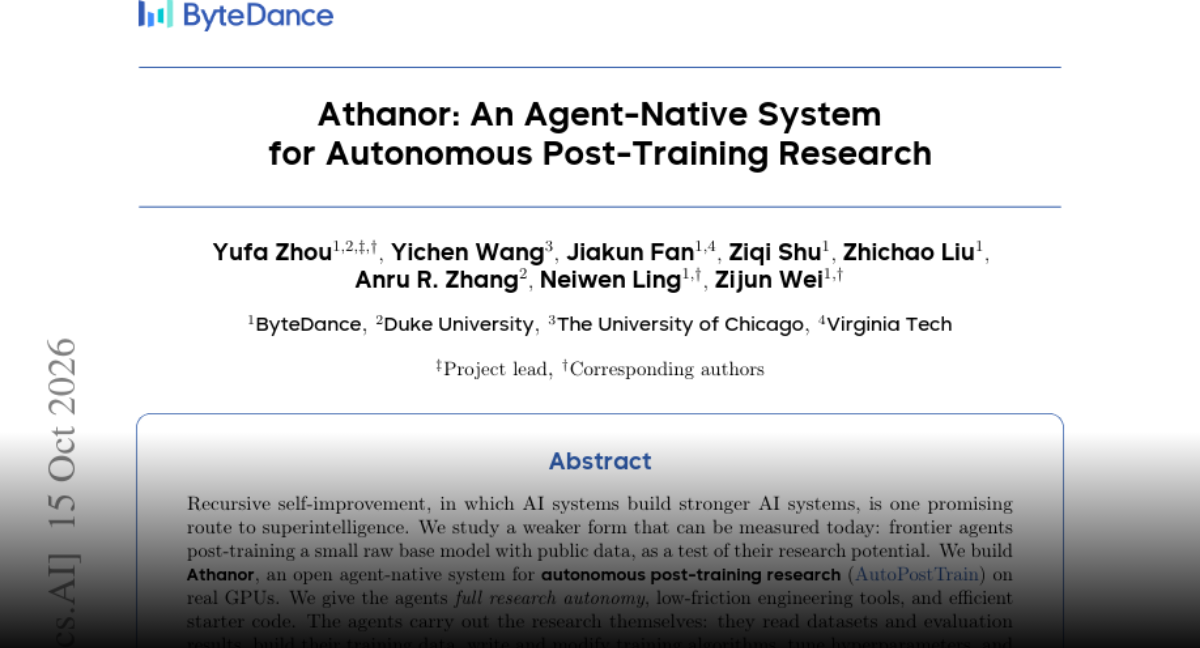
Athanor tests autonomous post-training research on real GPUs

Athanor tests autonomous post-training research on real GPUs

Athanor provides an open system for agents to conduct post training research with managed GPU jobs, decontaminated data, and frozen evaluation. In a reported 104 hour campaign, four Claude Opus 5.5 agents improved Qwen3 4B Base to averages slightly above the official instruct model on development and held out suites. The agents recombined known techniques, including supervised tuning, reinforcement learning, and merging. This is a bounded research demonstration, not evidence of unrestricted recursive improvement.

05

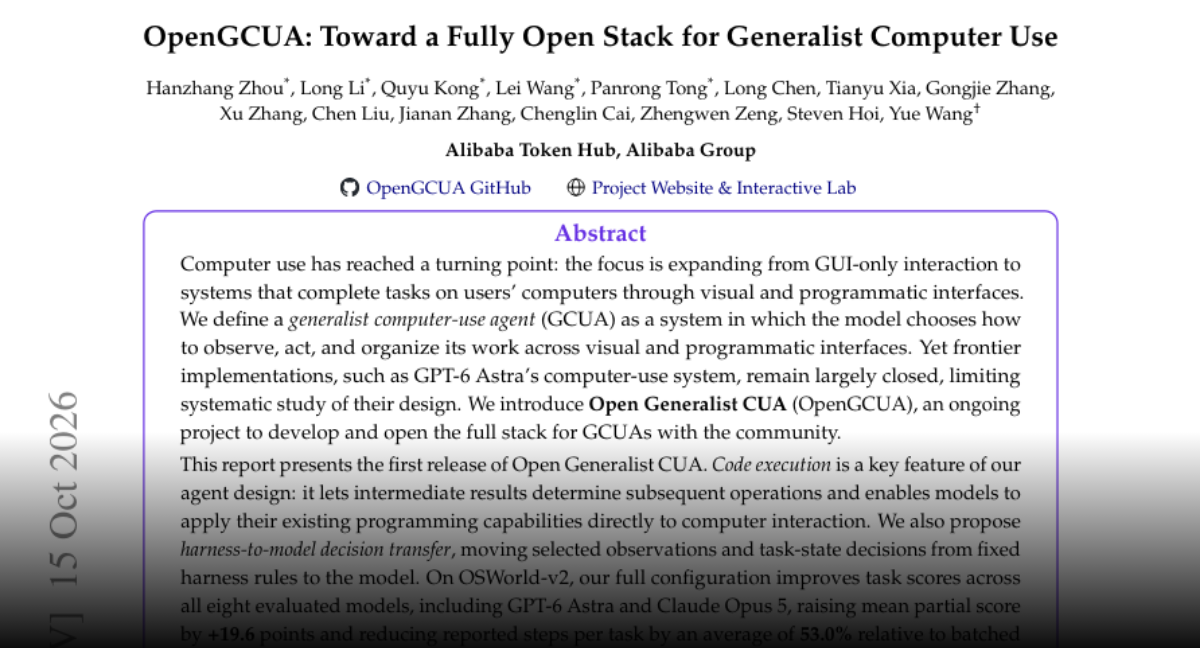
OpenGCUA combines visual and programmatic computer use

OpenGCUA combines visual and programmatic computer use

OpenGCUA releases a computer use stack in which models can choose visual or programmatic interaction and manage more task decisions themselves. Its authors report that the full configuration improves OSWorld v2 scores for all eight evaluated models, raising mean partial score by 19.6 points and reducing reported steps by 53 percent relative to batched GUI only execution. Released artifacts include implementation, prompts, and trajectories, with preliminary real device and cross device tooling.

06

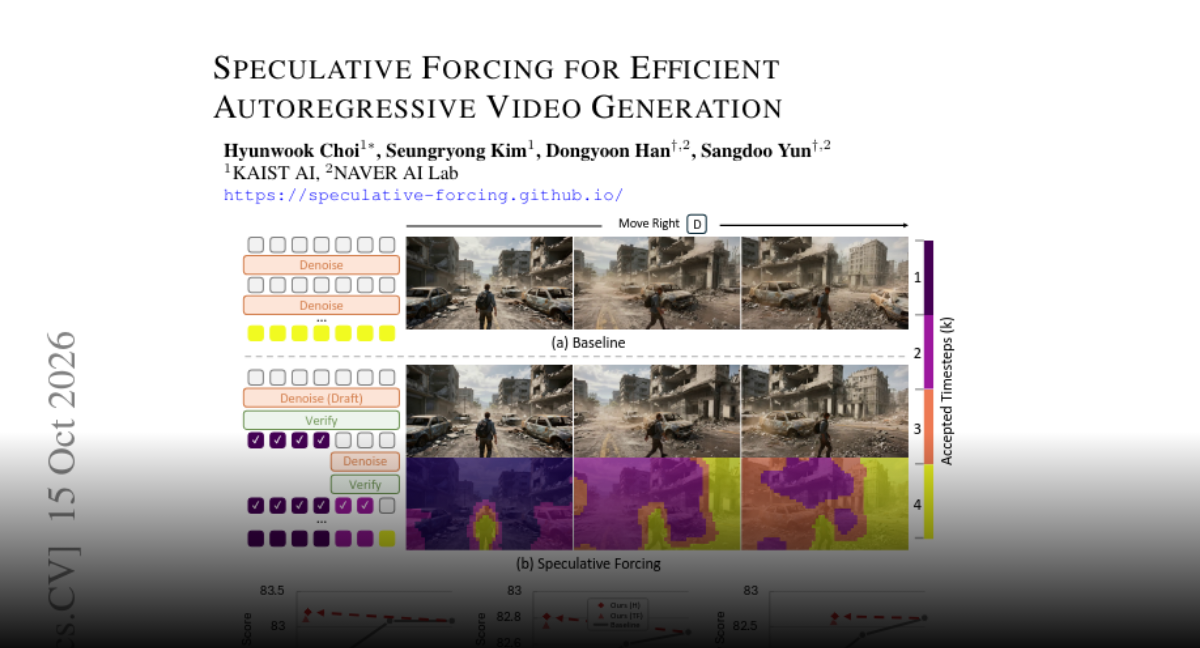
Speculative Forcing skips unnecessary video denoising

Speculative Forcing skips unnecessary video denoising

Speculative Forcing reduces video generation work by accepting individual tokens before every denoising step finishes. Accepted tokens remain available as context while later computation focuses on tokens needing more refinement. The paper studies both a training free verifier and a learned verifier. Its authors report more than 1.5 times speedup on LongLive with similar quality, and 1.35 times on Lingbot World 2.0, pointing toward more responsive streaming and interactive video generation.

07

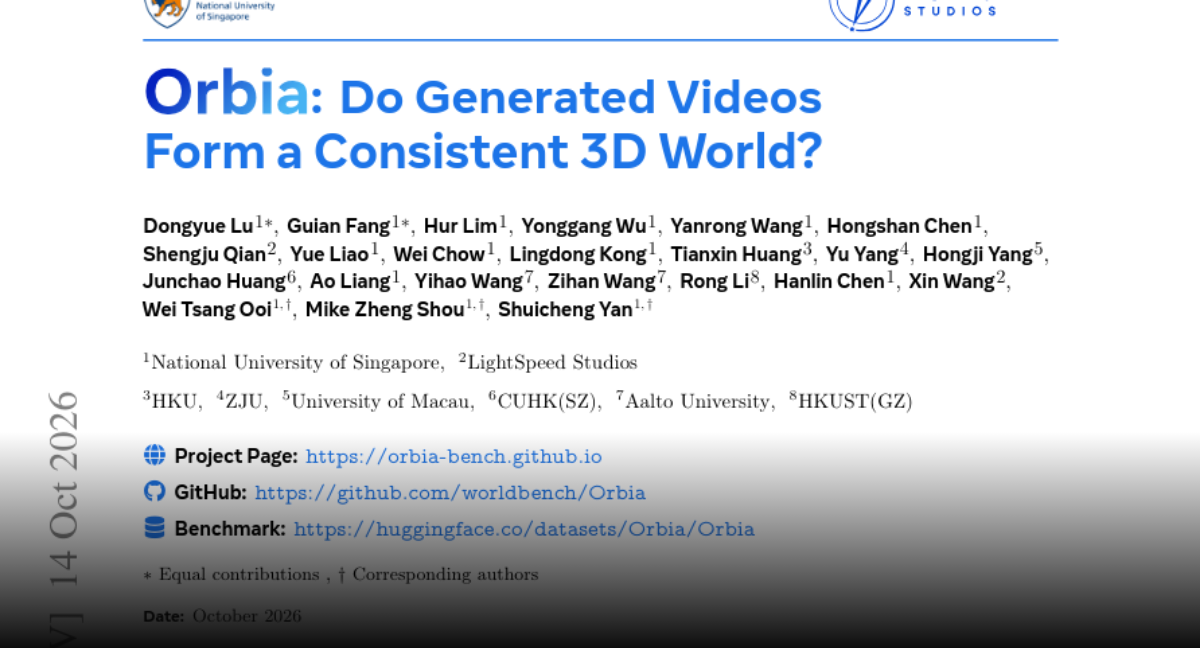
Orbia measures whether generated video worlds remain consistent

Orbia measures whether generated video worlds remain consistent

Orbia introduces a benchmark for three dimensional consistency in interactive video world models. Its 720 instances and six exploration and revisit protocols evaluate input preservation, persistence of newly generated content, and consistency across viewpoints. The study covers 27 models using their native interaction interfaces. By checking geometry and revisits as well as appearance, the benchmark targets a gap between visually convincing frames and a world that stays coherent when an observer moves through it.