NO/FOMO

Independent AI signal, once a day

The AI briefing worth opening.

ISSUE DATE2026-10-19DEFAULT EDITION
This issue
—
All time
—

AI Blog

2 stories
01

Anthropic proposes a growing public-benefit equity fund

Anthropic proposes a growing public-benefit equity fund

Anthropic says it will commit 5% of its shares to a wholly owned Public Benefit Fund, subject to stockholder approval. An additional 2% may be added at the board’s discretion for each 50% increase above a valuation baseline. The LLC structure permits different forms of giving, including potential worker support. Governance details are still forthcoming, so the announcement establishes a proposed mechanism rather than evidence of completed distributions.

02

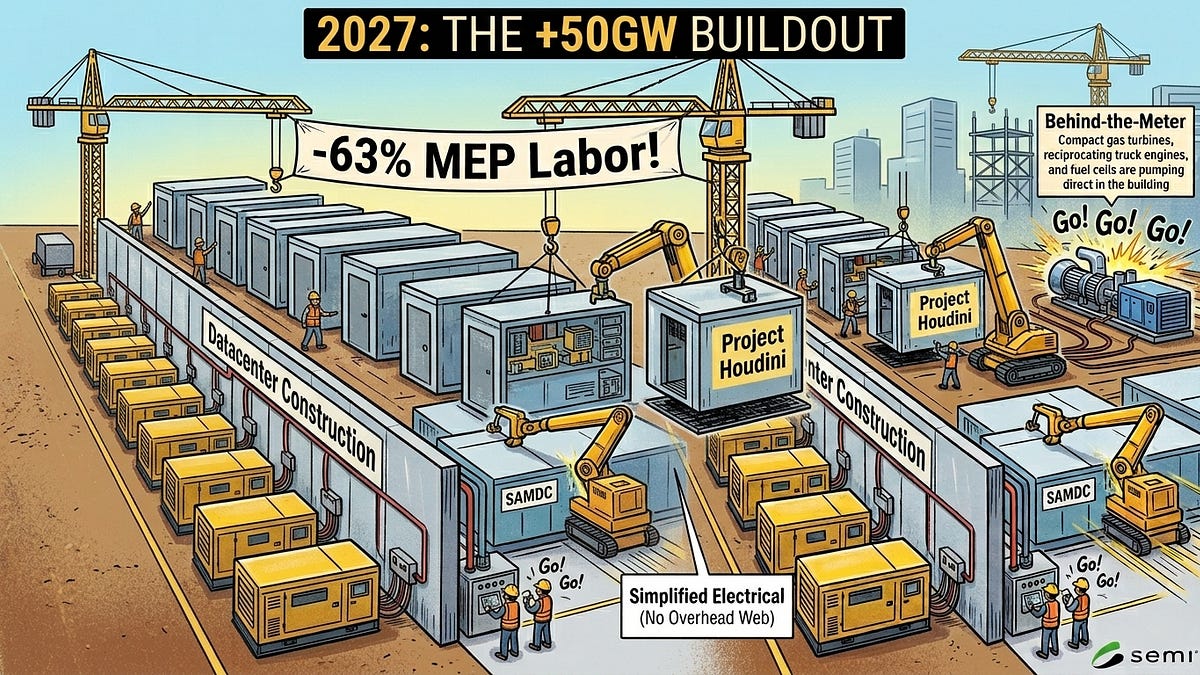
SemiAnalysis forecasts a sharp acceleration in datacenter capacity

SemiAnalysis forecasts a sharp acceleration in datacenter capacity

SemiAnalysis argues that datacenter expansion could accelerate sharply in 2027, projecting an additional 50 gigawatts in a single year. Its published synopsis cites 60 gigawatts under construction and 1.3 trillion in lease contracts signed year to date, while suggesting the bottleneck could shift toward chips. These are the publication’s forecasts and indicators, not confirmed delivered capacity. The analysis makes infrastructure availability a central variable in assessing future AI deployment costs.

Hacker News

6 stories
01

Report links AI-agent intrusions to more than 100 websites

Report links AI-agent intrusions to more than 100 websites

The Verge reports that security researchers uncovered an operator using AI agents to compromise more than 100 websites, with Reuters identifying John Deere, SharkNinja and Cummins among affected organizations. Company responses describe different scopes: John Deere reported no indication of sensitive information access, while SharkNinja said a standalone support site was affected. The incident highlights how agent orchestration can scale intrusion activity, while the impact still requires case-by-case verification.

02

Mistral brings compact foundation models to time-series forecasting

Mistral brings compact foundation models to time-series forecasting

Mistral’s Timestral family targets probabilistic multivariate forecasting with models ranging from 5 million to 209 million parameters. Its announcement reports leading results on GIFT-Eval, TIME and fev-bench, with support for past and known-future covariates and CPU inference. Published on October 15 and discussed prominently today, the release expands foundation-model applications beyond language. Teams can evaluate it for forecasting workloads where uncertainty estimates, domain adaptation and deployment cost matter.

03

CERN and Mistral plan a foundation model for collider physics

CERN and Mistral have signed a statement of intent for a long-term AI research partnership. Their proposed Large Physics Model would learn from billions of simulated proton collisions and support reconstruction, particle identification and other scientific tasks. The October 15 announcement gained attention on Hacker News today. It describes a research ambition, not a deployed model, and could test whether shared representations improve a workflow now served by specialized algorithms.

04

Laminar launches a specialized model for silent agent failures

Laminar introduced flow-1, a model trained with reinforcement learning to investigate agent traces for errors that may not appear as failed tool calls. Its Signals harness treats trace spans as searchable files and returns structured findings that can be clustered into recurring problems. The company reports matching GPT-6-sol detection quality at 23 times lower cost on its own benchmark. Independent evaluation would be needed to establish how broadly those results transfer.

05

Google Research releases recursive agent-harness optimization

Google Research releases recursive agent-harness optimization

Google Research’s Harness² refines the system around an agent while keeping model weights fixed. It proposes harness changes, probes their effects on a task and combines evidence into an improved configuration, then retains lessons for future tasks. The repository reports gains across professional-work benchmarks and supports OpenCode and Codex executors. Its contribution is an explicit optimization loop for prompts, memory, tools and orchestration, with evaluation conditions important to interpreting the reported improvements.

06

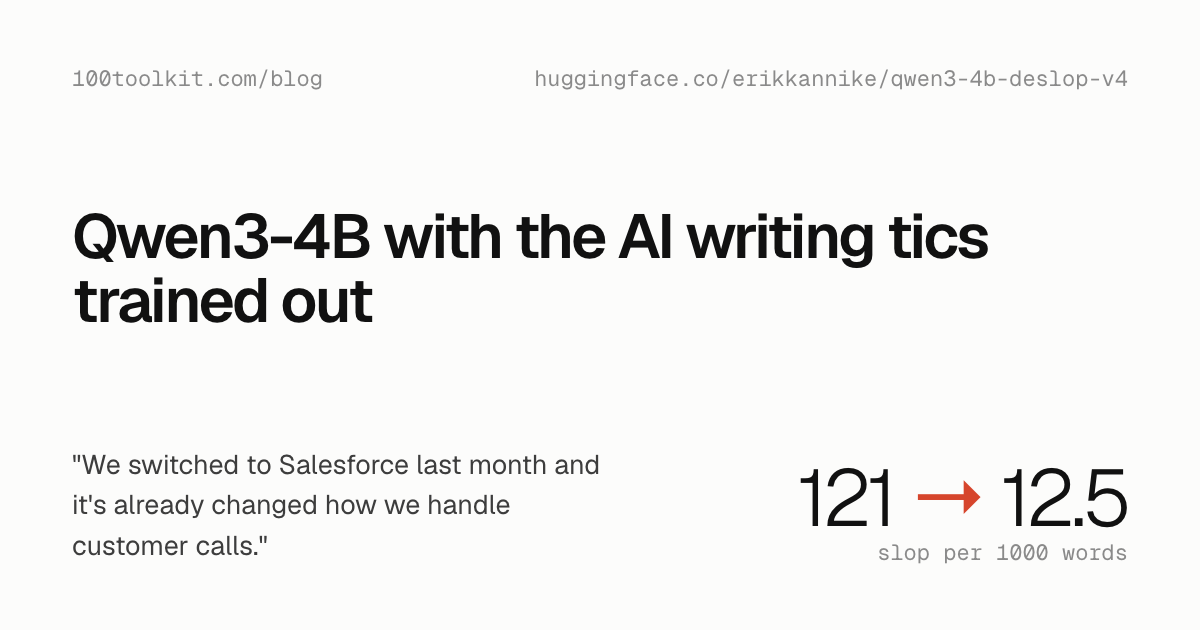
Small Qwen fine-tune targets formulaic AI prose

Small Qwen fine-tune targets formulaic AI prose

A developer released a Qwen3-4B fine-tune designed to reduce recognizable assistant writing habits without a special system prompt. On 40 held-out prompts, the author reports a large reduction in a custom style score, while noting that earlier iterations damaged task adherence. The final recipe filters for both style and task fit. Remaining hallucinations, flat prose and limited evaluation make this a useful small-model experiment rather than a general solution to writing quality.

Twitter

7 stories
01

Google demonstrates a desk-photo-to-game agent workflow

Google demonstrates a desk-photo-to-game agent workflow

Google demonstrated Gemini 4 Argon coordinating subagents, Blender MCP and Nano Banana to turn a photograph of a physical desk into a playable three-dimensional track. The example connects visual understanding, tool orchestration and asset creation in one workflow. It is a product demonstration rather than a controlled benchmark, but offers a concrete picture of how multimodal agents can assemble interactive artifacts from everyday scenes and external creative tools.

02

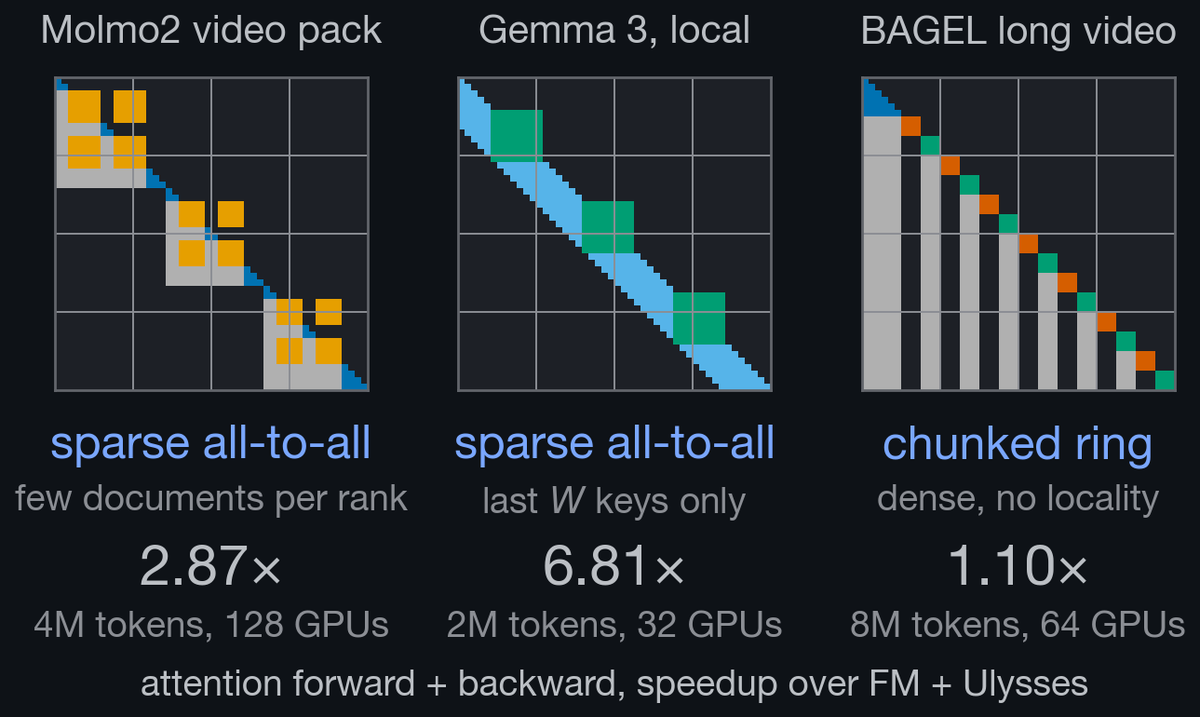
Luma highlights exact sequence parallelism for multimodal training

Luma highlights exact sequence parallelism for multimodal training

Luma highlighted a sequence-parallel approach for packed multimodal attention masks that chooses among ring attention, sparse all-to-all communication and Ulysses on a per-layer basis. The post reports matching single-GPU numerics and beating a FlashMask plus Ulysses hybrid in 47 of 48 cases on up to 128 H100 GPUs. These reported results suggest communication strategy can materially affect large multimodal training efficiency without changing the intended numerical computation.

03

Thomas Wolf points to FLUX derivatives as an open-model adoption signal

Thomas Wolf says FLUX.1-dev is the most built-upon model on the Hugging Face Hub, with about 43,000 derivatives. He contrasts Europe’s roughly 8% share of open-model training compute with about 18% of downstream building activity. The figures are presented as ecosystem observations rather than a standardized economic measurement. They suggest that reuse and derivative creation can reveal influence that raw training expenditure or headline model rankings do not capture.

04

Pika demonstrates camera-motion editing inside ChatGPT

Pika demonstrates camera-motion editing inside ChatGPT

Pika demonstrated Camera Director adding cinematic camera movements to an existing clip from within ChatGPT, including an orbit or slow push-in. The company says the original performance remains unchanged. The demonstration points toward conversational access to specific video-editing operations, rather than requiring users to rebuild an entire scene. Production usefulness will depend on how reliably movement edits preserve subjects and performances across varied footage, which this short post does not establish.

05

Nathan Lambert flags a gap between coding strength and everyday planning

Nathan Lambert reports that using current models for slides, coherent plans and longer content design leaves him less convinced that general intelligence is imminent. His observation contrasts strong coding and machine-learning assistance with less dependable performance in other knowledge-work settings. This is practitioner commentary, not a benchmark result. It is useful context for teams deciding whether success in software tasks transfers to presentation design, planning and sustained editorial work.

06

Sara Hooker argues innovation is shifting beyond pretraining

Sara Hooker argues innovation is shifting beyond pretraining

Sara Hooker argues that apparent transformer saturation is shifting research attention from major pretraining gains toward post-training and inference-time computation. She characterizes many recent pretraining improvements as changes to data recipes rather than large capability jumps. The post offers a research perspective rather than evidence that pretraining has literally ended. For practitioners, it frames a useful question: which improvements come from base-model learning, and which emerge from adaptation or additional computation at use time?

07

Thomas Wolf turns alignment notes into an educational game prototype

Thomas Wolf turns alignment notes into an educational game prototype

Thomas Wolf described asking Claude to turn a brainstorming document about alignment into a game inspired by Zelda. He framed the experiment through the adaptive educational book imagined in The Diamond Age. The post provides a concrete example of using coding assistance to translate technical ideas into an interactive teaching format. It does not establish learning outcomes, but illustrates a direction for personalized educational software built around source material supplied by its author.

GitHub

2 stories
01

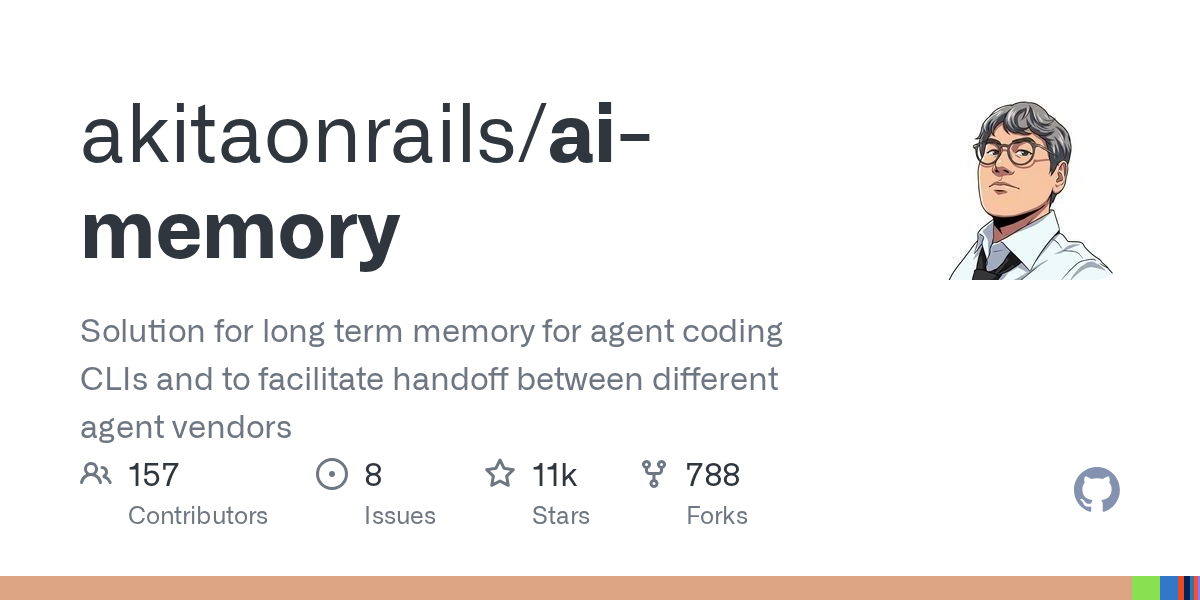
AI Memory targets persistence across coding-agent vendors

AI Memory targets persistence across coding-agent vendors

The trending ai-memory repository describes a Rust-based solution for long-term memory in coding-agent command-line tools and handoff between vendors. That scope addresses a practical problem: useful task context can be stranded when developers switch assistants or start a new session. The collected repository description does not establish compatibility coverage or measured reliability. It is worth examining as infrastructure for continuity, with particular attention to what state is retained and how it is restored.

02

ComfyUI remains a modular foundation for generative media workflows

ComfyUI remains a modular foundation for generative media workflows

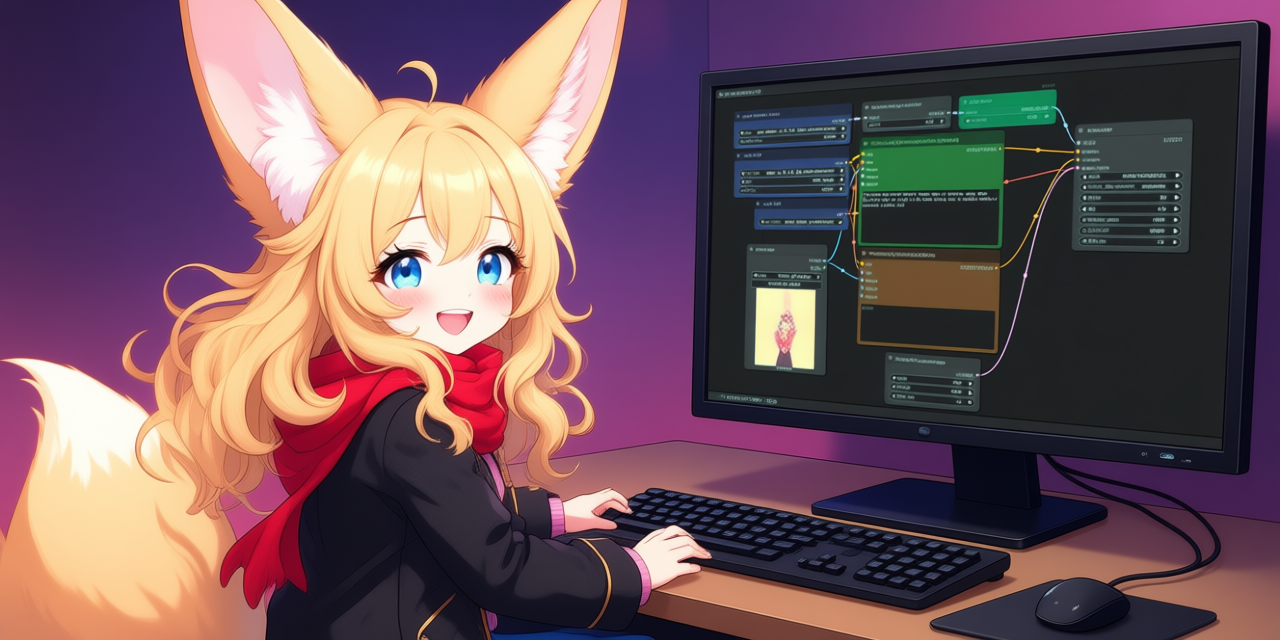
ComfyUI appeared among the collected trending repositories as a modular interface, API and backend for diffusion-model workflows. Its graph-based approach lets users express generation pipelines as connected nodes, making it relevant to teams assembling repeatable creative processes. The repository’s description includes a strong inference-speed claim, but the collection provides no comparative benchmark to validate it. The practical value is its programmable workflow structure rather than any unverified performance superlative.

HF HuggingFace

7 stories
01

HexaShell tests coding agents as robot controllers

HexaShell tests coding agents as robot controllers

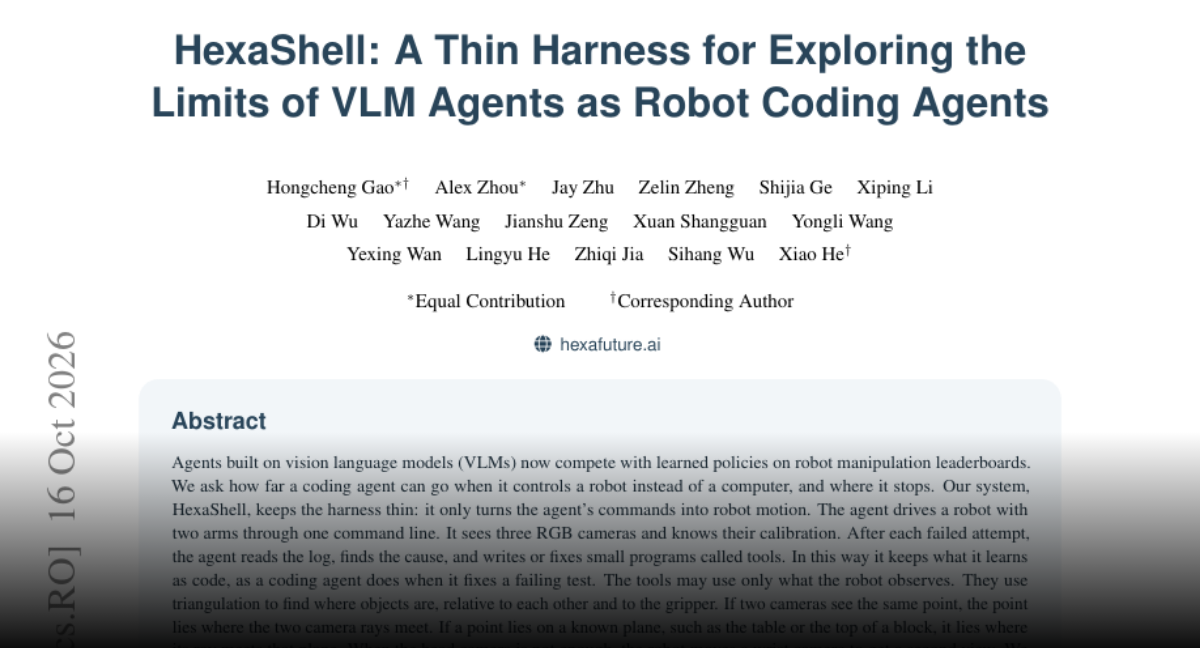
HexaShell uses a thin harness to translate a vision-language coding agent’s commands into robot motion. The agent learns reusable tools from failed attempts and uses calibrated camera observations for geometry. The paper reports 39.7% success across 42 RoboDojo tasks, with much stronger pushing than tight insertion. Its findings locate a major limitation in contact-rich execution, showing that recognizing a failure and reasoning about it do not automatically produce a successful physical maneuver.

02

PPMem gives video world models compact planar memory

PPMem gives video world models compact planar memory

PPMem augments a video diffusion transformer with persistent three-dimensional memory represented by planes. Each generated chunk jointly predicts video and geometry, then updates memory that conditions later chunks through rendered depth. The paper reports a roughly five-megabyte full-scene representation and stronger video quality on two datasets. Its appeal is explicit, compact scene structure that can preserve consistency across viewpoint changes while also producing useful depth, normals and exportable surfaces.

03

Whole-file selection beats compression in a coding-agent study

Whole-file selection beats compression in a coding-agent study

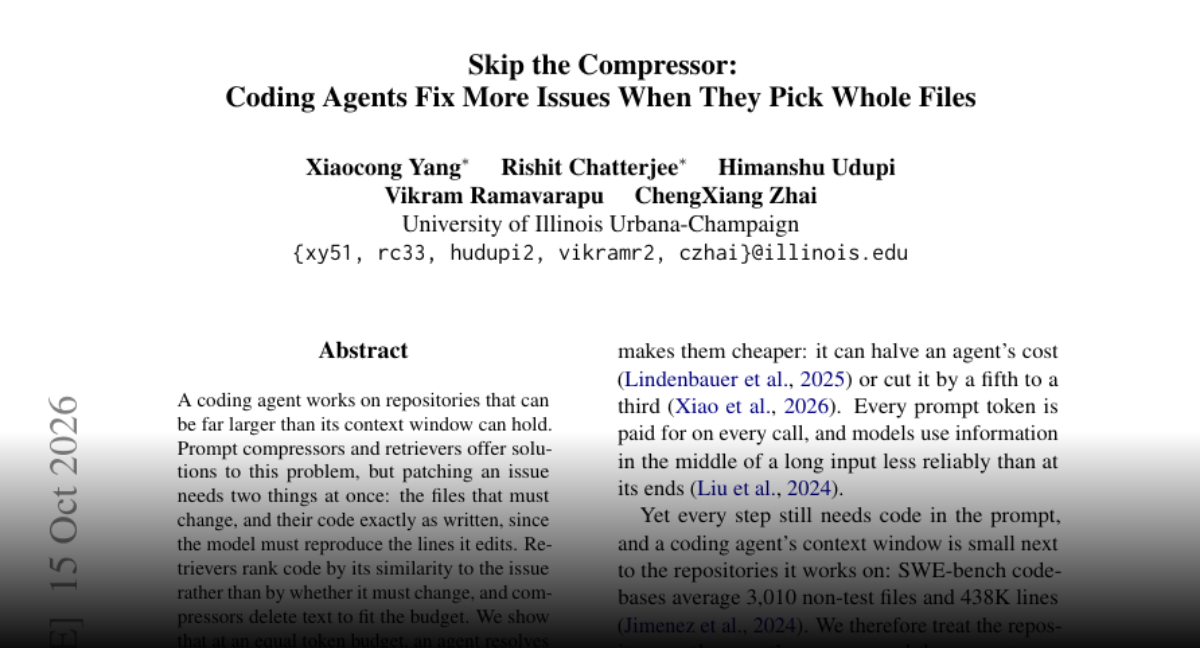
A study of 300 SWE-rebench issues compares context strategies under equal per-issue token budgets. Its CQ2-CARE selector preserves chosen files verbatim and reports better resolution rates than tested compressors and retrievers with two models. The authors attribute failures to missing edit targets or altered source text that prevents patches from applying. The result argues for measuring context usefulness by successful repository edits, rather than treating maximum compression as the primary objective.

04

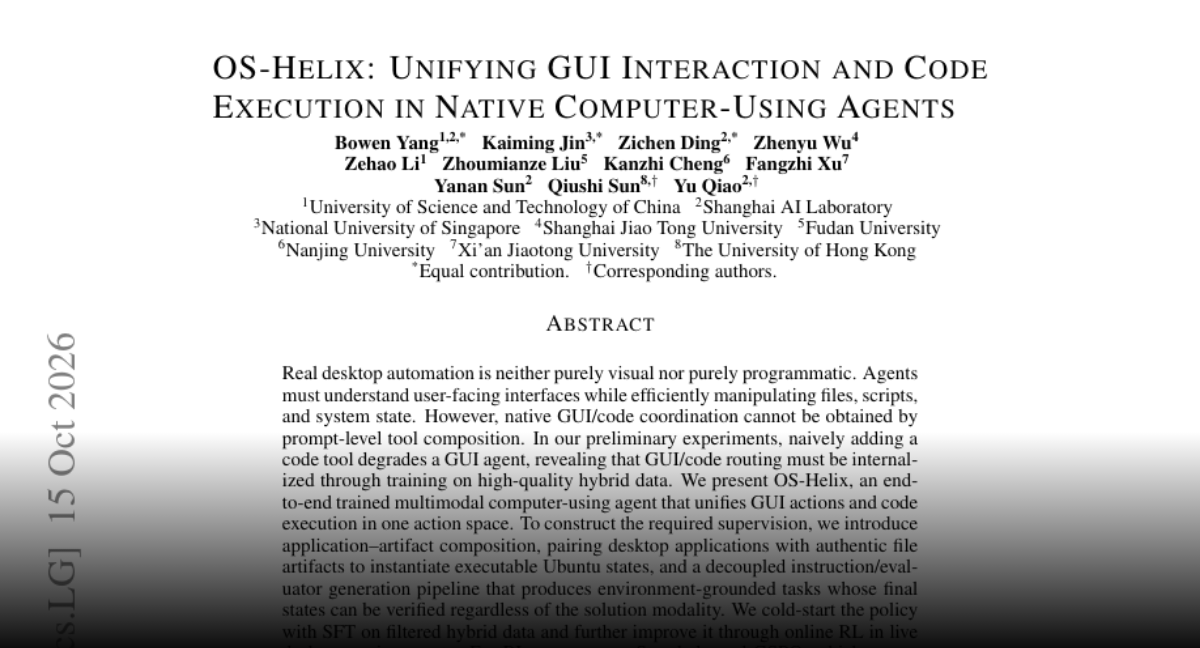
OS-Helix trains coordinated GUI and code execution

OS-Helix trains coordinated GUI and code execution

OS-Helix trains a computer-using agent to coordinate graphical actions and code execution within a shared action space. The authors report that simply adding code tools can degrade an existing GUI agent, motivating hybrid supervision and reinforcement learning. Their step-balanced optimization prevents long code actions from dominating the training objective. The strongest reported variant reaches 66.44% success on OSWorld-Verified, making coordination policy an important part of the system rather than an incidental tool choice.

05

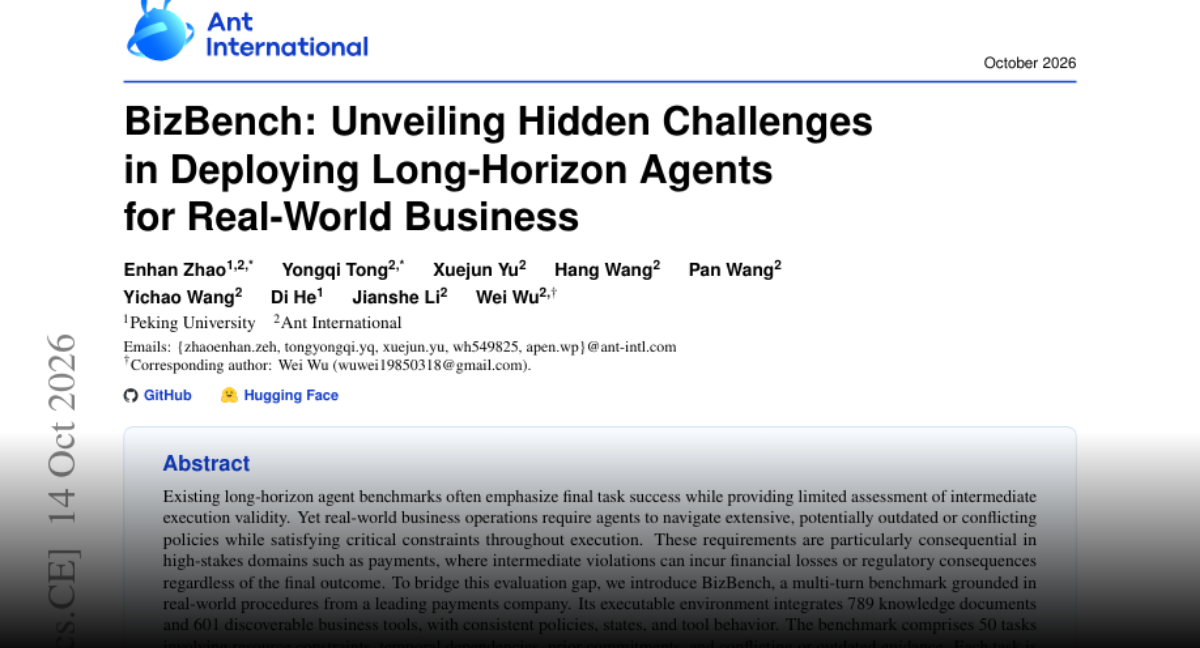
BizBench checks whether business agents obey constraints along the way

BizBench checks whether business agents obey constraints along the way

BizBench evaluates long-horizon agents against both final goals and valid intermediate execution in simulated business procedures. Its environment contains 789 documents, 601 discoverable tools and 50 tasks involving constraints, dependencies and conflicting guidance. The paper reports strict success rates of 64.0% and 61.3% for its two leading models. The gap between goal attainment and valid execution shows why a seemingly correct outcome may conceal costly process violations in business automation.

06

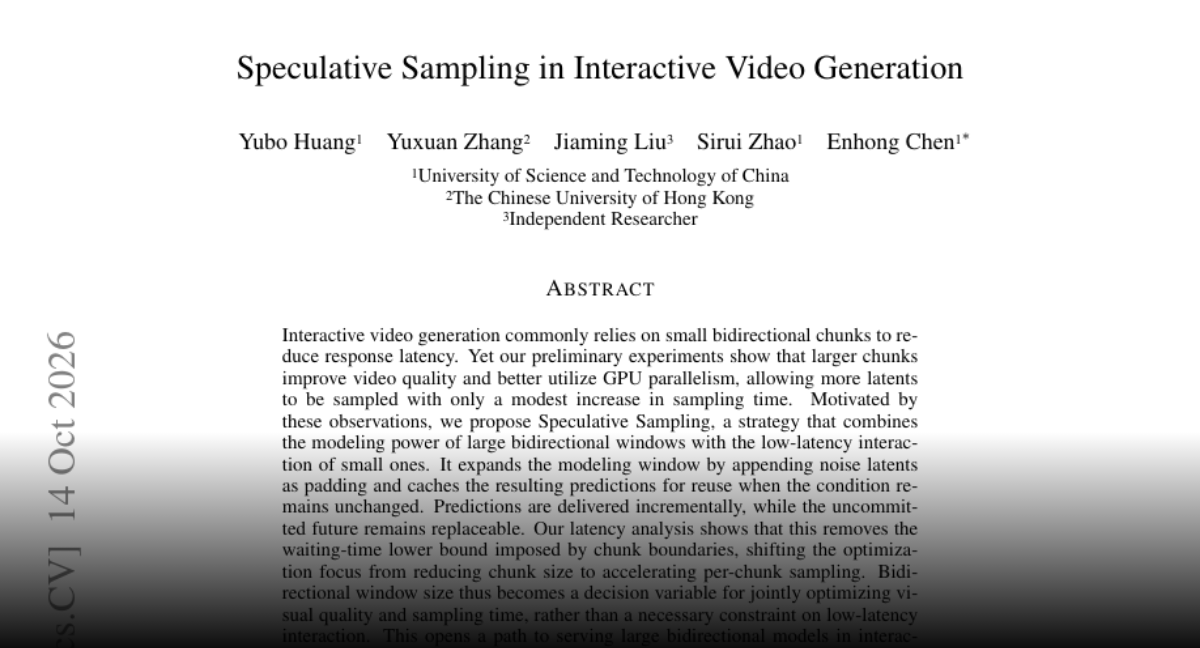
Speculative sampling explores responsive video generation with larger windows

Speculative sampling explores responsive video generation with larger windows

A new paper proposes speculative sampling for interactive video generation, combining larger bidirectional modeling windows with incremental delivery. It appends noise latents, caches predictions while conditions remain unchanged and leaves the uncommitted future replaceable. The authors argue that this removes a waiting-time bound imposed by chunk boundaries. The approach reframes the quality-latency tradeoff around sampling speed and reusable predictions, although the abstract does not establish a universal production performance improvement.

07

CarryOn organizes long-running agent context around reusable task state

CarryOn organizes long-running agent context around reusable task state

CarryOn replaces repeated processing of interaction history with reusable task objects, execution context and a short tail of recent interactions. It updates affected records against evidence and environment checks while preserving unaffected state. The paper reports better results on OSWorld 2.0 and BrowseComp-Plus alongside token reductions of 51.9% and 22.9%. The central idea is to preserve actionable progress directly, reducing the cost of reconstructing it from a compressed narrative.