NO/FOMO

Independent AI signal, once a day

The AI briefing worth opening.

ISSUE DATE2026-10-20DEFAULT EDITION
This issue
—
All time
—

AI Blog

1 story
01

OpenAI expands coding evaluations for low-resource languages

OpenAI’s latest blog post describes efforts to improve ChatGPT on programming languages with less available training material, including new evaluations for software engineering, SQLite and COBOL migration. The focus broadens coding assessment beyond the languages and tasks that dominate public benchmarks. For organizations maintaining legacy systems, the useful question is whether improvements transfer to their own code and migration constraints. The collected overview does not provide enough detail to claim specific performance gains.
Hacker News

6 stories
01

DeepSeek releases DeepInfer, its production inference framework

DeepSeek has released DeepInfer under Apache 2.0, exposing the inference framework behind its large-scale production services. The release supports DeepSeek-V4.1-Flash, optimized kernels, asynchronous scheduling, speculative decoding and structured outputs on NVIDIA SM100 GPUs and Huawei Ascend 950 NPUs. It currently provides offline inference: a complete service still needs a KV cache system, disaggregation and load balancing. That distinction matters for teams assessing how much deployment engineering remains.

02

Mistral launches Voxtral 3 speech models and voice-agent SDK

Mistral introduced Voxtral 3, combining speech recognition, speech generation and a streaming voice-agent SDK with tool calling. Transcription covers more than 50 languages, while speech generation supports more than 35 languages and 50 dialects. Deployment is available through an EU-hosted API or customer infrastructure. Listed prices include $0.0035 per minute for Mini transcription and $13 per million characters for speech generation, making integration and operating cost central to the launch.

03

Google opens TorchTPU for native PyTorch workloads on TPUs

Google opens TorchTPU for native PyTorch workloads on TPUs

Google’s TorchTPU repository provides a PyTorch backend for Tensor Processing Units, with custom ATen kernels, a compilation cache and torch.compile integration. It includes distributed-training support and examples spanning models such as Llama, Qwen and ResNet. The release gives PyTorch users another route to TPU execution while retaining familiar model code. Actual portability and performance depend on operation coverage and workload characteristics, so the examples are starting points for application-specific evaluation.

04

Fake-statistics experiment exposes citation laundering in AI search

Fake-statistics experiment exposes citation laundering in AI search

A Peec AI researcher reports that a site containing 50,000 fabricated statistics continued attracting AI retrieval and citations even after losing Google visibility. The account describes more than 330 referring domains and examples reaching academic and investment research. These are the author’s reported observations, not an independent audit. The case highlights a practical weakness in source-grounded generation: repeated citation can make unsupported numbers appear credible without validating the underlying evidence.

05

Report alleges Grok Bot exposed banking information in a public channel

Report alleges Grok Bot exposed banking information in a public channel

A Techdirt report highlighted on Hacker News alleges that Grok Bot exposed a technology executive’s banking information in a public Slack channel. The available collection establishes the report’s headline, but the article could not be retrieved for further verification. Treat the incident as a reported allegation with unresolved implementation details. Its relevance is the boundary between an agent’s access to private information and its authority to disclose that information in shared destinations.

06

Respan launches a plugin-based Rust AI gateway

Respan introduced an open-source Rust AI gateway built around a small core and plugin interfaces for providers, protocols, modalities and operational features. The team says experience maintaining an increasingly large LiteLLM wrapper motivated the redesign. Plugins can supply capabilities such as routing, fallbacks, observability and redaction without changing the core. The project is explicitly pre-alpha, making interface flexibility the current proposition while production maturity and compatibility still require evaluation.

Twitter

7 stories
01

Anthropic commits 5% of shares to a public-benefit fund

Anthropic commits 5% of shares to a public-benefit fund

Anthropic announced the Anthropic Public Benefit Fund, a wholly owned entity dedicated to public benefit, with an initial commitment of 5% of company shares. The announcement is a material corporate-governance development because it links a defined equity allocation to the company’s public-benefit mission. The collected post also references company-value growth, but is truncated before explaining the mechanism; the initial allocation is the concrete commitment supported by the available text.

02

Anthropic offers free vulnerability scans for critical open source

Anthropic offers free vulnerability scans for critical open source

Anthropic’s developer account announced OSS Scanner, offering critical open-source projects free, periodic vulnerability scans using its strongest models. Findings include a proof of concept and, where possible, a patch. The release brings AI security analysis closer to maintainer workflows by pairing discovery with evidence and remediation. The announcement does not establish universal coverage or elimination of false positives; maintainers still need to assess each reported issue and proposed change.

03

Claude explores protein binders against scorpion neurotoxins

Claude explores protein binders against scorpion neurotoxins

Anthropic highlighted early research using Claude to design protein binders against scorpion neurotoxins. The company frames the work around a treatment-access problem: scorpions sting about 1.2 million people annually, while antivenoms can be expensive or scarce. This is an exploratory application of AI to therapeutic design, rather than evidence of an available medicine. The important next questions concern experimental validation, effectiveness and whether promising designs can translate into practical treatments.

04

Google demonstrates Gemini 4 Argon building an interactive periodic table

Google demonstrates Gemini 4 Argon building an interactive periodic table

Google DeepMind demonstrated a three-dimensional periodic table built with Gemini 4 Argon in Antigravity and synchronized to Tom Lehrer’s song The Elements. The scene includes orbiting electrons, atomic data and light spectra. It is a concrete example of combining code generation, animation and educational presentation in one artifact. As a vendor demonstration, it illustrates a workflow rather than establishing general reliability across arbitrary graphics or scientific visualization tasks.

05

Luma Style Match applies reference art direction while preserving composition

Luma Style Match applies reference art direction while preserving composition

Luma described a Style Match workflow that starts with a product image and one to four reference images, then restyles the result while preserving the product and composition. The capability targets a familiar creative problem: exploring art direction without rebuilding an already useful layout. The announcement provides a specific interaction pattern, but no comparative evaluation or consistency guarantees, so production users should assess identity preservation on their own products and reference sets.

06

Runway brings its MCP generation tools into Grok Bot

Runway brings its MCP generation tools into Grok Bot

Runway announced that its MCP integration is available in Grok Bot, allowing users to access generation capabilities from the chat interface. The practical change is distribution: creative tools can become callable parts of an existing conversational workflow instead of requiring a separate application session. The post does not specify model versions, pricing or detailed access limits. Those omissions matter when evaluating the integration for repeatable production work rather than a demonstration.

07

Pika adds video-scoring workflow inside ChatGPT

Pika adds video-scoring workflow inside ChatGPT

Pika showcased Soundtrack, a workflow inside ChatGPT that generates music and ambience timed to a video’s action from a single request. The announcement points toward conversational control over post-production tasks that previously required moving between specialized tools. Its concrete promise is synchronized scoring, not a demonstrated replacement for every sound-design workflow. The post supplies no licensing terms or quantitative quality results, leaving those as important checks for commercial creators.

GitHub

2 stories
01

Orca coordinates fleets of coding agents across devices

Orca is an open-source workspace for working with a fleet of coding agents, including Grok Bot and Claude Code. Its repository describes support for users’ existing agent subscriptions and availability across desktop, mobile and remote runtimes. This addresses coordination and access as distinct problems from model capability. The collected description does not establish isolation, concurrency limits or benchmark gains, so teams should evaluate those operational properties before relying on it for shared engineering workflows.

02

Cloudflare security-audit skill structures independently verified findings

Cloudflare’s security-audit-skill repository describes a coding-agent skill for multi-phase security audits with independently verified, machine-readable findings. The design emphasizes how an audit is conducted and how results are recorded, rather than merely asking a model to list possible bugs. It is an older repository surfaced in today’s collection, not a newly dated launch. Its relevance is the growing need for reviewable evidence when integrating agent-generated security findings into engineering processes.

HF HuggingFace

8 stories
01

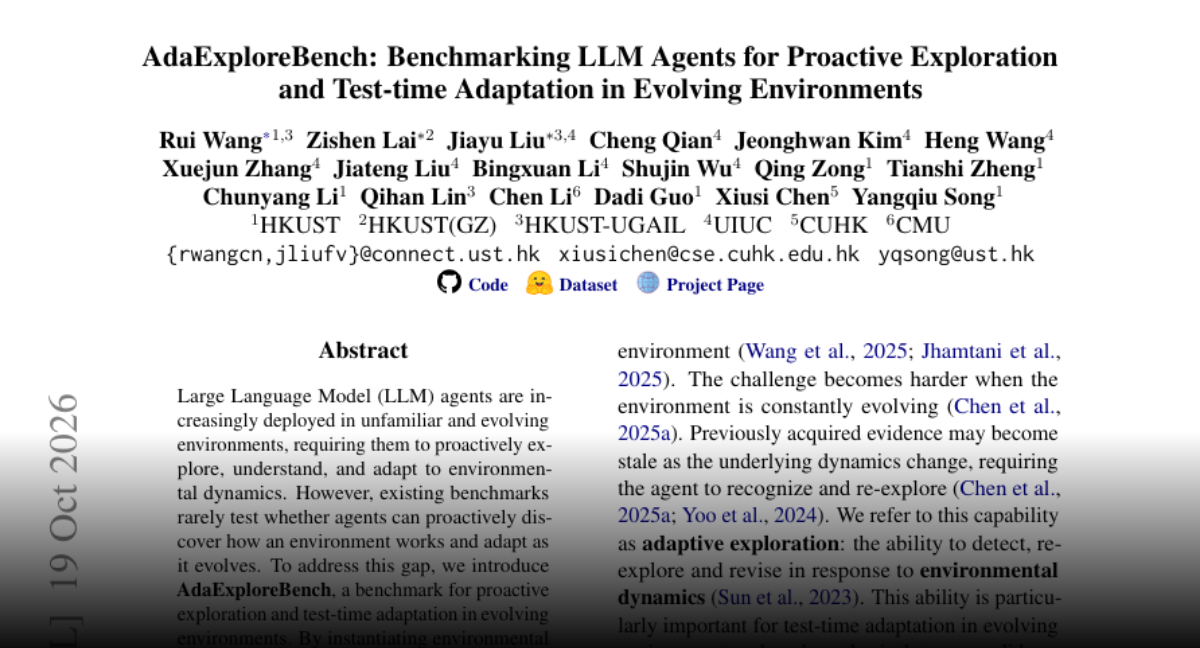
AdaExploreBench tests agents when hidden rules change

AdaExploreBench tests agents when hidden rules change

AdaExploreBench evaluates whether language-model agents can discover hidden environmental rules and recognize when those rules drift without warning. Across eight models, the authors report persistent difficulty with proactive exploration; GPT-6 Sol reaches 61.9% calibrated accuracy. Supplying sufficient evidence or removing drift improves average performance by roughly ten points. The result separates reasoning over available information from the harder operational problem of gathering the right evidence and noticing when it has become stale.

02

Fréchet Forcing extends world-model rollouts beyond short training clips

Fréchet Forcing extends world-model rollouts beyond short training clips

Fréchet Forcing fine-tunes streaming world models using real-data statistics and action-conditioned objectives rather than a long-rollout teacher. The authors report that MiniWorld-1B, pretrained on 253-frame clips, can remain stable beyond 4,000 frames after at most 36 GPU-hours of fine-tuning on 381-frame clips. The method targets accumulated errors when generated history feeds future predictions. Its reported results cover robotic manipulation and camera-controlled exploration, rather than every form of interactive video.

03

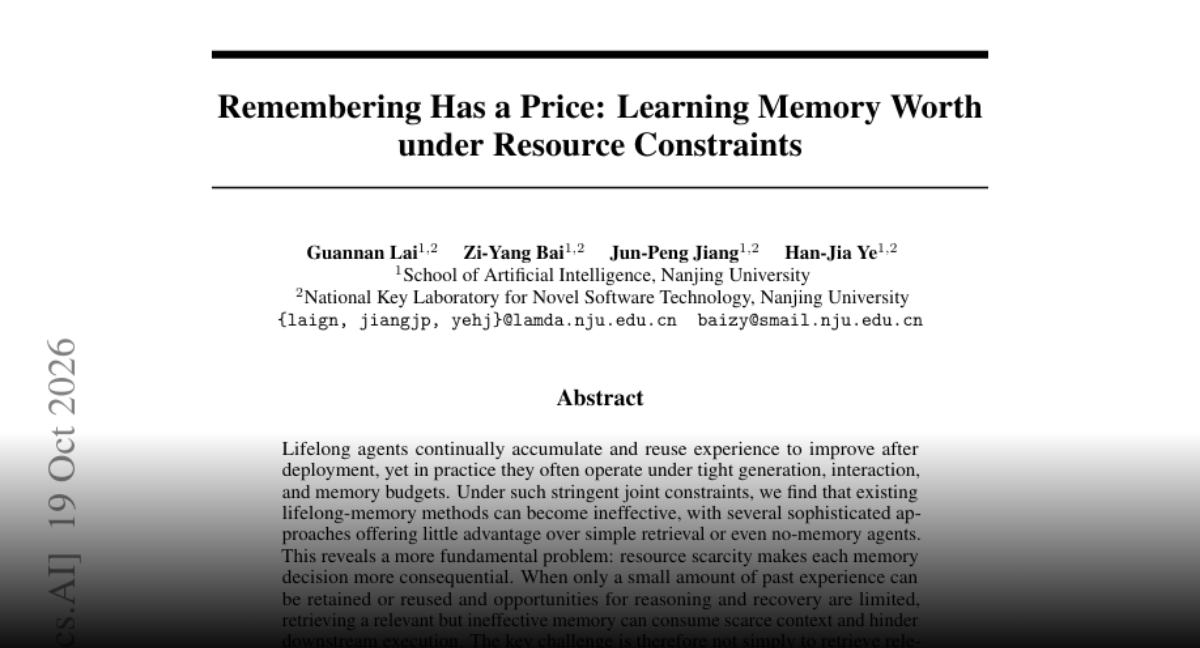
TokenWorth learns which agent memories justify their cost

TokenWorth learns which agent memories justify their cost

TokenWorth treats agent memory as a constrained resource and learns which experiences are worth retaining and retrieving from sparse execution feedback. The authors find that sophisticated memory systems can lose their advantage under simultaneous generation, interaction and storage limits. Across three LifelongAgentBench environments, their method reportedly achieves the best success rate with the fewest output tokens among evaluated approaches. The practical contribution is selecting useful memory rather than assuming that more stored experience necessarily helps.

04

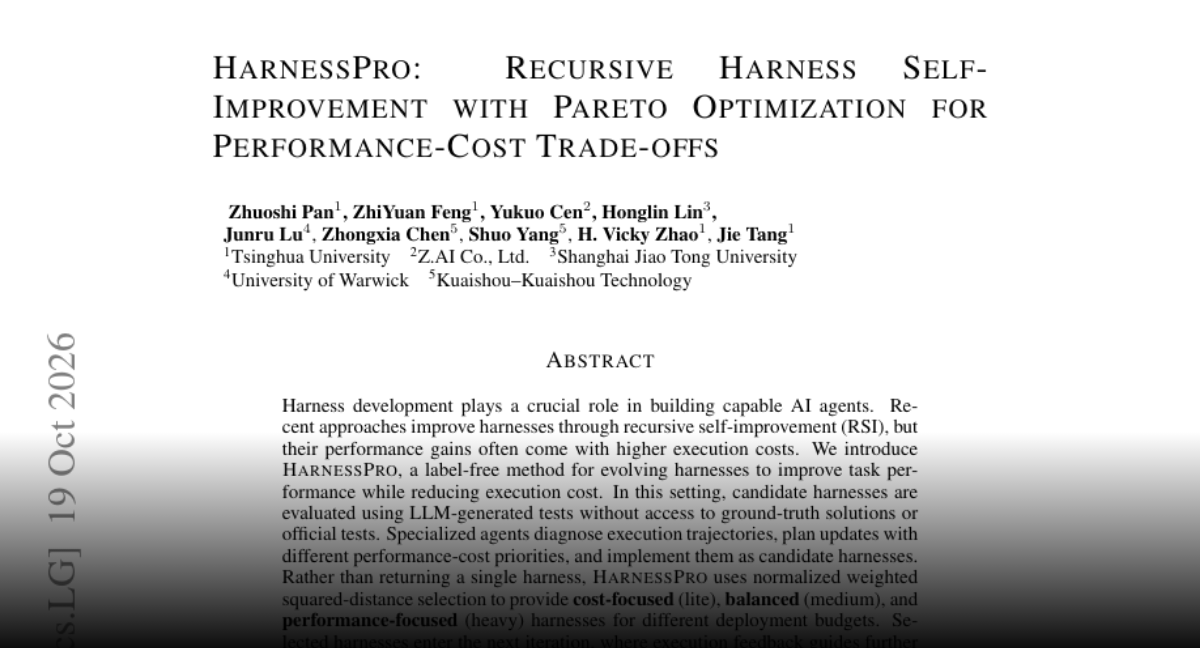
HarnessPro optimizes coding-agent quality and execution cost together

HarnessPro optimizes coding-agent quality and execution cost together

HarnessPro evolves agent harnesses using generated tests and execution feedback, offering lite, medium and heavy configurations for different budgets. The authors evaluate Terminal-Bench 2, SWE-Bench Pro and ProgramBench. With GPT-5.5 and Codex, the heavy configuration reportedly improves average pass rate by two percentage points while reducing per-task cost by 26.1% relative to RHO. These are benchmark-specific findings, but they make deployment cost an explicit objective of recursive harness improvement.

05

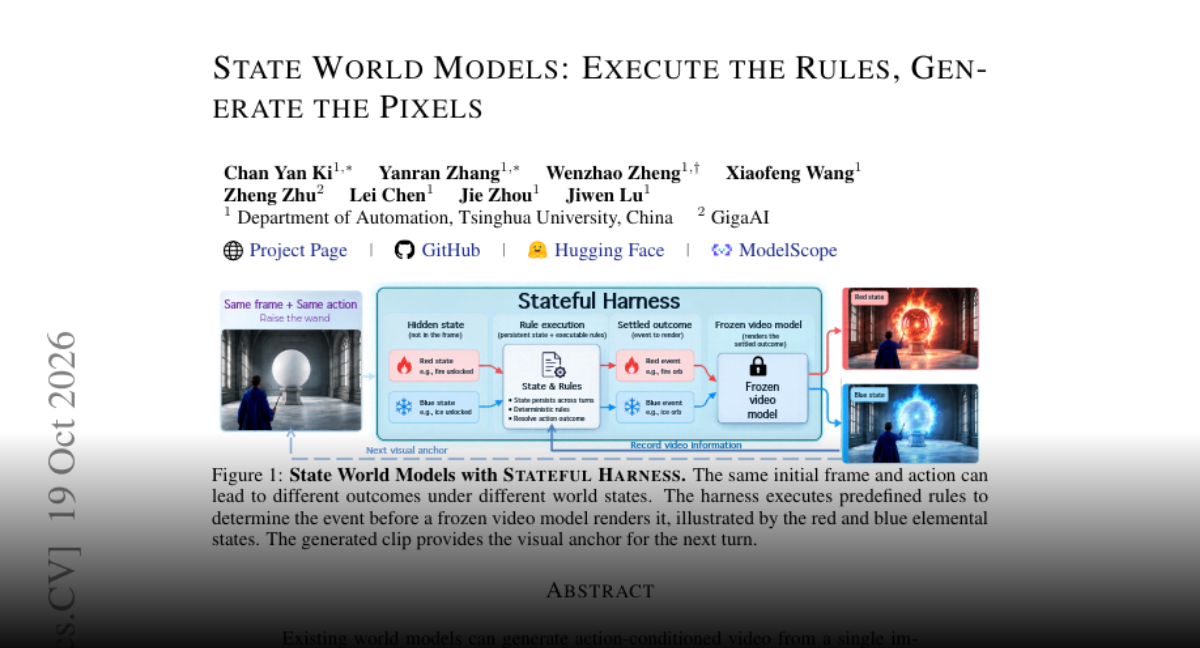
Stateful Harness separates world rules from generated video

Stateful Harness separates world rules from generated video

Stateful Harness maintains explicit world state and resolves actions before asking a frozen video model to render the resulting events. Its WorldState-Bench uses 50 counterfactual pairs with identical starting images and actions but different hidden states. For MiniMax-H3, the authors report required endings in 92% of pairs with the full harness, compared with 32% under rule-only prompting. The result supports testing persistent rules separately from the visual plausibility of generated worlds.

06

OpenVLHarness combines visual tools with persistent multimodal evidence

OpenVLHarness combines visual tools with persistent multimodal evidence

OpenVLHarness connects visual reasoning models to heterogeneous tools through a capability layer and persistent multimodal memory. Images, structured data and web references remain addressable while generated code combines tool results. Across 22 benchmarks and eight backbones, the authors report average improvements of 9.7 to 12.6 points over matched no-tool baselines. The work argues that better access to usable evidence can matter more than simply increasing a model’s internal reasoning budget.

07

Study finds safety scores can reflect labeling policy more than capability

Study finds safety scores can reflect labeling policy more than capability

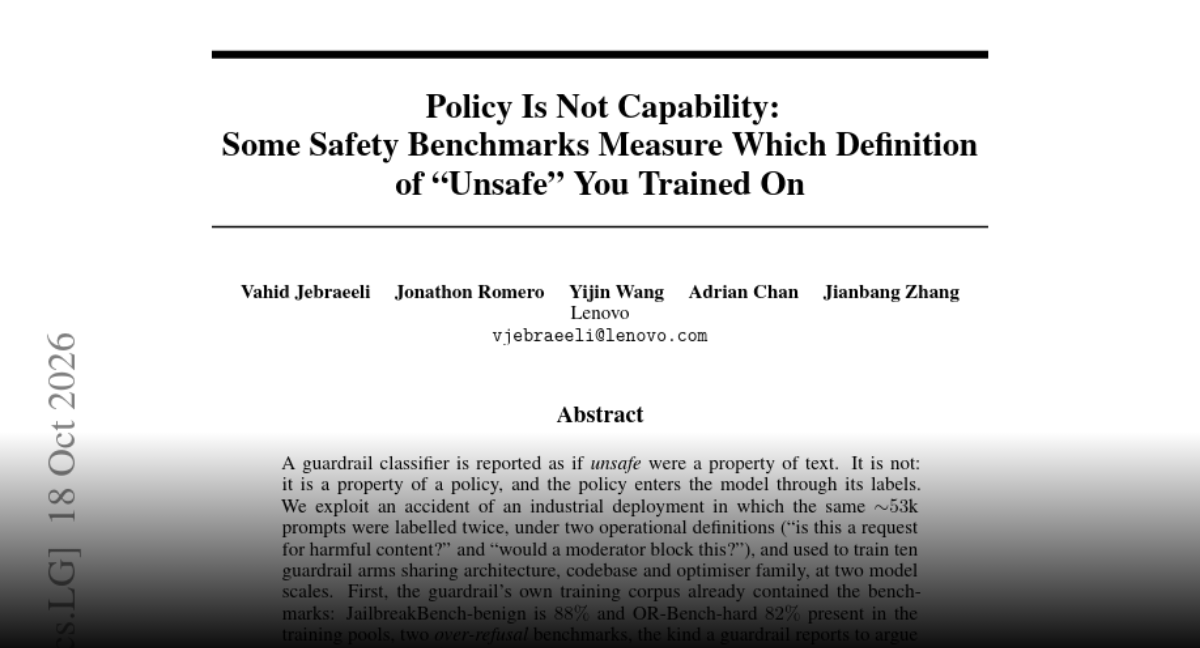
A guardrail study examines models trained on the same prompts under two different definitions of unsafe content. After addressing benchmark contamination, the authors find that some safety scores vary sharply with labeling policy despite shared architectures and training machinery. They also show that a small parameter update can move selected benchmark scores across their range. The paper argues for reporting policy definitions, contamination and seed variability alongside aggregate safety metrics before comparing systems.

08

InfiniDream generates editable procedural 3D worlds

InfiniDream generates editable procedural 3D worlds

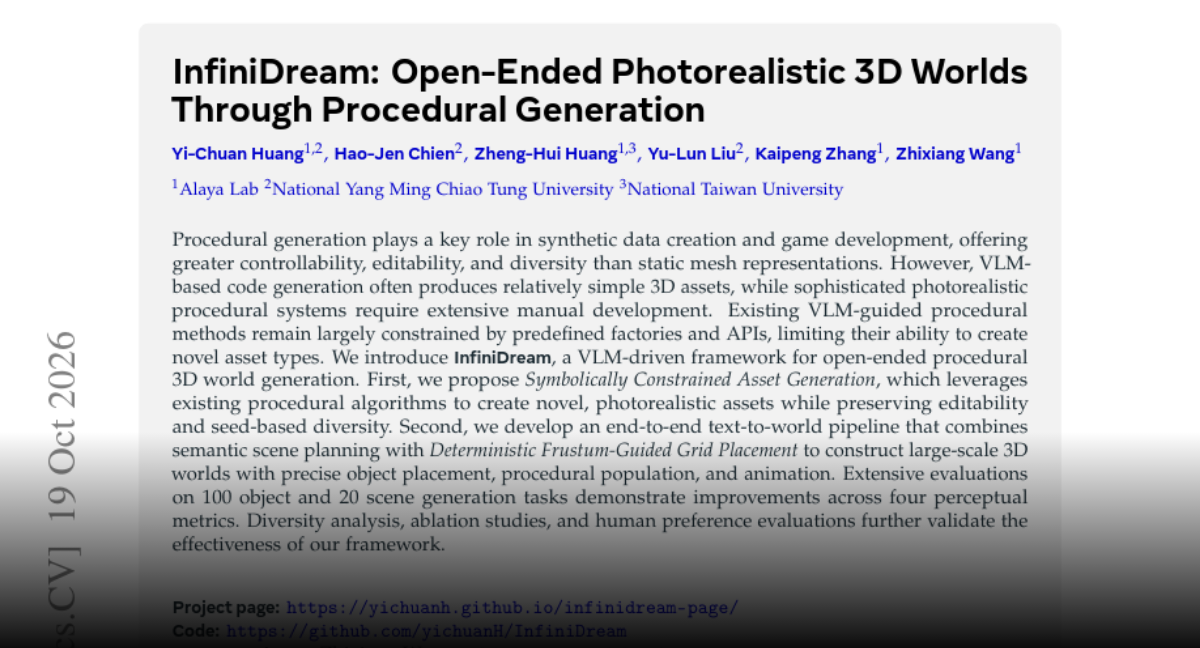
InfiniDream uses vision-language models to construct procedural 3D assets and assemble them into large scenes. Symbolic constraints reuse existing generation algorithms while preserving editability and seed-based variation; scene planning and guided placement organize the resulting worlds. The authors evaluate 100 object tasks and 20 scene tasks, reporting improvements across four perceptual metrics and human-preference checks. The approach is relevant to synthetic data and game development where reusable procedural structure matters alongside visual appearance.