NO/FOMO

Independent AI signal, once a day

The AI briefing worth opening.

ISSUE DATE2026-10-26ENGLISH EDITION
This issue
—
All time
—

AI Blog

2 stories
01

Anthropic files for a proposed IPO

Anthropic files for a proposed IPO

Anthropic announced that it has filed an S-1 registration statement with the US Securities and Exchange Commission for a proposed initial public offering. Its accompanying announcement on X says the registration statement has not yet become effective. This is a filing milestone rather than a completed offering. The development puts a major frontier AI company’s proposed public listing at the center of today’s industry news.
02

Fanatics reports higher engagement with OpenAI-assisted shopping

OpenAI published a customer story describing how Fanatics uses its technology for Shop the Look, helping fans assemble game-day outfits. Testing across roughly 30,000 MLB products reportedly showed 10 percent higher engagement. This is a vendor-published customer result, rather than an independently audited business outcome. It offers a concrete application of AI in product discovery, with engagement as the stated metric rather than conversion or revenue.

Hacker News

4 stories
01

Ubicloud examines tool-call accuracy in vLLM

Ubicloud examines tool-call accuracy in vLLM

An engineering article from Ubicloud focuses on fixing tool-call accuracy in vLLM and attracted discussion on Hacker News. The collected listing identifies the serving stack and the reliability problem but does not include the article’s implementation details. For agent developers, the topic matters because successful tool use depends on the inference path as well as the model. Changes to serving behavior deserve task-level validation before rollout.

02

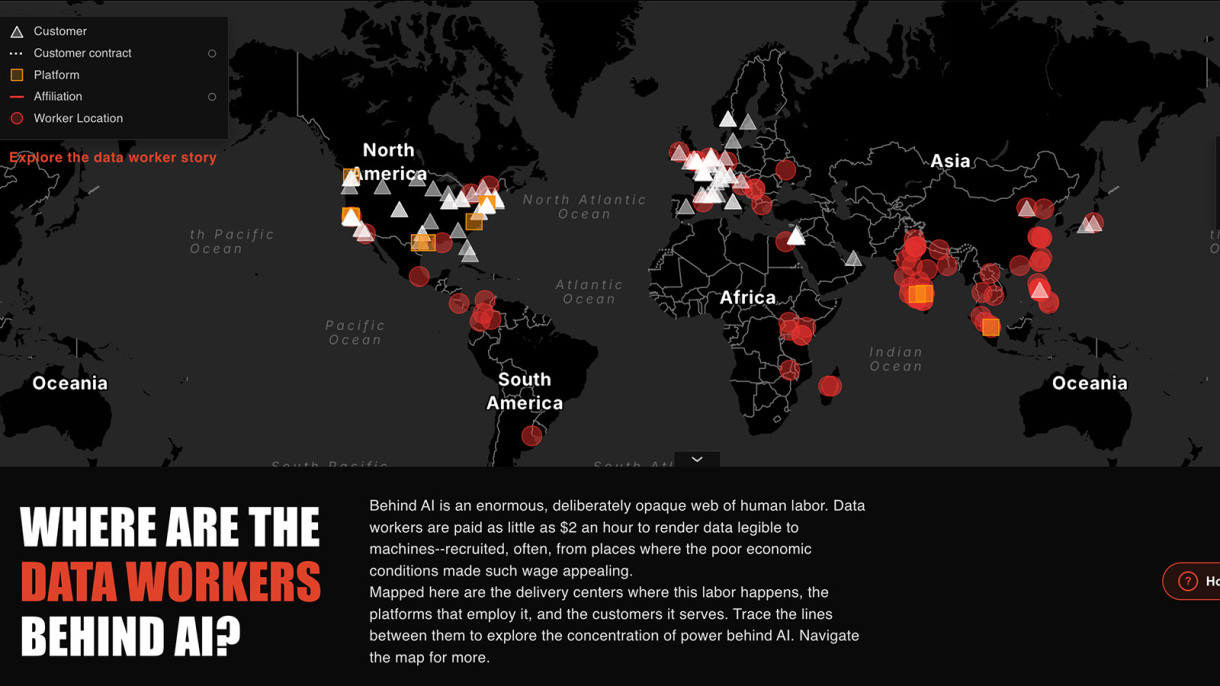
Brown research maps the labor behind AI

Brown research maps the labor behind AI

Brown University published a story about a student mapping the hidden global labor that powers AI. The item brings the people supporting AI production into a news cycle often dominated by model capabilities and capital spending. The collected listing does not provide the study’s methods or numerical findings. Its relevance is the visibility of human work within AI supply chains, an important context for claims about automation.

03

PaperPilot brings a local Rust PDF engine to MCP workflows

PaperPilot brings a local Rust PDF engine to MCP workflows

PaperPilot appeared on Hacker News as a pure-Rust PDF engine offering WebAssembly and Model Context Protocol support without a cloud dependency. The project connects document processing with a standard interface used by AI tools and agents. Its local execution model is relevant to workflows handling documents on the user’s own machine. The listing does not establish extraction accuracy or performance, which would need evaluation on representative PDFs.

04

IBM CEO argues open-weight models are attractive on premises

IBM CEO argues open-weight models are attractive on premises

A Register report about IBM’s CEO arguing that open-weight models have become good and inexpensive for on-premises use drew substantial Hacker News discussion today. The linked article is dated October 22, so this is renewed attention rather than a same-day announcement. The argument adds an enterprise perspective to the open-model debate: model quality, deployment economics, and control over infrastructure all influence purchasing decisions.

Twitter

8 stories
01

Nanbeige 33B draws attention to a broader open-model ecosystem

Nanbeige 33B draws attention to a broader open-model ecosystem

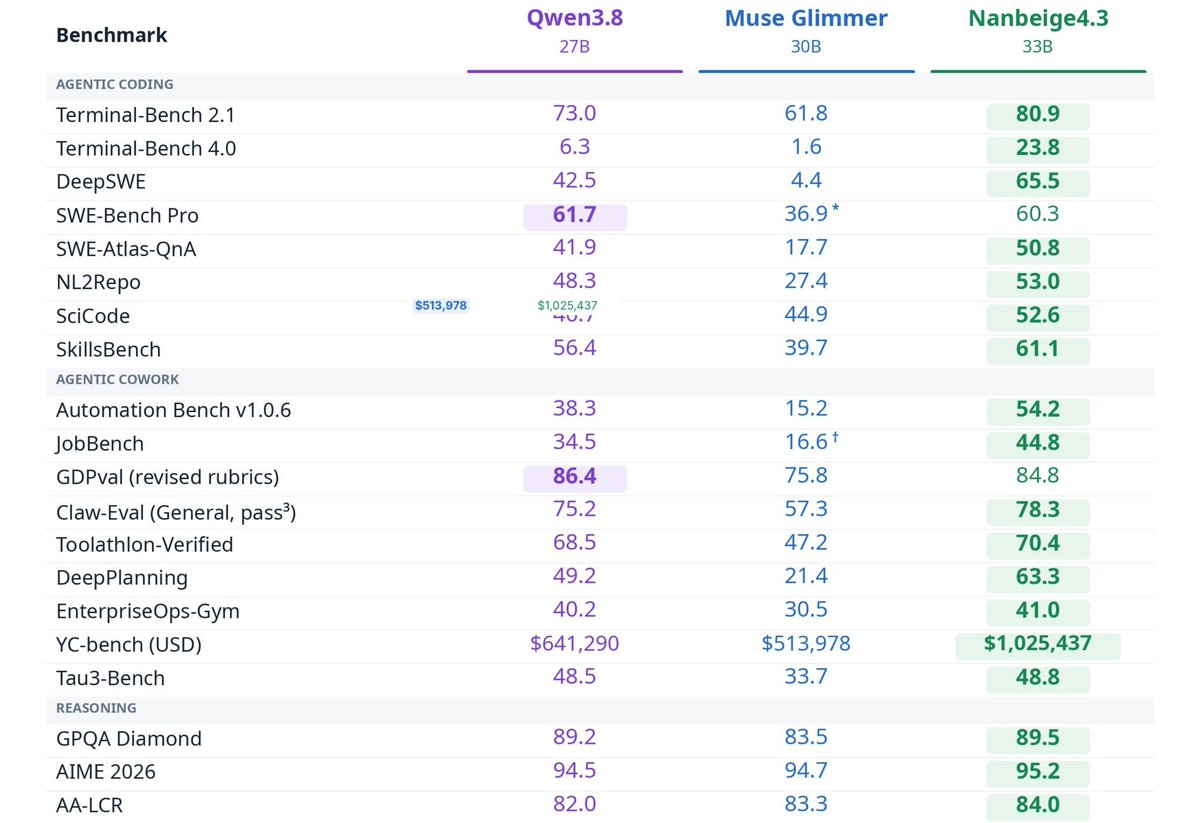
Hugging Face cofounder Thomas Wolf highlighted a 33-billion-parameter open-weights model from Nanbeige, the research team at recruitment company BOSS Zhipin. He says it outperforms Qwen 27B on most agentic benchmarks. The comparison is a reported benchmark claim, rather than an independent evaluation here. The release illustrates how competitive Chinese open models increasingly come from businesses beyond specialist AI labs and major cloud providers.

02

Lambert points to stronger reinforcement learning in Kimi K3.1 Pro

Nathan Lambert interprets Kimi K3.1 Pro’s benchmark results as evidence of stronger reinforcement learning after an initial release with a capable base model and lighter post-training. His post frames the results as another sign that Chinese labs are keeping pace with capability improvements. This is an expert interpretation of benchmarks, not a new independent assessment of the model’s reliability or usefulness in production workflows.

03

Lambert maps the open-model ecosystem and its unresolved questions

Lambert maps the open-model ecosystem and its unresolved questions

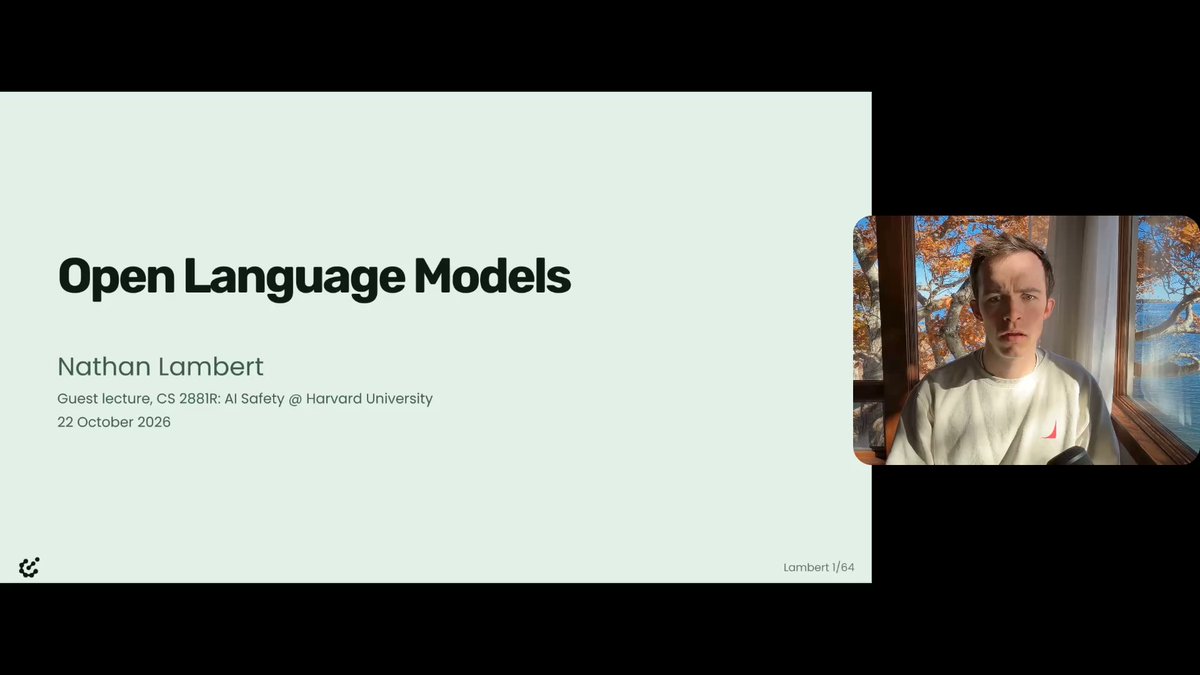
Nathan Lambert shared an introductory lecture on the open-model ecosystem, covering the different components that make it work and the debates shaping its future. The topics include distillation, risk management, and changing access to models. For teams choosing between hosted services and open weights, the framing is useful: openness involves development methods, distribution, and governance questions alongside the availability of a downloadable model checkpoint.

04

Microduck demonstrates compact onboard relocalization

Microduck demonstrates compact onboard relocalization

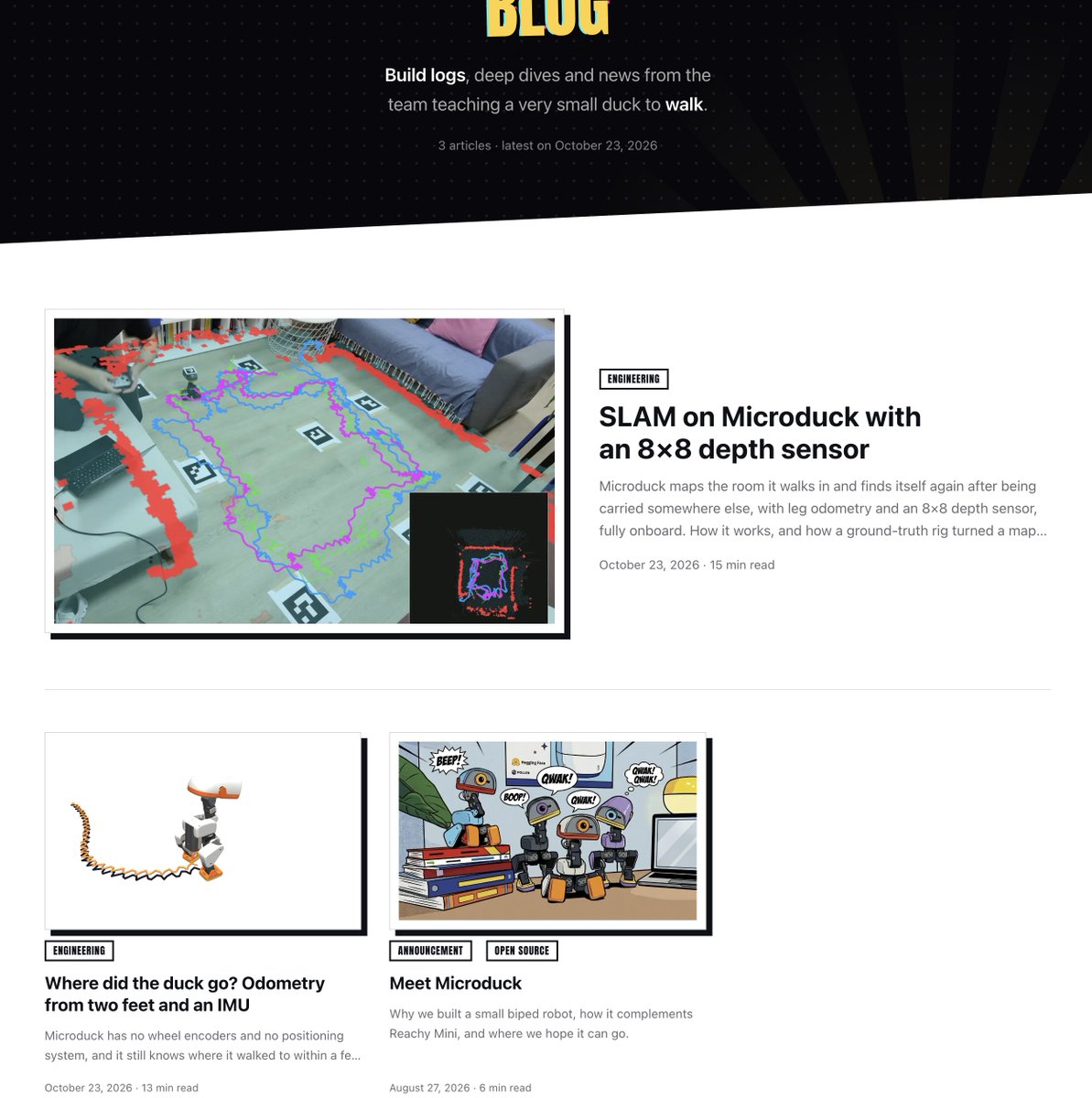
Thomas Wolf highlighted technical writeups from the Microduck team describing a robot that can be picked up, moved 1.5 meters, and put down before relocalizing within two centimeters. According to the post, it uses a 64-pixel depth sensor and leg odometry, with computation running onboard. The example puts efficient sensing and state estimation in focus, complementing the current emphasis on larger embodied AI models.

05

DeepMind shares plans for an AI peer-review assistant with Springer Nature

Google DeepMind shared Springer Nature’s announcement of a partnership to co-design an AI peer-review assistant. The available announcement describes an exploration of how AI could help the review process; it does not establish a deployed replacement for reviewers or report measured improvements. The collaboration is relevant to scientific AI because evaluating research quality is a different challenge from generating papers, predictions, or candidate explanations.

06

Enact announces a $30 million pre-seed round for tactile robotics

A post from Enact, shared by Yann LeCun, announces the company’s emergence from stealth with a $30 million pre-seed round. Its stated focus is mastering dexterity through force and touch. The short announcement supplies a funding milestone and technical direction, rather than detailed performance evidence. It highlights investor interest in the sensing and control problems that must be solved for robots to manipulate the physical world.

07

Google highlights Gemini 4 Argon applications in scientific research

Google shared a company post saying Gemini 4 Argon is helping researchers pursue breakthroughs across fusion, biology, and quantum research. The collected excerpt identifies these application areas but does not provide experimental details or independent validation. The signal is the breadth of scientific workflows being targeted. Assessing the results will require examining the underlying research, including how model contributions were checked by domain specialists.

08

Noam Brown describes large agent teams for infrastructure red-teaming

Noam Brown describes large agent teams for infrastructure red-teaming

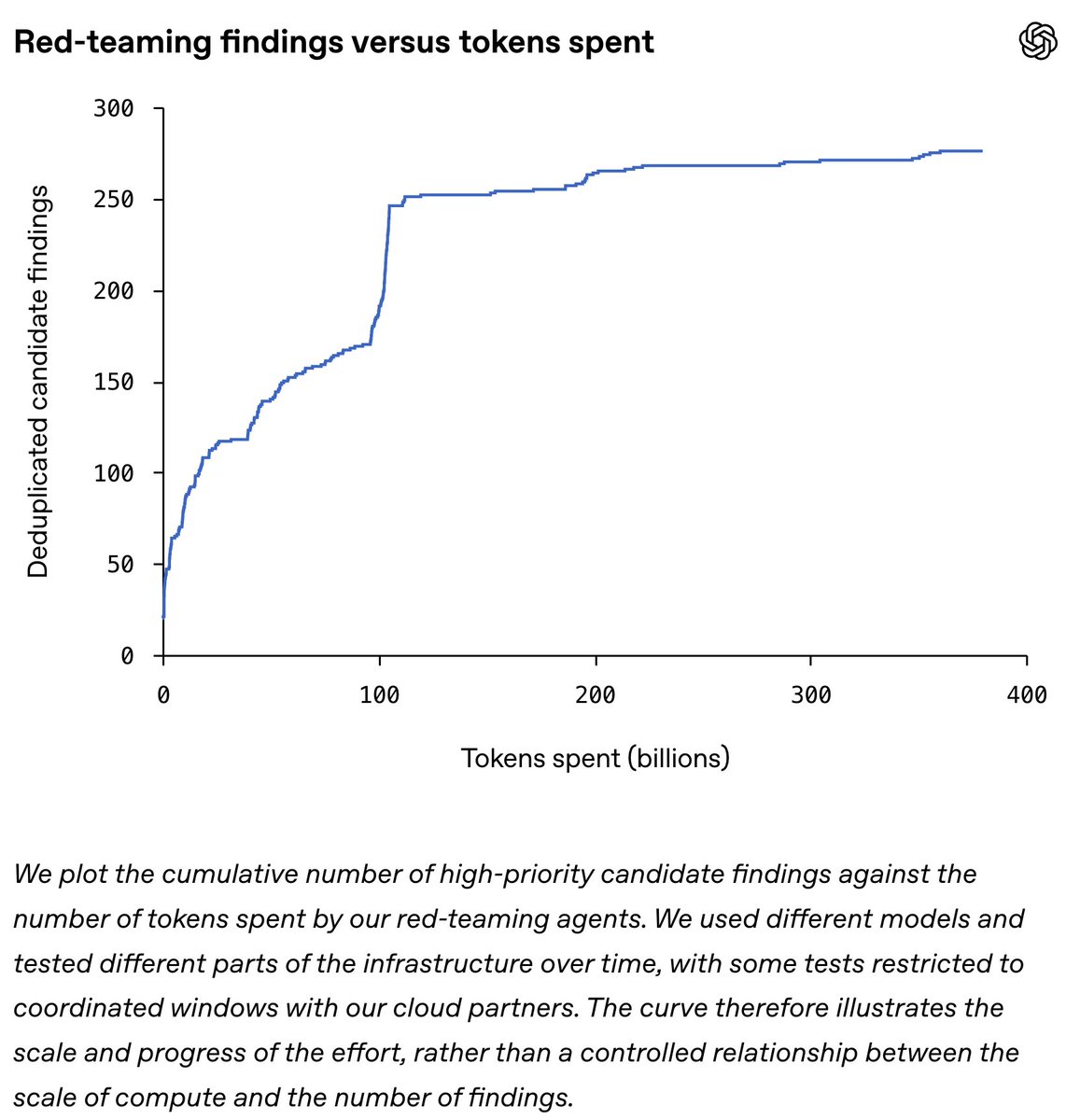
Noam Brown says his team is applying a large-agent approach to red-teaming, aiming to find and fix infrastructure vulnerabilities. He links it to an earlier effort that he says consumed more than 100 billion tokens and resolved the Navier–Stokes Millennium Prize problem. That extraordinary mathematical claim is not independently established by this post. The concrete direction described here is using coordinated agents for security testing and remediation.

GitHub

2 stories
01

JetBrains Thinkrail explores an adaptive AI coding IDE

JetBrains Thinkrail explores an adaptive AI coding IDE

JetBrains’ Thinkrail repository describes a lightweight IDE for coding with pi that customizes itself around the developer’s workflow. The project appeared among today’s collected GitHub trending candidates, with TypeScript as its listed language. Its positioning reflects growing interest in putting AI coding inside a full development environment. The repository description does not establish productivity gains; those depend on how well the environment supports real editing and debugging tasks.

02

TradingAgents packages multi-agent financial research workflows

TradingAgents packages multi-agent financial research workflows

TradingAgents is a Python framework for financial trading workflows built around multiple language-model agents. It remains prominent among the collected GitHub trending repositories, although its latest recorded update predates the report date. The project is relevant as an example of domain-specific agent orchestration. Repository popularity is not evidence of trading performance, and evaluating such systems requires separating workflow functionality from the quality of their financial decisions.

HF HuggingFace

6 stories
01

HoloBoxing reuses a whole-body controller for rapid task training

HoloBoxing reuses a whole-body controller for rapid task training

HoloBoxing separates reusable motor control from task planning: a compact planner requests body-point targets while a frozen controller handles joint execution. Imitation initializes the planner before reinforcement learning refines behavior. The authors report about seven minutes of additional single-GPU training from an available controller. That figure excludes controller pretraining, data preparation, evaluation, and search, so it should be read as incremental task-training cost rather than total system cost.

02

RynnUnify combines embodied understanding and video-based planning

RynnUnify combines embodied understanding and video-based planning

RynnUnify is a 16-billion-parameter embodied model combining spatial understanding, physical prediction, and long-horizon planning through interleaved video-language reasoning. Its extensions use reinforcement learning to decide when video prediction helps and translate model capabilities into robot control. The authors report gains on their planning evaluations and limited real-robot tasks. The work is notable for connecting understanding, imagined outcomes, and action within a shared foundation rather than treating them separately.

03

RSIHub standardizes experiments in agent self-improvement

RSIHub standardizes experiments in agent self-improvement

RSIHub provides reusable infrastructure for agent-evolution methods that modify prompts, skills, tools, and orchestration from execution feedback. It keeps evaluation outside the mutable resources while recording candidate lineage and evaluation conditions. The authors reproduce several methods and report a largest observed pass-at-one gain of 13.5 percentage points. Rankings vary by setting, and optimization gains do not always transfer to held-out tasks, making its comparison protocol particularly useful.

04

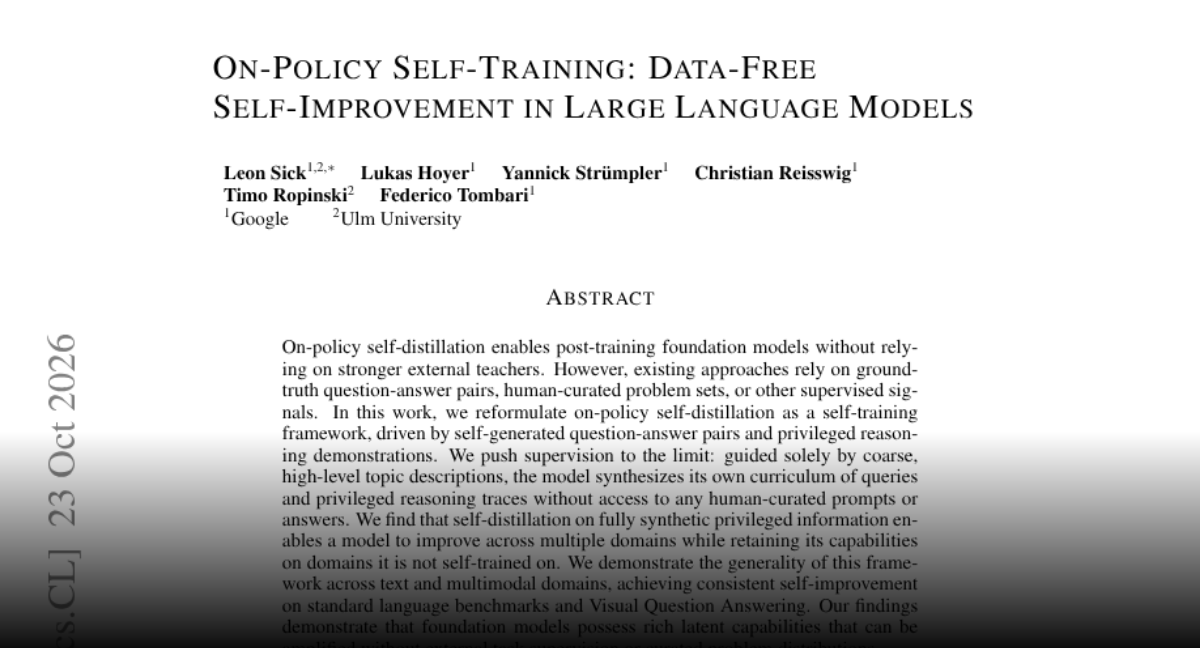
Self-training research removes curated question-answer supervision

Self-training research removes curated question-answer supervision

A study of on-policy self-training asks whether models can improve using their own generated questions, answers, and privileged reasoning traces. Starting only from broad topic descriptions, the method synthesizes a curriculum without curated prompts or answers. The authors report improvements across language and visual question-answering evaluations while retaining capabilities elsewhere. The result concerns amplification of existing model capabilities under the tested conditions, rather than proof of unrestricted autonomous improvement.

05

Speculative diffusion exposes two speed-quality controls

Speculative diffusion exposes two speed-quality controls

This paper studies diffusion models as draft generators for speculative decoding. It jointly varies diffusion effort and how leniently the verifier accepts draft output, instead of treating either choice in isolation. The authors report a better achievable speed-quality frontier than single-step diffusion drafting. Unlike strictly lossless speculative decoding, relaxed acceptance can change the output distribution, so deployment decisions must account for quality changes as well as measured speedups.

06

MultiAgent-OPD trains leaders and workers with local supervision

MultiAgent-OPD trains leaders and workers with local supervision

MultiAgent-OPD combines on-policy distillation and reinforcement learning to train a shared-parameter Leader-Searcher-Answerer team. A frozen teacher supplies token-level process supervision to searchers, while leaders learn from team success and answerers from correctness. Across seven datasets, the authors report 38.68 percent macro average performance over four attempts, exceeding two comparison systems. The contribution is a way to assign more informative training signals inside hierarchical agent teams.