NO/FOMO

Independent AI signal, once a day

The AI briefing worth opening.

ISSUE DATE2026-10-30ENGLISH EDITION
This issue
—
All time
—

AI Blog

5 stories
01

OpenAI will honor a shared AI-training robots signal

OpenAI says it will honor a shared robots.txt signal through which website operators can communicate AI-training preferences to participating providers. The announcement addresses how publishers express those preferences across services, rather than asking each site to invent its own mechanism. Its scope is the participating providers and the stated signal. The collected summary does not establish universal adoption, retroactive removal of training data, or a legal settlement over previously collected material.

02

OpenAI outlines community safety and teen protections

OpenAI announced expanded safeguards, earlier interventions, and a new commitment to public safety reporting as part of strengthening violence prevention in ChatGPT. The post is presented as a community safety report with new protections for teens. It signals a broader operational focus on how the service responds to potential harm. The collected summary does not provide enough detail to quantify effectiveness or determine how each protection changes individual conversations.

03

OpenAI describes layered monitoring for model misalignment

OpenAI describes using layered monitoring to detect frontier-model misalignment and unauthorized agent behavior, with the aim of letting responders intervene before incidents escalate. The operational emphasis is on detection and response as agents become more capable of acting. This complements, rather than substitutes for, policy documents and preventive safeguards. The collected summary describes the approach but does not establish comprehensive coverage, measured detection rates, or the absence of undetected failures.

04

OpenAI updates the Model Spec around five core values

OpenAI’s updated Model Spec sets out five core values intended to guide increasingly capable AI toward sound judgment, human agency, and faithfulness to human intent. The announcement concerns the behavioral framework for models, rather than a direct measurement of how consistently deployed systems follow it. For builders, the distinction matters when translating general principles into evaluations, tool permissions, and product behavior. The collected summary does not enumerate all five values.

05

Qwen3-TTS voice embeddings enable custom voice experiments

Qwen3-TTS voice embeddings enable custom voice experiments

Armin Ronacher explores custom voices with Qwen3-TTS, including blending speaker embeddings and passing a cloned embedding into the CustomVoice model to apply instructions. The article explains how the Base, CustomVoice, and VoiceDesign variants differ and demonstrates practical tradeoffs. Instructions on cloned voices were less reliable than on built-in speakers in these experiments. The post also distinguishes voice cloning from speaker verification, where a dedicated verification model performed better across recording conditions.

Hacker News

6 stories
01

US lawmakers oppose a potential AI bailout

A congressional announcement describes Representatives Casar and Waters leading a Democratic resolution opposing an AI-bubble bailout for large technology companies. The item drew substantial discussion on Hacker News, making the politics of AI financing a prominent part of the day’s agenda. The stated action is a resolution and a political position; it should not be read as evidence that a bailout has occurred or that a binding prohibition has already become law.

02

Security report flags a Claude Code extension backdoor

A security report describes a backdoor in a Claude Code for VS Code extension distributed through the Cursor Marketplace. The report became one of the most discussed AI-related items in the collected Hacker News feed. Its significance is the distribution channel: developers increasingly place powerful AI tools inside trusted coding environments. The collected metadata does not establish the full affected-version range or remediation steps, so users should consult the linked investigation and vendor notices.

03

AI cost concerns weigh on US technology shares

AI cost concerns weigh on US technology shares

The BBC reports sharp falls in US technology stocks amid fears about AI costs. The story connects the industry’s expanding technical ambitions with investor concern over the expense of delivering them. It belongs alongside the day’s financing and policy debate, rather than being treated as a model-performance story. The collected headline does not supply individual company moves, index percentages, or a detailed causal decomposition, so those specifics are not inferred here.

04

Report raises questions about Anthropic’s post-IPO credit rating

The Financial Times reports Blackstone’s view that Anthropic may not secure an investment-grade rating after an IPO. The conditional wording matters: this is an assessment of a possible credit outcome, not an announced rating decision. Together with broader concern about AI spending, the story highlights financing quality as an important industry constraint. The collected metadata does not establish the terms of an offering, the timing of any rating, or the company’s eventual borrowing costs.

05

Proton CEO cancels AI re-interviews, report says

404 Media reports that Proton’s CEO has cancelled AI re-interviews. The story places AI use in workplace assessment on the day’s industry agenda and attracted substantial Hacker News discussion. The collected headline establishes the reported reversal but does not explain the complete process, its scope, or the reasons behind the decision. Those limits matter when assessing what this episode says about employee evaluation and the organizational adoption of AI tools.

06

Essay warns that AI may deskill SRE teams

Essay warns that AI may deskill SRE teams

A Signoz newsletter essay argues that AI is deskilling site reliability engineers rather than replacing them. The piece drew strong engagement on Hacker News and adds an operational perspective to the debate over AI at work. Its framing concerns what happens to expertise when tasks are delegated to tools. This is an argument presented by the author, not a measured industry-wide finding established by the headline or the discussion score.

Twitter

9 stories
01

Claude renames Max plans and starts removing Ultra’s five-hour limit

Claude renames Max plans and starts removing Ultra’s five-hour limit

Anthropic’s Claude account announced that Max 5x becomes Max and Max 20x becomes Ultra, while monthly prices remain $100 and $200 respectively. Existing subscribers do not need to take action. The announcement also begins removing the five-hour limit for verified Ultra accounts. This changes the usage experience for heavy subscribers, although the collected announcement does not establish that every account or every other usage restriction is covered.

02

Runway Agent adds file access and code execution

Runway Agent adds file access and code execution

Runway announced expanded Agent capabilities that include opening files and running code alongside generating creative assets. Its examples span brand launch kits, product shots, ad variations, and motion graphics built from references. The update places creative generation inside a broader task workflow, where an agent can work with inputs and tools. The announcement describes product capabilities, rather than providing independent measurements of reliability or production quality.

03

Claude API raises request limit to 128 MB

Claude API raises request limit to 128 MB

Anthropic raised the maximum request size for the Claude API’s Messages and Token Counting endpoints from 32 MB to 128 MB. The developer announcement identifies image-heavy computer-use sessions and large PDFs as workloads that previously hit the transport limit while still having context capacity available. The change gives those requests roughly four times more room. It should be understood as a request-size increase, rather than an announced expansion of the model’s context window.

04

Anthropic describes Claude’s misuse self-assessment

Anthropic describes Claude’s misuse self-assessment

Anthropic says it has trained Claude to flag potential misuse through a technique called self-assessment. After responding, the model produces a preliminary safety assessment of the conversation. The company says the approach has been in use since June and has surfaced misuse. This is a concrete example of models participating in operational safety monitoring; the available announcement does not quantify detection accuracy, false positives, or the scope of subsequent review.

05

Pika introduces open-weight H3 Flex for video workflows

Pika introduces open-weight H3 Flex for video workflows

Pika introduced H3 Flex as an open-weight video model oriented toward professional iteration. The company highlights exportable audio stems, output resolutions up to 4K, and faster-than-real-time generation. It also claims the top open-weight position on DesignArena’s text-to-video board at launch. Those features target editing and delivery needs beyond a single generated clip, while the ranking and speed statements remain vendor-reported claims in the collected announcement.

06

Google announces Gemini 4 Carbon

Google announces Gemini 4 Carbon

Google announced Gemini 4 Carbon as its latest frontier model, claiming improved performance across domains and a leading position on version 5.0 of the Artificial Analysis Intelligence Index. The company particularly emphasizes cybersecurity and long-horizon capabilities. The collected post signals a rollout but does not provide its complete availability conditions. For teams evaluating agent workloads, the important follow-up is whether these claimed gains translate into accessible, reproducible performance on their own tasks.

07

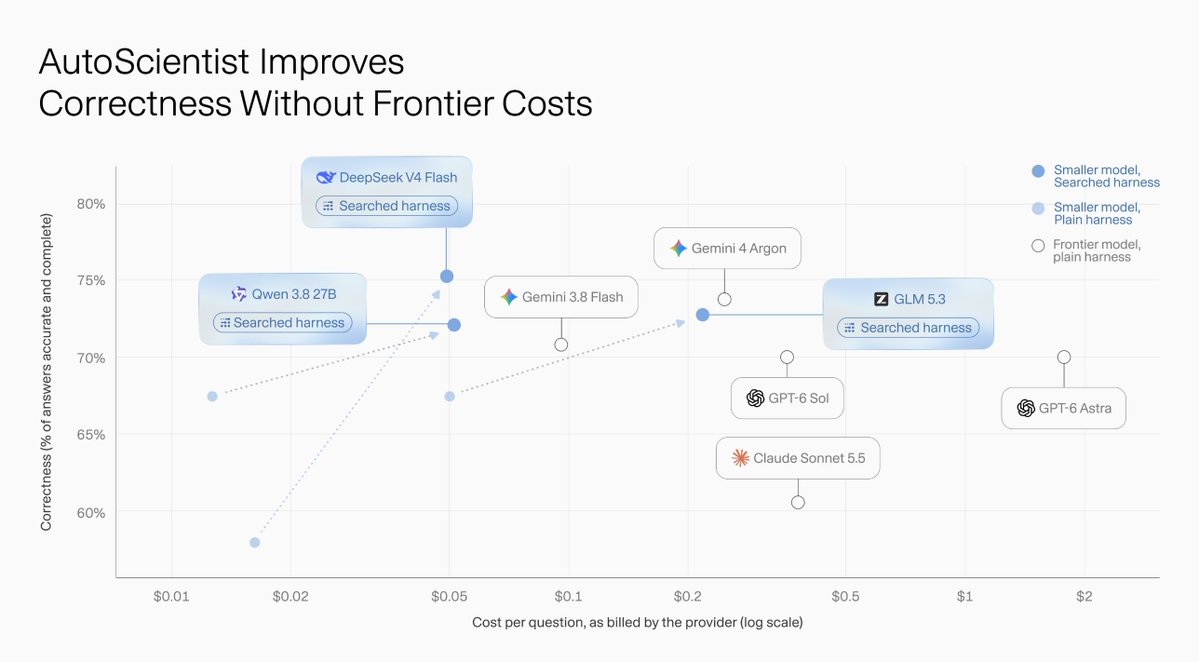
Adaption reports AutoScientist gains in medical reasoning

Adaption reports AutoScientist gains in medical reasoning

Adaption cofounder Sara Hooker reports that AutoScientist raised correctness on long-horizon medical reasoning from 58.1% to 75.2%, with results claimed to exceed GPT-6 Astra and Gemini 4 Argon on that task. The post presents the approach as applicable to open-weight starting models. This points toward task-specific improvement as an alternative to relying exclusively on larger general models, but the figures are research claims and do not establish clinical safety or effectiveness.

08

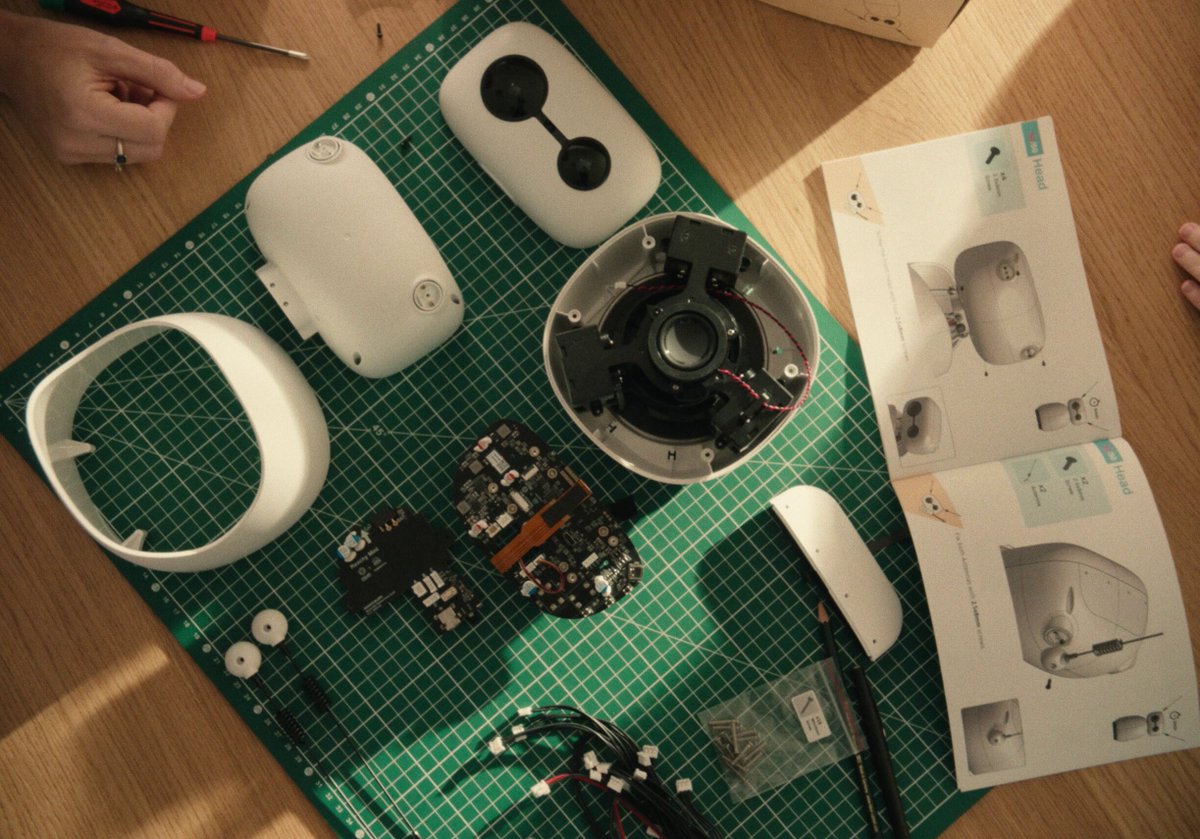
Reachy Mini gains an open-source mobile base

Reachy Mini gains an open-source mobile base

Hugging Face’s Thomas Wolf highlighted a $149 Reachy Mini Hoverboard that lets the robot move beyond a stationary desktop setup. The post describes the system as open source and names several model families that users can connect. Mobility broadens the kinds of embodied-agent experiments possible with the platform. The announcement does not provide navigation benchmarks, autonomy guarantees, or a complete breakdown of the cost of the robot and its accessories.

09

Anthropic expands its AI for Science program

Anthropic expands its AI for Science program

Anthropic announced that its AI for Science program is expanding beyond individual teams to include scientific foundations, institutions, and research groups. The change is about the scope of institutional support, rather than a new model benchmark or a specific scientific discovery. Broader participation could influence how research organizations evaluate and adopt AI tools, although the collected announcement does not specify the full eligibility rules, funding terms, or outcomes of participating projects.

GitHub

1 story
01

OpenBot gives AI coworkers their own computers

CopilotKit’s OpenBot repository describes open-source AI coworkers that each receive a computer environment with a browser, files, and tools. Its stated design decides actions before execution and records them afterward, and it supports bringing an AG-UI agent. This makes it relevant to teams building observable agent workflows across real applications. Repository popularity indicates interest, while production isolation, policy enforcement, and task reliability still require evaluation in the intended deployment.

HF HuggingFace

5 stories
01

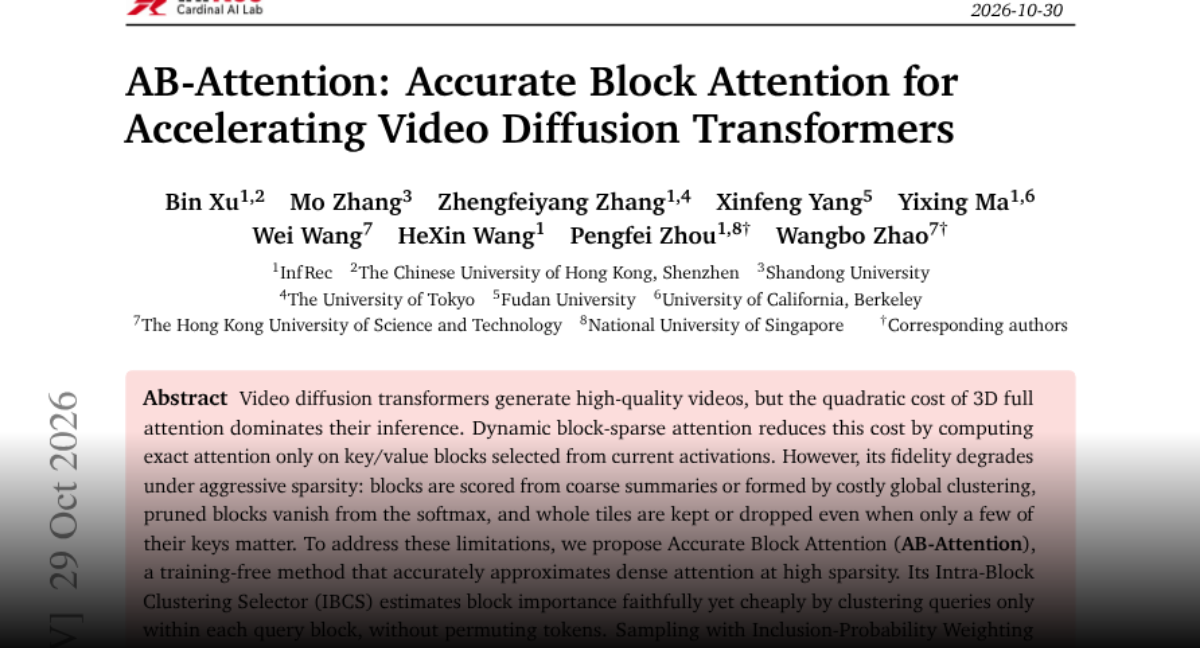
AB-Attention accelerates video diffusion with sparse attention

AB-Attention accelerates video diffusion with sparse attention

AB-Attention proposes a training-free approximation to dense attention for video diffusion transformers. It combines local query clustering, probability-weighted block sampling, and a kernel that packs smaller key/value blocks efficiently. On Wan2.1 and HunyuanVideo, the authors report skipping 89–92% of attention and reaching up to 2.23 times end-to-end speedup while improving fidelity against the strongest compared baseline. These results make it a concrete inference-efficiency candidate, with benefits tied to the evaluated models and settings.

02

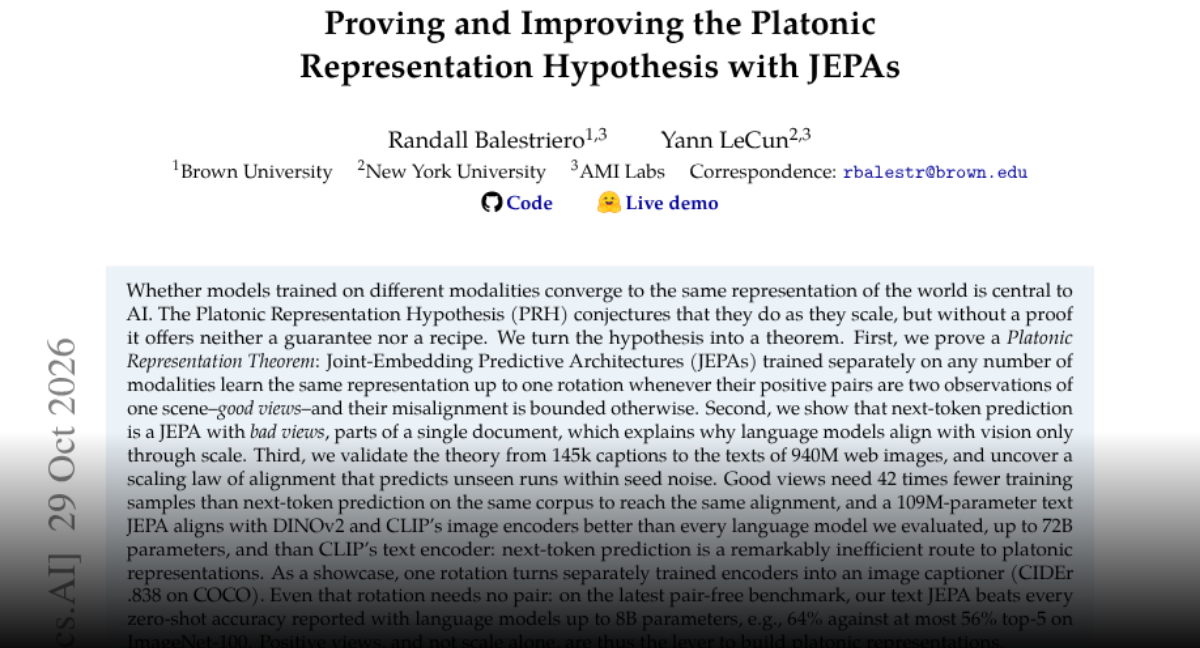
JEPA research gives conditions for aligned representations

JEPA research gives conditions for aligned representations

Randall Balestriero and Yann LeCun present a theorem connecting separately trained JEPAs across modalities when positive pairs are good views of the same scene. Their experiments report much greater sample efficiency for alignment than next-token prediction, including a 42-fold reduction in needed training samples in the compared setting. The central contribution is the role of positive-view construction. The theorem’s assumptions matter; the result should not be generalized into an unconditional guarantee for every model or dataset.

03

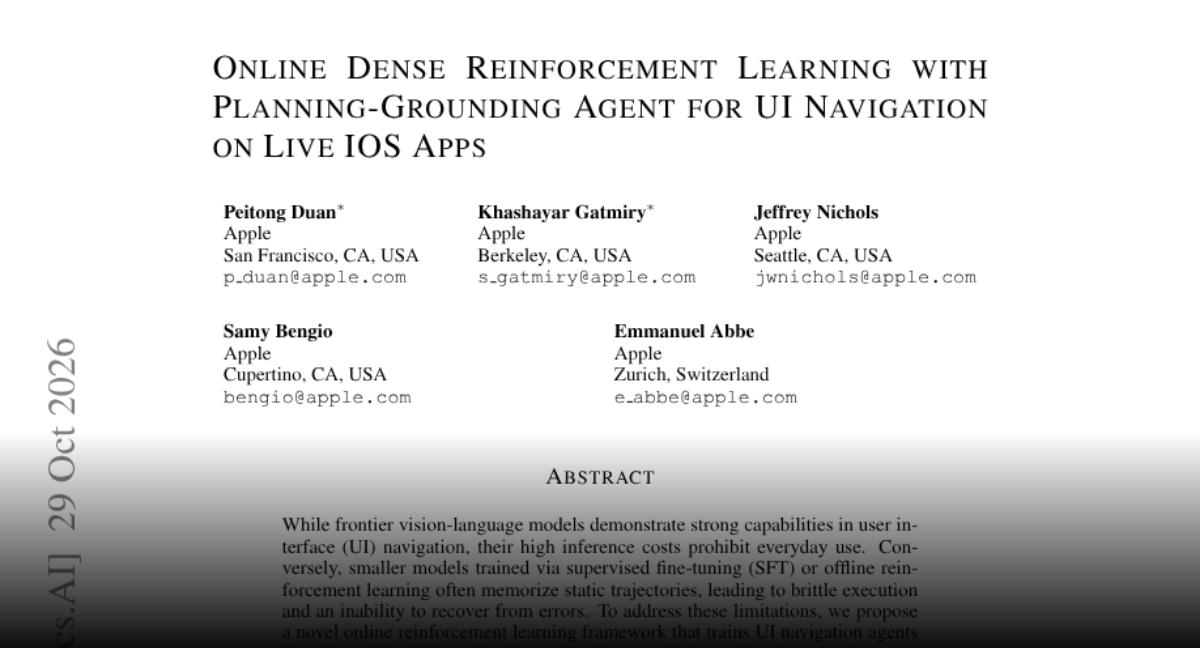
Online RL trains UI agents directly on live iOS apps

Online RL trains UI agents directly on live iOS apps

This research separates UI navigation into planning and grounding components, then trains agents on live iOS applications using dense step-level rewards and terminal feedback. The framework combines PPO with a value-estimation method called GiGPPO and infrastructure for hundreds of virtual devices. The authors report stronger performance than supervised and terminal-only baselines, including nearly sevenfold Android generalization gains for an 8B agent. The findings support studying recovery through interaction instead of relying only on static demonstrations.

04

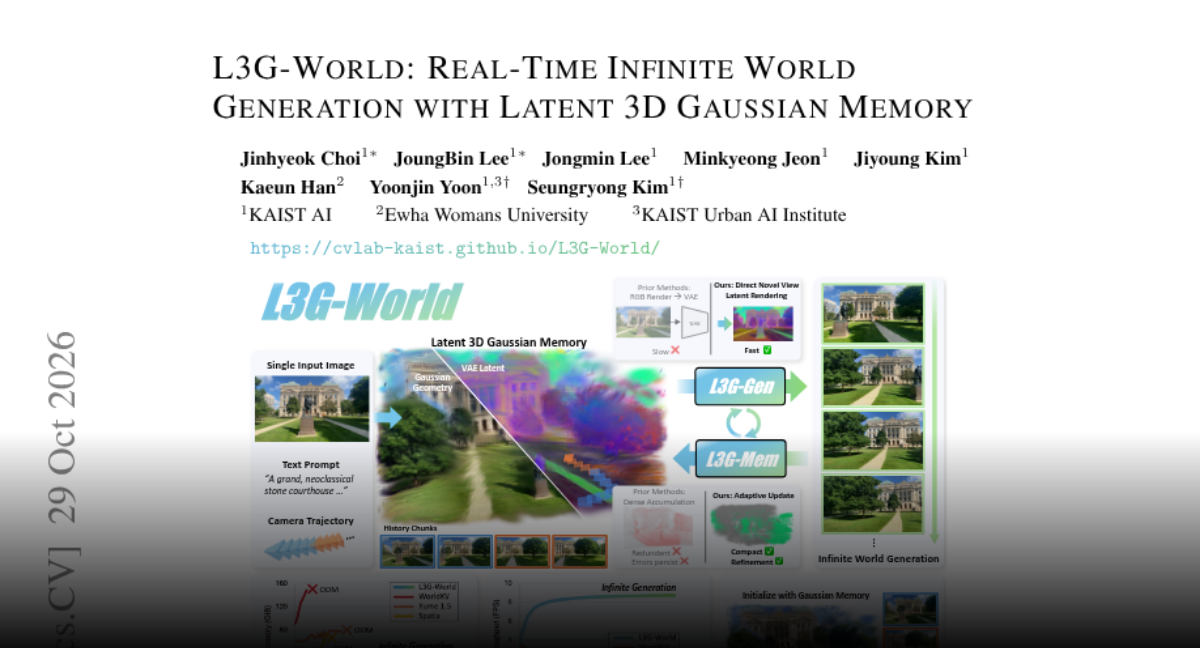
L3G-World uses latent Gaussian memory for interactive worlds

L3G-World uses latent Gaussian memory for interactive worlds

L3G-World introduces a latent 3D Gaussian memory to preserve spatial consistency during interactive world generation. Memory grows with explored scene extent rather than the length of the generated stream, and latent features render directly into the video generator’s space without repeated RGB encoding. The authors report real-time generation at nine frames per second and substantial memory-operation improvements over compared baselines. The work targets a practical bottleneck in long-horizon world models: retaining geometry without continually expanding temporal context.

05

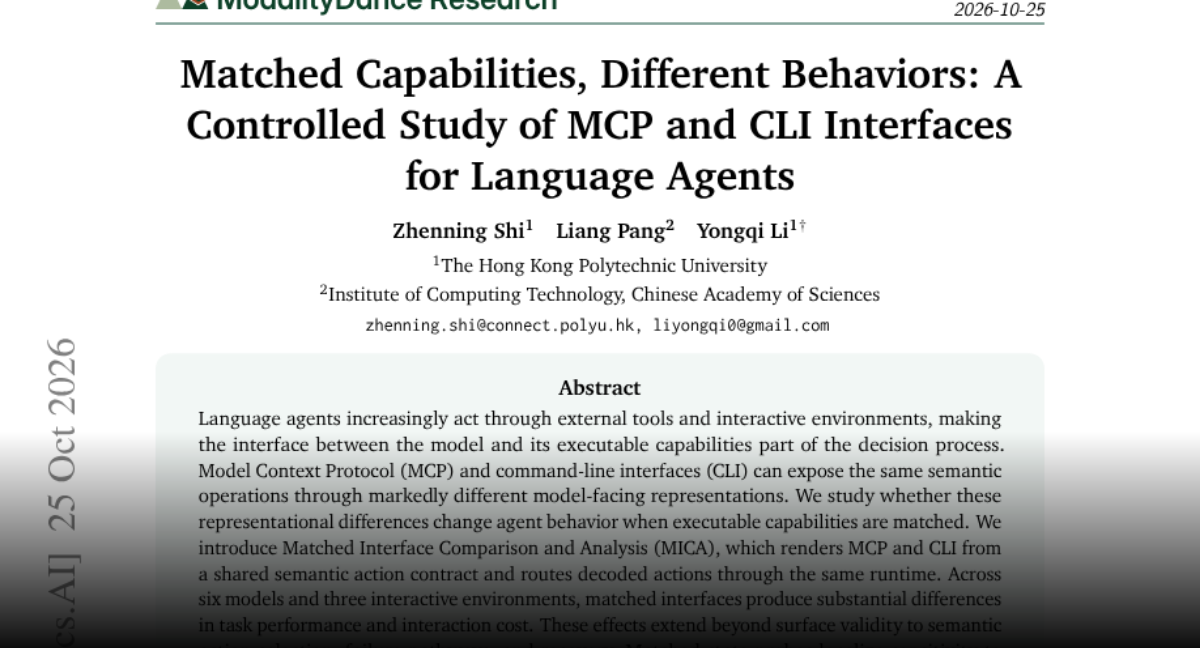
Matched MCP and CLI tools still change agent behavior

Matched MCP and CLI tools still change agent behavior

A controlled study compares MCP and CLI interfaces built from the same semantic action contract and executed through the same runtime. Across six models and three environments, the authors find substantial behavioral and cost differences despite matched capabilities. Their DART approach preserves validated semantic decisions while repairing interface-specific realization, improving scores in all six evaluated settings. The practical implication is that tool presentation and feedback are experimental variables, not neutral wrappers around an otherwise unchanged agent.