NO/FOMO

Independent AI signal, once a day

The AI briefing worth opening.

ISSUE DATE2026-11-02ENGLISH EDITION
This issue
—
All time
—

AI Blog

4 stories
01

OpenAI introduces Grid Protectors Program

OpenAI announced the Grid Protectors Program, an initiative to work with utilities so future compute campuses support grid reliability and protect consumer electricity costs. The announcement places power-system integration alongside computing capacity as a requirement for AI infrastructure expansion. Its stated goals address two central concerns around large campuses: whether electricity service remains reliable and whether households bear higher costs. The collected announcement describes the program's intent, rather than demonstrated outcomes from completed deployments.
02

Datacenter permitting becomes a bipartisan buildout risk

Datacenter permitting becomes a bipartisan buildout risk

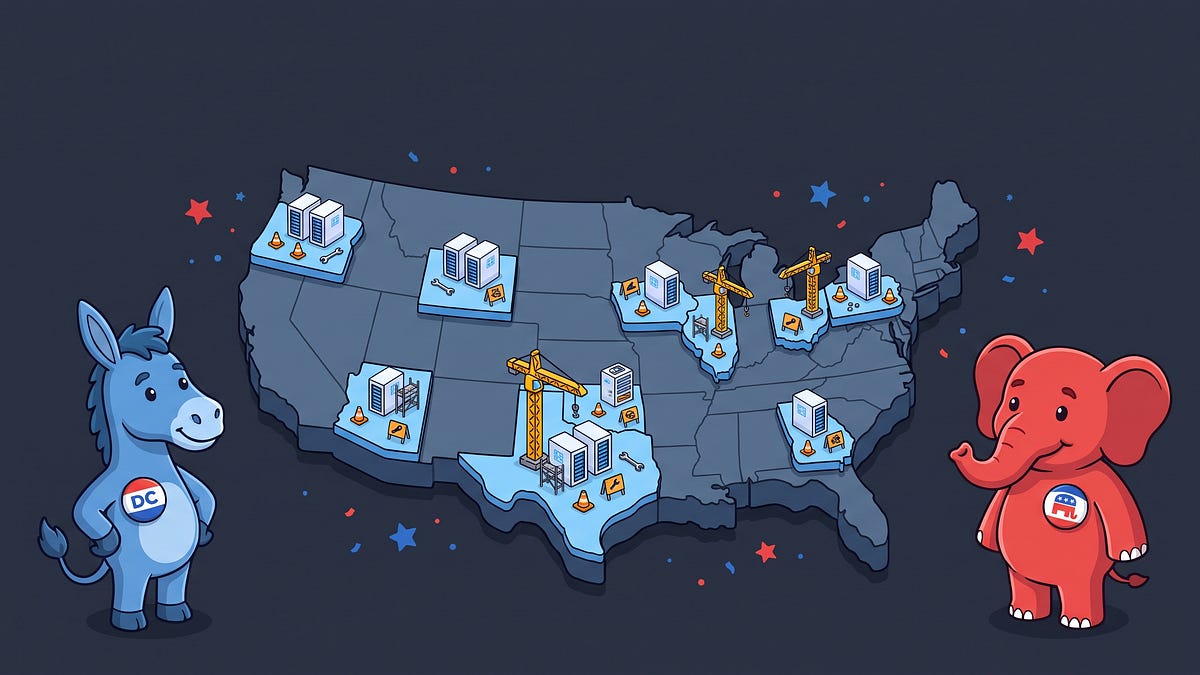
SemiAnalysis argues that datacenter opposition is becoming bipartisan ahead of the US midterm elections. Its analysis distinguishes largely committed 2027 capacity from a less certain 2028 buildout, identifying a prolonged Texas permit freeze as the largest single risk to US expansion. This is an analyst assessment, not a confirmed nationwide construction halt. The piece makes permitting and local political support central variables in forecasts that otherwise focus primarily on chips, capital, and electricity supply.

03

LifeVal measures AI assistance on everyday tasks

OpenAI introduced LifeVal, a benchmark focused on how well AI helps people complete everyday tasks. Examples include finding childcare, managing finances, and navigating government paperwork. The evaluation shifts attention toward practical assistance that requires understanding a person's situation and completing useful work. The collected announcement does not provide model rankings or numerical results, so the relevant development here is the benchmark's scope and its emphasis on daily utility rather than a claimed performance winner.

04

GDPx targets economically valuable frontier capabilities

GDPx targets economically valuable frontier capabilities

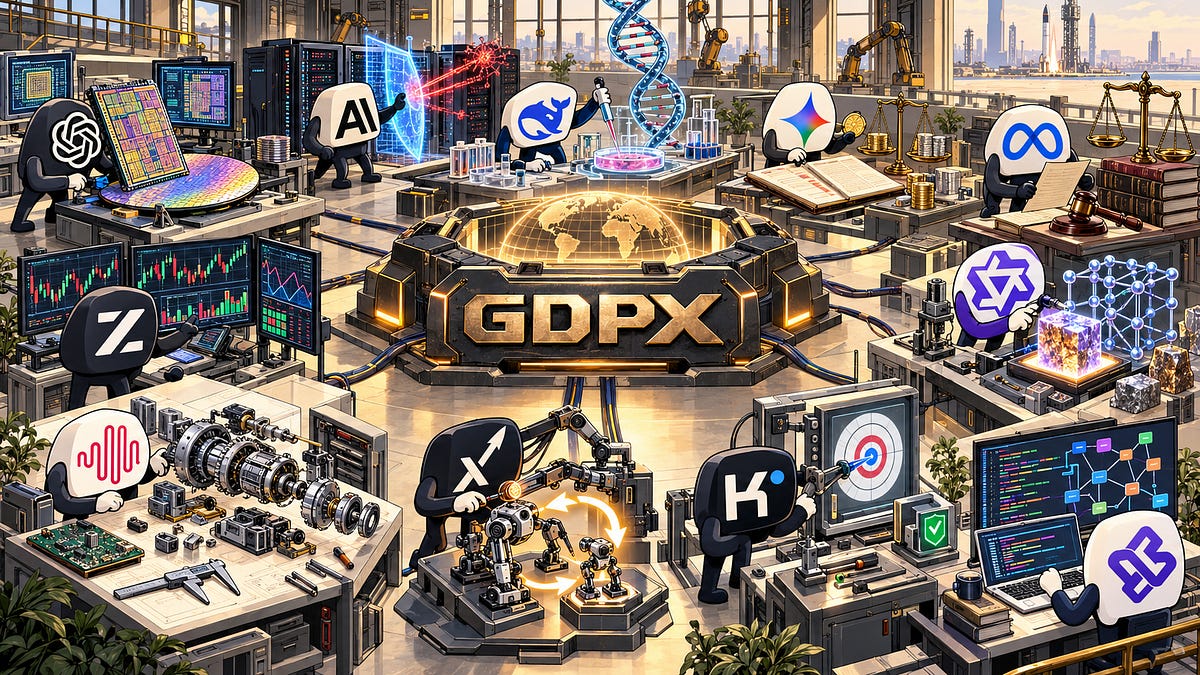
SemiAnalysis introduced GDPx as a frontier-model benchmark spanning economically significant domains, including hardware and chip design, software engineering, finance, legal work, biology, cybersecurity, materials science, alignment, and recursive self-improvement. Its breadth makes the choice of evaluation tasks particularly relevant to claims about AI's economic potential. The collected description establishes the domain coverage but not enough detail to compare model scores or cost curves. Readers should distinguish the benchmark announcement from independently validated productivity gains.

Hacker News

7 stories
01

Anthropic reports $17B in Q3 revenue and $895B in commitments

Anthropic reports $17B in Q3 revenue and $895B in commitments

CNBC reports that Anthropic disclosed $17 billion in third-quarter revenue and $895 billion in commitments in a revised S-1. The filing-related story attracted substantial discussion on Hacker News, putting the relationship between revenue growth and future obligations at the center of the day's AI business debate. The two figures measure different things; the commitments should not be treated as a quarterly expense or directly subtracted from quarterly revenue.

02

China frontier-AI export controls draw scrutiny

China frontier-AI export controls draw scrutiny

A Cloud Security Alliance research note examines China's frontier-AI export controls under Ministry of Commerce Announcement No. 48. The report became one of the day's prominent AI policy discussions on Hacker News. For organizations distributing models or building international AI services, the issue is whether new controls change what can be transferred across borders. The collected listing does not establish the precise scope, exemptions, or enforcement dates, so those details require the underlying policy text.

03

Anthropic internal AI usage highlights the cost of agent-heavy work

Anthropic internal AI usage highlights the cost of agent-heavy work

Business Insider reports that Anthropic's internal AI usage, valued at retail prices, now exceeds employee pay. The retail-price qualification matters: it describes an imputed value rather than establishing the company's actual inference bill. Alongside the day's financing coverage, the story raises a practical question for AI-intensive businesses: how much compute is consumed as agents become part of routine work, and how should that usage be compared with labor costs and productivity gains?

04

Subvocal demonstrates silent-speech glasses

The Subvocal Company demonstrated prototype glasses that use radio-frequency sensing to turn silent articulation into text. The founders describe replacing facial electrodes with antennas embedded in frames and training models on recordings from many users. They report that a demonstration participant needed a short calibration and plan to ship in the first quarter of 2027. The system detects intentional mouth articulation, not unconstrained thoughts; the launch presents a promising interface prototype rather than established mass-market performance.

05

Momentic launches agents that find bugs by using applications

Momentic launches agents that find bugs by using applications

Momentic introduced Mo, a QA agent harness that explores applications, plans tests, and coordinates specialized agents across browsers and devices. In its own benchmark of four open-source applications with 1,396 labeled bugs, the company reports 269 bugs found in an hour, with 84% precision and a cost of $2.67 per bug. Those are vendor-reported results under a specific setup. The approach highlights a growing need to test application behavior as coding agents accelerate software production.

06

LongCat-2.5 introduces native multimodality for agentic tasks

LongCat-2.5 introduces native multimodality for agentic tasks

LongCat's official blog introduced LongCat-2.5 under the theme of native multimodality for agentic tasks. The announcement surfaced in the day's Hacker News discussion and connects two active development directions: handling multiple input modalities and using models to carry out tasks. The collected listing contains no technical specification, licensing terms, or benchmark results. It therefore supports reporting the announcement and its stated focus, while leaving capability and deployment comparisons to the detailed release materials.

07

OpenAI publishes GPT-Rosalind-6 system-card addendum

OpenAI publishes GPT-Rosalind-6 system-card addendum

OpenAI's deployment-safety site published a GPT-Rosalind-6 system-card addendum, which appeared in the day's Hacker News coverage. A system-card update is relevant to readers tracking how model developers document deployment risks and safeguards. The collected listing supplies the document title and official destination but not the addendum's findings. It should therefore be read as notice of updated safety documentation, without inferring new capability thresholds, changed access rules, or particular risk conclusions from the title alone.

Twitter

5 stories
01

Google demonstrates Gemini Argon across a retro-video workflow

Google demonstrates Gemini Argon across a retro-video workflow

Google showed a video workflow built with Gemini 4 Argon and Antigravity, combining scripted Blender boot animations with SuperCollider audio. The team then routed the output through a Raspberry Pi to a physical vintage CRT television. The demonstration is a concrete example of a model coordinating code, graphics, sound, and hardware presentation within one creative project. It illustrates workflow breadth, while offering no controlled benchmark of reliability or the amount of human intervention required.

02

Hailuo previews interactive H3 and ORB360 LoRA output

Hailuo previews interactive H3 and ORB360 LoRA output

Hailuo AI highlighted an interactive demonstration combining H3 with ORB360 LoRA, extending a visual-generation workflow into an experience viewers can interact with. The post suggests virtual reality as a possible next direction, rather than announcing a confirmed VR product. For generative-video builders, the useful signal is the move from passive clips toward controllable experiences. The short announcement does not establish supported controls, release availability, latency, or whether the interaction generalizes beyond the showcased example.

03

Sakana connects world-model research to an agent-native LLM

Sakana connects world-model research to an agent-native LLM

Sakana AI's David Ha described the company's Tokyo symposium with scientific adviser Jürgen Schmidhuber and linked their earlier World Models work to research at its RSI Lab. The post says the lab is building on those foundations to train an agent-native language model. The collected text ends before further implementation detail, so it does not establish architecture, training scale, or release timing. The substantive signal is Sakana's stated research direction connecting world models and language-based agents.

04

Chollet argues for robustness beyond benchmark optimization

François Chollet argued that evolution favors generality and robustness because overspecialization leaves organisms vulnerable when environments change. The widely engaged post applies that intuition to the tendency to optimize AI systems for benchmarks. It is a research perspective rather than a new experimental result. Alongside new evaluation suites, it offers a useful question for model assessment: whether gains transfer to changing conditions or mainly improve performance on the specific tasks being measured.

05

Gemini agents design and simulate a physical robot pumpkin

Gemini agents design and simulate a physical robot pumpkin

A Google DeepMind demonstration describes Gemini Argon agents designing, simulating, and helping bring a physical robot pumpkin to life from a single prompt, without requiring CAD input. The project connects agent-generated design work to an embodied artifact, extending beyond screen-only outputs. It remains a curated demonstration rather than evidence of general autonomous hardware engineering. Its practical interest lies in the integration of design and simulation, with reliability, fabrication effort, and human supervision still unspecified in the post.

GitHub

1 story
01

Agent Desktop uses accessibility trees for computer-use agents

Agent Desktop uses accessibility trees for computer-use agents

Vercel Labs' Agent Desktop is a Rust project that gives agents access to desktop applications through operating-system accessibility trees. Its description emphasizes stable references and actions that are safe to retry, reducing dependence on inferring controls from screenshots. That design targets an important source of fragility in computer-use automation: identifying the same interface element consistently across steps. The repository's claims describe its intended behavior; the collected metadata does not supply comparative reliability measurements across applications.

HF HuggingFace

8 stories
01

LARC moves image-generation reasoning into continuous latent space

LARC moves image-generation reasoning into continuous latent space

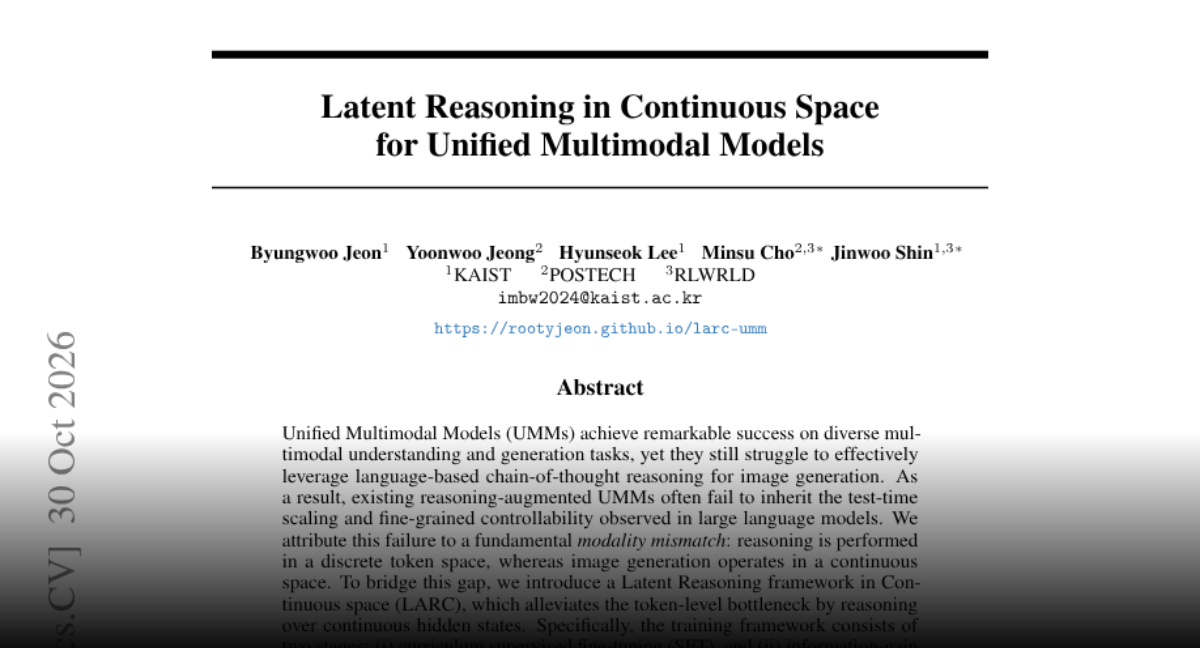
LARC addresses a mismatch between discrete language reasoning and continuous image generation by reasoning over hidden states. The proposed training process first converts token-based reasoning through curriculum supervised fine-tuning, then applies information-gain reinforcement learning without ground-truth supervision. The authors report improved prompt following and compositional fidelity, including a seven-percentage-point GenEval gain over BAGEL. The work suggests a route to test-time scaling for image generation, although the reported gains remain specific to the paper's evaluated models and benchmarks.

02

RoboArchitect improves frozen robot policies by evolving their harness

RoboArchitect improves frozen robot policies by evolving their harness

RoboArchitect uses a coding model to inspect robot rollouts, diagnose failures, and revise the harness around a frozen policy. The authors report unseen-scene success improving from 9.7% to 43.3% and unseen-task success from 12.7% to 40.2% across their evaluations, without updating policy weights. The harness can develop persistent memory and practical control strategies. The result points to orchestration and tool-use logic as substantial sources of robotics improvement, alongside the more familiar route of policy fine-tuning.

03

rTaste questions whether research agents choose their best experiments

rTaste questions whether research agents choose their best experiments

rTaste evaluates how six frontier models propose and prioritize experiments based on seven NLP papers. Of 415 proposed minimum viable experiments, auditors judged 194 sound, valuable, and new, but only 73 also extended beyond the seed paper in a non-obvious way. Agent rankings beat random selection but were not shown to improve on choosing the first proposal. Teams cost more without clear overall quality gains, highlighting a gap between generating worthwhile ideas and reliably deciding which deserve execution.

04

CodeSpecWeave trains coding agents on interacting requirements

CodeSpecWeave trains coding agents on interacting requirements

CodeSpecWeave synthesizes software tasks whose requirements interact, such as interface compatibility and error handling, rather than treating each constraint as an isolated checklist item. A synthesis agent develops requirements and executable tests while a review agent audits solution trajectories. The authors construct 4,670 training tasks across 2,865 repositories and a benchmark with 100 tasks and 1,044 specifications. Reported reinforcement-learning improvements suggest that training on coupled constraints can better target the demands of long-horizon engineering work.

05

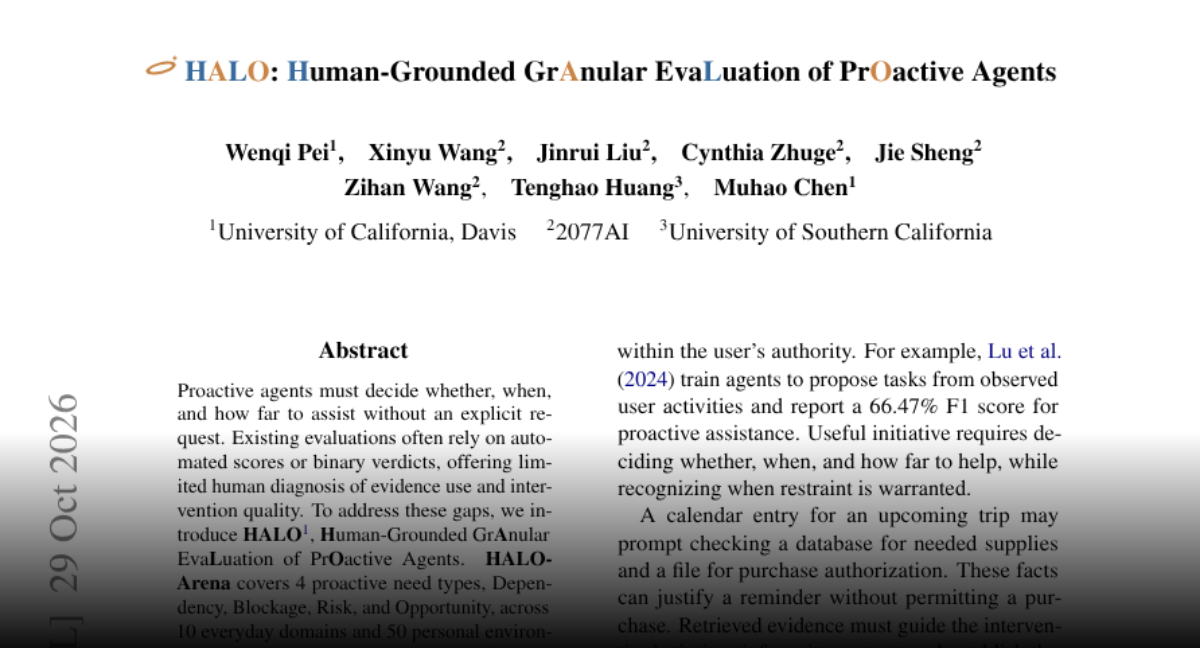
HALO finds excessive intervention is a major proactive-agent failure

HALO finds excessive intervention is a major proactive-agent failure

HALO evaluates whether proactive agents intervene at the right time and with appropriate scope. Its human-annotated dataset contains 8,000 responses from ten models across 400 scenarios. The best proprietary and open models reached 72.88% and 56.63% acceptability, respectively. Premature timing or excessive intensity accounted for 61.20% of rejected responses. The findings make restraint an explicit evaluation target: retrieving evidence and recognizing a possible need are not sufficient to justify taking stronger action.

06

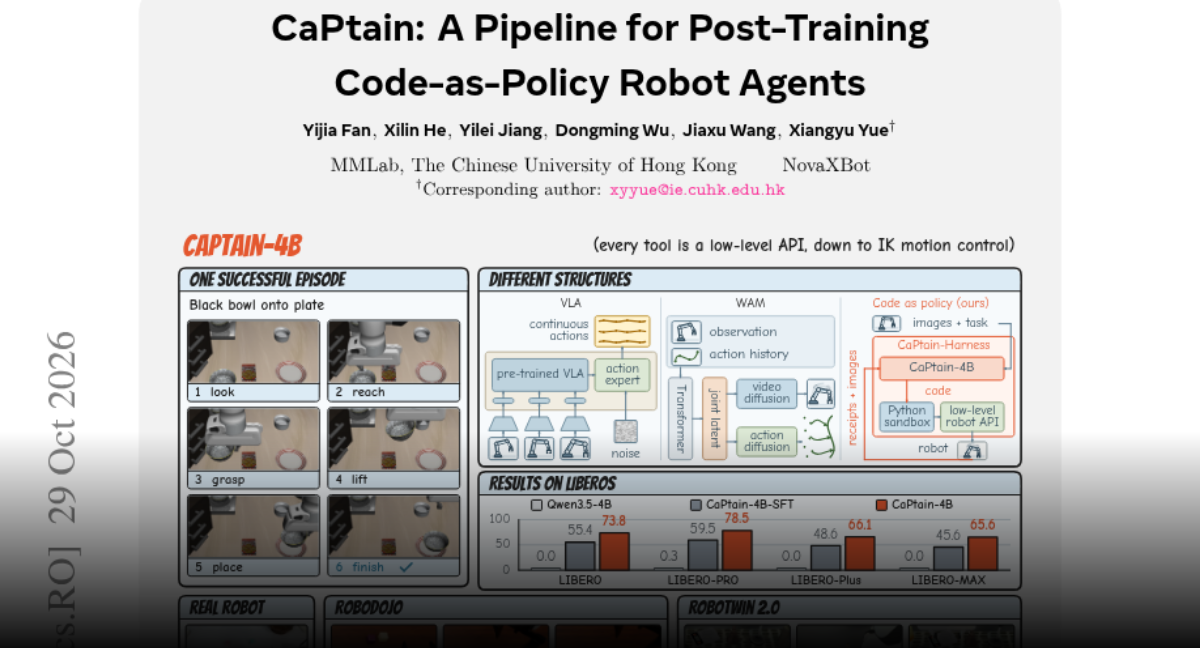
CaPtain trains a small open model to control robots through code

CaPtain trains a small open model to control robots through code

CaPtain applies supervised fine-tuning followed by multi-turn reinforcement learning to code-as-policy robot agents. Starting from Qwen3.5-4B, the authors report held-out LIBERO success rising from zero-shot failure to 55.4% after supervised training and 73.8% after reinforcement learning. A physical critic uses privileged simulator state during training to assign credit across requests, while the deployed policy does not receive that state. The release includes code, data, and weights, supporting investigation of smaller trainable robotic agents.

07

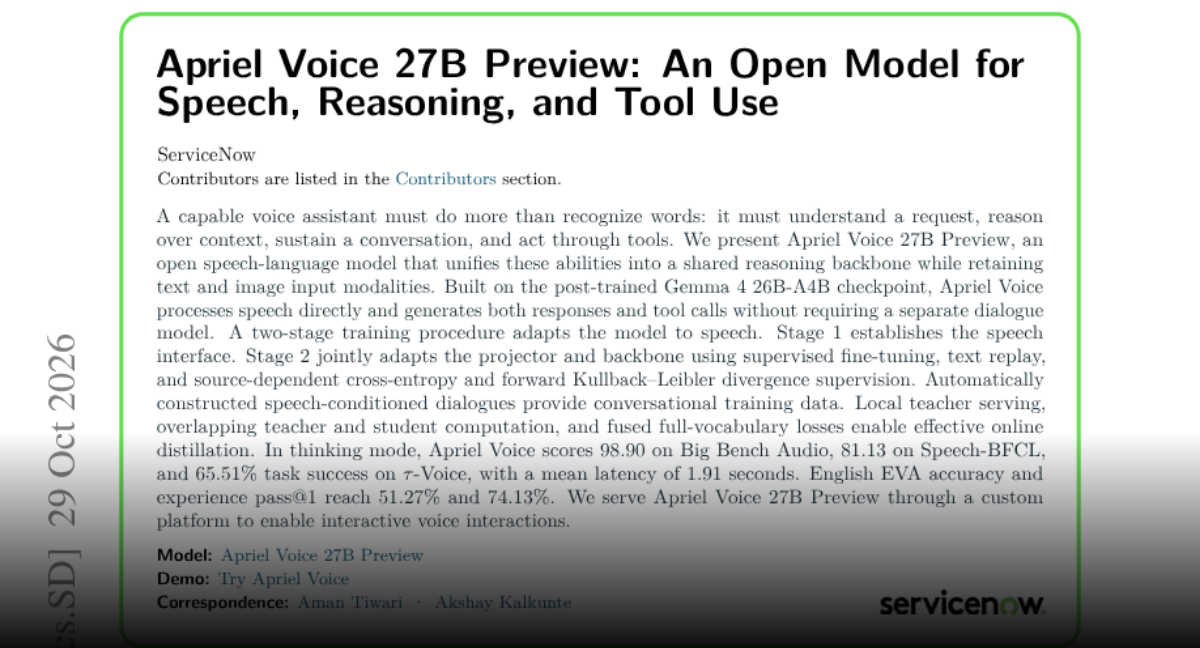
Apriel Voice 27B Preview combines speech, reasoning, and tools

Apriel Voice 27B Preview combines speech, reasoning, and tools

Apriel Voice 27B Preview is an open speech-language model built on Gemma 4 26B-A4B, combining speech processing, responses, and tool calls in a shared reasoning backbone while retaining text and image inputs. The authors describe two-stage speech adaptation and online distillation. In thinking mode, they report 98.90 on Big Bench Audio, 81.13 on Speech-BFCL, and 65.51% task success on tau-Voice with 1.91-second mean latency. These figures characterize the reported evaluation setup rather than every deployment environment.

08

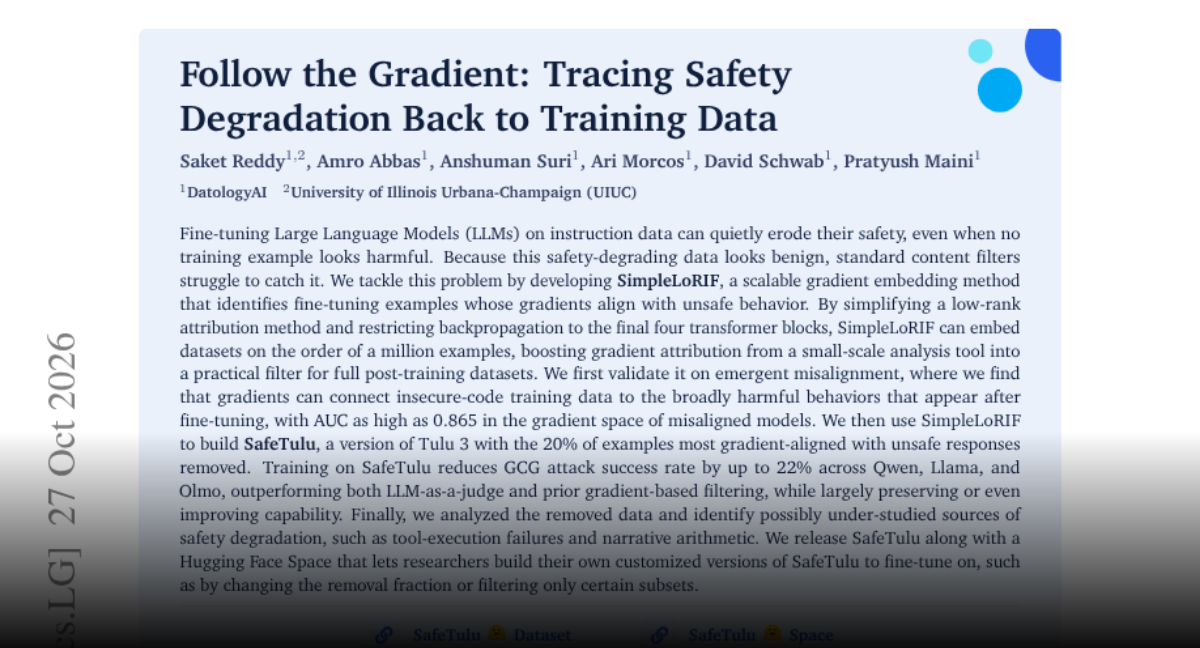
SimpleLoRIF traces safety degradation to apparently benign training data

SimpleLoRIF traces safety degradation to apparently benign training data

SimpleLoRIF uses scalable gradient embeddings to identify fine-tuning examples associated with unsafe behavior, including examples that ordinary content filters might consider benign. The authors build SafeTulu by removing the 20% of Tulu 3 examples most aligned with unsafe responses. They report reducing GCG attack success by up to 22% across evaluated model families while largely preserving capabilities. The work connects post-training data selection with safety outcomes and releases resources for studying different filtering fractions and subsets.