NO/FOMO

Independent AI signal, once a day

The AI briefing worth opening.

ISSUE DATE2026-11-04DEFAULT EDITION
This issue
—
All time
—

AI Blog

4 stories
01

OpenAI plans to acquire Pierre Computer Company

OpenAI announced that it will acquire Pierre Computer Company, describing the deal as an expansion of the tools available around Codex for building, understanding, and reviewing code. The announcement positions code review and developer workflow as part of the coding assistant product. For engineering teams, the relevant development is the intended integration of more of the software lifecycle; the announcement does not itself establish a completed acquisition or a delivery timetable.

02

SGLang adds day-zero Kimi K3.1 Pro serving and RL support

SGLang adds day-zero Kimi K3.1 Pro serving and RL support

SGLang announced day-zero inference support for Kimi K3.1 Pro across NVIDIA, AMD, Google TPU, AWS Trainium, and Zhenwu PPU hardware, alongside reinforcement learning support through Miles. The breadth of listed accelerators makes this an infrastructure announcement as well as a model ecosystem update. Teams considering the model have several deployment paths to evaluate, although support on a platform does not by itself establish equivalent performance, pricing, or operational maturity across those platforms.

03

Daybreak Red reaches AWS GovCloud through Bedrock

OpenAI announced availability of Daybreak Red in AWS GovCloud US-East through Amazon Bedrock, bringing GPT-5.6 Cyber to approved customers for authorized cybersecurity work. The stated scope is a controlled customer and deployment environment rather than general consumer access. For security organizations, the development concerns where the capability can be deployed and procured. The collected announcement does not provide independent effectiveness measurements or establish that access is available to every GovCloud customer.

04

Jill Hazelbaker to lead corporate affairs at OpenAI

OpenAI announced that Jill Hazelbaker will join as Chief Corporate Affairs Officer, with responsibility for global communications and corporate positioning. This is a leadership appointment rather than a model or product release. It is relevant to the broader industry because the way major AI companies explain their strategy and public commitments increasingly accompanies technical competition. The announcement identifies the remit of the role but does not establish any resulting change in policy or product direction.

Hacker News

5 stories
01

US voters reject data centers in ballot measures

US voters reject data centers in ballot measures

Semafor reports that US voters rejected data centers in ballot measures, bringing local political consent into the debate over AI infrastructure expansion. The story attracted substantial discussion on Hacker News. Its immediate significance is that access to capital and computing hardware does not settle whether projects can proceed in a community. The collected headline does not establish the geographic scope or the details of individual votes, so those should not be generalized into a nationwide construction ban.

02

AI security debate puts accumulated technical debt in focus

AI security debate puts accumulated technical debt in focus

An IEEE Spectrum article argues that AI is forcing the software industry to confront decades of technical debt, with its source URL identifying the PHP2Shell vulnerability as part of the cybersecurity discussion. It was the highest-scoring AI-related Hacker News candidate in this collection. The story matters because existing software weaknesses shape the consequences of stronger automated capabilities. The collected metadata alone does not establish the exploit mechanics or quantify how much technical debt AI can resolve.

03

Geoffrey Hinton questions whether AI will leave society better off

Geoffrey Hinton questions whether AI will leave society better off

The Guardian reports Geoffrey Hinton saying that it might turn out humanity would have been better off without AI. The article became a heavily discussed Hacker News item, reflecting continued attention to the social consequences of increasingly capable systems. The wording expresses a possibility and concern, rather than a demonstrated prediction. It belongs in the broader governance debate alongside industry statements about human control, without treating either position as evidence that a particular outcome is inevitable.

04

Gemini chat-history training policy draws subscriber scrutiny

A Hacker News discussion highlights Google documentation saying personal Gemini chat history can be used to improve services and train models when Keep Activity is enabled, including for paid personal accounts. The post also cites human review and retention of reviewed chats. Turning off the setting changes history availability, creating a practical privacy tradeoff. This is a discussion of personal-account settings; the collected material does not justify extending the same claims to enterprise contracts or every Google AI product.

05

Report flags RTX Spark inference slowdown on Linux

Report flags RTX Spark inference slowdown on Linux

A MindStudio article reports that encrypted firmware on an NVIDIA RTX Spark laptop reduces Linux inference speed to 35 percent of the comparison level described in its headline. The report drew strong interest on Hacker News. The practical issue is the influence of platform software and firmware on usable AI hardware performance. The collected metadata does not specify the test configuration or baseline, so the percentage should be treated as the article’s reported result rather than a universal hardware characteristic.

Twitter

9 stories
01

Runway brings its developer plugin to Claude Code

Runway brings its developer plugin to Claude Code

Runway announced that its developer plugin is available in Claude Code, allowing the coding assistant to integrate Runway APIs for video, image, and audio generation into applications. The described workflow begins with a developer explaining what an application should generate, after which the assistant writes the integration. This makes creative model access part of a coding workflow. The announcement describes integration assistance, without supplying measured improvements in development speed or guarantees about generated application quality.

02

Kling 4.0 Flash opens access across web and API

Kling 4.0 Flash opens access across web and API

Kling announced that Kling 4.0 Flash is available to everyone through its website and API, with additional access through MCP, command-line tooling, and AI plugins. The release broadens the routes through which creators and developers can incorporate video generation into their workflows. Its practical significance is distribution across both interactive and programmable interfaces. The captured announcement does not specify comparative quality, pricing, or latency, so those remain separate questions for prospective users to evaluate.

03

Luma adds Character Sheet for consistent references

Luma adds Character Sheet for consistent references

Luma highlighted Character Sheet, a feature that turns character references into a consistent sheet for continued creative work. The product addresses a familiar difficulty in generated imagery: maintaining the same character as viewpoint or presentation changes. A reusable reference sheet could help creators carry a visual identity across subsequent steps in production. The post describes the intended workflow, but it does not provide a benchmark demonstrating how reliably identity is preserved across arbitrary scenes or generations.

04

Pika highlights community Turbo LoRA for H3 Flex

Pika highlights community Turbo LoRA for H3 Flex

Pika reported that a community developer built a Turbo LoRA within a day of the H3 Flex weights being released. The post describes two-step draft generation, four-step fast generation, and eight-step HD variants compatible with ComfyUI and Diffusers. This is a concrete example of community adaptation following a weight release. The different sampling configurations give creators options to test, although the post does not establish a controlled quality or latency comparison against the original model.

05

Anthropic introduces FlashProve for verifiable inference

Anthropic introduces FlashProve for verifiable inference

Anthropic introduced FlashProve as research into provable inference for large language models. Using established cryptographic techniques, the system is intended to let developers verify that a response came from a specified AI model. This addresses model provenance in an inference pipeline, a different question from whether the response is accurate or safe. The collected announcement establishes the research direction but does not provide enough detail to assess production overhead or deployment requirements.

06

Claude plugins gain automatic connection through trusted MCP issuers

Claude plugins gain automatic connection through trusted MCP issuers

Claude developers announced that users can automatically connect plugins when signing in, provided the MCP servers accept Claude as a trusted issuer. Plugin builders are encouraged to add support so users can stay connected without repeated authorization. The change targets friction in connecting external capabilities to an assistant. Its usefulness depends on the server implementing the trust relationship correctly; the announcement does not imply that every MCP server already supports the flow or that authorization checks disappear.

07

Claude Messages API adds server-cached message threads in beta

Claude Messages API adds server-cached message threads in beta

Claude developers announced a public beta for message threads in the Messages API. The server caches the conversation between turns, allowing clients to send new messages together with the previous message identifier instead of resending the entire conversation. The stated benefit is an earlier response start. For application builders, this changes conversation state handling at the API boundary, while the collected post does not specify retention terms, pricing effects, or compatibility constraints for existing integrations.

08

Anthropic opens applications for its research residency

Anthropic opened applications for a paid, fixed-term research residency aimed at academics, technical founders, and staff-level engineers interested in AI safety and beneficial AI. The announcement says a machine learning background is not required and gives November 22 as the application deadline. The program is notable as a recruiting route for experienced technical people from outside conventional ML research. The post does not specify selection rates, compensation amounts, or guaranteed employment after the residency.

09

Sam Altman argues people must retain control of AI’s future

Sam Altman said that people should remain in control of the future and described OpenAI as opposing a situation in which humans are relegated to activities that AI systems choose to reward. The statement drew substantial engagement and adds a prominent industry voice to debates about human agency. It is a public position on the desired relationship between people and AI, rather than evidence of a new technical control mechanism or a concrete governance commitment.

GitHub

2 stories
01

Worktrunk manages Git worktrees for parallel coding agents

Worktrunk manages Git worktrees for parallel coding agents

Worktrunk is a command-line tool for managing Git worktrees, designed around parallel AI agent workflows. The repository provides a focused infrastructure building block for teams running multiple coding tasks against a shared codebase. Separate worktrees can help organize concurrent changes while retaining Git as the underlying version-control system. The collected repository description establishes the project’s purpose, but it does not provide a comparative benchmark, conflict-resolution guarantee, or evidence about suitability for a particular production workflow.

02

NVIDIA Auto Ontology builds graph-based reasoning layers

NVIDIA Auto Ontology builds graph-based reasoning layers

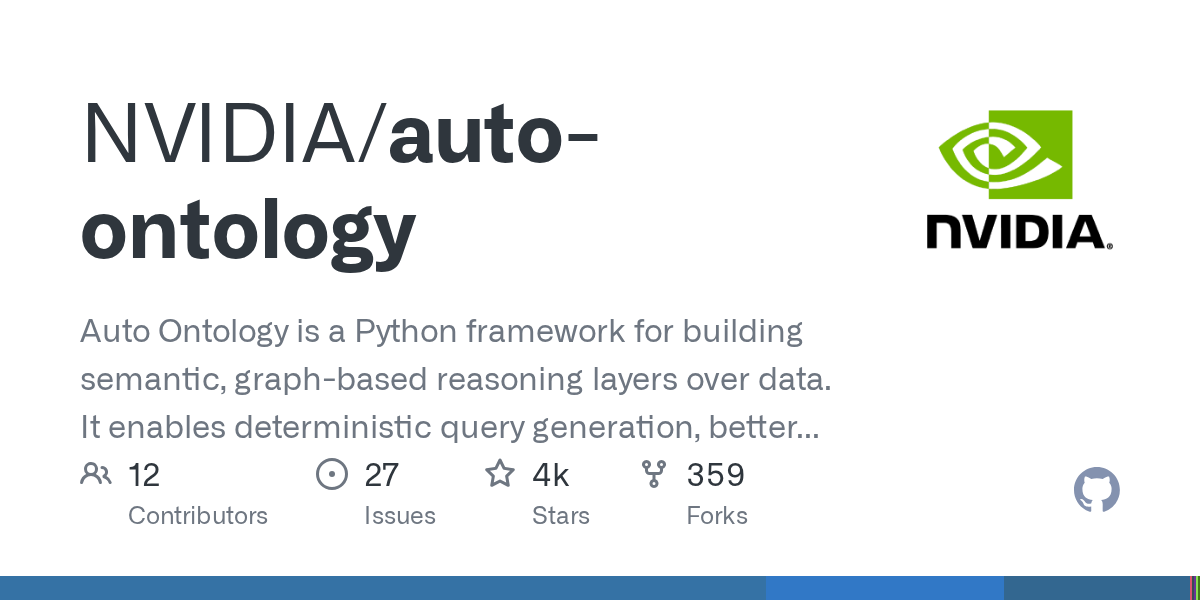
NVIDIA’s Auto Ontology repository describes a Python framework for building semantic, graph-based reasoning layers over data. Its stated goals include deterministic query generation, improved context retrieval, and more explainable AI in LLM and agent workflows. The project is relevant to developers who need structured information access alongside language models. Those are the repository’s design claims; the collected description does not independently establish retrieval accuracy gains or demonstrate that explanations faithfully represent every downstream model decision.

HF HuggingFace

5 stories
01

ToolSpace builds agent environments from real tool dependencies

ToolSpace builds agent environments from real tool dependencies

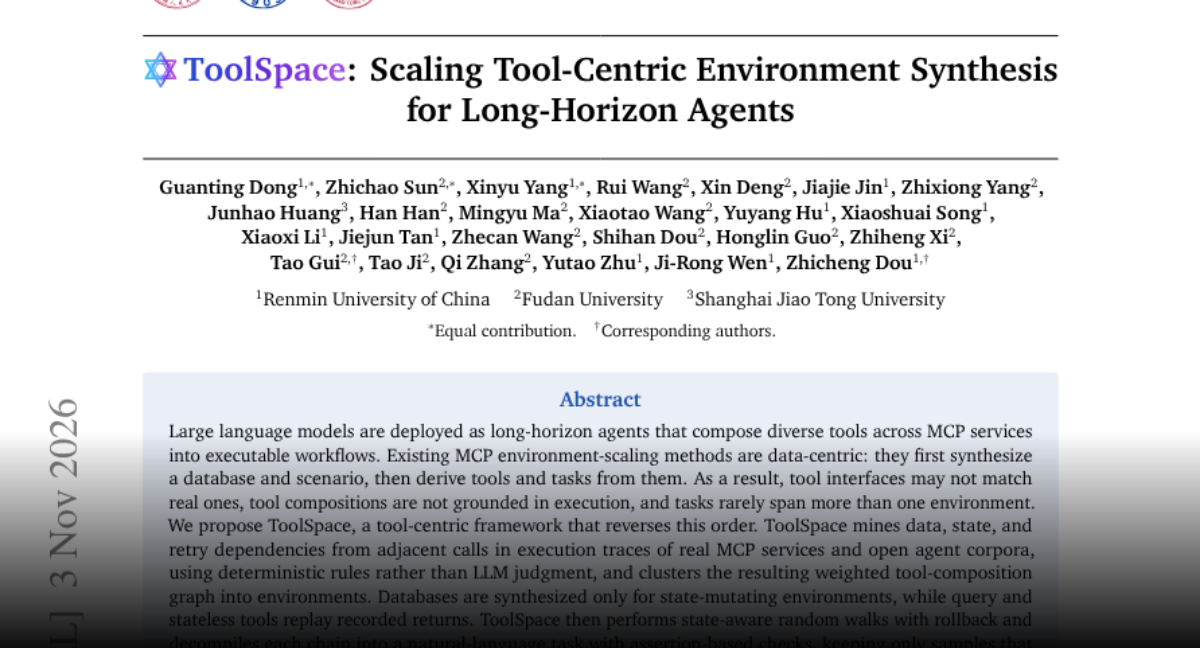
ToolSpace constructs training environments from dependencies observed in real MCP execution traces instead of inventing tools around synthetic databases. It retains task chains that can replay successfully and uses assertion-based checks. The authors report that harder benchmark variants reduce frontier-model scores by up to 38.2 points, while their training pipeline improves several open models. The result suggests execution-grounded environment design can strengthen long-horizon tool use, with the reported gains remaining specific to the evaluated models and benchmarks.

02

DreamX turns video diffusion features into transferable actions

DreamX turns video diffusion features into transferable actions

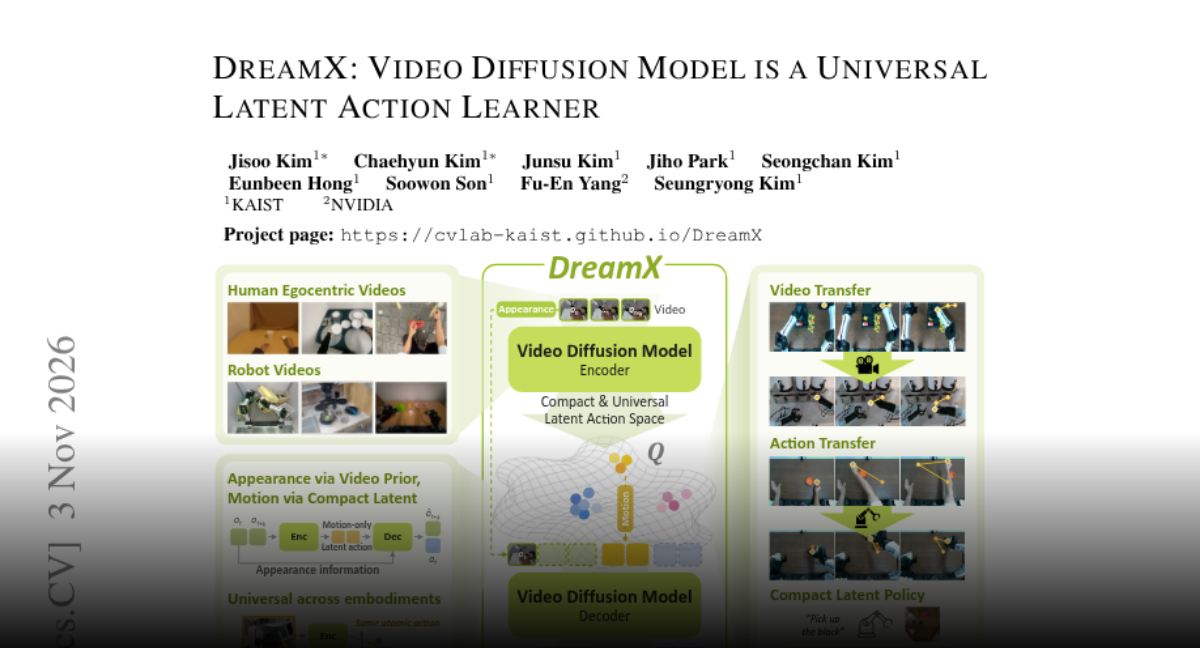
DreamX repurposes a pretrained video diffusion model to learn compact latent actions that separate motion from appearance and embodiment. The authors report compressing each latent video frame from 1,200 tokens to four, while supporting action transfer across human and robot settings. They also report strong performance on LARY-Bench and zero-shot transfer examples. The work connects generative video representations with policy learning, although benchmark results do not establish reliable deployment across arbitrary real-world robots or environments.

03

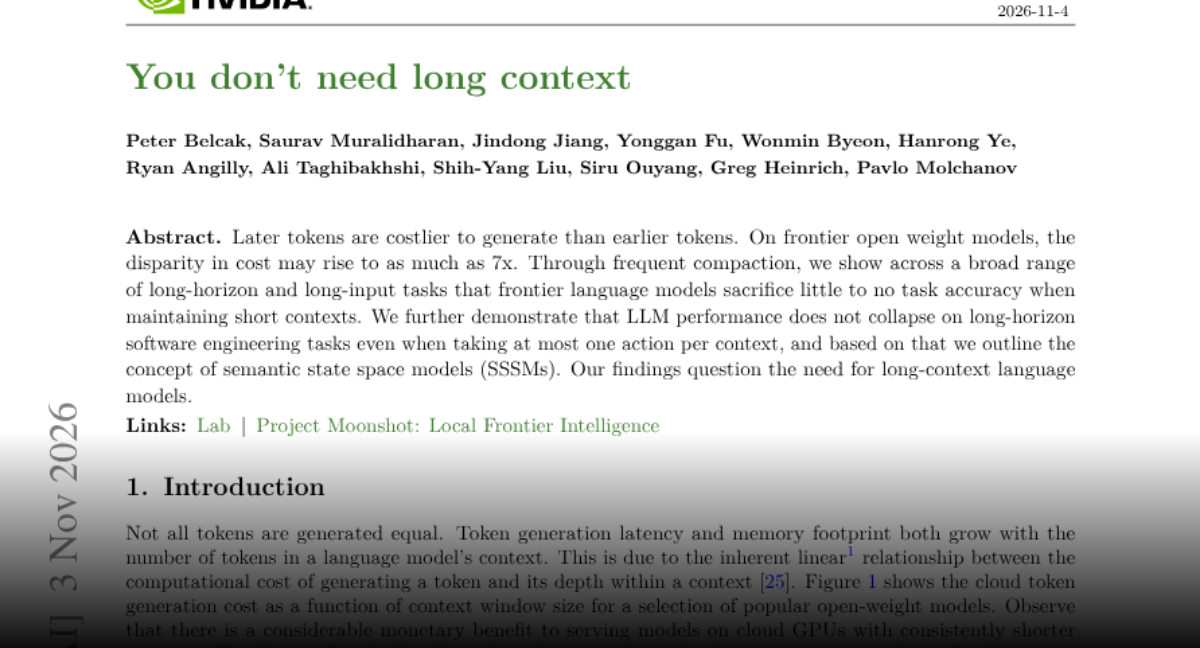
Research tests frequent compaction instead of long context

Research tests frequent compaction instead of long context

The paper You don’t need long context reports that frequent context compaction can preserve task accuracy across tested long-input and long-horizon workloads. It notes that later tokens can cost substantially more to generate and examines software-engineering agents taking at most one action per context. The authors use these findings to motivate semantic state space models. The study challenges assumptions about retaining every interaction, but its results should not be read as proof that long context is unnecessary for every task.

04

MoviEdit targets consistent editing across long multi-shot videos

MoviEdit targets consistent editing across long multi-shot videos

MoviEdit introduces a framework for keeping video edits coherent across changes in scene, viewpoint, and subject appearance. Its pipeline generates 87,000 paired editing videos without manual annotation, then combines a compressed bidirectional draft with autoregressive refinement over the full video. The authors also introduce MoviEdit-Bench and report improvements over existing open models. The work is relevant to longer creative workflows, with comparative performance still dependent on the paper’s evaluated tasks and chosen reference systems.

05

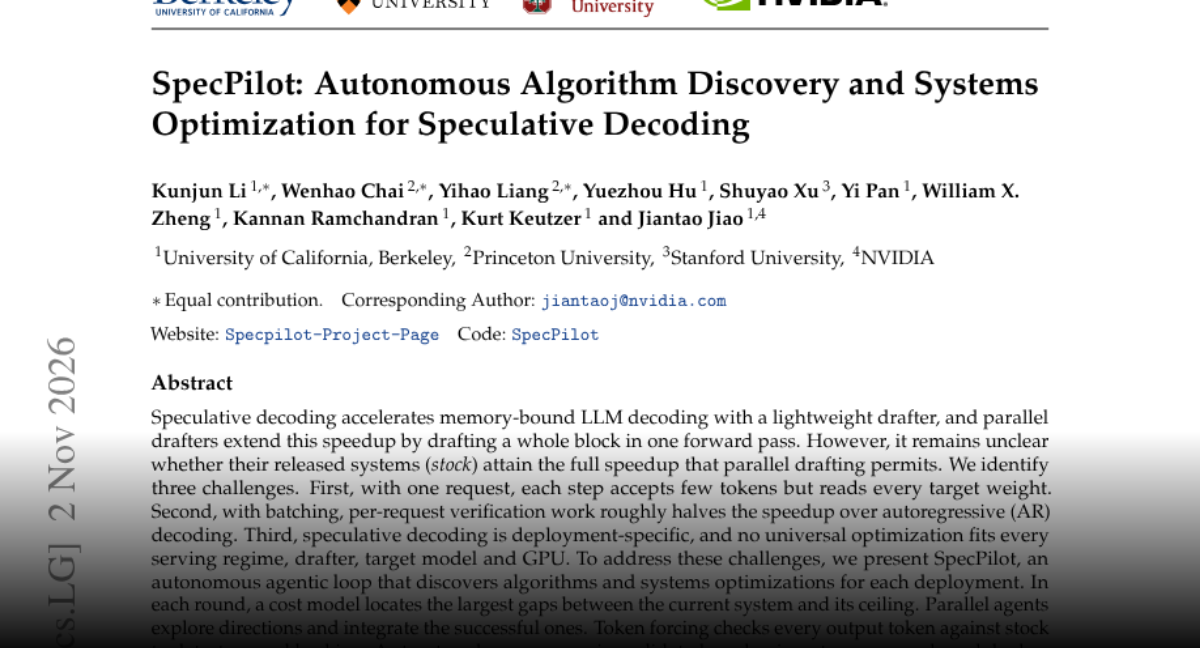
SpecPilot uses agents to optimize speculative decoding

SpecPilot uses agents to optimize speculative decoding

SpecPilot uses an autonomous optimization loop to find deployment-specific improvements in speculative decoding. A cost model identifies bottlenecks, agents explore changes, and token-level checks compare outputs with the original system. Across the reported evaluation, single-request speedup over autoregressive decoding rises from 4.46 times to 10.87 times, with batching also improving. The authors report no quality loss in those tests; the results are tied to the evaluated models, drafters, hardware, and workloads rather than a universal serving guarantee.