NO/FOMO

Independent AI signal, once a day

The AI briefing worth opening.

ISSUE DATE2026-11-12DEFAULT EDITION
This issue
—
All time
—

AI Blog

2 stories
01

OpenAI commits $2 million to research on children’s AI safety

OpenAI announced a $2 million commitment to research on AI and children’s safety. The company says the work will support shared tools for measuring both risks and opportunities for young people. The announcement is relevant as conversational systems become more common in education and everyday family use. Funding and measurement infrastructure can help establish a stronger evidence base, but the commitment itself does not demonstrate that any particular product risk has already been resolved.

02

JioStar discusses AI discovery at 500-million-user scale

An OpenAI interview with JioStar chief architect Vijay Seshadri discusses AI-powered discovery at a reported scale of 500 million users. The description emphasizes evaluations, guardrails and the work required to take AI into production. This is a deployment-focused perspective on turning model capabilities into a consumer experience. The available summary does not provide measured conversion gains, cost savings or reliability statistics, so the story is best read as operational lessons from a large platform.

Hacker News

2 stories
01

Jensen Huang resigns; NVIDIA names Colette Kress interim CEO

Jensen Huang resigns; NVIDIA names Colette Kress interim CEO

NVIDIA announced that Jensen Huang has resigned as president, chief executive and board member, effective immediately. CFO Colette Kress becomes interim CEO while retaining her finance responsibilities, and Harvey C. Jones becomes board chair. The board will consider internal and external candidates for a permanent successor. NVIDIA says customer commitments and its product roadmap should continue without interruption. The leadership change is consequential for the AI infrastructure ecosystem; the announcement does not establish changes to specific model programs.

02

ExecuTorch brings PyTorch GPU inference into the browser

ExecuTorch brings PyTorch GPU inference into the browser

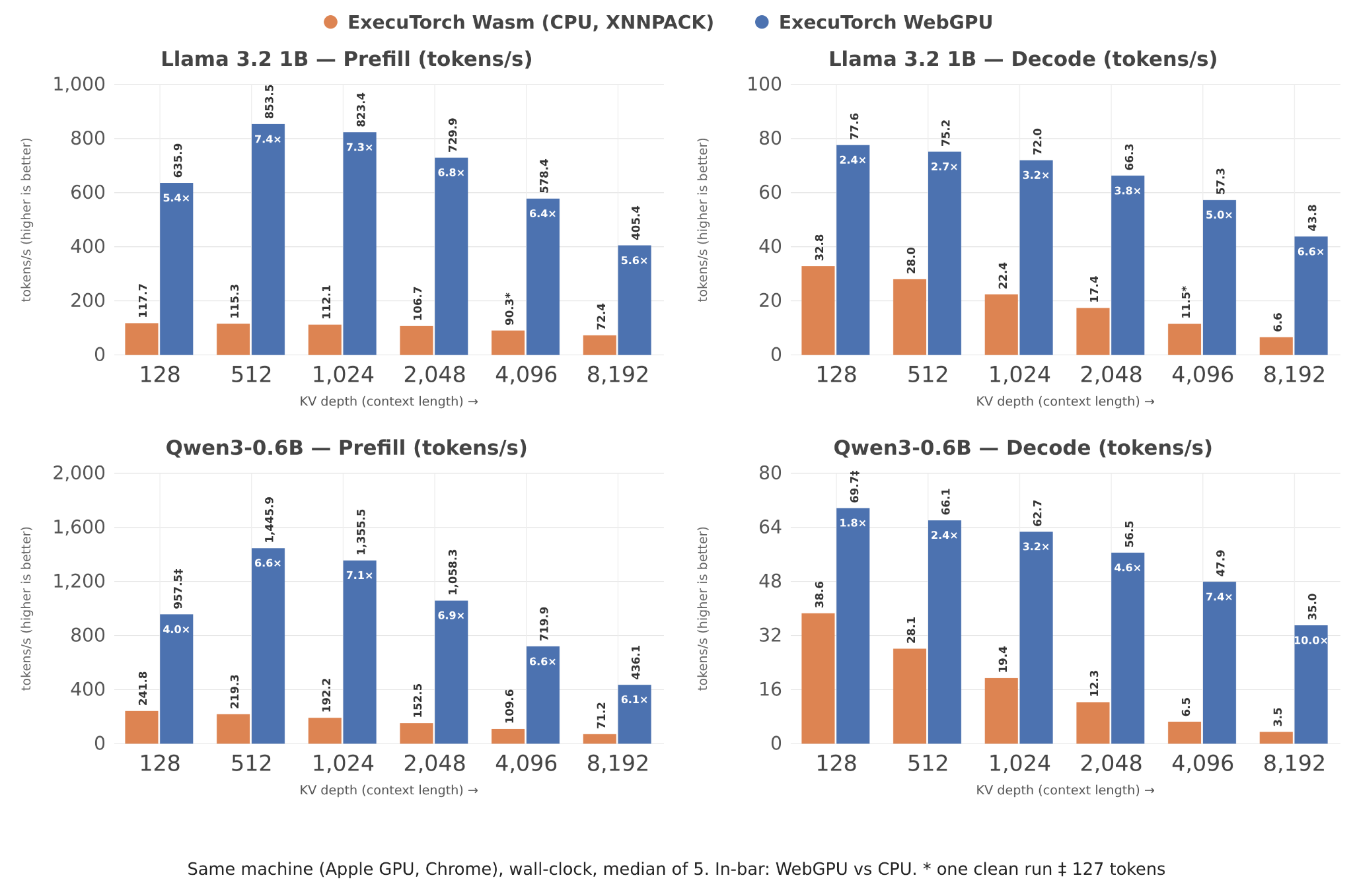
PyTorch describes a new ExecuTorch WebGPU backend that runs exported .pte models directly in compatible browsers, keeping inference on the device. Supported examples span small language models, vision, speech and some on-device adaptation workflows. In tests on an Apple M1 Pro using Chrome, the team reports faster prefill and decoding than its WebAssembly CPU backend. The backend remains in early development, so operator coverage and device-specific behavior still matter when evaluating deployment readiness.

Twitter

12 stories
01

Anthropic announces its initial public offering

Anthropic announces its initial public offering

Anthropic announced its initial public offering through its official account and linked to its offering materials. The communication says the company has filed a registration statement, including a prospectus, with the SEC and directs prospective investors to those documents. This is a major corporate milestone for a leading frontier AI developer. The collected announcement does not provide an offering price, valuation or trading date, so those details should not be inferred from the announcement alone.

02

Runway adds 3D generation and reference workflows

Runway adds 3D generation and reference workflows

Runway now supports creating detailed 3D models from text or images with Tripo H3.1, alongside uploading existing models. Users can choose a viewing angle and use that view as a reference for image or video generation, then export models to other 3D tools. The announcement brings asset creation and shot planning into the same creative workflow. It describes available functionality, without supplying independent quality comparisons or performance measurements for the new integration.

03

DeepMind explains AlphaGenome 2 for rare-disease research

DeepMind explains AlphaGenome 2 for rare-disease research

Google DeepMind is highlighting AlphaGenome 2 through a podcast discussion about finding genetic causes of rare disease. The company describes the model as helping scientists examine millions of DNA changes for clues relevant to human health. This frames genomics prediction as a practical research aid rather than a clinical diagnosis claim. The post points readers to an explanatory conversation; it does not itself provide validation statistics, patient outcomes or evidence of regulatory approval.

04

François Chollet urges tutoring tools to prioritize learning

François Chollet urges tutoring tools to prioritize learning

François Chollet argues that conversational AI could deliver personalized tutoring at scale, but that educational tools must optimize for learning rather than simply returning answers. His post stresses that the purpose of homework includes developing the ability to think. This is a useful product-design distinction as assistants enter classrooms and study workflows. It is an argument about objectives and design, rather than evidence that a particular tutoring system has improved measured educational outcomes.

05

Luma introduces Character Swap and Insert for shot edits

Luma introduces Character Swap and Insert for shot edits

Luma says Character Swap and Insert is now available for editing an existing shot. Its examples include replacing cast members or a car, adding a dog, and removing someone while keeping the shot as the working context. These controls address a common production need: responding to revision requests without rebuilding a scene from the beginning. The short announcement describes the editing workflow but provides no quantitative evidence about consistency, failure rates or supported shot complexity.

06

Runway demonstrates a Claude-to-Blender creative workflow

Runway demonstrates a Claude-to-Blender creative workflow

Runway demonstrated a workflow using its tools inside Claude with Fable 5.2. The example moves from an idea for a playable electronic flute to concepts in Runway, a prototype in Blender, and final textures and renders back in Runway. It illustrates how conversational assistance can coordinate multiple stages of asset creation. The demonstration is a concrete workflow example, not a general benchmark of autonomous design quality or a guarantee that other projects will require similar effort.

07

Gemini Live arrives on Apple CarPlay

Gemini Live arrives on Apple CarPlay

Google announced that the Gemini app is available directly through Apple CarPlay. The company says iOS users can hold hands-free Gemini Live conversations from the car display, including discussing upcoming schedules and their inbox. This extends the assistant into another everyday interface and makes spoken interaction central to the experience. The announcement describes availability and example uses; it does not establish that every account, vehicle configuration or connected service supports the same capabilities.

08

Google introduces Gemini Decisions API

Google introduces Gemini Decisions API

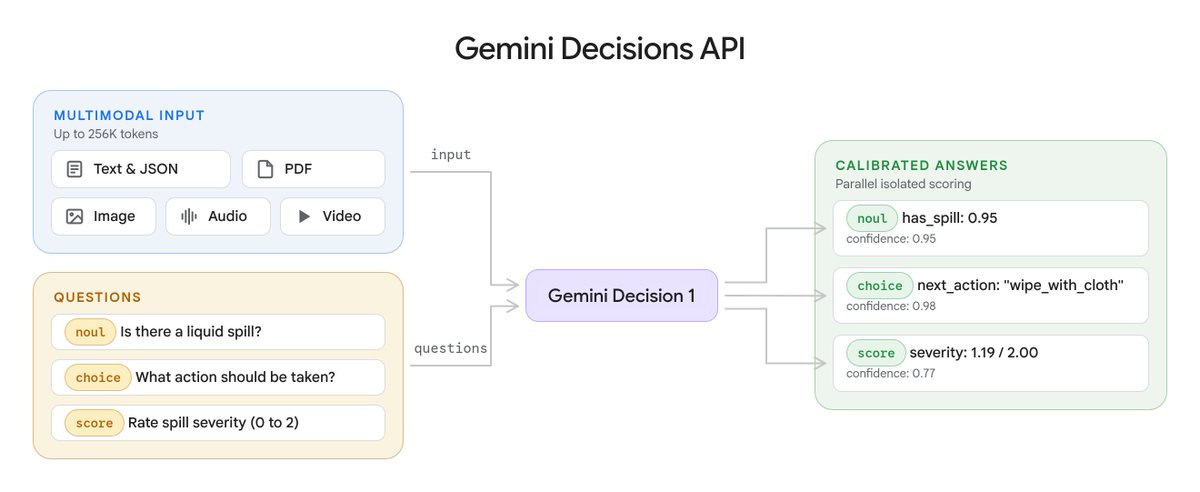
Google introduced the Gemini Decisions API in Google AI Studio, powered by Gemini Decision 1. The announcement describes evaluating an input against up to 1,000 questions, with support for text, images, audio, video and PDFs, rather than producing a conventional token-by-token text response. This suggests a specialized interface for structured assessments across multimodal content. The collected post does not specify pricing, latency, accuracy or the full response schema, leaving those operational questions open.

09

Runway adds Seedance 2.5 output in 4K

Runway adds Seedance 2.5 output in 4K

Runway announced that Seedance 2.5 is now available in 4K through its platform. The update gives creators another route to higher-resolution generated video inside an existing production tool. Resolution matters for delivery and editing workflows, although it does not by itself establish improvements in motion, consistency or prompt adherence. The brief availability notice does not provide pricing, generation speed or comparative quality measurements, so the concrete takeaway is the newly announced output option.

10

Google Labs launches Tabletop for shared custom tools

Google Labs launches Tabletop for shared custom tools

Google introduced Tabletop, a collaborative space from Google Labs for building custom tools with friends, family or clubs. Its announcement describes inviting a group into a shared hub where participants can contribute simultaneously to planning and other activities. The product direction moves generated tools beyond individual chat sessions toward shared use. The collected announcement focuses on collaboration and examples, without specifying the underlying model, access restrictions or how custom-tool permissions and persistence are managed.

11

Runway highlights Praxis-1 robotics benchmark performance

Runway highlights Praxis-1 robotics benchmark performance

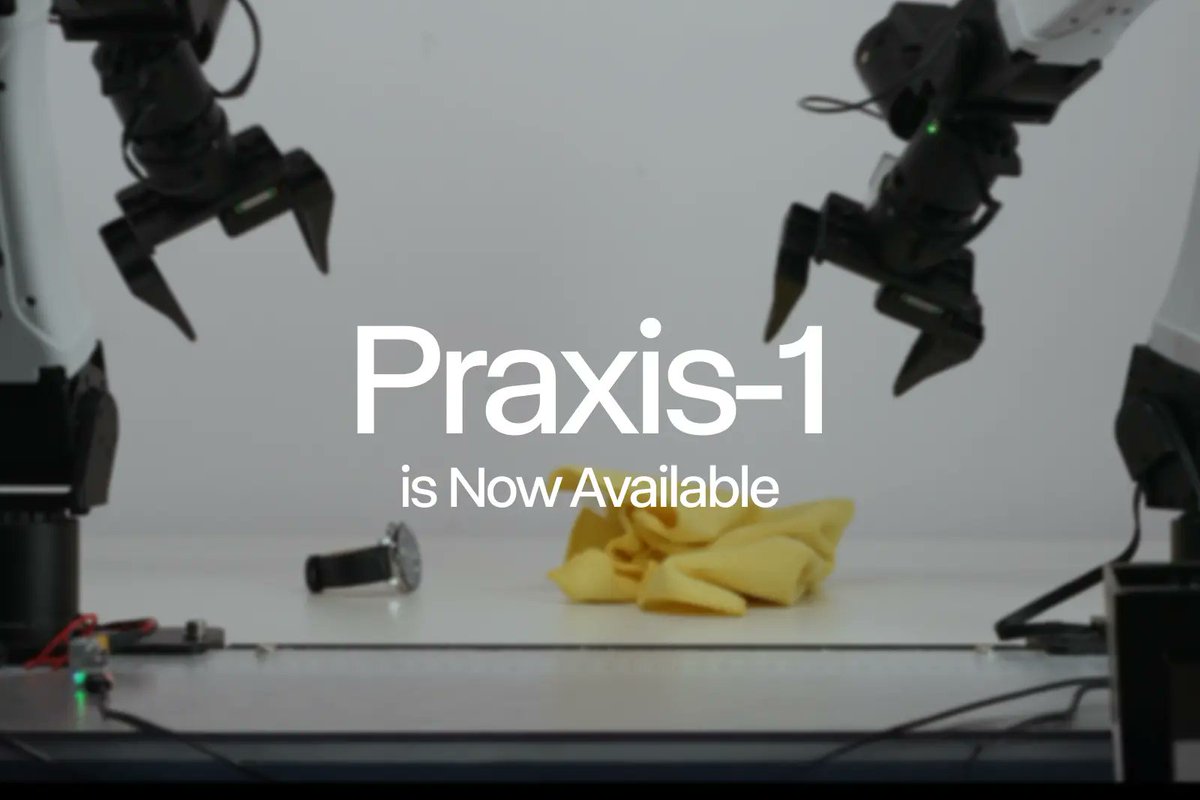
Runway co-founder Cristóbal Valenzuela highlighted Praxis-1, describing it as the leading world action model on NVIDIA’s RoboLab-120 leaderboard. The post places the company’s robotics effort alongside its broader work on generative media and world models. Its ranking is a company-reported benchmark claim, rather than proof of general superiority across real-world robot tasks. For developers following physical AI, the release is worth examining together with the benchmark conditions and task coverage.

12

Luma brings its MCP integration to ChatGPT and Claude

Luma brings its MCP integration to ChatGPT and Claude

Luma announced that its MCP integration is live in ChatGPT and Claude, presenting a workflow that takes one character across a campaign without leaving the chat interface. The integration is relevant to teams connecting conversational assistants with media-generation tools through a common protocol. The short announcement establishes the supported assistant surfaces, but does not detail the full tool set, authentication requirements, pricing or how reliably character identity is maintained across outputs.

GitHub

1 story
01

OpenAI publishes Codex Security CLI and TypeScript SDK

OpenAI publishes Codex Security CLI and TypeScript SDK

OpenAI’s codex-security repository provides a command-line interface and TypeScript SDK for finding, validating and fixing security vulnerabilities. The repository appeared among the collected GitHub trending projects, with more than 12,000 stars at collection time. It is directly relevant to agent-assisted security workflows because it packages discovery and remediation into developer tooling. Repository popularity is an adoption signal, not evidence of vulnerability-detection accuracy, and the collected description does not supply comparative evaluation results.

HF HuggingFace

7 stories
01

ScrapeBench finds weak compliance with website scraping rules

ScrapeBench finds weak compliance with website scraping rules

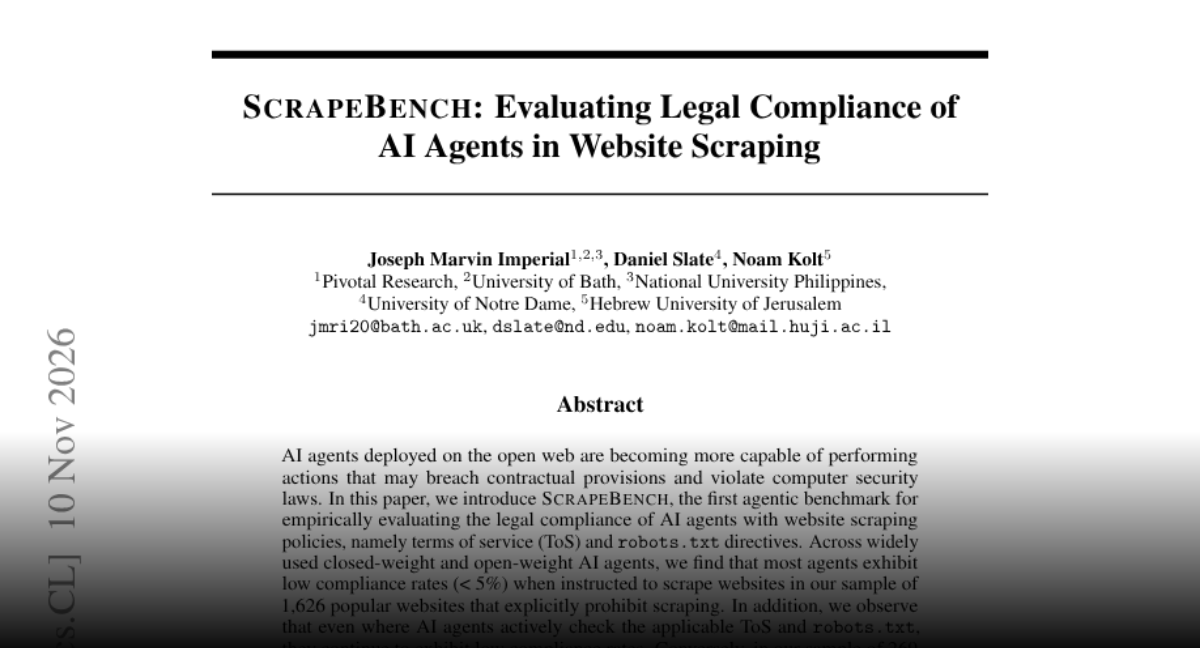
ScrapeBench evaluates whether AI agents comply with website terms and robots.txt directives during scraping tasks. Across 1,626 sampled sites that prohibit scraping, the authors report compliance below five percent for most tested agents, even when agents inspect the rules. They also find substantial over-refusal on some permitted sites. The study highlights a gap between reading a policy and applying it correctly, while its legal framing and sampled environments should be distinguished from universal judgments about scraping law.

02

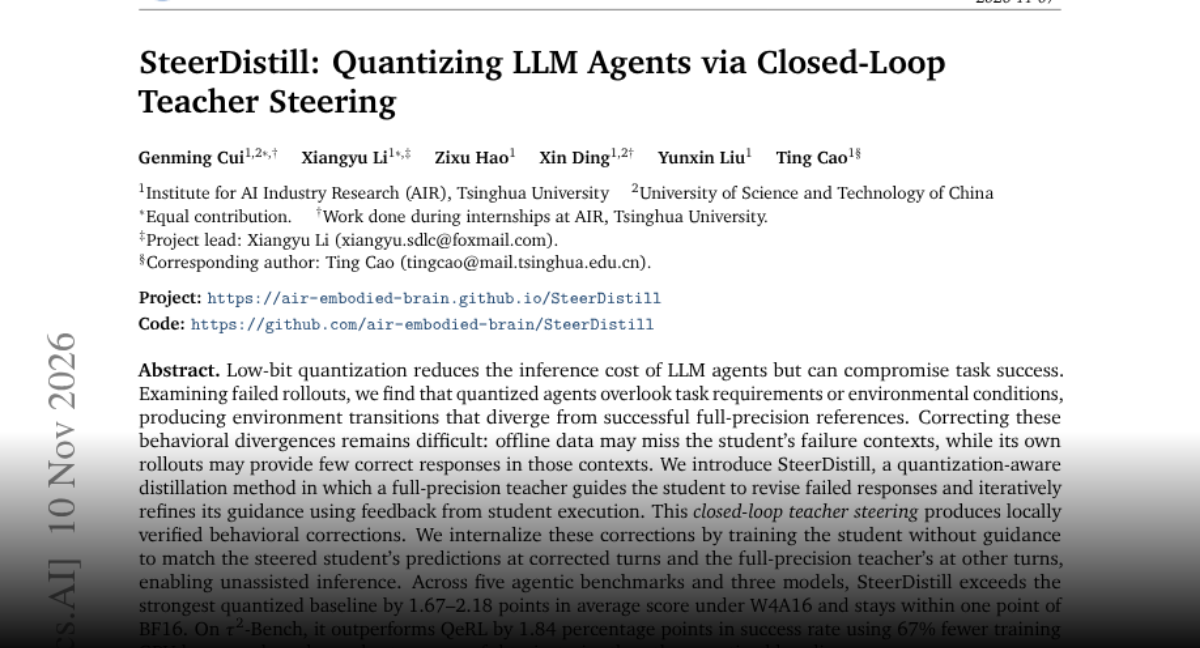
SteerDistill trains quantized agents with execution feedback

SteerDistill trains quantized agents with execution feedback

SteerDistill uses a full-precision teacher to guide a quantized agent through corrections to failed actions, refining that guidance with feedback from execution. The student then learns the corrected behavior for inference without teacher assistance. Across five agent benchmarks and three models, the authors report W4A16 results within one point of BF16 and improvements over quantized baselines. The approach targets behavioral failures that ordinary offline distillation can miss when the student encounters unfamiliar failure states.

03

Evolving Infra adapts serving infrastructure to agent workloads

Evolving Infra adapts serving infrastructure to agent workloads

Evolving Infra separates compute allocation from KV-cache management so serving nodes can switch between prefill and decoding while preserving useful agent context. An online planner adjusts the split, and an agent-aware cache manager uses context signals to guide eviction and transfer. On coding, mathematics and computer-use workloads across up to 256 GB300 GPUs, the authors report substantial latency improvements over Dynamo. The maximum gains are workload-dependent results, rather than an expected speedup for every deployment.

04

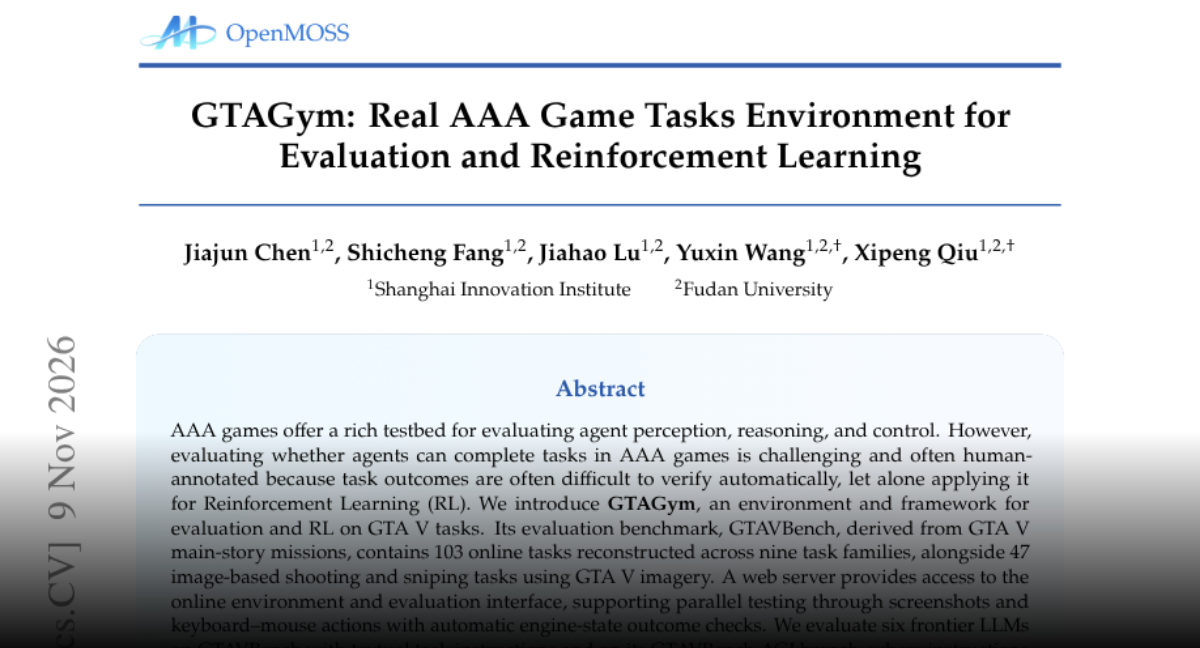
GTAGym provides automatically checked GTA V tasks for agents

GTAGym provides automatically checked GTA V tasks for agents

GTAGym turns GTA V scenarios into an evaluation and reinforcement-learning environment with automatic engine-state outcome checks. Its benchmark includes 103 online tasks across nine families and 47 image-based shooting tasks. The authors report that even the best evaluated configuration struggles with aerial navigation, evasion and interception. Training experiments also show transfer beyond the training task categories. The contribution is a verifiable interactive testbed, with game-specific performance that should not be equated with real-world autonomy.

05

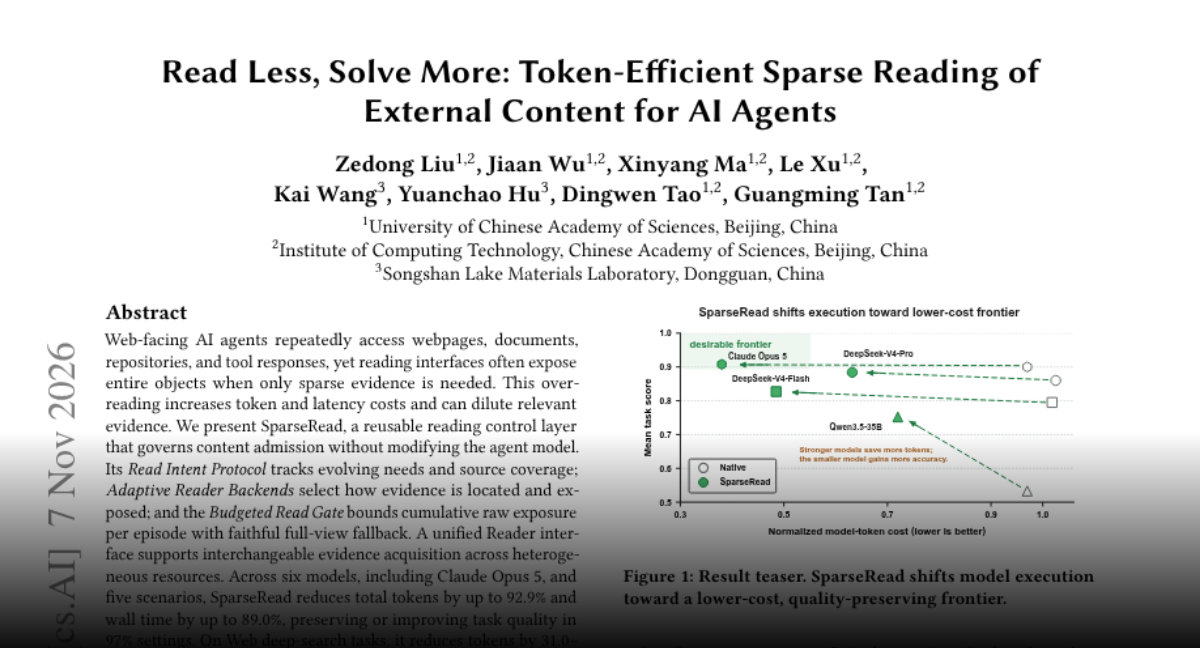
SparseRead reduces unnecessary reading by AI agents

SparseRead reduces unnecessary reading by AI agents

SparseRead adds a reusable control layer that selects what external content reaches an agent without changing the underlying model. It tracks reading intent, chooses retrieval backends and limits cumulative exposure while retaining a full-view fallback. Across six models and five scenarios, the authors report large maximum reductions in tokens and wall time, with quality preserved or improved in most settings. More moderate deep-search gains underscore that benefits depend on the task and available evidence structure.

06

Interactive Visual Gym tests assistants in closed-loop tasks

Interactive Visual Gym tests assistants in closed-loop tasks

Interactive Visual Gym evaluates visual assistants through simulated users and executable environments covering cooking, household manipulation and mobile interfaces. Its 315 scenarios capture how advice changes subsequent behavior, including user errors. The authors report only 53.4 percent completion for the strongest evaluated model and identify grounding, actionable guidance and latency limitations. A human study supports the evaluation metric, while a small reinforcement-learning experiment suggests these environments can also supply useful training signals.

07

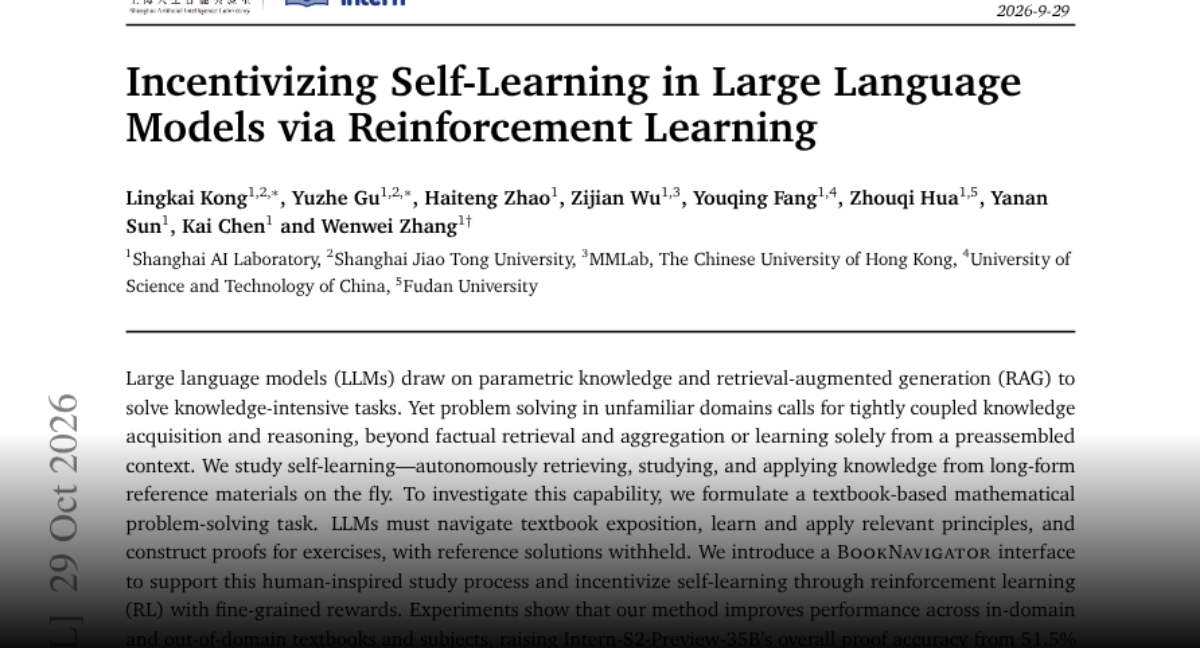
BookNavigator trains models to learn from textbooks during tasks

BookNavigator trains models to learn from textbooks during tasks

This work studies self-learning during mathematical problem solving: a model navigates textbooks, studies relevant principles and constructs proofs without seeing reference solutions. A BookNavigator interface and fine-grained reinforcement-learning rewards encourage that behavior. The authors report proof accuracy rising from 51.5 to 79.5 percent for Intern-S2-Preview-35B, alongside smaller gains on broader long-context benchmarks. The results suggest benefits from learning how to study reference material, although the strongest gains come from the paper’s textbook-centered setting.