NO/FOMO

Independent AI signal, once a day

The AI briefing worth opening.

ISSUE DATE2026-11-16ENGLISH EDITION
This issue
—
All time
—

AI Blog

4 stories
01

OpenAI expands ChatGPT for Healthcare with computer-use agents

OpenAI announced additions to ChatGPT for Healthcare that include computer-use agents, improved clinical answers, and new healthcare plugins. The stated goal is to help teams complete work across healthcare software, extending the product beyond answering questions. This is a consequential deployment direction because useful assistance depends on how well models interact with existing workflows. The announcement describes product capabilities; it does not by itself establish clinical outcomes or reliability across every healthcare setting.

02

LVMH’s Media Division partners with OpenAI

LVMH’s Media Division and OpenAI announced a partnership intended to support journalism with AI and make the division’s publications more accessible through ChatGPT. The agreement connects newsroom use of AI with distribution through an assistant interface, two increasingly linked questions for publishers. The collected announcement does not specify financial terms or detailed implementation arrangements. Its immediate significance is another major media organization formally engaging with how its work reaches readers through AI products.

03

The King’s Trust and OpenAI launch a £1 million AI skills partnership

The King’s Trust and OpenAI announced a £1 million partnership aimed at helping up to 25,000 young people across the United Kingdom build practical AI skills for work. The program frames AI adoption as a workforce capability issue, with attention to people entering employment rather than only specialist developers. The figures describe the partnership’s funding and intended reach; the announcement does not yet demonstrate participation, completion, or employment outcomes from the planned training.

04

OpenAI describes GPT-6 Astra’s role in a lattice Standard Model proposal

OpenAI published an account of a candidate nonperturbative lattice definition of the Standard Model and described how GPT-6 Astra helped develop the idea into a detailed proof. The work places AI assistance inside theoretical physics, where useful output must survive mathematical and scientific scrutiny. The announcement calls the construction a candidate, so it should be read as a research claim requiring expert assessment rather than a settled resolution of the underlying physics problem.

Hacker News

3 stories
01

Nvidia faces a leadership transition as AI chip competition intensifies

Nvidia faces a leadership transition as AI chip competition intensifies

WIRED reports that Colette Kress has taken the reins at Nvidia following Jensen Huang’s departure, as rivals challenge the company across AI infrastructure. Its analysis highlights AMD, cloud providers’ custom silicon, specialized inference chips, and AI-assisted software porting that could weaken CUDA’s switching-cost advantage. The business story extends beyond leadership: growing inference demand and alternative hardware put pressure on the technical and commercial decisions Nvidia makes for its next product cycles.

02

Google researchers report autonomous patch-to-exploit attacks

Google researchers report autonomous patch-to-exploit attacks

The Register reports that Google Threat Intelligence Group observed an AI-powered framework turning security patches into working exploits without human intervention. According to the report, researchers found an exposed staging server containing the framework and data stolen from victim organizations. The case suggests attackers are moving beyond isolated chatbot assistance toward automated intrusion workflows. For defenders, the practical concern is a shorter interval between a public security fix and attempts to exploit unpatched systems.

03

Qwen4-Max draws strong attention on Hacker News

Qwen4-Max draws strong attention on Hacker News

Qwen’s official Qwen4-Max page was one of the strongest AI signals in today’s Hacker News collection, with 746 points and 375 comments at collection time. The collected entry establishes the announcement and its discussion momentum but does not supply technical specifications or independently checked benchmark results. Readers evaluating the model should use the official announcement for current capabilities and access details, and separate community interest from evidence about performance in their own workloads.

Twitter

9 stories
01

Google says Gemini 4 Hydrogen is broadly available across its products

Google says Gemini 4 Hydrogen is broadly available across its products

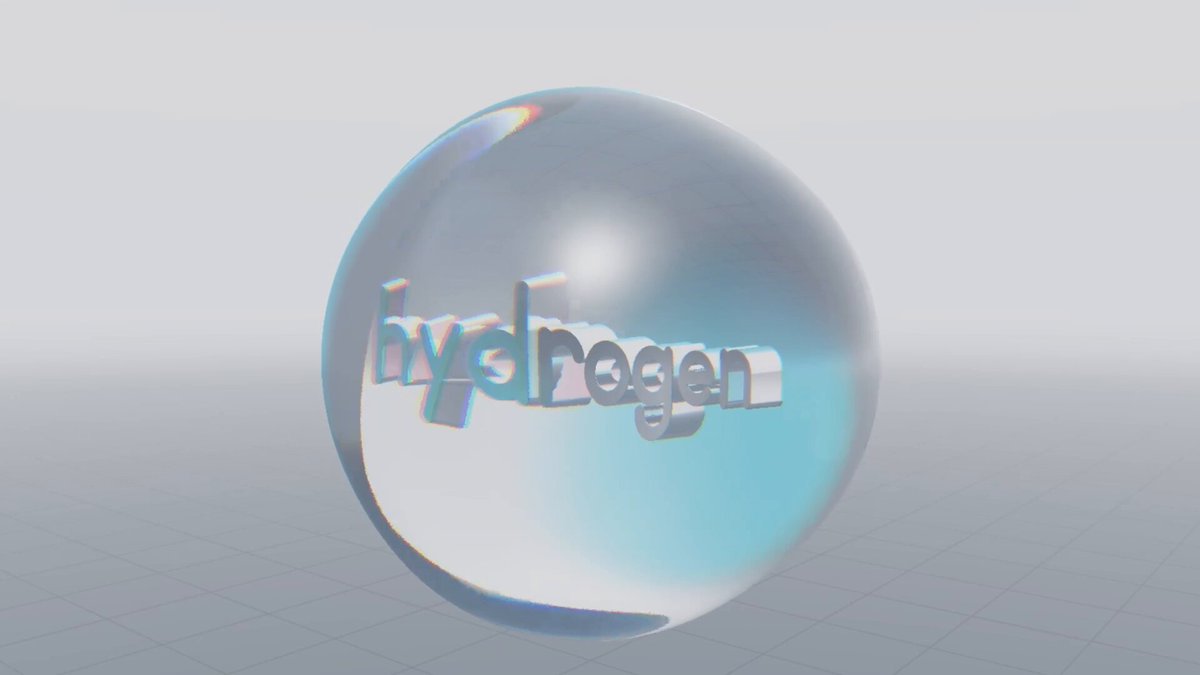
Google highlighted Gemini 4 Hydrogen’s availability across Gemini, Search, AI Studio, and other products in a post accompanied by a visual demonstration. The update emphasizes broad access and creative use, rather than a new benchmark or technical specification. For developers and users, distribution across familiar interfaces may matter as much as a standalone model release. The post provides an availability statement, while actual usefulness still depends on the task and product surface used.

02

Sebastian Raschka calls for a shared API for LLM building blocks

Sebastian Raschka calls for a shared API for LLM building blocks

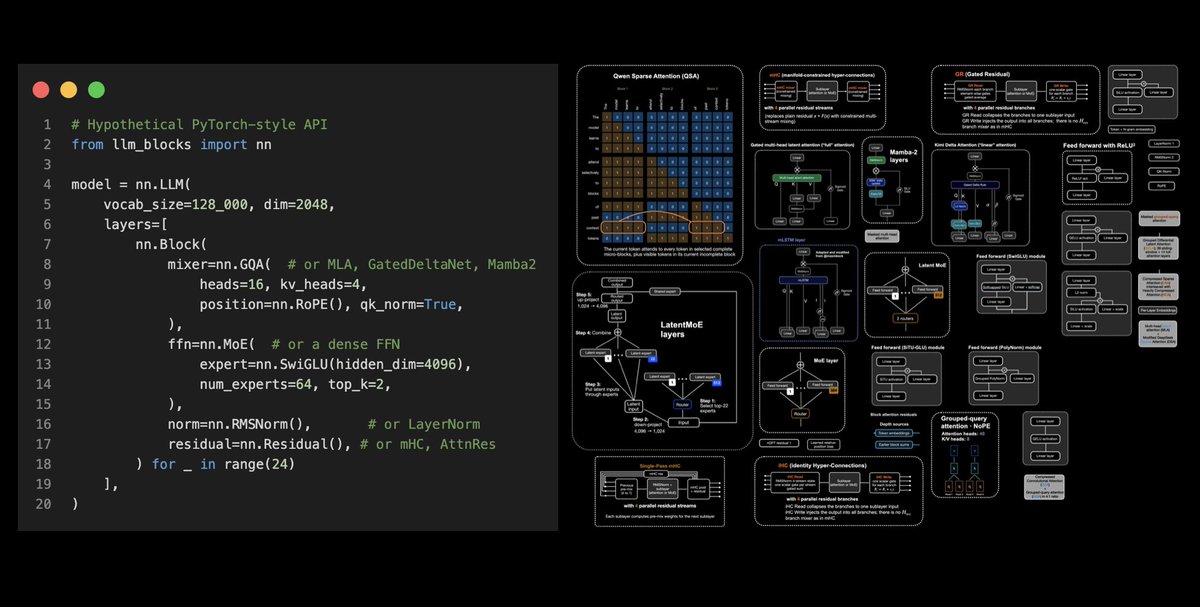
Sebastian Raschka argues that the open-source LLM ecosystem needs a building-block API to reduce the cost of experimenting across model architectures. His post points to the growing variety of components and the friction of switching between implementations in PyTorch or lower-level C++ and CUDA. This is a tooling proposal rather than a released standard. Its appeal is practical: reusable interfaces could make architectural comparisons and controlled experiments easier to reproduce and maintain.

03

A practical guide to positional embeddings surveys RoPE and newer designs

A practical guide to positional embeddings surveys RoPE and newer designs

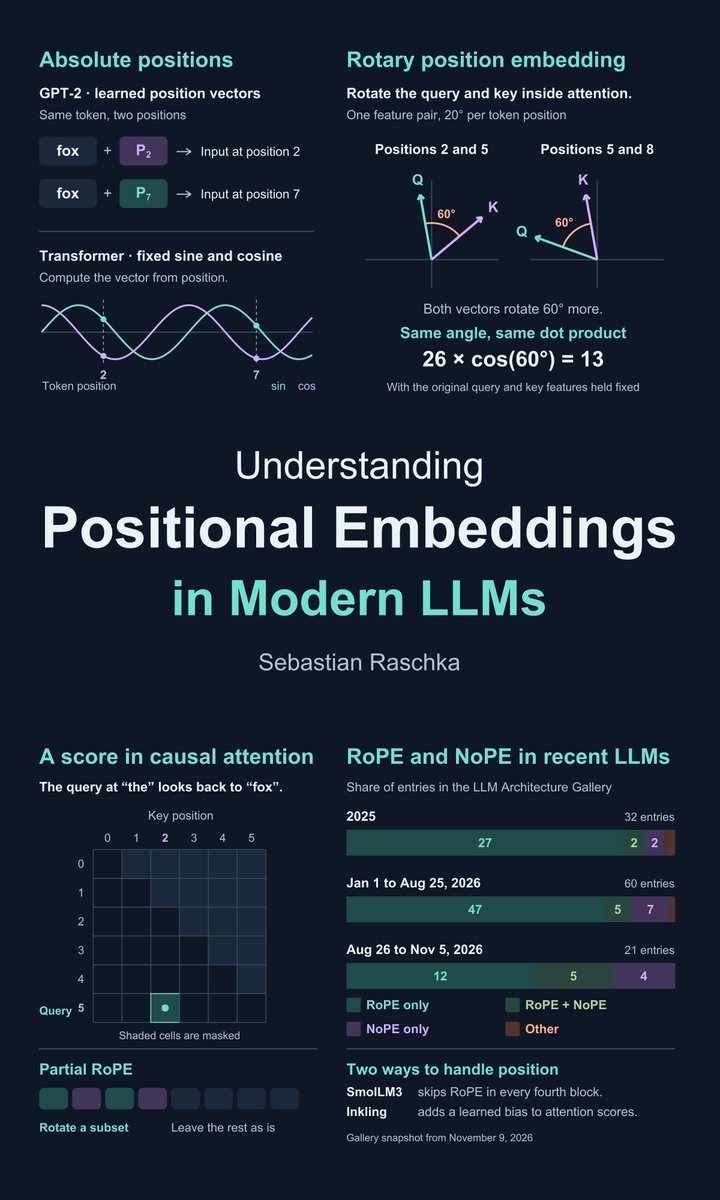
Sebastian Raschka published a tutorial on positional embeddings in modern language models, including a from-scratch treatment of rotary positional embeddings. The guide also discusses designs such as NoPE, partial RoPE, and hybrid approaches. It drew substantial engagement in the collected X window and offers useful background for interpreting architecture changes. The contribution is educational: it helps readers understand a foundational model component rather than claiming a new model or a fresh performance record.

04

Inkling 2 Small architecture discussion highlights attention residuals

Inkling 2 Small architecture discussion highlights attention residuals

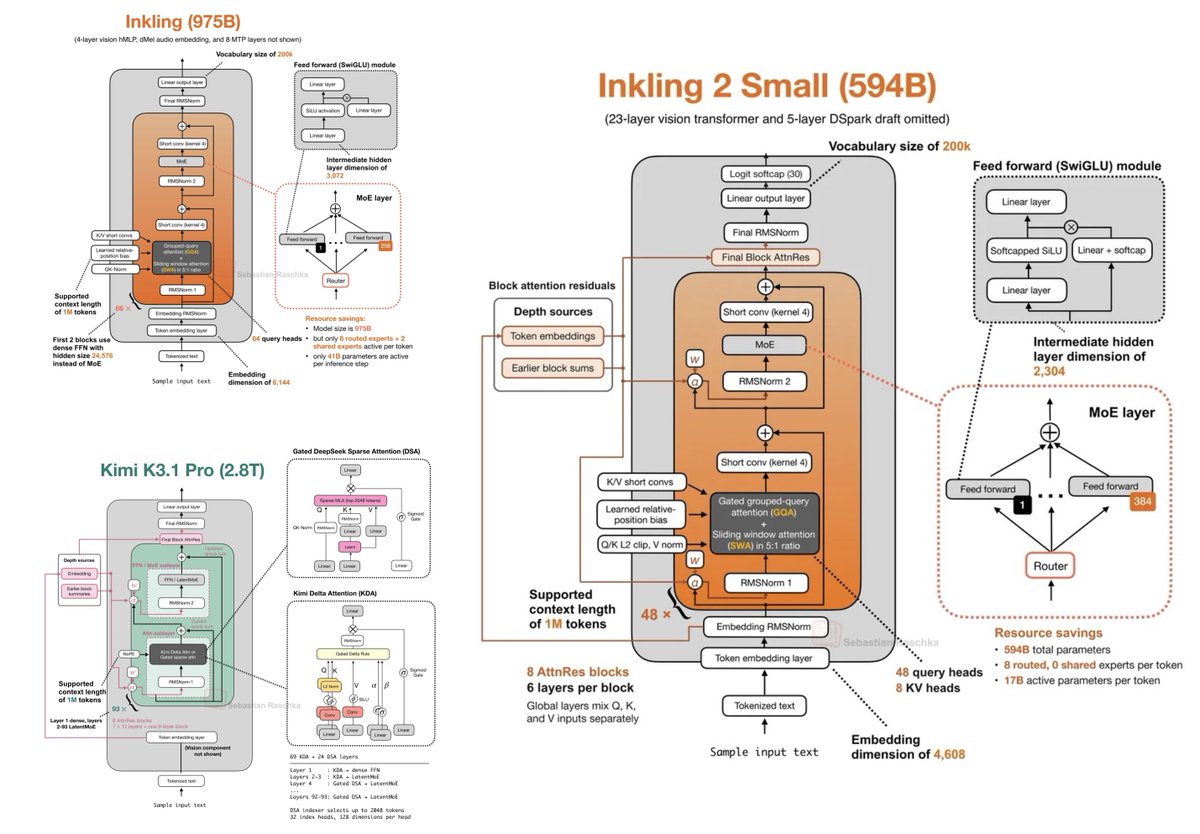
Sebastian Raschka highlights attention residuals in Inkling 2 Small and compares that choice with Kimi K3, while noting the absence of a linear-attention hybrid. The observation contributes to an emerging discussion about which architectural components are becoming common across language models. It is a technical interpretation from a researcher, not an independent benchmark result. For model builders, the useful question is how these choices affect implementation, training behavior, and comparisons with other architectures.

05

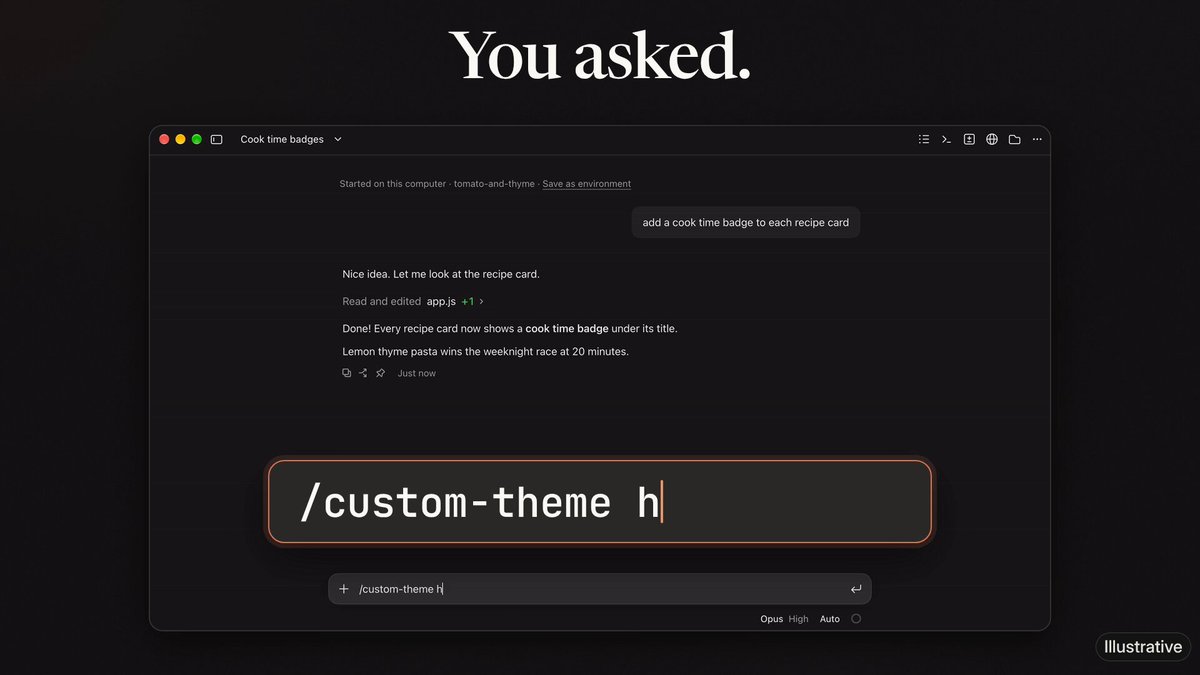
Claude Code desktop adds custom themes through mods

Claude Code desktop adds custom themes through mods

Anthropic’s developer account announced custom themes for Claude Code on desktop through mods, including color changes and animated backgrounds. Users can describe the appearance they want to Claude or begin with a theme-examples plugin. The post was the most heavily liked item in the collected X candidates, making it a notable developer-product update. It expands interface customization; the announcement does not claim changes to coding ability, task accuracy, or underlying model performance.

06

Hugging Face’s Thomas Wolf highlights GR00T 2 and LeRobot integration

Hugging Face’s Thomas Wolf highlights GR00T 2 and LeRobot integration

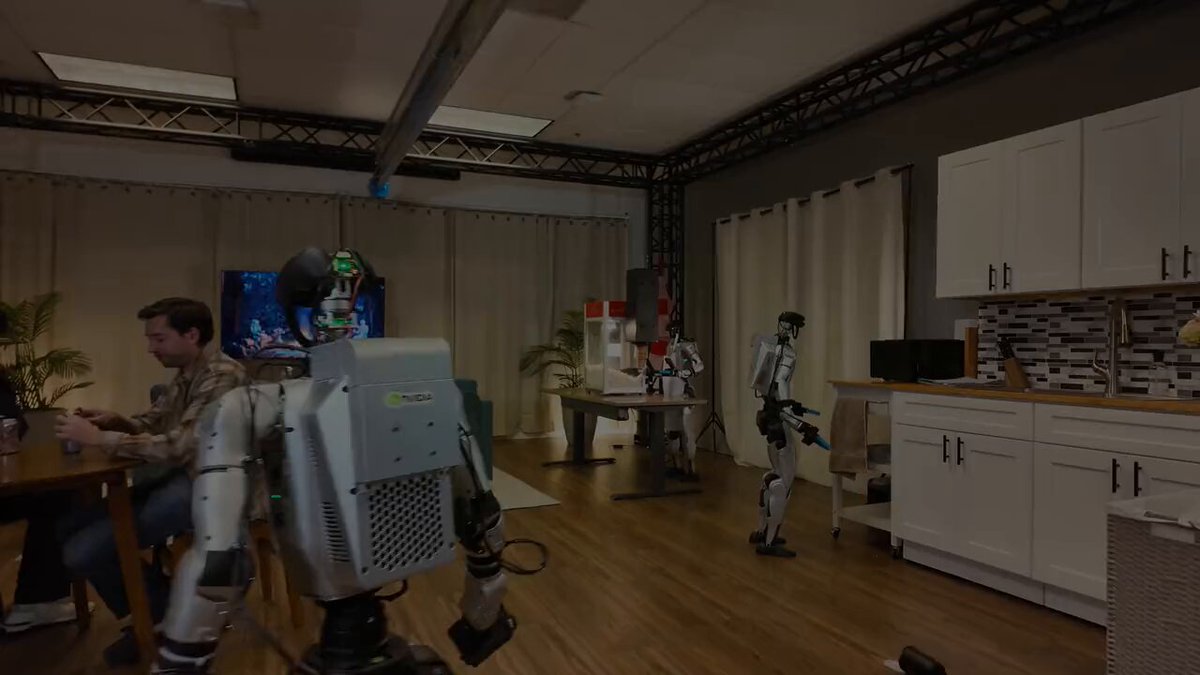
Hugging Face’s Thomas Wolf praised Nvidia’s GR00T 2 open-weight robotics model and said LeRobot integration was underway. The update connects a model release with an open robotics software ecosystem, where access to tooling can influence practical experimentation. It remains a brief status report rather than documentation of a completed integration or independent capability evaluation. Robotics developers should distinguish the stated integration work from verified compatibility and performance on their own hardware and tasks.

07

Nathan Lambert links model specifications to more autonomous agents

Nathan Lambert links model specifications to more autonomous agents

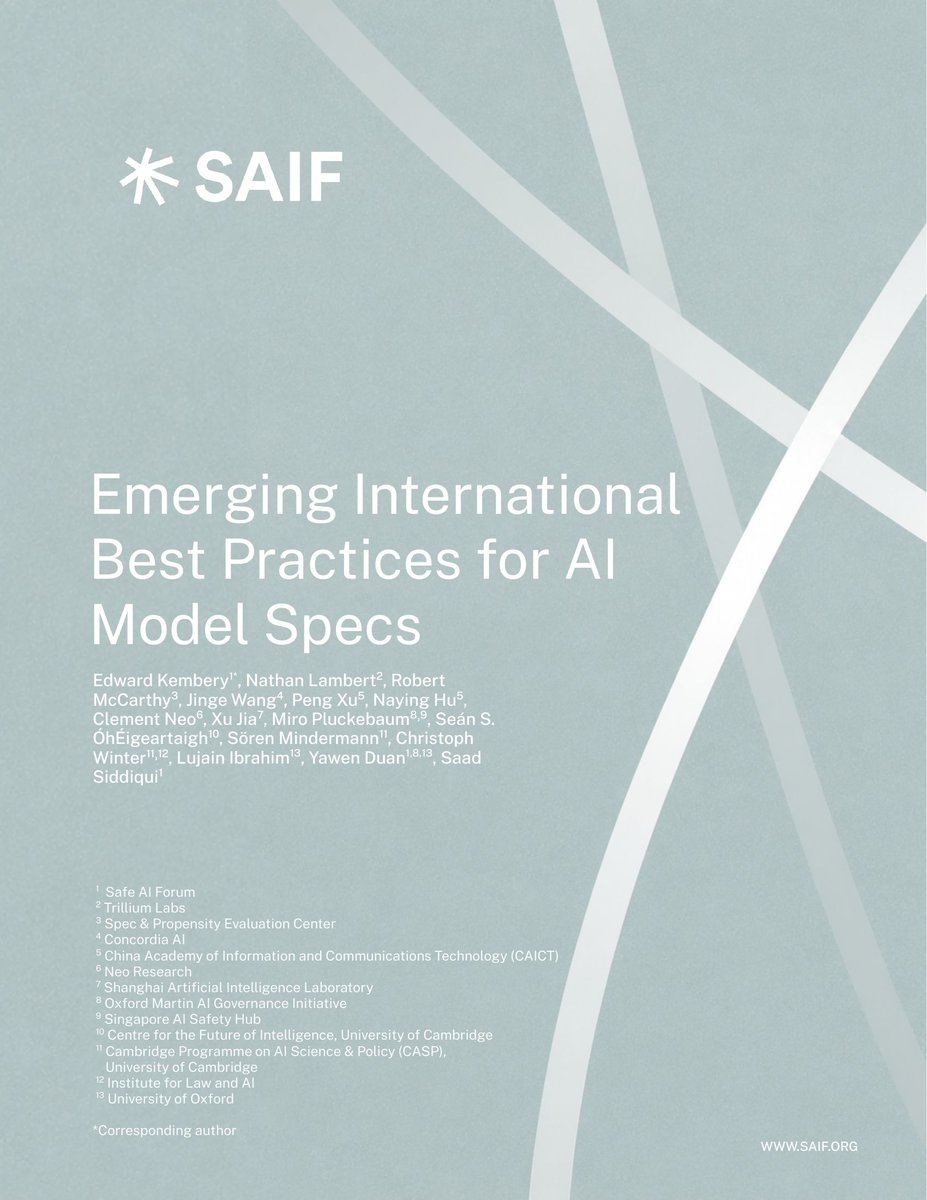
Nathan Lambert argues that model specifications have become useful instruments for organizational alignment and lightweight external oversight. He notes their growing importance as agents act more independently on users’ behalf instead of only generating text. The post is a governance observation, not a new compliance framework. It highlights a practical design issue for agent products: intended behavior needs to be understandable and reviewable as the scope of delegated actions becomes broader and more consequential.

08

Greg Brockman highlights dot payments with major card networks

Greg Brockman highlights dot payments with major card networks

Greg Brockman said users can make secure purchases with dot in partnership with American Express, Mastercard, and Visa. The short announcement places payment execution within the expanding set of AI-related product actions, where commercial partnerships are essential to connecting software with real transactions. The collected post does not detail availability, authentication flows, or liability arrangements. Those implementation questions matter when assessing how much purchasing authority a user can safely delegate to an assistant.

09

Runway adds Seedance 2.5 Flash to its video tools

Runway adds Seedance 2.5 Flash to its video tools

Runway announced that Seedance 2.5 Flash is available on its platform, positioning the option as faster and lower cost for video generation. The announcement adds another model choice to a creative workflow rather than describing a new Runway-trained foundation model. For teams iterating on many shots, the claimed speed and cost direction is relevant. The post does not provide numerical pricing or latency comparisons, so production decisions still require checking the current product details.

GitHub

3 stories
01

AG-UI brings an agent interaction protocol to frontend applications

AG-UI brings an agent interaction protocol to frontend applications

AG-UI appears in today’s GitHub candidates as a TypeScript project focused on an Agent-User Interaction Protocol. Its stated purpose is to bring agents into frontend applications, addressing the interface between automated reasoning and the people using a product. The repository had 18,596 stars at collection time, indicating developer attention rather than proving production suitability. It is a relevant project to examine when designing how an application presents and coordinates agent-driven work for users.

02

Claude trading skills package reusable financial workflows

Claude trading skills package reusable financial workflows

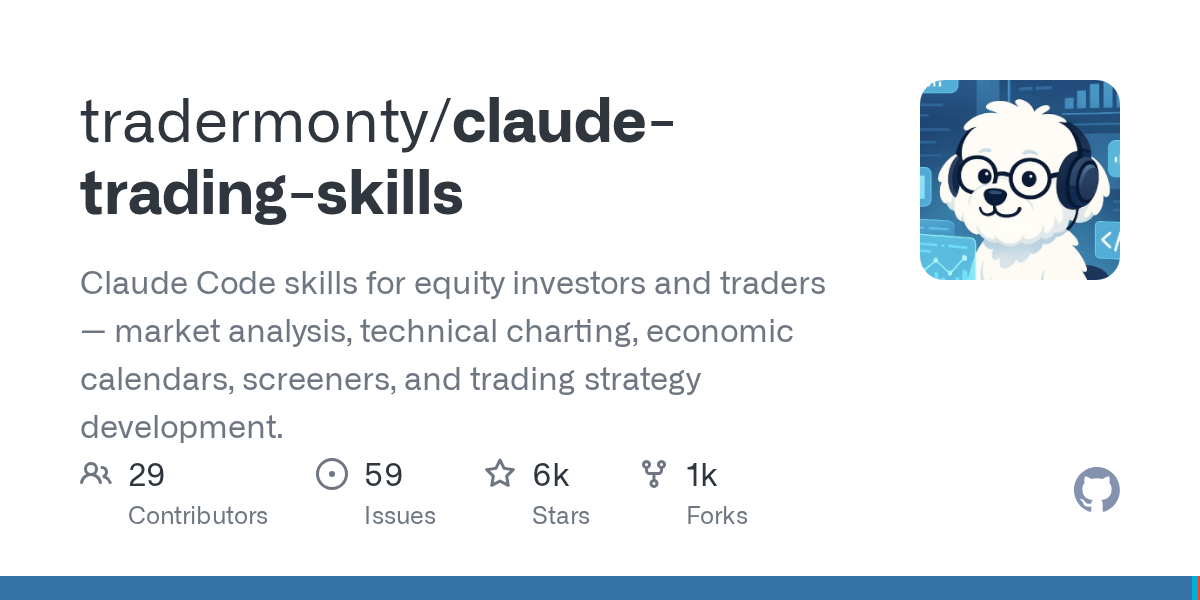
The claude-trading-skills repository packages Claude Code skills for equity investors and traders, covering market analysis, technical charting, economic calendars, screeners, and strategy development. It illustrates how agent capabilities are being organized around a specific professional workflow rather than a general chat interface. The project had 6,106 stars at collection time. Its repository description establishes intended functionality, not investment performance; generated analysis and trading strategies still require separate evaluation before practical use.

03

Univer offers office capabilities for people and AI agents

Univer offers office capabilities for people and AI agents

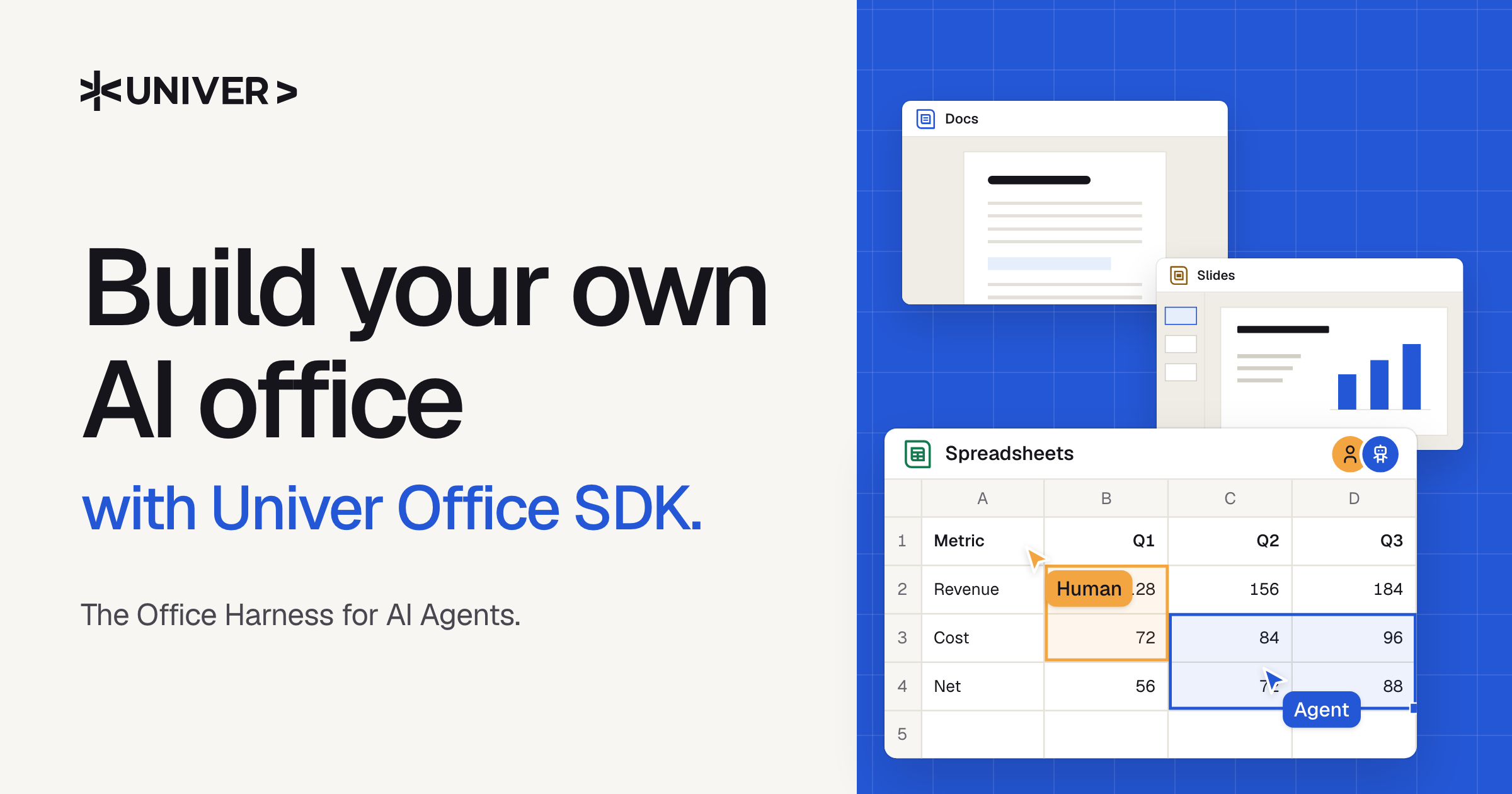
Univer describes an extensible open-source office SDK that brings editing, calculation, collaboration, and file processing into applications for both people and AI agents. The TypeScript repository had 27,573 stars in the collected snapshot. Its relevance is the application layer: agents need structured ways to work with documents and office workflows, not only generate text. The repository’s positioning identifies useful integration possibilities, while specific feature coverage and deployment requirements should be checked in its documentation.

HF HuggingFace

8 stories
01

WebArena-Pro evaluates multimodal agents across 20 web applications

WebArena-Pro evaluates multimodal agents across 20 web applications

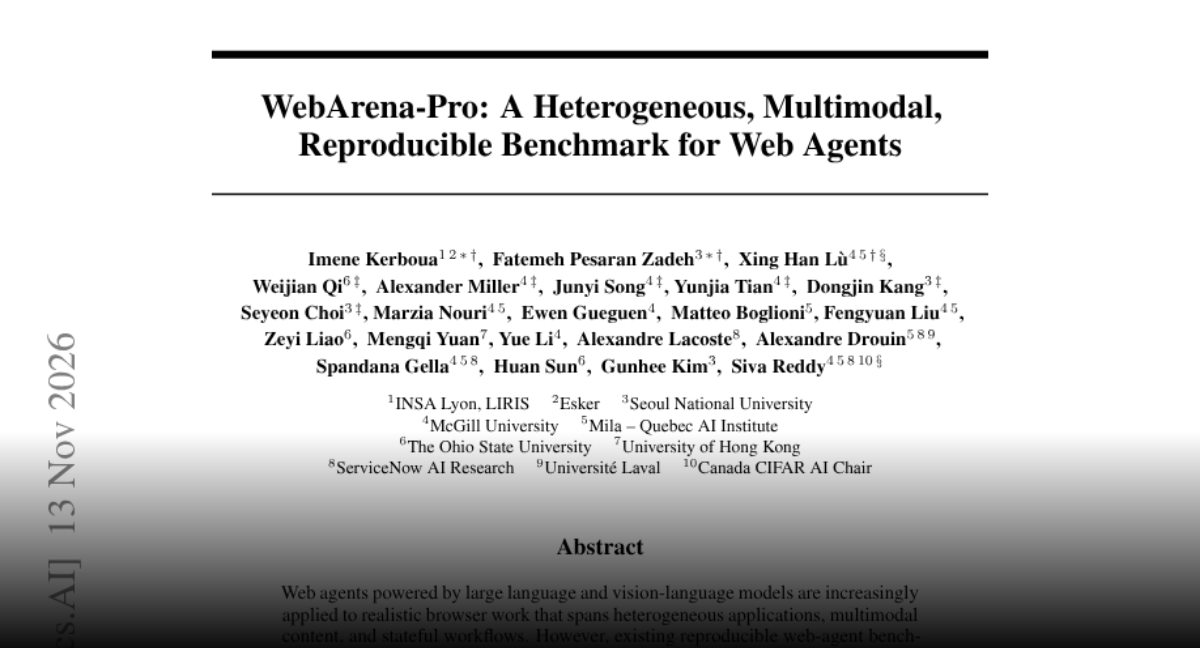
WebArena-Pro introduces 300 tasks across 20 self-hosted web applications spanning six domain categories, with audio and video treated as core observations alongside text and images. The authors aim to combine broader workflow coverage with reproducible evaluation, avoiding the drift of live websites. Their best reported agent results reach 62.3 percent. The gap to full completion matters for deployment: even strong systems still struggle with realistic browser work that crosses interfaces, modalities, and stateful task sequences.

02

MMFlash targets visually dependent tokens to accelerate VLM decoding

MMFlash targets visually dependent tokens to accelerate VLM decoding

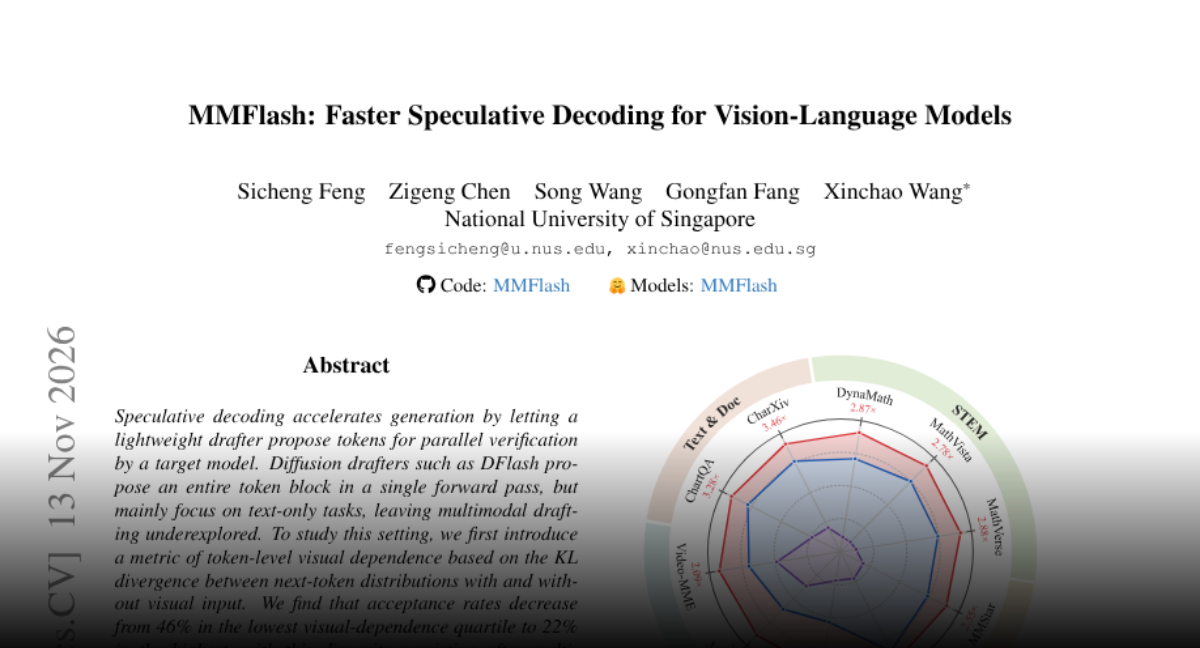
MMFlash studies why speculative decoding becomes harder when token predictions depend strongly on visual input. The authors report that draft-token acceptance falls from 46 percent in the lowest visual-dependence quartile to 22 percent in the highest. Their method upweights difficult visually dependent tokens and adds sparse attention for long videos. Across the evaluated multimodal benchmarks, they report lossless decoding speedups of up to 3.58 times, making this a concrete inference-efficiency result to investigate.

03

JFinBench refreshes Japanese financial evaluation with current exams

JFinBench refreshes Japanese financial evaluation with current exams

JFinBench contains 321 examples from six Japanese financial certification exams published in 2026, covering accounting, tax, financial planning, and banking. Its human-reviewed agentic conversion pipeline is designed to make future editions easier to incorporate and reduce contamination from aging benchmarks. The authors evaluate 12 models and find that tool access improves every model while leaving meaningful gaps. The result emphasizes that jurisdiction-specific knowledge and refreshed evaluation remain important even when models can search the web.

04

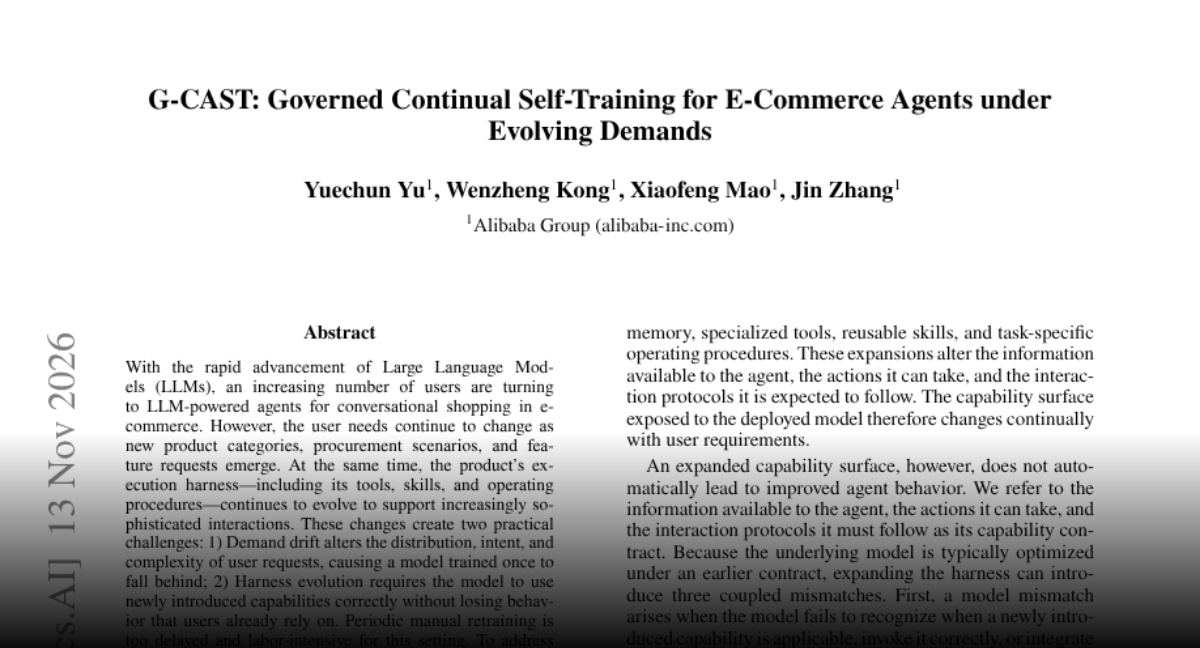
G-CAST governs continual training for a production procurement agent

G-CAST governs continual training for a production procurement agent

G-CAST addresses changing customer demands and evolving tools in an e-commerce agent by turning production evidence into continual training data. The system combines reward routing, entropy-based prioritization, and governed reward updates with cumulative evaluation before checkpoint transitions. The authors report better adaptation while preserving previously accepted behavior compared with their baseline, and say the system is deployed in Alibaba 1688’s Yuancai procurement agent. The contribution is a concrete operational approach to updating agents without treating every apparent improvement as safe.

05

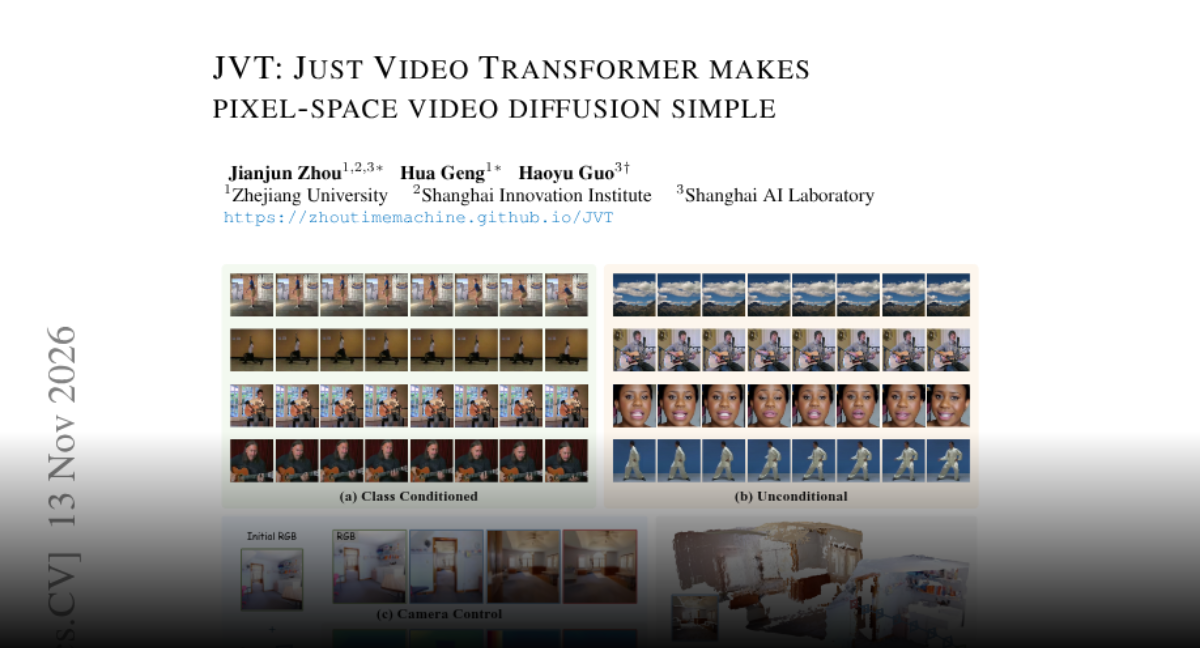
JVT simplifies video diffusion directly in pixel space

JVT simplifies video diffusion directly in pixel space

JVT explores video diffusion with a large-patch DiT-style Transformer operating directly in pixel space, without a pretrained autoencoder, auxiliary detailers, or cascaded stages. The authors study patch embeddings, register tokens, and normalization choices, reporting quality competitive with latent diffusion baselines in their evaluated settings. They also demonstrate joint RGB and disparity generation for improved camera following. The work offers a simpler architectural direction for researchers interested in video synthesis and explicit scene geometry.

06

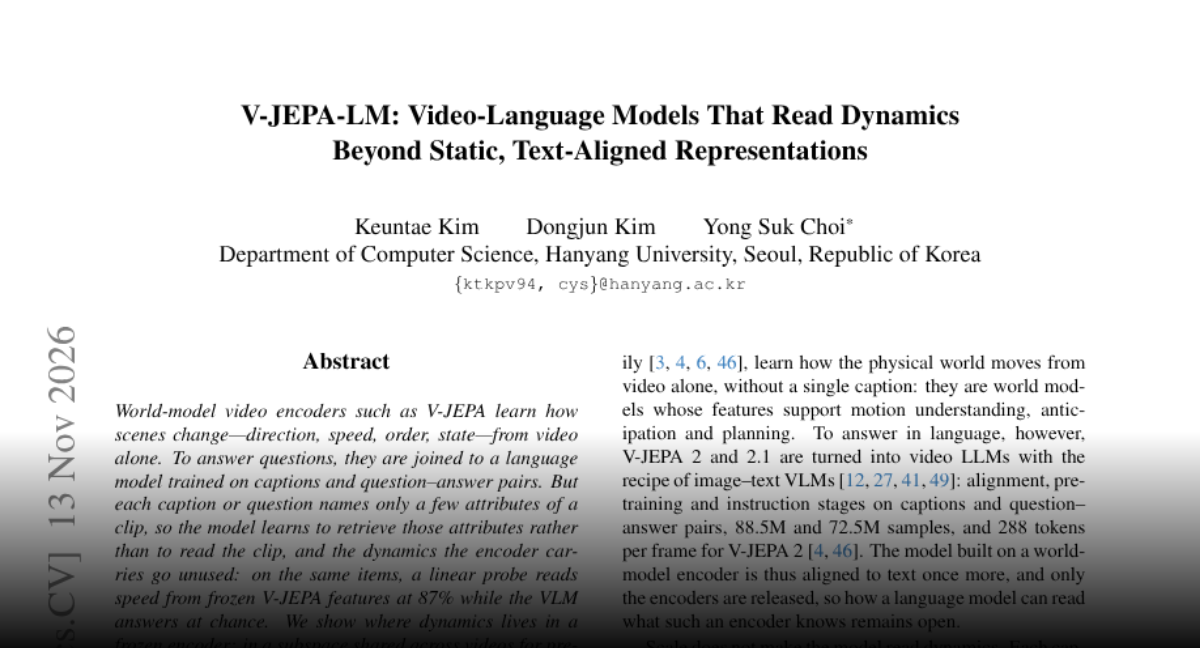
V-JEPA-LM trains language models to read video dynamics

V-JEPA-LM trains language models to read video dynamics

V-JEPA-LM investigates why language models can fail to use motion information already present in a frozen video encoder. The authors introduce counterfactual supervision using transformed public videos so answers depend on changes such as direction and speed. They report strong results across eleven video benchmarks with models from one to eight billion parameters. The key distinction is between what an encoder represents and what language supervision teaches a model to extract from those representations.

07

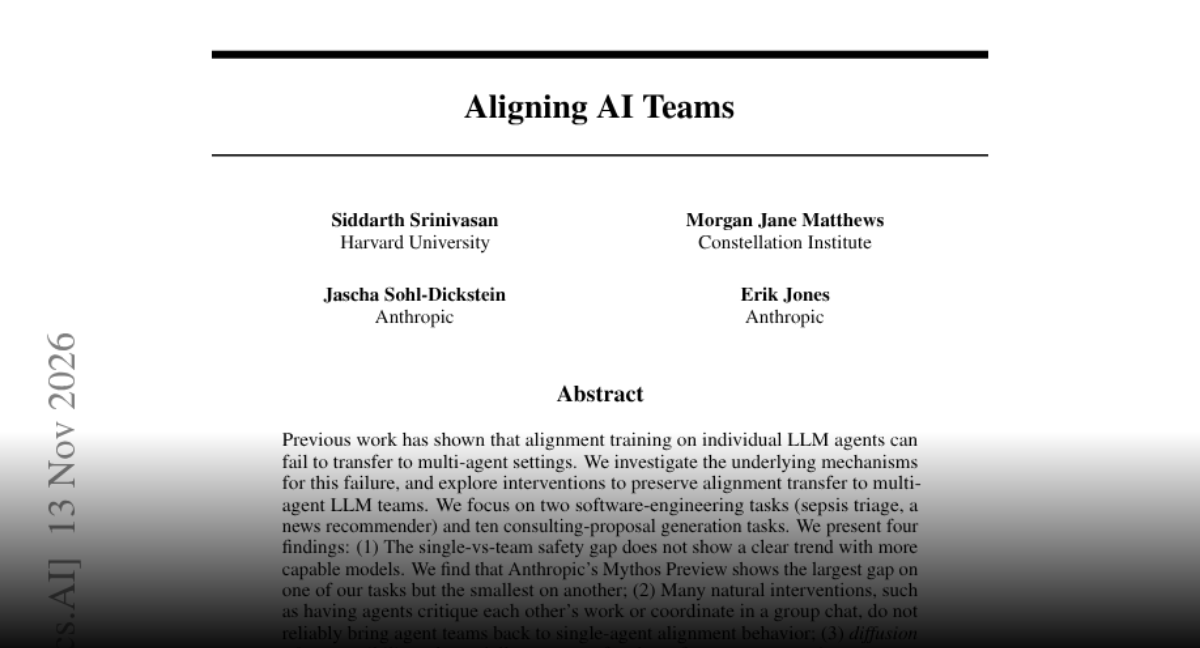
Aligning AI Teams finds responsibility gaps in multi-agent systems

Aligning AI Teams finds responsibility gaps in multi-agent systems

Aligning AI Teams studies why alignment behavior from individual agents may not transfer to teams. Across software-engineering and proposal tasks, the authors find that critique and group chat do not reliably close the gap. They identify diffusion of responsibility as a major mechanism and report that a designated safety lead and a shared safety specification help restore behavior. The findings suggest that adding agents is an organizational design problem as well as a capability choice.

08

Continual-ARC separates persistent memory from transferable learning

Continual-ARC separates persistent memory from transferable learning

Continual-ARC evaluates lifelong learning using recurring tasks from three ARC-AGI editions, with fresh instances, feedback budgets, and later tests on both familiar and unseen tasks. The study compares agent harnesses with memory and weight-based learning on a shared scale. In the reported experiments, persistence generally fails to improve memorization without expert guidance, and harness methods do not gain on unseen tasks. The results challenge the assumption that retaining interaction history automatically produces generalizable skills.