NO/FOMO

Independent AI signal, once a day

The AI briefing worth opening.

ISSUE DATE2026-11-17ENGLISH EDITION
This issue
—
All time
—

AI Blog

4 stories
01

OpenAI outlines work with NATO and allied cyber defenders

OpenAI says it is working with NATO and allied cyber agencies to help trusted defenders find vulnerabilities, test fixes, and protect essential systems. The announcement places AI tools within institutional cybersecurity workflows rather than only consumer software. Its practical significance is the focus on both discovery and remediation: finding a weakness is useful only when defenders can validate a repair. The collected announcement does not establish measured reductions in attacks or outages.

02

OpenAI and Chile announce an AI adoption partnership

OpenAI and the Government of Chile announced a partnership focused on responsible AI adoption, public-sector skills, and helping local startups build AI applications. The program links national adoption efforts with practical capacity building rather than only access to models. It is relevant to how governments develop domestic expertise and support smaller businesses using AI. The collected announcement states the partnership's aims but does not provide evidence of completed deployments or measured economic effects.

03

OpenAI expands free frontier-model access to 200,000 researchers

OpenAI says it is expanding ChatGPT for Academic Researchers to offer 200,000 researchers worldwide free access to its frontier models. The announcement concerns access to scientific tools rather than a demonstrated discovery rate. Wider availability could let more research groups test AI in analysis, coding, and literature workflows, but benefits will depend on disciplinary needs and validation practices. The collected description does not specify every eligibility condition or establish that all researchers will achieve similar productivity gains.

04

OpenAI announces tools and partnerships against online child exploitation

OpenAI announced new tools, practical guidance, and partnerships intended to help prevent, detect, and respond to online child sexual exploitation and abuse. The collected announcement describes a coordinated safety effort rather than reporting a quantified reduction in harm. Its significance lies in pairing technical detection with response and organizational support. Assessing the program's effectiveness will require evidence about coverage, error rates, and how confirmed cases are handled by the relevant safeguarding institutions.

Hacker News

4 stories
01

Mem announces shutdown and deadlines for exporting notes

Mem announces shutdown and deadlines for exporting notes

Mem will shut down on January 15, 2027, according to its official announcement. Notes become read-only on December 18, 2026, and users must export their libraries before access ends. Charging has already been paused, with previously paid functionality maintained during the remaining availability period. The company provides migration guidance covering notes, attachments, collections, and meeting transcripts. For users of AI memory products, this is an immediate data-portability issue with specific deadlines.

02

Baidu and Xiaomi chiefs warn about the gap between AI hype and returns

A South China Morning Post report highlighted on Hacker News says the chief executives of Baidu and Xiaomi warned about a growing gap between AI hype and returns. The item attracted substantial discussion in today's collection, making commercial outcomes an important counterweight to launch announcements. The accessible candidate establishes the subject of their warning, but not detailed quotations or financial estimates. The broader question for buyers is whether AI spending produces measurable business value.

03

Claude Code team explains how it keeps verification independent

Claude Code team explains how it keeps verification independent

The Claude Code team describes end-to-end, property, and differential tests as foundations for reliable agent development. Its engineering article emphasizes running the actual application, keeping review rules outside the changes they judge, and evaluating reviewers against historical defects and stable changes. It reports that a separate grader improved some internal structured-file tasks by up to ten points. The central lesson is that executable evidence and independent checks matter more than a confident completion message.

04

Large harness study finds 64.5% of inference cost goes to unsuccessful runs

Large harness study finds 64.5% of inference cost goes to unsuccessful runs

Runta and Baseten evaluated 22 harness configurations with five models across 62 tasks and four attempts, totaling 27,280 agent runs. Their report attributes 64.5% of estimated list-price inference cost to failures or timeouts. The best-value harness varied by model, and higher spending did not reliably buy higher pass rates. These findings support testing model and harness combinations together, while the study's open-model set, provider pricing, and task selection limit generalization.

Twitter

9 stories
01

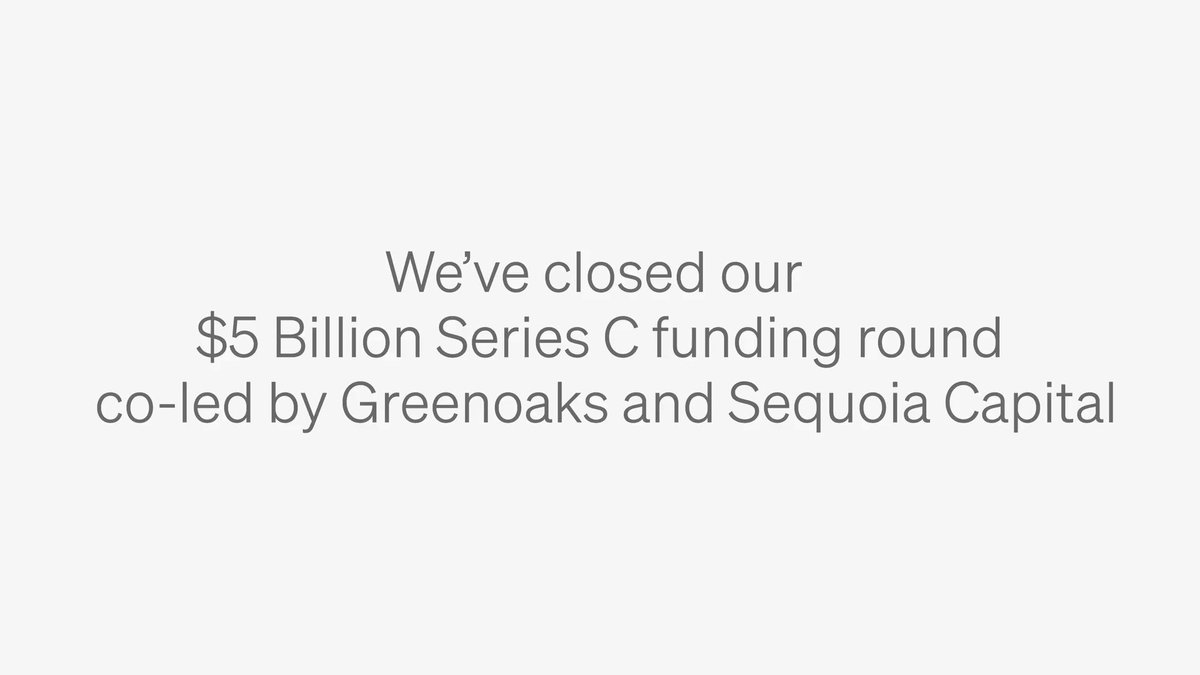
Isomorphic Labs closes Series C as AI drug discovery advances

Isomorphic Labs closes Series C as AI drug discovery advances

Isomorphic Labs executive Max Jaderberg announced the close of the company's Series C financing, describing progress in turning model capabilities into potential medicines. His account frames biology as a programmable science and points to internal research progress rather than published clinical outcomes. The announcement makes AI drug discovery a major industry story today, while leaving an important distinction between financing, computational capability, and medicines demonstrated to work in patients.

02

Kling introduces Image 4.0 in a new official announcement

Kling introduces Image 4.0 in a new official announcement

Kling's official account introduced Kling Image 4.0 in a short visual announcement, following an earlier teaser that described the model as coming soon. The post establishes the new image-model branding but provides no benchmark results, pricing, or detailed access conditions in the collected text. It is a relevant development for generative visual tools, with evaluation of image quality, editing control, and availability still depending on fuller product documentation and hands-on use.

03

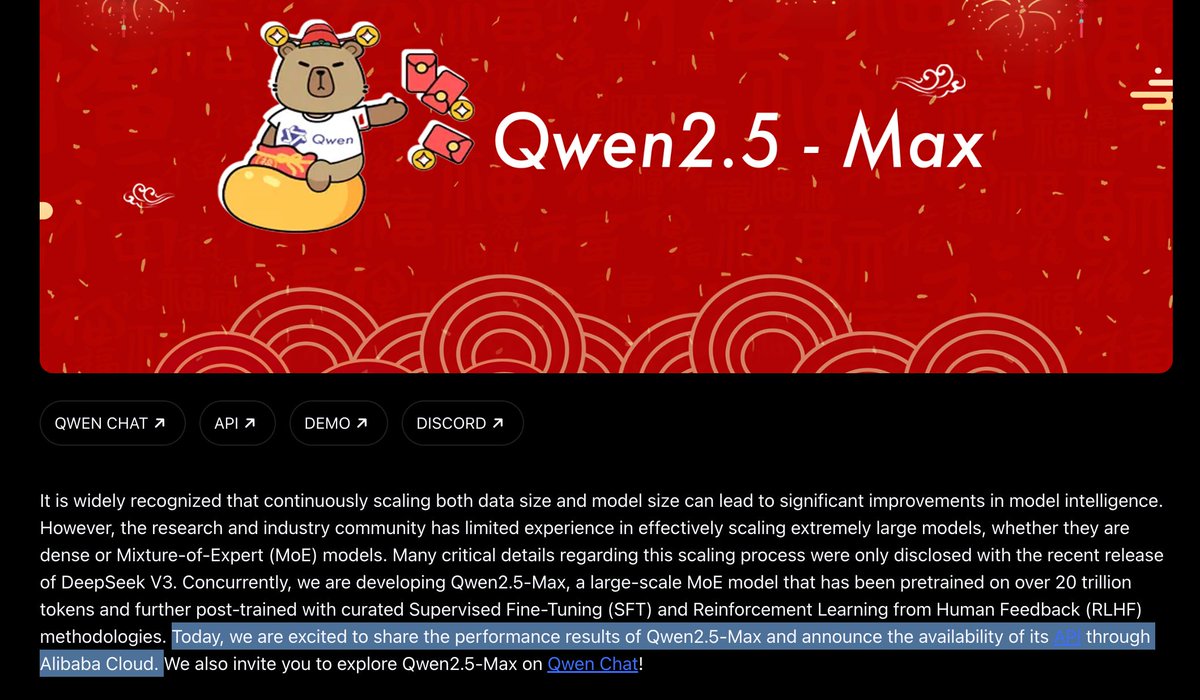
Nathan Lambert argues Qwen 4 Max fits a longstanding release strategy

Nathan Lambert argues Qwen 4 Max fits a longstanding release strategy

Nathan Lambert argues that keeping Qwen 4 Max closed does not by itself signal the end of Qwen's open-weight strategy. His post describes an established pattern: the strongest model remains available through an API while smaller models receive open weights. This is an interpretation of release strategy, not a new licensing announcement. The distinction matters for developers deciding whether a flagship API launch changes the availability of models they can deploy themselves.

04

Hugging Face cofounder describes a 1,000-agent PyBot experiment

Hugging Face cofounder describes a 1,000-agent PyBot experiment

Thomas Wolf described the experiment behind PyBot as an attempt to run 1,000 agents together and investigate whether agent swarms can scale outside closed laboratory settings. The collected post emphasizes transparency and the research motivation, rather than providing a complete evaluation of the system. Its importance is the shift from isolated assistants toward coordinated groups. The announcement alone does not establish that more agents deliver better reliability, lower cost, or stronger task completion.

05

Google adds interactive site generation to Gemini Notebook

Google adds interactive site generation to Gemini Notebook

Google says Gemini Notebook can turn a user's sources into interactive sites, including dashboards and visual explainers. The announced workflow starts with a request to make a site in the notebook chat, followed by opening the result in a new tab. This expands source-based assistance from answering questions to producing navigable artifacts. The collected post describes the feature and entry point, but does not quantify factual accuracy or reliability across different source collections.

06

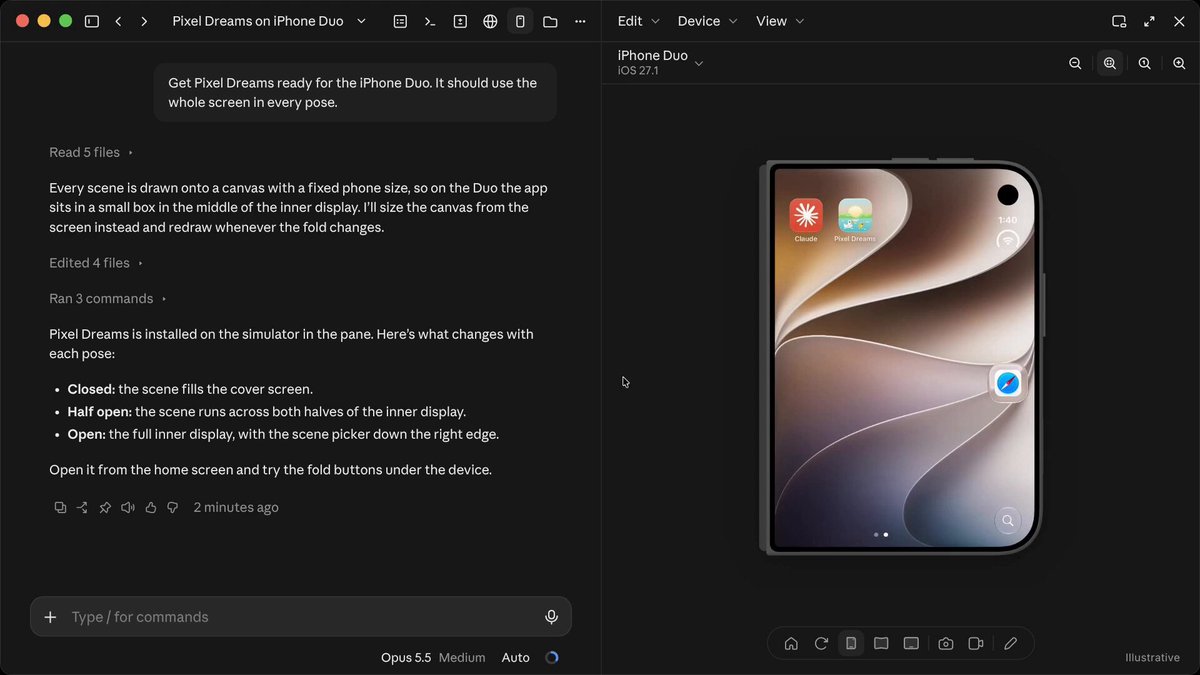
Claude Code desktop adds iPhone Duo simulator support in public beta

Claude Code desktop adds iPhone Duo simulator support in public beta

The official Claude developer account says Claude Code on desktop now supports iPhone Duo in the iOS simulator as a public beta. Developers can run an app alongside the conversation, and Claude can fold and unfold the simulated device to inspect different layouts. The change gives coding agents a more direct way to exercise interface behavior. The announcement describes simulator support, without establishing comprehensive device coverage or guarantees that every layout defect will be detected.

07

DeepMind shows Gemini 4 Carbon working on scientific tasks

DeepMind shows Gemini 4 Carbon working on scientific tasks

Google DeepMind says researchers are using Gemini 4 Carbon through Google Antigravity for multistep problems in physics, mathematics, and the life sciences. The post presents scientific workflows as an application of the model rather than announcing a specific peer-reviewed discovery. It complements growing interest in assistants that coordinate tools and reasoning over extended tasks. The collected announcement does not provide enough experimental detail to judge correctness, reproducibility, or productivity gains independently.

08

Sebastian Raschka highlights checkpoint averaging in pretraining recipes

Sebastian Raschka highlights checkpoint averaging in pretraining recipes

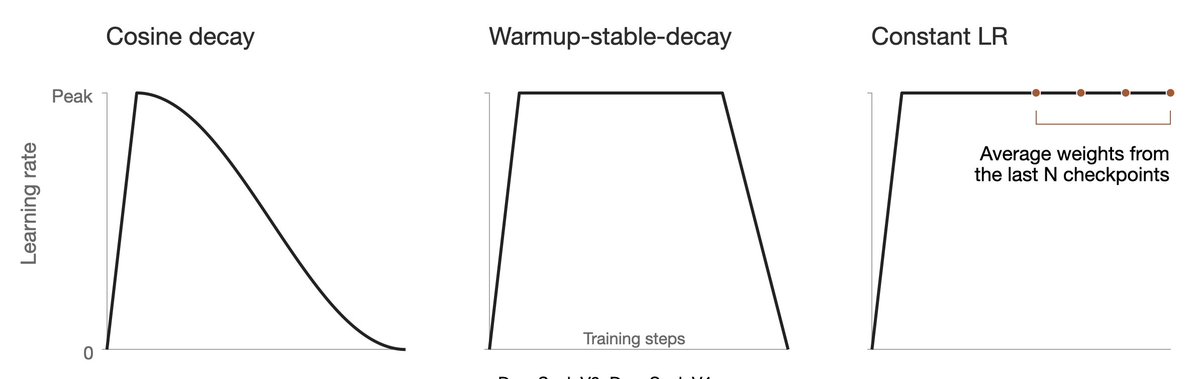
Sebastian Raschka highlights a possible shift in pretraining recipes toward a constant learning rate combined with averaging recent checkpoints or maintaining a running weight average. His post notes a similar approach in Kolibri and frames it as a potential trend, not an established replacement for learning-rate decay. The practical appeal is greater flexibility around the training schedule. Comparing final quality and compute efficiency still requires controlled experiments across models and data regimes.

09

Lambert highlights political and investment pressures on open models

Lambert highlights political and investment pressures on open models

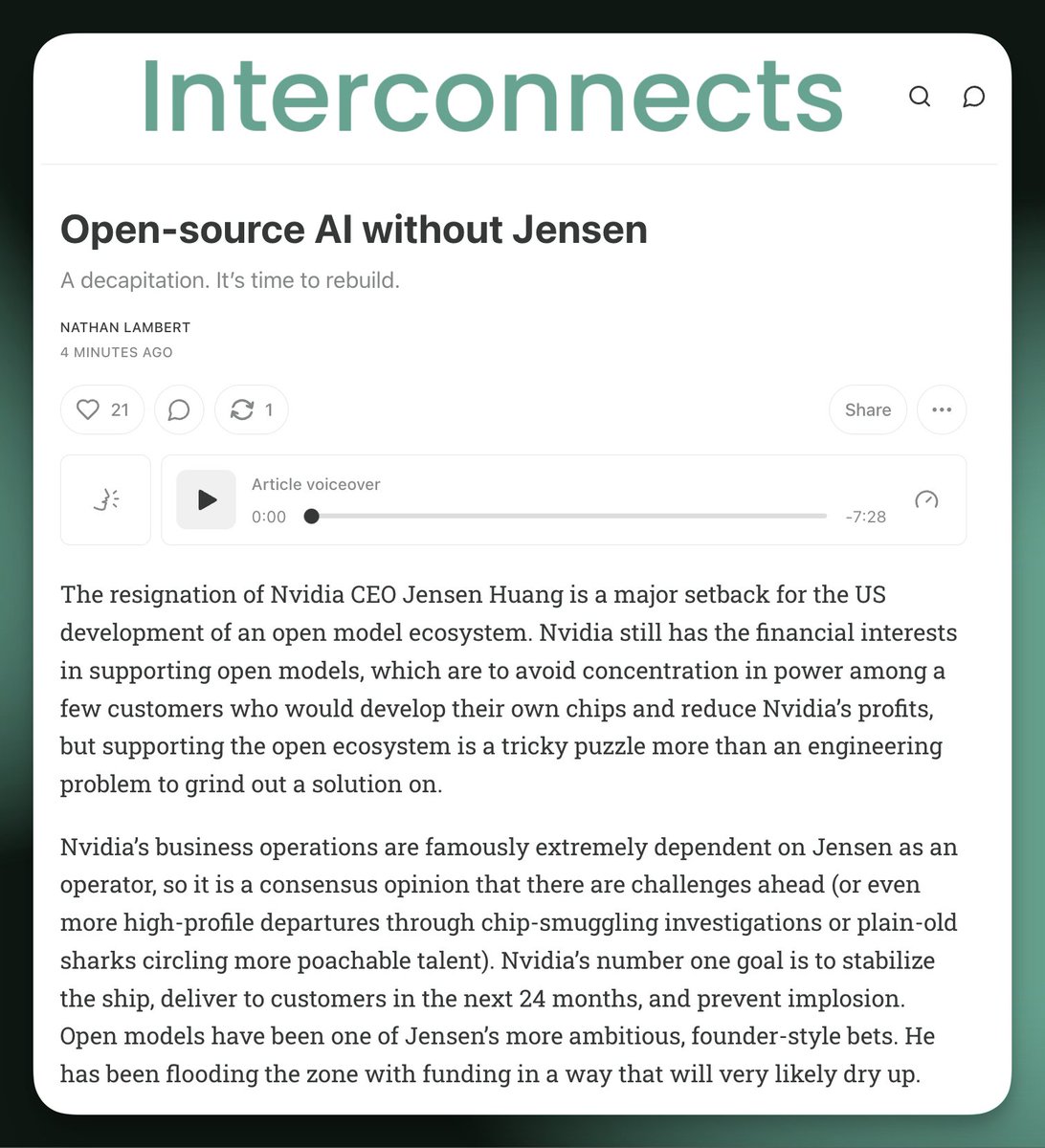
Nathan Lambert identifies political exposure and investment as two pressures on the open-model ecosystem, framing his commentary around a future without Jensen Huang's backing. He argues that model builders may need profitable products sooner as support weakens. The collected post is analysis rather than a verified corporate leadership announcement. Its useful contribution is to connect open-model availability with financing and political support, rather than treating release licenses as the only determinant of openness.

GitHub

2 stories
01

last30days-skill combines research across social and web sources

last30days-skill combines research across social and web sources

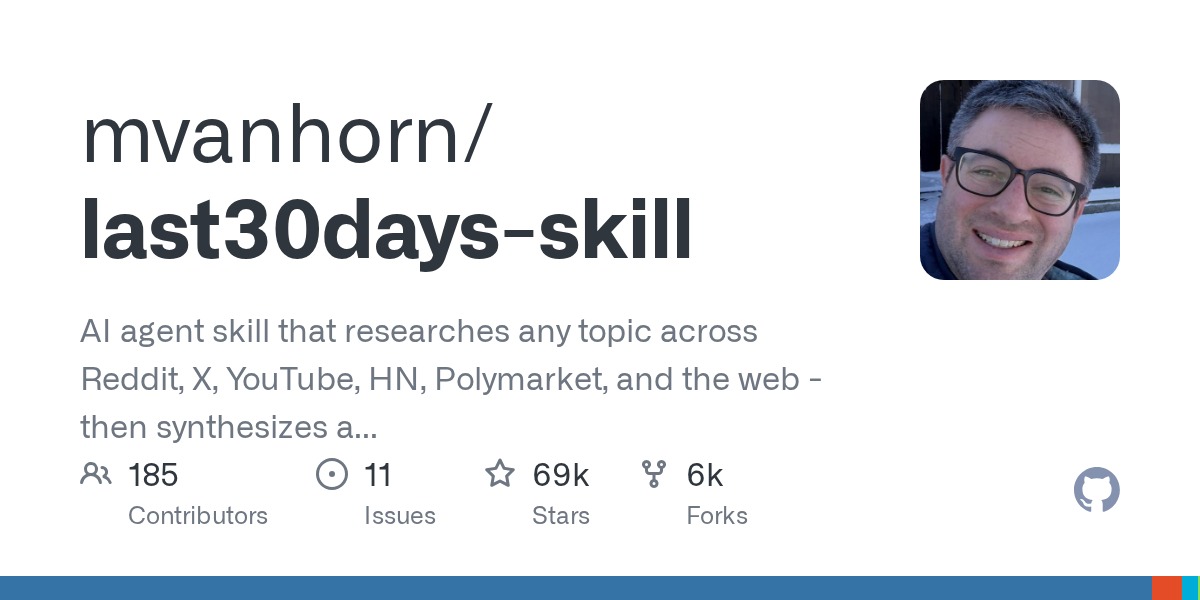
The trending last30days-skill repository describes an AI-agent skill for researching topics across Reddit, X, YouTube, Hacker News, Polymarket, and the wider web. Its stated goal is to synthesize a grounded summary from those sources. The project is relevant to research assistants that need more than a single search result stream. Repository popularity signals developer interest, but it does not by itself demonstrate source access quality, factual accuracy, or robust handling of conflicting evidence.

02

Tencent LoopForge organizes coding-agent delivery with approval gates

Tencent LoopForge organizes coding-agent delivery with approval gates

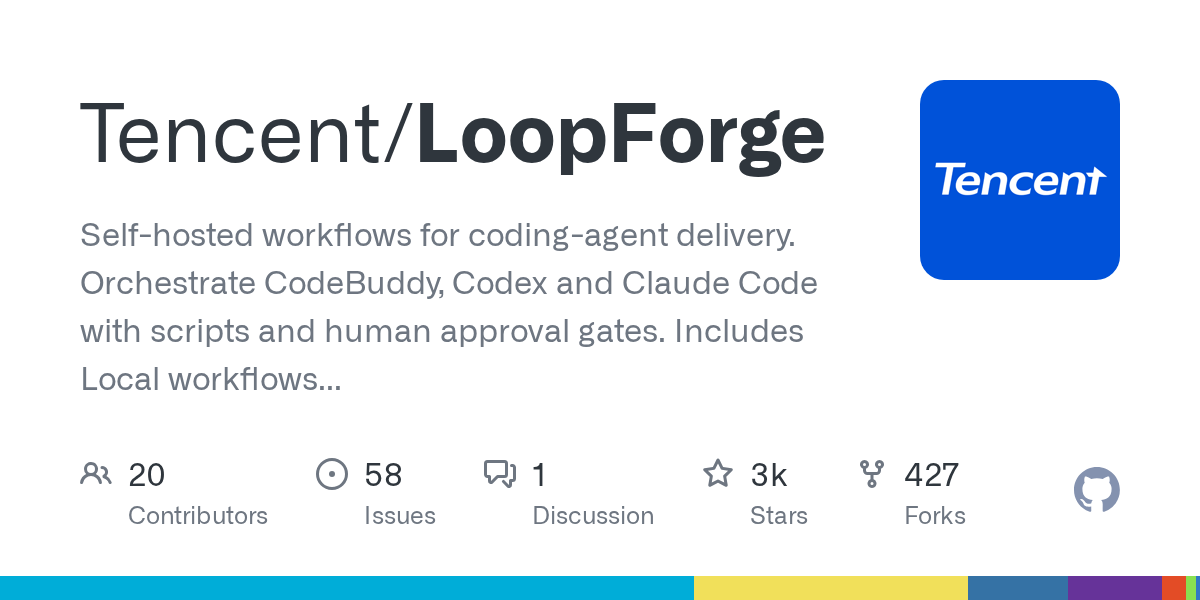
Tencent's LoopForge repository presents self-hosted workflows for coding-agent delivery, with orchestration for CodeBuddy, Codex, and Claude Code. Its description combines scripts with human approval gates and includes local workflows for coding assistants. The project addresses the operational layer around code generation: coordinating work and deciding when changes may advance. The collected repository metadata establishes that scope, while production reliability, integration effort, and security properties still require inspection and deployment-specific evaluation.

HF HuggingFace

8 stories
01

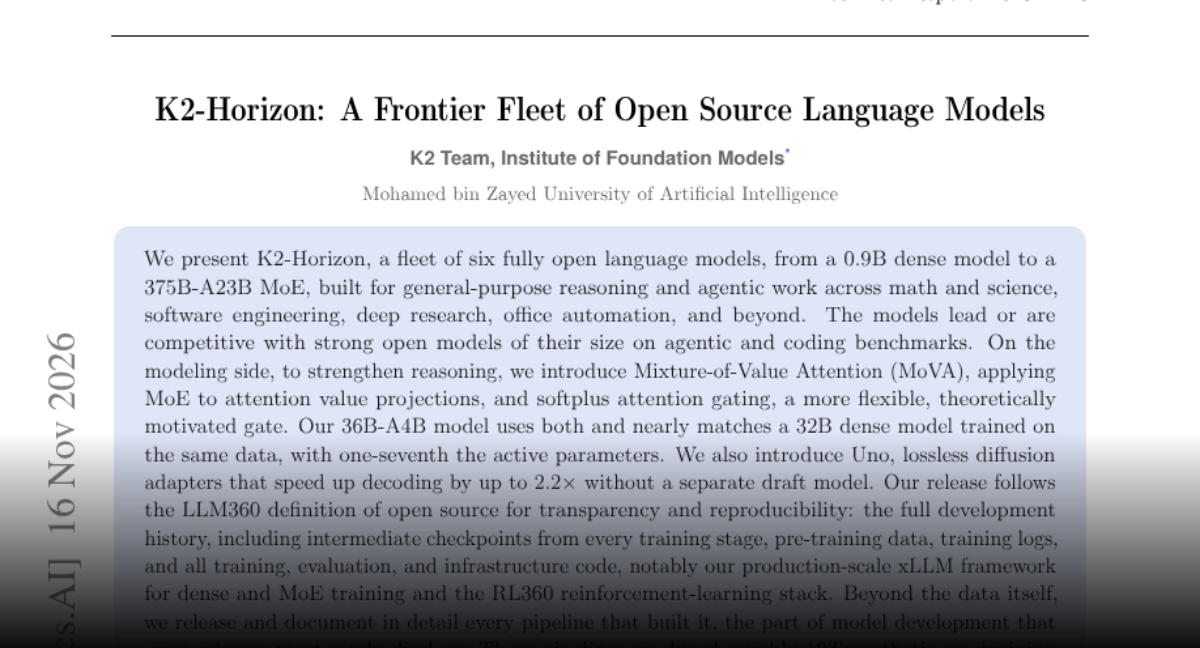
K2-Horizon releases six models with extensive training artifacts

K2-Horizon releases six models with extensive training artifacts

K2-Horizon introduces six open language models ranging from a 0.9-billion-parameter dense model to a 375-billion-parameter mixture-of-experts model with 23 billion active parameters. The authors describe releases covering intermediate checkpoints, pretraining data, logs, and training infrastructure. They also introduce attention changes and diffusion adapters that reportedly accelerate decoding by up to 2.2 times. The unusually broad artifact release makes reproducibility a central contribution alongside claimed reasoning and coding performance.

02

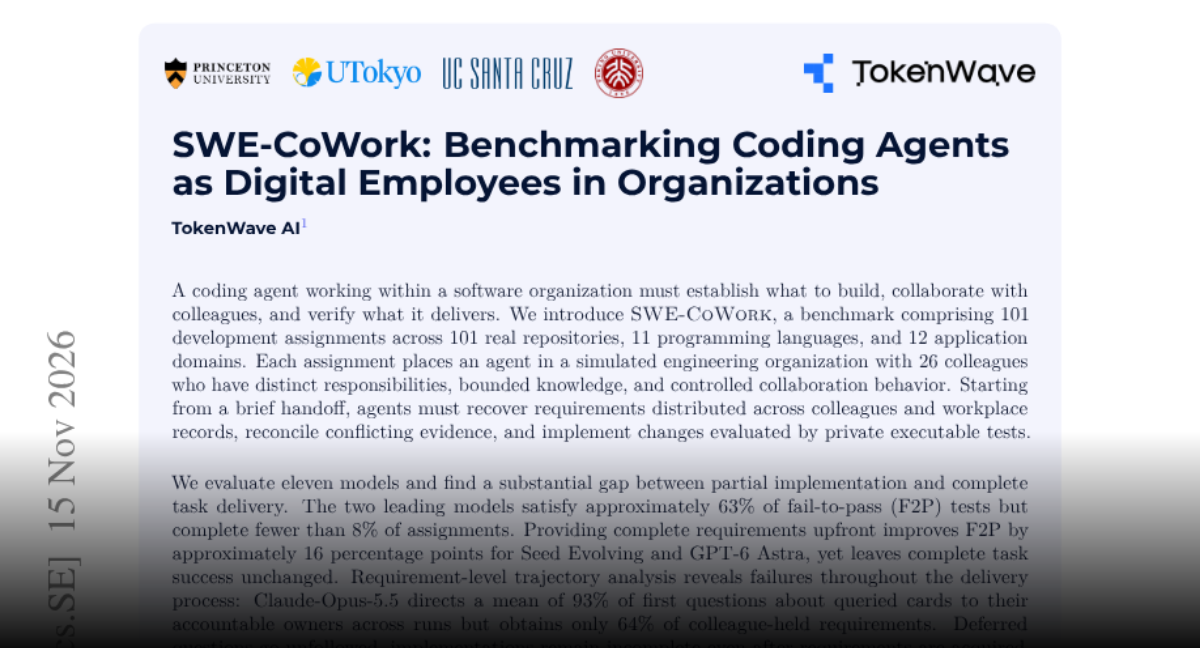
SWE-CoWork exposes a gap between partial code and complete delivery

SWE-CoWork exposes a gap between partial code and complete delivery

SWE-CoWork evaluates coding agents on 101 assignments in simulated organizations where requirements are distributed across colleagues and records. The two leading models passed roughly 63% of fail-to-pass tests but completed fewer than 8% of whole assignments. Supplying complete requirements improved some test results without improving complete-task success. The study points to persistent tracking failures across clarification, implementation, verification, and handoff, making organizational task completion a tougher target than isolated patch generation.

03

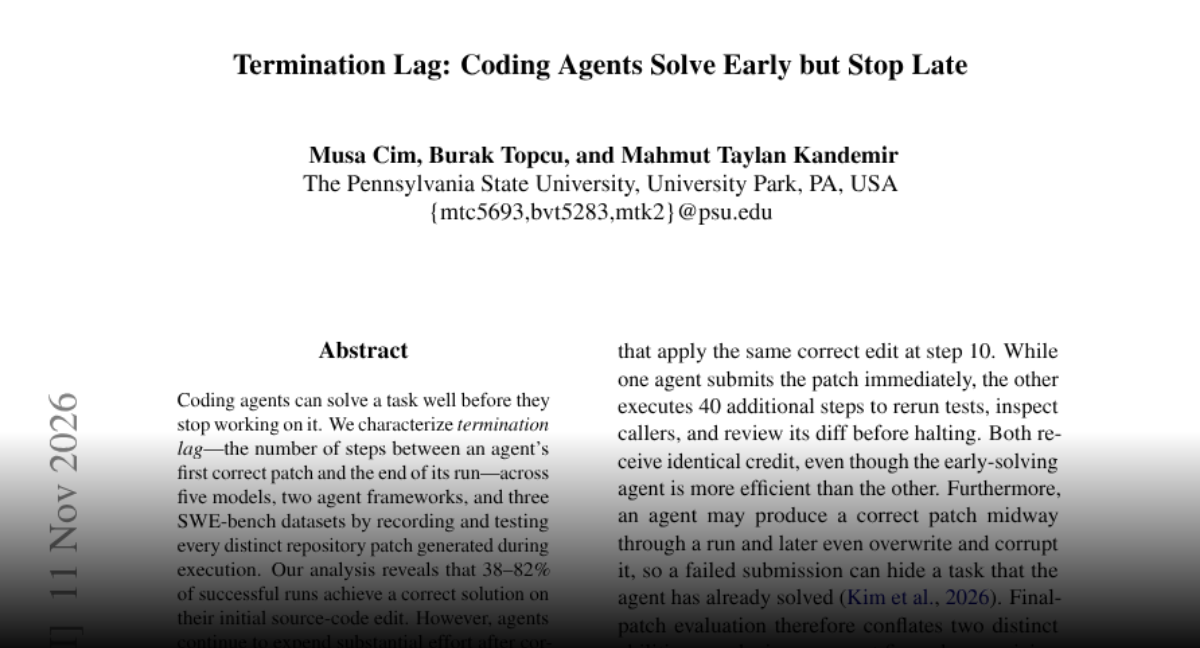
Termination Lag measures work after coding agents already solve a task

Termination Lag measures work after coding agents already solve a task

A study across five models, two frameworks, and three SWE-bench datasets measures how long coding agents continue after their first correct patch. Between 38% and 82% of successful runs already had a correct solution in the initial source edit. Substantial later effort went into verification and exploration, and 1% to 8% of cases lost an earlier correct patch. The findings argue for better stopping decisions while preserving checks that catch real defects.

04

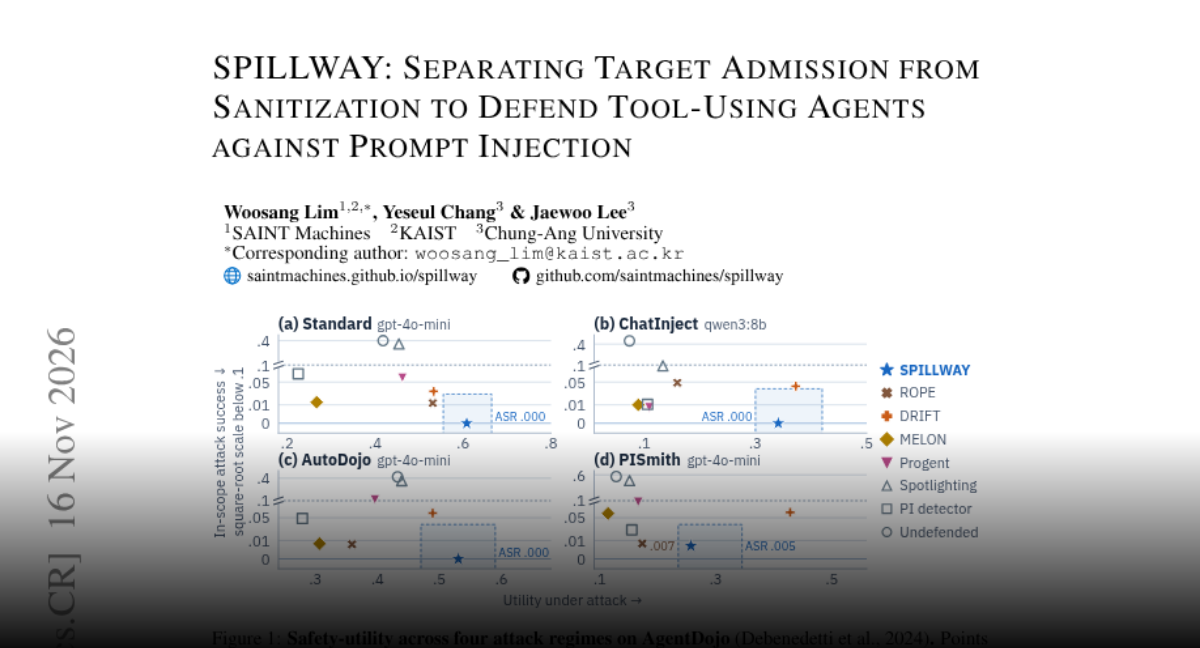
SPILLWAY uses typed tool provenance to constrain injected action targets

SPILLWAY uses typed tool provenance to constrain injected action targets

SPILLWAY proposes a deterministic check on action targets for tool-using agents, using typed values returned by read-only tools and fixed delegation rules. It separates target admission from sanitizing suspicious free text, aiming to keep the final permission decision outside model interpretation. The authors report no redirected actions under standard templated attacks in their evaluation and low success for a learned attacker. These are results within tested suites, not proof against every prompt-injection strategy.

05

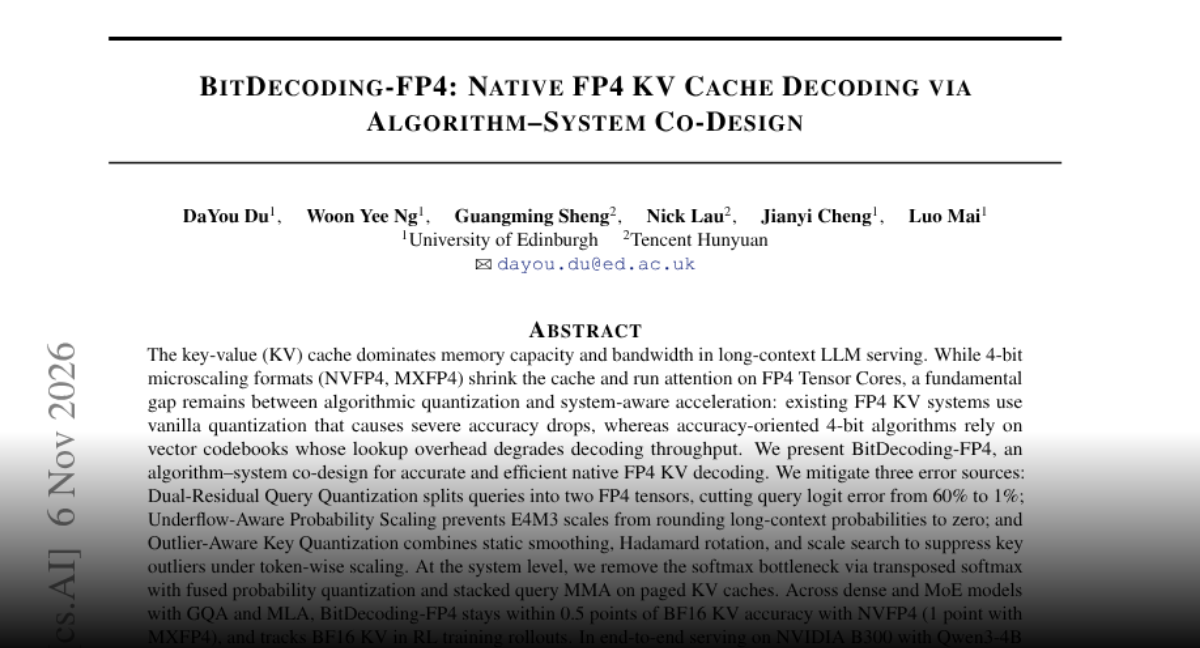
BitDecoding-FP4 combines quantization and kernels for faster serving

BitDecoding-FP4 combines quantization and kernels for faster serving

BitDecoding-FP4 tackles accuracy and throughput together for native four-bit key-value cache decoding. Its design addresses query quantization error, probability underflow, and key outliers, then aligns those changes with attention kernels. The authors report accuracy close to BF16 caches and 2.4 to 3.0 times higher peak serving throughput on NVIDIA B300 with two Qwen3 models. The result is hardware- and workload-specific, but illustrates why numerical methods and implementation need to be evaluated together.

06

MovieRoll targets sustained quality in longer generated videos

MovieRoll targets sustained quality in longer generated videos

MovieRoll combines streaming fine-tuning, long-rollout distillation, and inference strategies to sustain video quality beyond the training horizon. Hierarchical key-value cache compression reportedly reduces cache memory by up to 78%, while a long-rollout training method supports a few-step generator. On HeliosBench, the authors report strong distilled-model scores on sequences up to 60 seconds. The contribution addresses both accumulating generation errors and growing memory demands, with the reported comparisons tied to that benchmark.

07

LynnReal-Hand explores hand-controlled streaming video worlds

LynnReal-Hand explores hand-controlled streaming video worlds

LynnReal-Hand introduces a video world model controlled through hand movements, trained with 100,000 real and synthetic interaction clips. It combines hand-aware supervision, few-step generation, and a compact video decoder. The authors report 540p streaming at 18.03 frames per second with 741-millisecond latency on one H200 GPU. The work focuses on responsive object interaction rather than camera-only navigation, and its planned release includes data, model weights, and training and inference code.

08

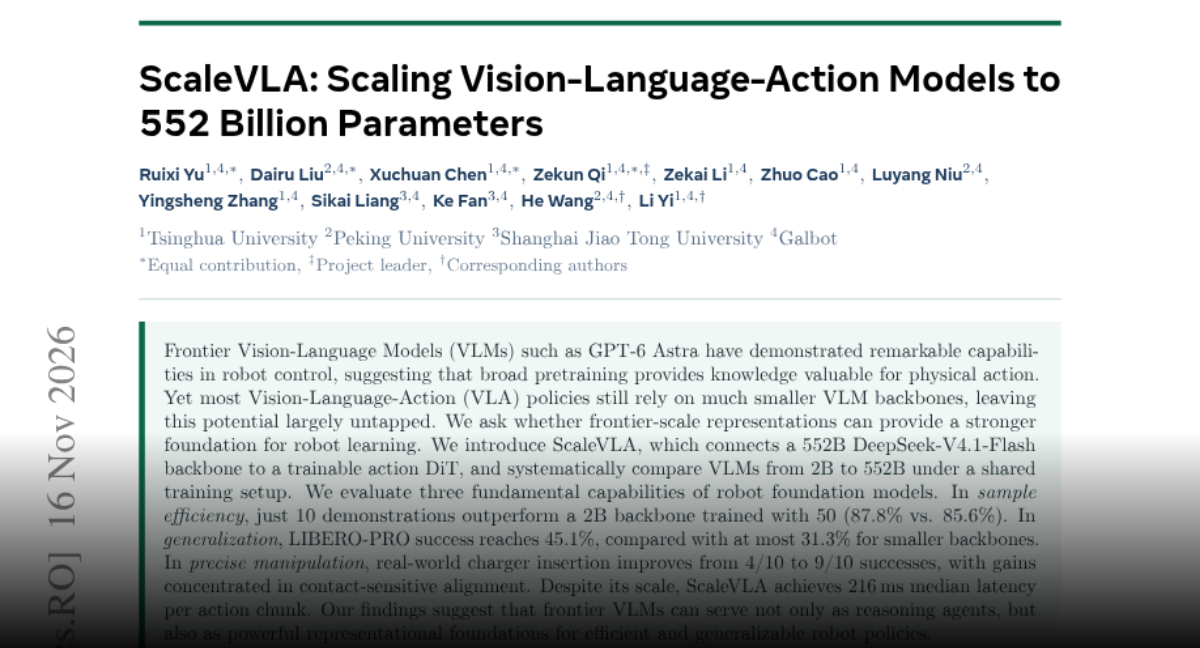
ScaleVLA tests a 552B backbone for robot control

ScaleVLA tests a 552B backbone for robot control

ScaleVLA connects a 552-billion-parameter DeepSeek backbone to a trainable action diffusion transformer and compares model sizes under a shared setup. The authors report better sample efficiency and generalization, including 45.1% success on LIBERO-PRO and improved charger insertion in a small real-world test. Median latency was 216 milliseconds per action chunk. The results suggest larger representations can help robot policies, while the limited physical trial count warrants caution about broader deployment performance.