NO/FOMO

Independent AI signal, once a day

The AI briefing worth opening.

ISSUE DATE2026-11-18ENGLISH EDITION
This issue
—
All time
—

AI Blog

6 stories
01

OpenAI introduces GPT-6.2 Astra and Sol

OpenAI announced GPT-6.2 Astra and Sol, describing improvements in professional outputs, coding, computer use, and efficiency. The release spans ChatGPT Work, Codex, and the API, with the company emphasizing lower costs alongside capability gains. This makes the launch relevant to both workplace users and developers building automated workflows. The announcement frames the models around practical work and per-task efficiency rather than a single specialist application.

02

Le Figaro journalism is coming to ChatGPT

Le Groupe Figaro and OpenAI announced a partnership to bring Le Figaro journalism into ChatGPT. The described format includes summaries and excerpts with links back to original stories. The agreement is a concrete example of a publisher choosing a distribution relationship with an AI platform. It also puts source attribution and referral links at the center of how readers encounter journalism inside conversational products.

03

ChatGPT for Sales adds prospecting and CRM workflows

OpenAI introduced ChatGPT for Sales with a Sales plugin and more than thirty new or expanded partner plugins. The announcement describes workflows for researching prospects, preparing pitches, updating CRM records, and moving deals forward. These are connected business tasks where useful assistance depends on access to working systems. The launch extends the company's focus on role-specific applications of conversational AI beyond general question answering.

04

Astra for Law expands enterprise access

OpenAI says Astra for Law ranked first in a launch evaluation covering twenty-four areas of law. Every ChatGPT Enterprise customer can now request access, according to the announcement. The news combines a specialized evaluation claim with a broader enterprise availability step. For legal teams, the relevant development is access to a model tailored to legal intelligence; the ranking remains a result reported by the company in its launch evaluation.

05

OpenAI and Chile partner on AI adoption

OpenAI and the Government of Chile announced a partnership focused on responsible AI adoption, public-sector skills, and support for local startups developing AI applications. The announcement places workforce capability and application development alongside adoption itself. It is a government partnership rather than a new model release, and illustrates how AI companies are extending their role into national deployment programs and the development of local technology ecosystems.

06

OpenAI outlines AI support for NATO cyber defense

OpenAI described work with NATO and allied cyber agencies to help trusted defenders find vulnerabilities, test fixes, and protect essential systems. The announcement connects AI-assisted discovery with remediation, rather than treating finding a flaw as the end of the workflow. It is a significant institutional deployment story for security applications of AI, with the stated scope centered on defensive teams and the systems they are responsible for protecting.

Hacker News

5 stories
01

All About Berlin author says AI threatens the site

The author behind All About Berlin published an account titled AI is killing All About Berlin. The story became one of the strongest AI-related discussions in the collected Hacker News set, with 668 points and 610 comments. It foregrounds the effect of AI on independent information businesses. The title expresses the publisher's assessment; the collected listing alone does not establish a measured causal estimate of the site's losses.

02

Report claims Google AI answers reduce search traffic by 40%

A report shared on Hacker News claims Google's AI answers are reducing search traffic by forty percent. It attracted 627 points and 474 comments in the collected snapshot, making it a major discussion about AI's impact on the web. The percentage is the report's claim, not a universal effect established by the listing. The story raises a consequential question for publishers and businesses that depend on visitors arriving through search.

03

Energy-Based Reasoners draw attention for efficiency claim

Energy-Based Reasoners draw attention for efficiency claim

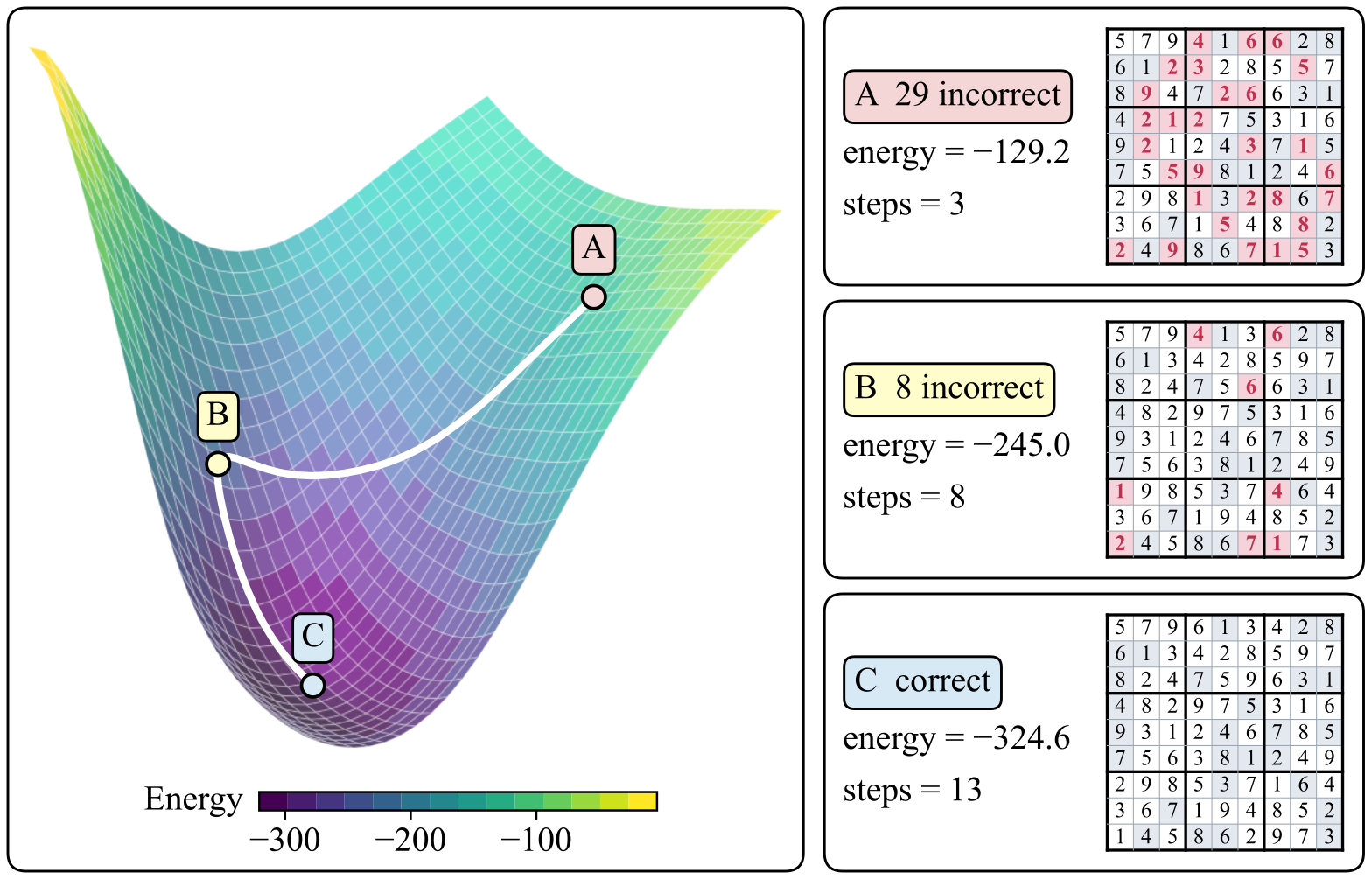
The Energy-Based Reasoners project drew substantial interest on Hacker News with a headline claiming inference that is 385 times more efficient. The collected snapshot records 228 points and 33 comments. The project is relevant to efforts to reduce the cost of reasoning, but that headline should be read as a project-specific claim. It does not, by itself, establish equivalent gains across production workloads, models, or hardware configurations.

04

Cerebras announces disaggregated inference

Cerebras announces disaggregated inference

Cerebras announced disaggregated inference in a company blog post shared on Hacker News. The collected discussion records 96 points and 24 comments, indicating interest in the architecture of serving AI models. The available listing identifies the launch but does not supply performance figures or deployment requirements. The announcement belongs to the broader effort to improve inference infrastructure as reasoning and agent applications increase the amount of computation used during operation.

05

Financial Times examines Nvidia leadership and open models

The Financial Times published an analysis linking Jensen Huang's fall to pressure on open models and a potential benefit for Anthropic and OpenAI. The story appeared in the collected Hacker News feed. Its framing makes it an important industry item beyond technical releases: leadership and corporate support can shape the resources available to model ecosystems. The collected listing does not establish the underlying circumstances or quantify the competitive effect described in the headline.

Twitter

12 stories
01

Runway reports halving GPUs for real-time video

Runway reports halving GPUs for real-time video

Runway says it reduced the GPUs needed to run a fifty-seven-billion-parameter video model at twenty-four frames per second from eight to four. Its research post focuses on the optimizations behind that result and the implementation problems encountered. The claim is directly relevant to the cost of interactive generative video. It also highlights that deployment engineering can materially change hardware requirements without making model size the only lever.

02

Kling Image 4.0 launches with native 8K generation

Kling Image 4.0 launches with native 8K generation

Kling announced that Image 4.0 is available, highlighting native 8K generation, realistic detail, advanced text rendering, and batch image creation. The combination targets workflows that need both visual fidelity and multiple usable outputs. These are capabilities described by the provider in its launch post, rather than independent quality measurements. For creators, the release broadens the set of image-generation tools competing on resolution, typography, and production convenience.

03

Gemini 4 Hydrogen rolls out in Google Search globally

Gemini 4 Hydrogen rolls out in Google Search globally

Google announced the global rollout of Gemini 4 Hydrogen in Search, calling it its biggest model upgrade to the product yet. The company highlights better intent understanding, smarter query fan-out and linking, more visual and adaptive responses, and richer multilingual capabilities. This puts the model inside a widely used information-discovery surface. The rollout matters beyond model benchmarks because changes to search answers also affect how users reach outside sources.

04

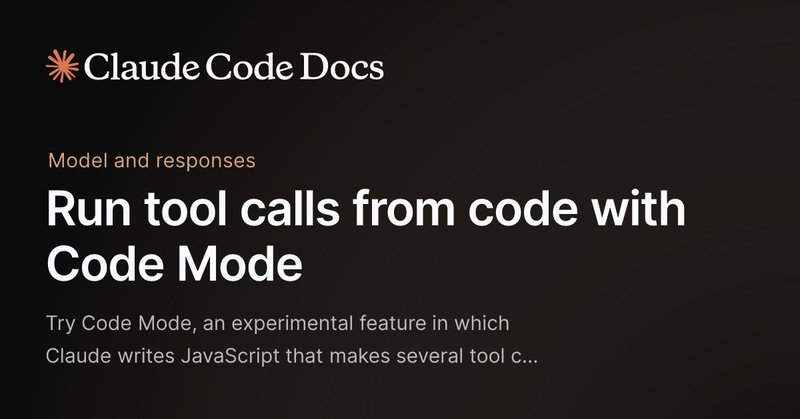
Claude Code experiments with scripted tool orchestration

Claude Code experiments with scripted tool orchestration

Anthropic's Claude developer account introduced Code Mode as an experimental way for Claude Code to work with tools. In this mode, Claude writes scripts that chain tools together and can answer the user while long commands are still running. The feature is offered through an explicit opt-in. Its practical focus is coordinating longer operations and more complex tool sequences while preserving an interactive conversation with the user.

05

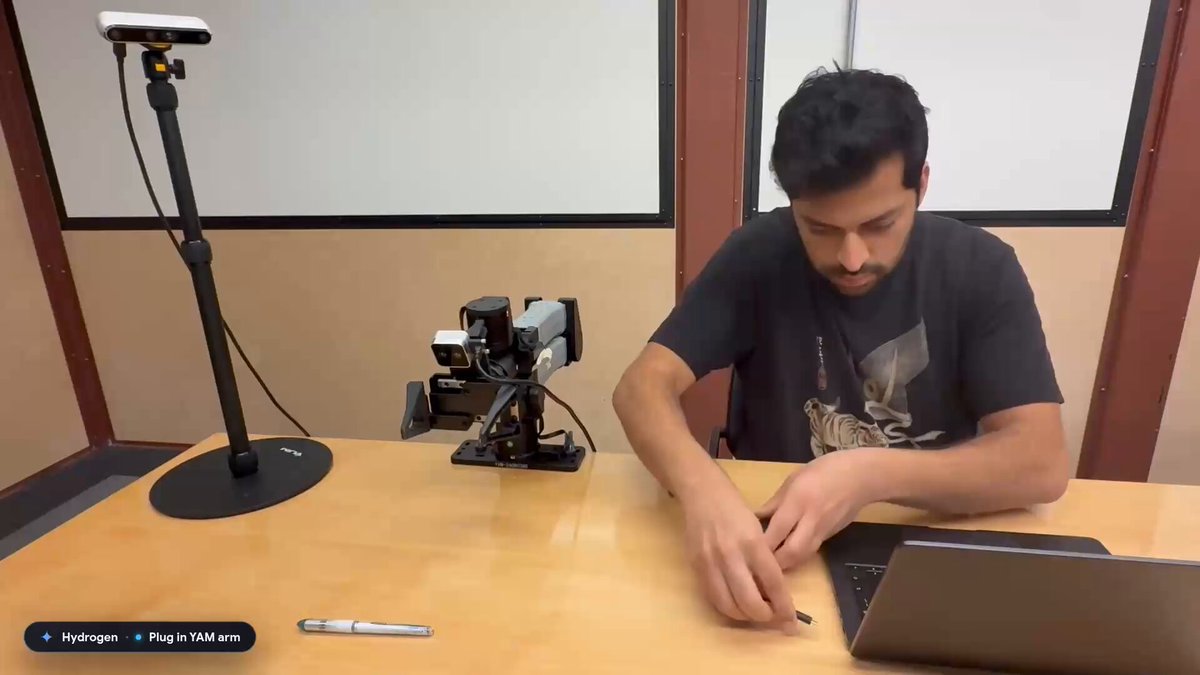
Gemini robotics plugin connects conversation, simulation, and arms

Gemini robotics plugin connects conversation, simulation, and arms

Google DeepMind described a robotics plugin for Antigravity that works with Gemini 4 Hydrogen. The announced workflow connects a supported robot arm, practices tasks in MuJoCo simulation, and runs tasks in the real world using conversation. The integration links language interaction to both simulated and physical execution. Its stated scope is supported hardware, making the hardware compatibility boundary an important part of understanding what the announcement actually enables.

06

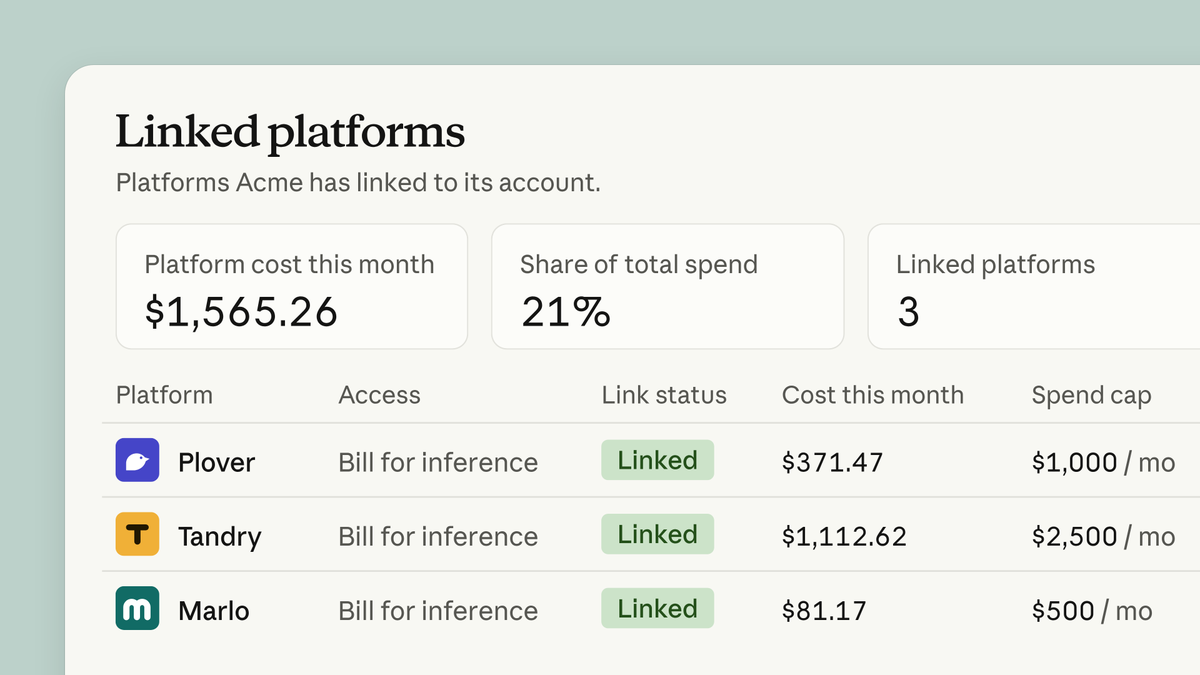
Claude Platform tests linked billing for partner tools

Claude Platform tests linked billing for partner tools

Claude Platform introduced linked billing in beta. Users of tools such as Factory, Linear, and Ramp can pay for Claude API usage through their Claude Platform organization without sharing an API key, according to the announcement. This changes how partner applications connect usage to an existing organization. The feature addresses the commercial and credential-handling side of the tool ecosystem, alongside the more visible changes to models and coding agents.

07

Google expands free Gemini Tasks access across six markets

Google expands free Gemini Tasks access across six markets

Google announced that Tasks in Gemini is expanding free of charge to hundreds of millions more people across the United States, Japan, Korea, Canada, Australia, and India. Users switch from Chat to Task in the Gemini application and describe the work they want handled. The expansion is a distribution story for delegated AI workflows, extending access to a mode designed for work beyond a quick conversational answer.

08

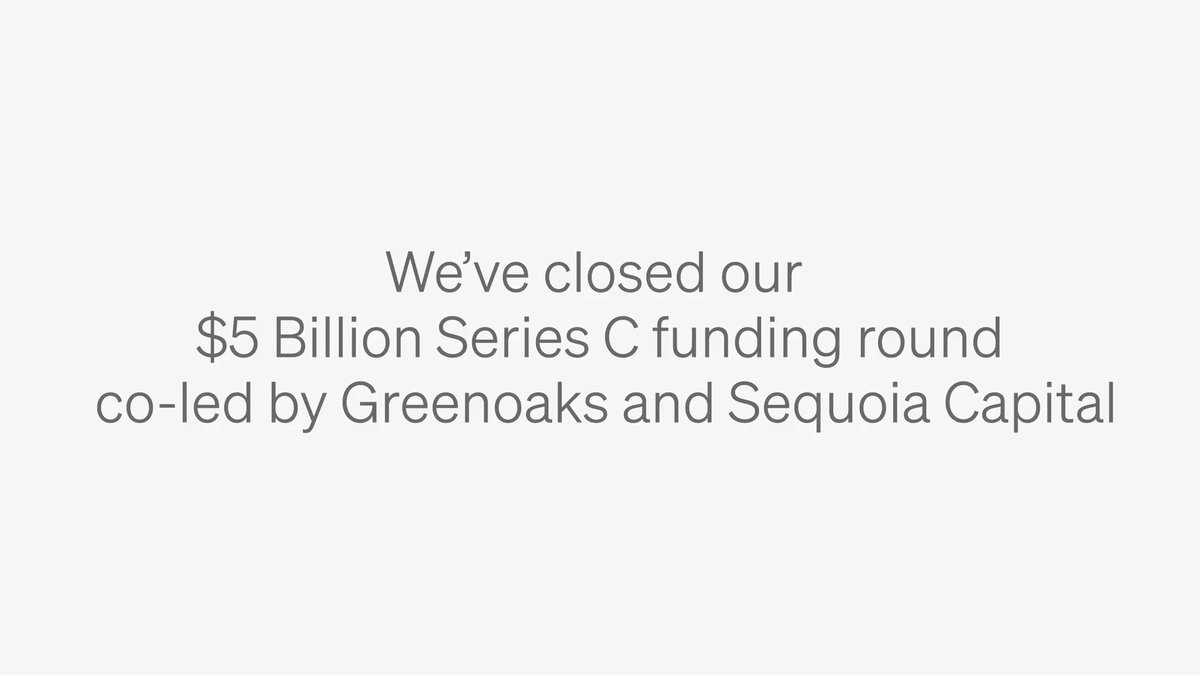
Isomorphic Labs announces Series C funding milestone

Isomorphic Labs announces Series C funding milestone

Isomorphic Labs executive Max Jaderberg announced the closing of the company's Series C funding round. He linked the milestone to its goal of making biology a programmable science and said internal model capabilities are translating into potential new medicines. The post offers a company perspective on progress rather than clinical evidence. The financing milestone is significant because it supports an AI application area where translating model output into real products remains central.

09

Claude Code team puts verification at the center of coding

Claude Code team puts verification at the center of coding

The Claude Code team argues that coding performance improves when the model can verify its own work. Its developer post highlights tests, benchmarks, and end-to-end runs as checks that have become less expensive to perform. This is workflow guidance rather than a new benchmark result. It points toward agent systems that spend effort obtaining feedback from execution, giving developers a concrete way to think about the quality of automated code changes.

10

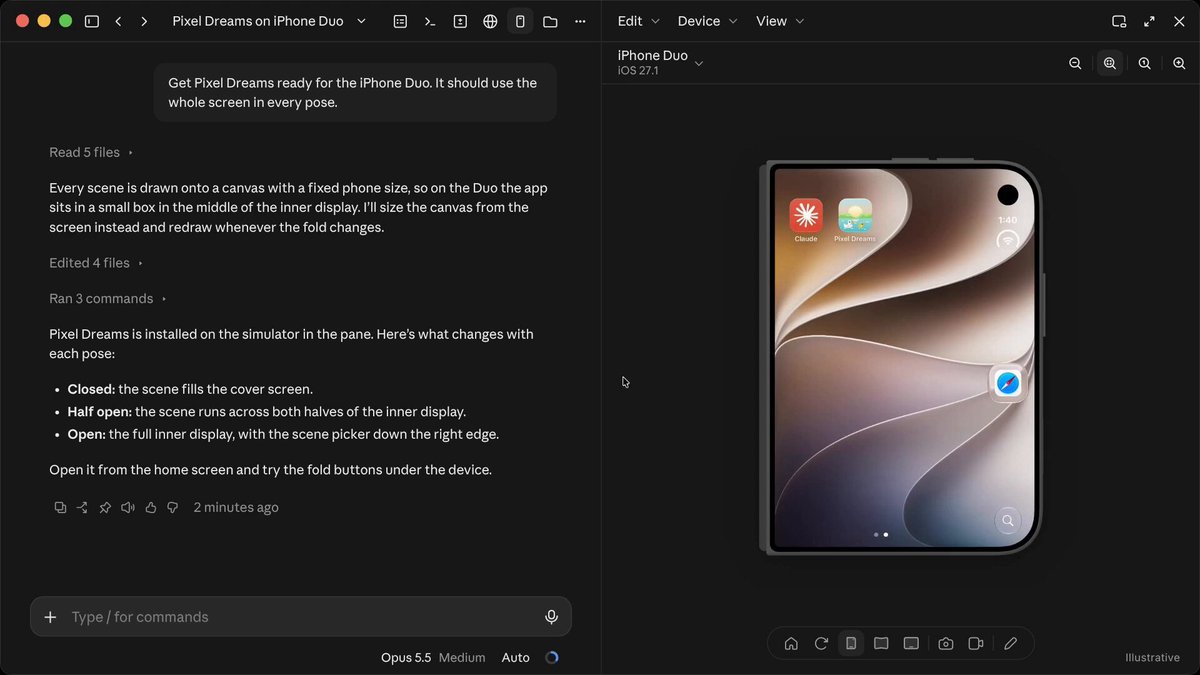
Claude Code adds iPhone Duo simulator support

Claude Code adds iPhone Duo simulator support

Claude Code on desktop now supports iPhone Duo in the iOS simulator as a public beta, according to the developer account. Users can run an application beside the conversation, and Claude can fold and unfold the simulated device to test layouts. This brings a concrete visual verification task into the coding workflow. The announcement focuses on checking application behavior across device states rather than only generating source code.

11

Thomas Wolf explains signing a critical Anthropic letter

Hugging Face cofounder Thomas Wolf posted an explanation of why he signed a letter criticizing Anthropic, while emphasizing his respect for people at the company. He said he did not fully agree with its wording and would not have used the word reckless. The post documents a visible disagreement within the AI community. His qualification matters: support for a letter does not necessarily imply agreement with every characterization it contains.

12

OpenAI executive cites Java flaw found with GPT-6 Cyber

OpenAI executive cites Java flaw found with GPT-6 Cyber

Greg Brockman highlighted a major Java security flaw found by Calif using GPT-6 Cyber as part of OpenAI's Patch the Planet initiative. The post presents the discovery as an example of using AI to help secure internet infrastructure. It does not provide technical exploit details in the collected text. The relevant development is the claimed connection between a specialized model, an external security team, and a concrete vulnerability-discovery effort.

GitHub

2 stories
01

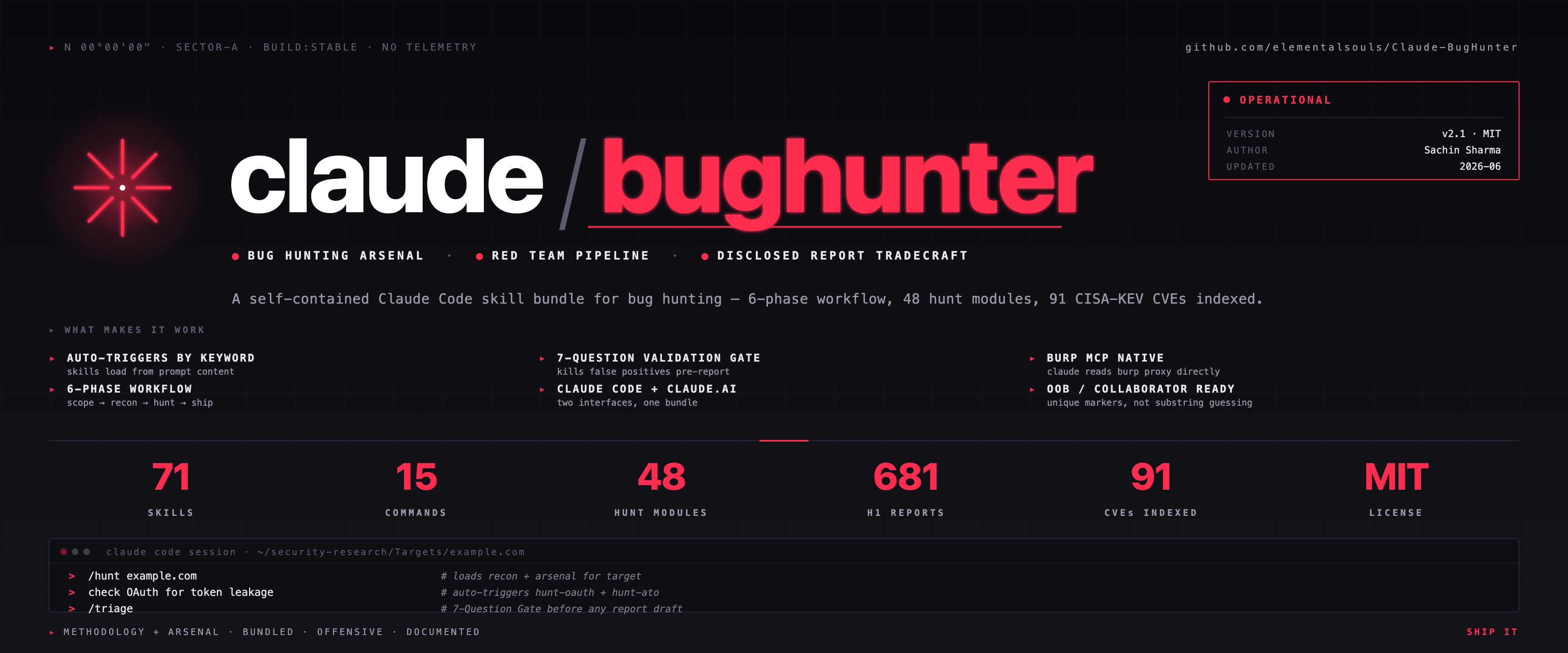
Claude-BugHunter packages security research workflows

Claude-BugHunter packages security research workflows

Claude-BugHunter is a Claude Code skill bundle for bug hunting and external red-team work. Its repository description lists eighty-two skills, fifteen slash commands, and 681 disclosed-report patterns organized across twenty-four core vulnerability classes, plus enterprise identity and infrastructure attack matrices. The project illustrates how specialized agent behavior is being packaged as reusable workflows. Those inventory counts describe the bundle's contents, rather than evidence that its automated findings are correct.

02

last30days skill synthesizes research across public platforms

last30days skill synthesizes research across public platforms

The last30days-skill repository provides an AI agent skill for researching topics across Reddit, X, YouTube, Hacker News, Polymarket, and the web. Its description emphasizes synthesizing the gathered material into a grounded summary. The project is relevant to agents that need current external context before answering or acting. Its contribution is the packaging of a multi-source research workflow, while the quality of any summary still depends on the underlying material and synthesis.

HF HuggingFace

6 stories
01

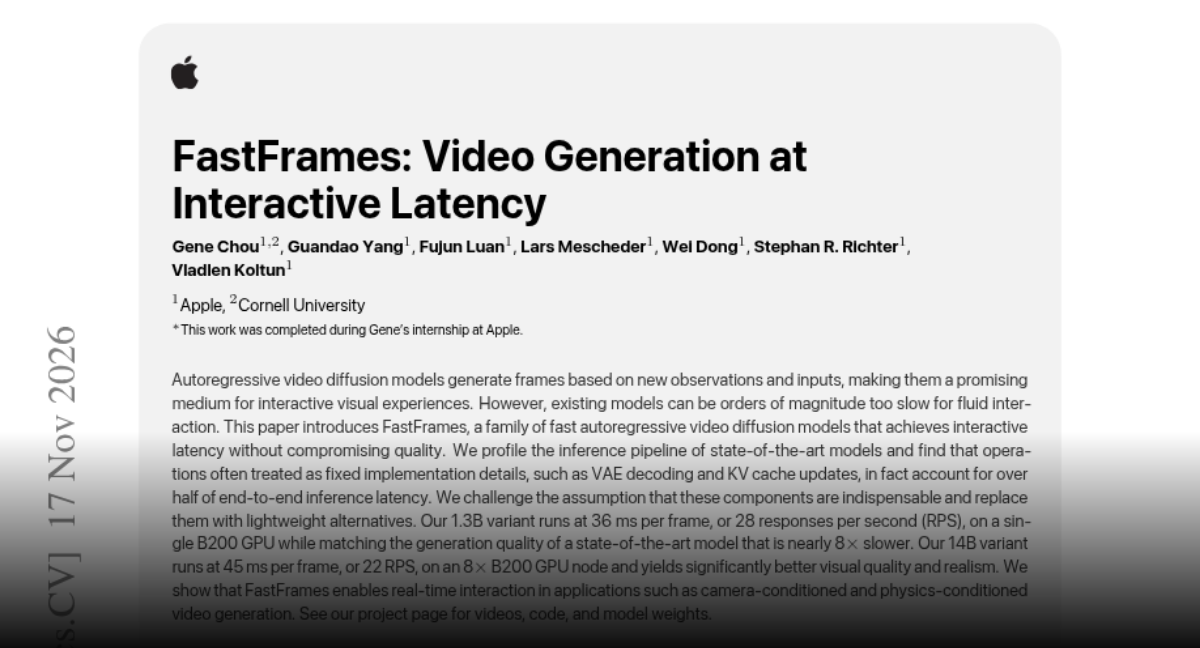
FastFrames targets interactive video generation latency

FastFrames targets interactive video generation latency

FastFrames proposes autoregressive video diffusion models designed for interactive latency. The authors identify VAE decoding and cache updates as major costs, then replace them with lighter alternatives. They report thirty-six milliseconds per frame for a 1.3-billion-parameter model on one B200 GPU and forty-five milliseconds for a fourteen-billion-parameter model on eight B200 GPUs. The work connects systems profiling with camera-conditioned and physics-conditioned video interaction, with results specific to the evaluated configurations.

02

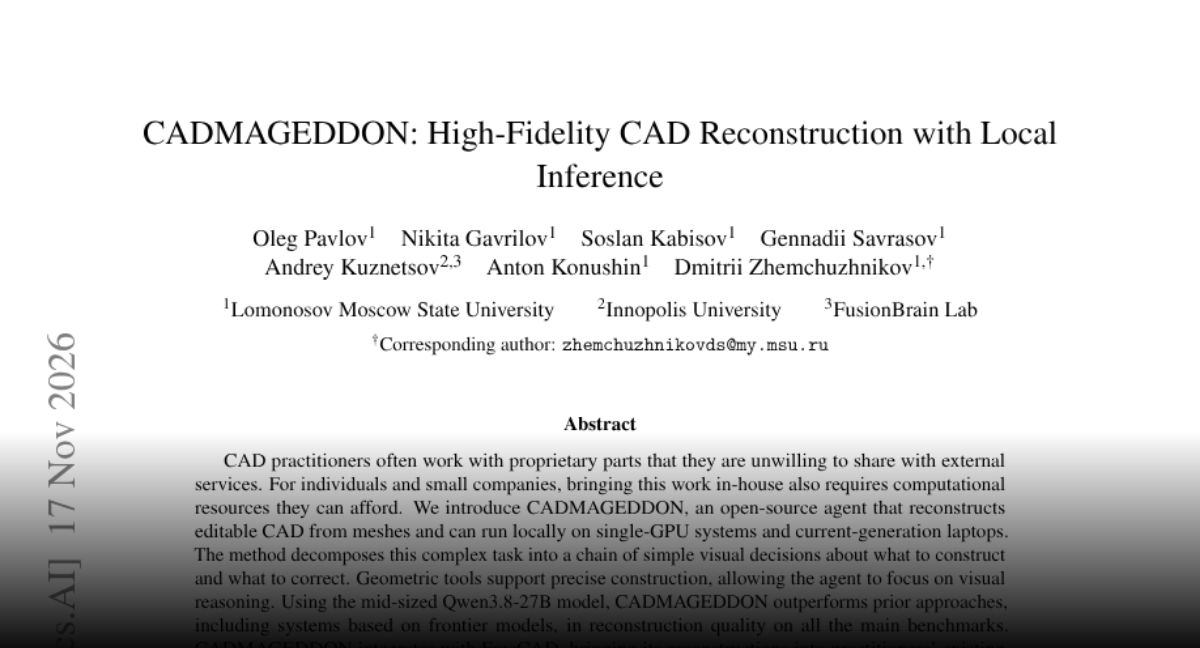
CADMAGEDDON reconstructs editable CAD locally

CADMAGEDDON reconstructs editable CAD locally

CADMAGEDDON is an open-source agent that reconstructs editable CAD from meshes and can run on single-GPU systems or current-generation laptops. It decomposes reconstruction into visual construction and correction decisions, supported by geometric tools. Using Qwen3.8-27B, the authors report better reconstruction quality than prior approaches on their main benchmarks. Integration with FreeCAD makes the output relevant to existing engineering workflows, particularly when proprietary parts need to remain within local infrastructure.

03

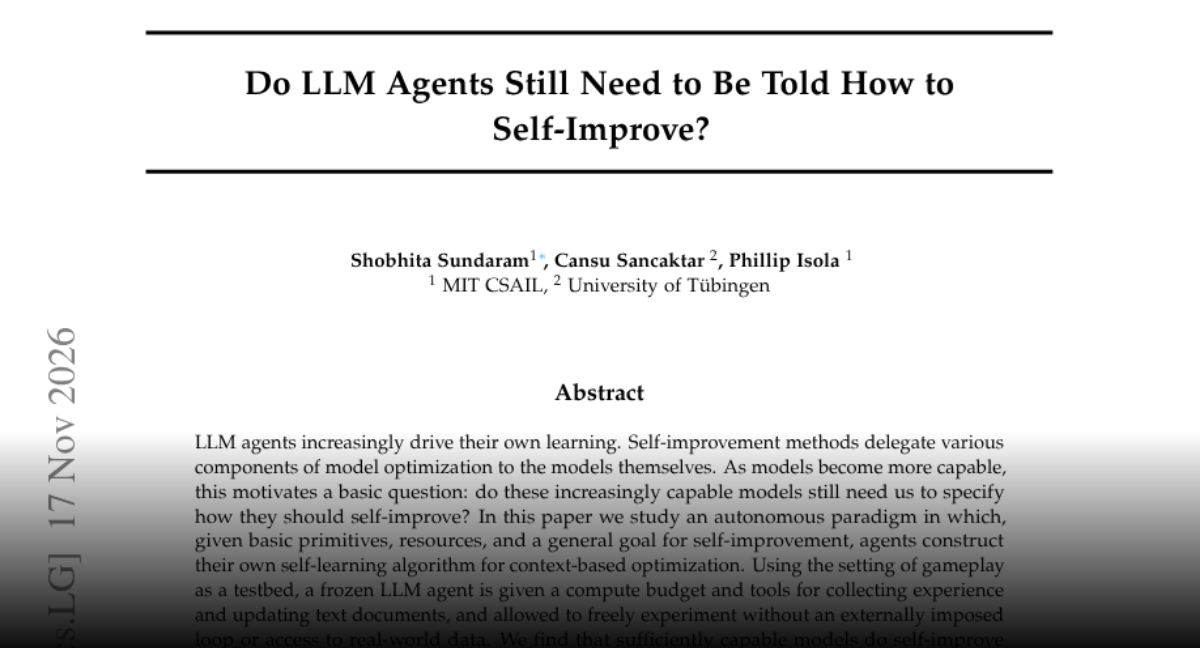
Study lets agents design their own self-improvement loops

Study lets agents design their own self-improvement loops

A new study asks whether capable LLM agents still need an externally specified self-improvement method. In gameplay experiments, a frozen model receives a compute budget, experience-collection tools, and editable text documents, then chooses its own context-based learning strategy. The authors report improvement for sufficiently capable models and some transfer to other tasks. The setting is important: the adaptation uses textual artifacts and experimentation, rather than unrestricted changes to the model's underlying weights.

04

Xing 4 report details training on 8,192 Ascend chips

Xing 4 report details training on 8,192 Ascend chips

The Xing 4 technical report describes the continuation of the TeleChat model family using Ascend hardware and MindSpore infrastructure. It discusses pretraining a 285-billion-parameter model on 8,192 Ascend 910C cards, with topology-aware sharding and memory-management techniques. For post-training, TeleGym connects agent execution, evaluation, and trajectory construction to policy optimization. The report offers a concrete account of how architecture, distributed systems, and agent training are coordinated on this hardware stack.

05

M3OPD-Reasoner releases multimodal distillation recipe

M3OPD-Reasoner releases multimodal distillation recipe

M3OPD-Reasoner presents an open post-training recipe for vision-language reasoning across image STEM, perception, and video. Starting from Qwen3.5-9B, it distills multiple domain teachers through on-policy learning and then applies reinforcement learning on the same prompts. The authors evaluate twenty-one benchmarks and report gains over mixed-training baselines. They release datasets, training code, and checkpoints for each stage, making the sequence of teacher specialization, distillation, and further optimization available for examination.

06

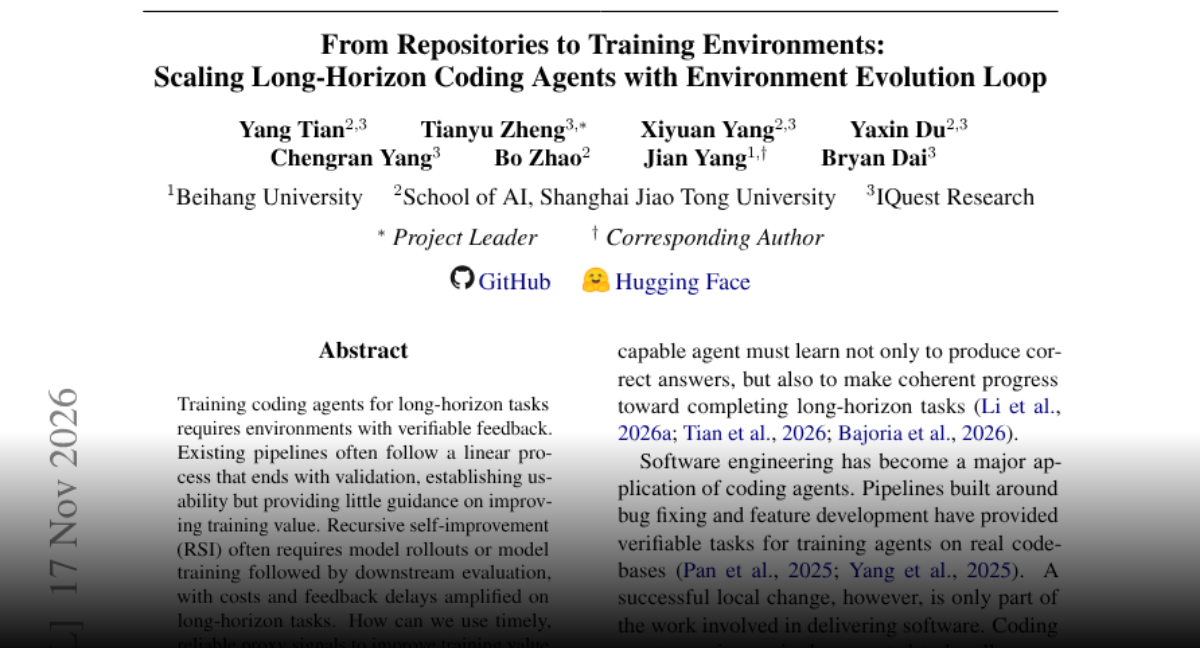
RepoFactory builds verifiable environments for coding agents

RepoFactory builds verifiable environments for coding agents

RepoFactory converts real repositories into environments where coding agents build complete projects from language specifications. Its Environment Evolution Loop uses proxy feedback to improve validity, structural coupling, and implementation scope. The authors report 10,159 environments across seventeen software domains and improved results when training Qwen3.5-35B-A3B on them. The contribution focuses on improving the training environments themselves, providing feedback about their value before repeatedly paying for full downstream agent evaluations.