NO/FOMO

Independent AI signal, once a day

The AI briefing worth opening.

ISSUE DATE2026-11-21DEFAULT EDITION
This issue
—
All time
—

AI Blog

3 stories
01

OpenAI describes defenses against adversarial distillation

OpenAI describes defenses against adversarial distillation

OpenAI describes a layered approach to adversarial distillation, combining model training, safeguards, detection, and enforcement to counter capability extraction. The issue matters as model providers consider how access to outputs can transfer capabilities to other systems. The collected official summary presents a defense strategy, not a quantified demonstration that extraction has been prevented. For developers and researchers, it signals that model-access governance increasingly includes monitoring and enforcement alongside technical safeguards.

02

MedChemBench tests reasoning for early drug discovery

MedChemBench tests reasoning for early drug discovery

OpenAI introduces MedChemBench to evaluate how well AI models interpret molecular structures, reason from experimental evidence, and select compounds during early drug discovery. The benchmark shifts attention from general chat performance to decisions embedded in a scientific workflow. Its practical relevance depends on whether evaluation tasks reflect real research constraints and translate into better experimental choices. The collected description establishes the evaluation scope, but does not demonstrate clinical benefit or successful drug development.

03

Eugene Yan examines how public evaluations work and fail

Eugene Yan examines how public evaluations work and fail

Eugene Yan examines twelve benchmarks to explain how public evaluations work, where they fail, and what should change. The article is relevant as new model releases generate competing scorecards and developers try to translate them into purchasing or deployment choices. Its stated focus is how to read scores and what to question. This makes it a methodological complement to specific leaderboard results, rather than another ranking or a claim that public evaluation is useless.

Hacker News

3 stories
01

Lean community certifies Riemann Hypothesis proof

Lean community certifies Riemann Hypothesis proof

The Lean and Mathlib communities say they have verified Levent Alpöge's Riemann Hypothesis proof, released as a 17-million-line Lean library. Their joint statement reports reproducible compilation, agreement between the proved theorem and Mathlib's vetted statement, and successful checks by several independent proof checkers. This is a major formal-verification development. The statement also looks ahead to explaining the proof's mathematical ideas; machine verification and a human-readable mathematical explanation remain distinct achievements.

02

SimpleBench keeps everyday reasoning gaps in focus

A Hacker News discussion draws attention to SimpleBench amid new frontier-model releases. The benchmark covers more than 200 multiple-choice questions in spatial and temporal reasoning, social intelligence, and resistance to linguistic traps. Its website reports an 83.7 percent human baseline from nine participants and 81.9 percent for its leading listed model, Claude Fable. The small human sample and benchmark-specific setup matter: these figures expose uneven capabilities without settling overall model usefulness.

03

A practical guide explores privately hosted open-weight AI

A practical guide explores privately hosted open-weight AI

Micah Lee's guide describes using open-weight models through Maple's chat, desktop, and API interfaces, presenting trusted execution environments as the provider's privacy mechanism. It shows that using open models need not require owning powerful hardware. The practical tradeoff is between accessibility, token costs, and trust in the hosting architecture. Readers should distinguish the guide's privacy claims from an independent security audit and assess the provider's implementation before sending sensitive material.

Twitter

12 stories
01

Anthropic CEO addresses the company’s IPO

Anthropic published CEO Dario Amodei's remarks on the company's initial public offering, framing the milestone around its founders' belief that powerful AI should benefit humanity. The announcement is a material corporate development for a leading frontier-model company and drew substantial attention on X. The collected excerpt establishes the IPO and the mission framing, but does not support conclusions about subsequent share performance, valuation, or how public-market pressures will affect the company's decisions.

02

Thinking Machines announces Inkling 2 Mini

Thinking Machines announces Inkling 2 Mini

A Thinking Machines announcement reshared by Hugging Face's Thomas Wolf introduces Inkling 2 Mini as a looped transformer. The excerpt positions it as a response to users who found Inkling 2 Small, described as having 594 billion parameters, too large. The smaller-model direction is relevant to the open-model ecosystem, but the collected post does not establish Mini's exact size, licensing, benchmark results, or deployment requirements. Those details should determine its practical accessibility.

03

Runway describes its agent-driven software factory

Runway describes its agent-driven software factory

Runway says agents have written nearly every pull request merged into Runway App Studio since the start of October. Its engineering post describes a surrounding system that reviews changes, tests them in a browser, and involves an engineer for high-risk decisions. The important implementation lesson is the review and testing workflow around code generation. This is a company-reported experience for a particular product, rather than evidence that every engineering task can run autonomously.

04

Hugging Face reports nearly an exabyte of monthly CDN traffic

Hugging Face reports nearly an exabyte of monthly CDN traffic

Thomas Wolf says Hugging Face has operated its own content delivery network since the summer and is now shipping almost one exabyte each month. He describes throughput of roughly 420 gigabytes per second across 80,000 requests per second. The figures illustrate how distributing AI artifacts can strain conventional infrastructure economics. They are an operational account from Hugging Face, not a standardized measure of model usage, training activity, or the number of distinct developers.

05

Google brings voice editing to the Gemini API

Google brings voice editing to the Gemini API

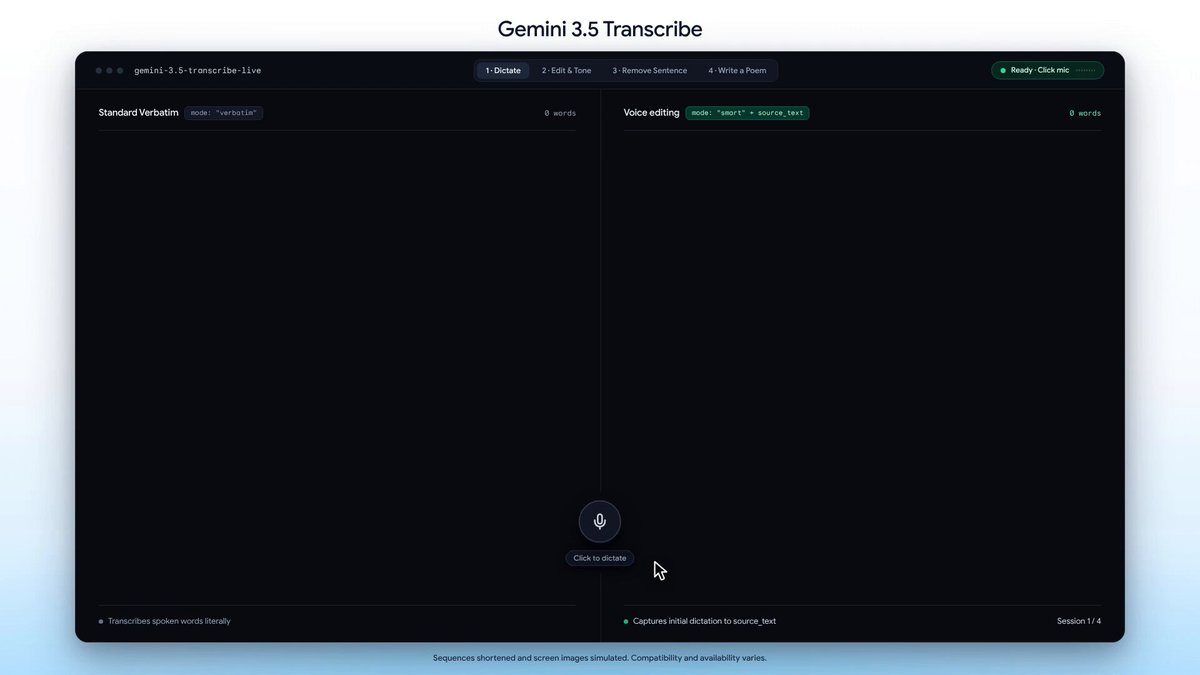
Google says Gemini 3.5 Transcribe's voice-editing capabilities are coming to the Gemini API. The announcement describes applications that let users edit, rephrase, and translate existing text through speech, using technology already associated with Rambler on Gboard and Gemini on macOS. For developers, the significant change is exposing an interaction capability through an API. The collected announcement does not specify pricing, latency guarantees, language coverage, or production reliability measurements.

06

Gemini 4 Hydrogen reaches Gemini and Search

Gemini 4 Hydrogen reaches Gemini and Search

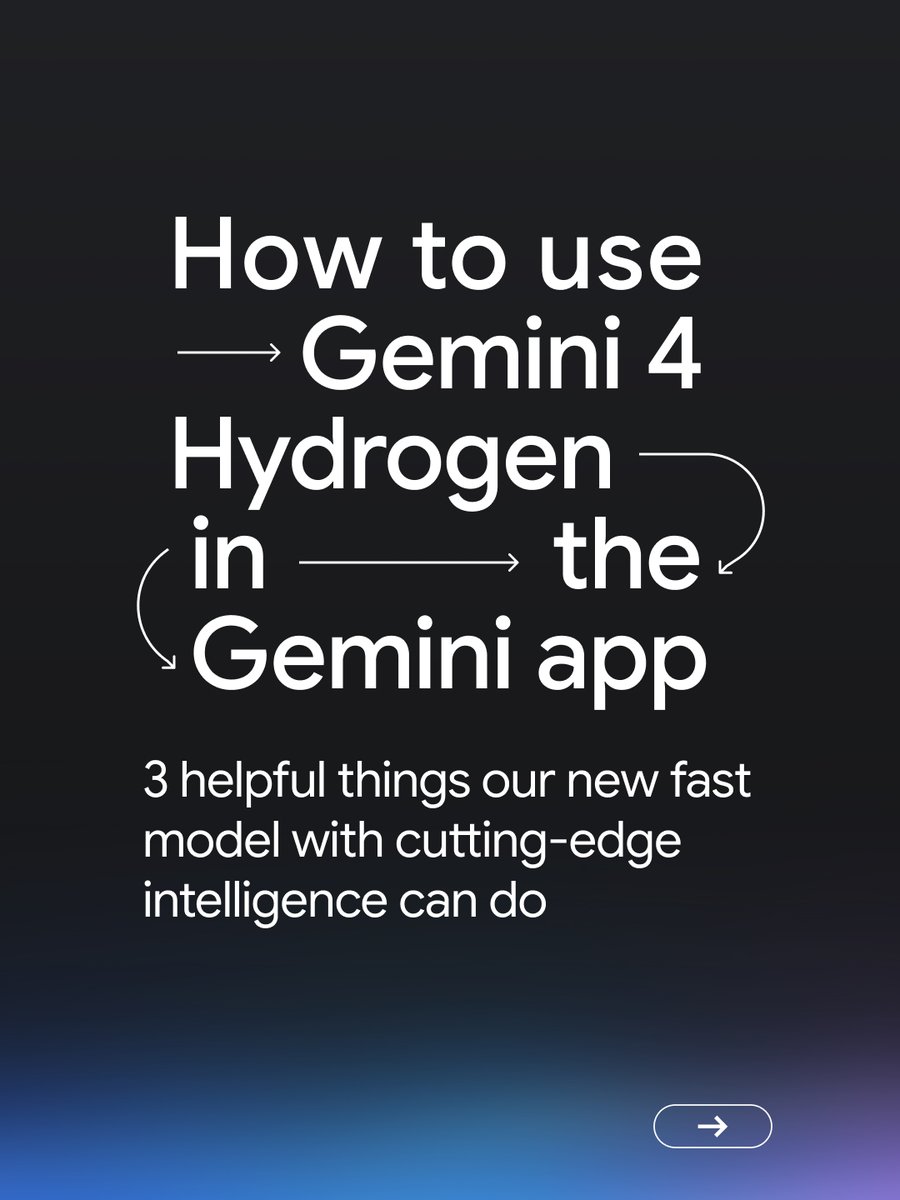
Google says Gemini 4 Hydrogen is live in the Gemini app and Search, positioning the model around speed and everyday work. The company describes it as designed for rapid, efficient execution across agentic workflows. Distribution through these existing products makes the update relevant beyond developer benchmarks. However, the announcement supplies no quantified latency or cost comparison, so its efficiency positioning should be treated as a product claim pending workload-specific evaluation.

07

DeepMind showcases Gemini 4 Neon building a terrain-based simulator

DeepMind showcases Gemini 4 Neon building a terrain-based simulator

Google DeepMind showcases a ski simulator that it says Gemini 4 Neon coded in Antigravity using real Mont Blanc terrain. The demonstration includes custom shaders, live snow carving and avalanches, with no premade 3D models. It is a concrete illustration of code generation extending into interactive graphics. As a selected demonstration, it does not establish reproducibility across prompts, development time, or comparative performance against other models on the same task.

08

Pika adds Seedance 2.5 Flash for iterative video production

Pika adds Seedance 2.5 Flash for iterative video production

Pika announces availability of Seedance 2.5 Flash, emphasizing workflows that need many takes, including advertising variations and batch experiments. The post specifies videos up to 30 seconds at 480p or 720p, with reference inputs of up to ten images, five videos, and five audio clips. These concrete limits help creators assess workflow fit. The announcement does not provide comparative quality measurements or pricing, so throughput economics remain an open consideration.

09

Runway Agent offers conversational video creation

Runway Agent offers conversational video creation

Runway presents Runway Agent as a way to create videos through a short conversation. The announcement points toward an interface where users describe a creative goal and iterate conversationally, rather than managing every generation step directly. This is relevant to the convergence of agents and generative media. The post is a product demonstration, however, and does not document available controls, reliability across complex briefs, pricing, or the amount of human editing needed.

10

Nathan Lambert outlines open problems in post-training

Nathan Lambert outlines open problems in post-training

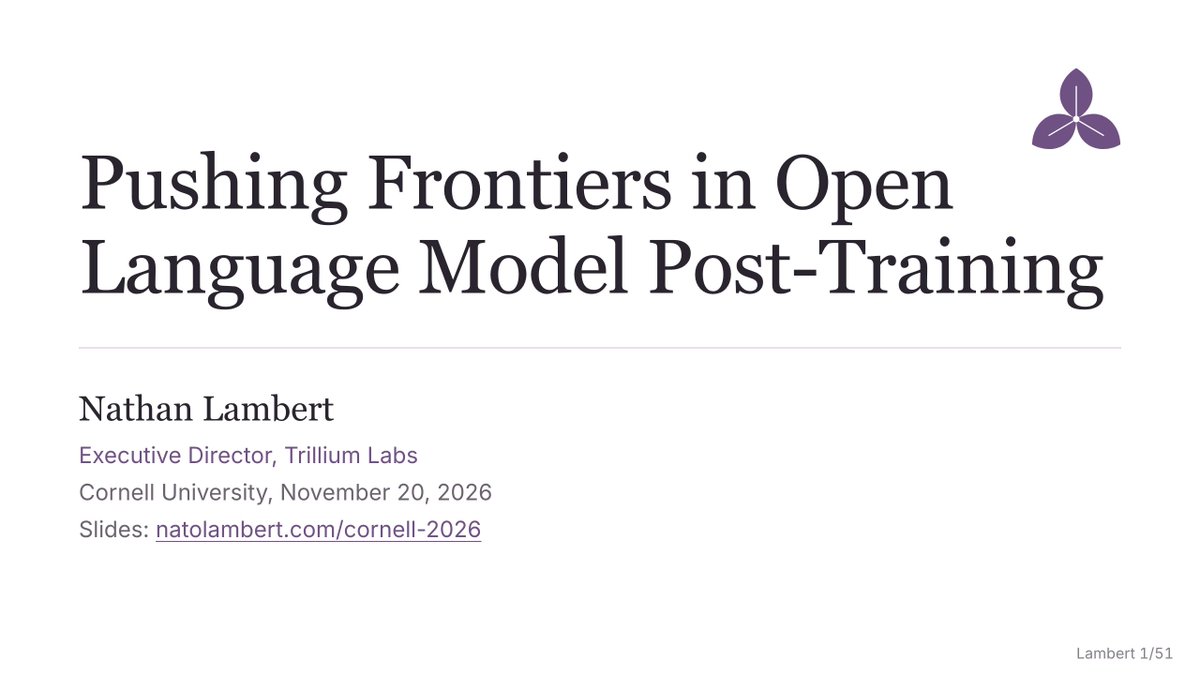
Nathan Lambert shares a new slide deck on major open problems in post-training and how the field reached its current state. He describes the material as largely reflecting his goals for Trillium Labs and invites researchers working openly on these topics to connect. The item is useful as a research-agenda signal rather than a new benchmark result. Its value lies in identifying unresolved work as post-training becomes central to model capability development.

11

Raschka argues open-model competition benefits the wider ecosystem

Raschka argues open-model competition benefits the wider ecosystem

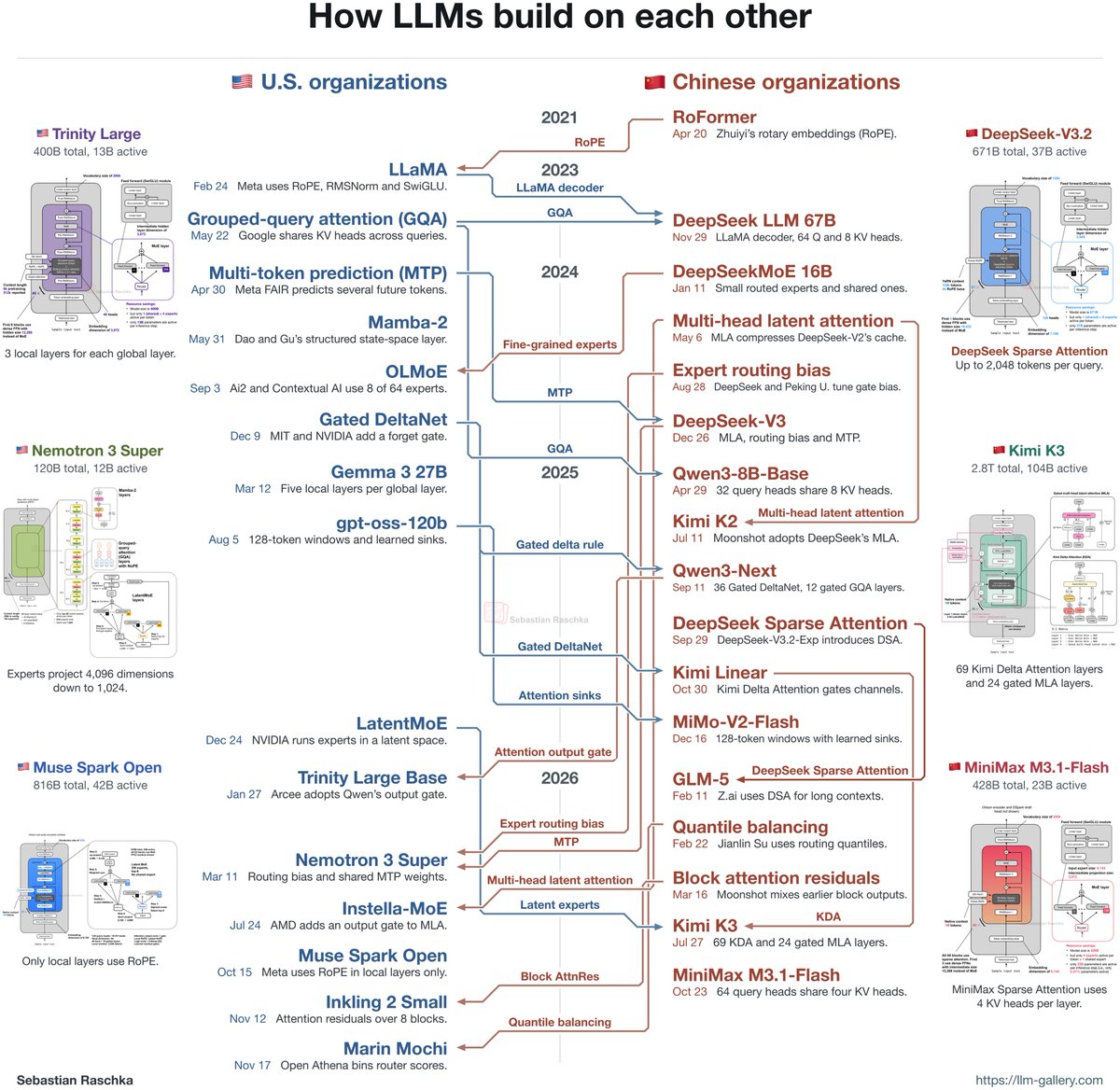
Sebastian Raschka argues that American and Chinese open-weight models have improved each other through competition, and that proprietary models also benefit in quality and price from open alternatives. His widely engaged post is an assessment of ecosystem dynamics, not a controlled causal study. It highlights why access to competitive model weights matters to builders: alternatives can influence deployment choices and negotiating power even when a team ultimately uses a proprietary service.

12

DeepMind’s Kavukcuoglu emphasizes reliability over one AGI test

DeepMind’s Kavukcuoglu emphasizes reliability over one AGI test

Google DeepMind shares Koray Kavukcuoglu's view that no single test or benchmark will establish the arrival of artificial general intelligence. Instead, he points to models becoming less uneven and more reliable across everyday life. The position provides a useful counterweight to headline benchmark wins and impressive demonstrations. For users and developers, it directs attention toward consistency across tasks, while remaining an executive's framing rather than an operational definition or validated measurement framework.