NO/FOMO

Independent AI signal, once a day

The AI briefing worth opening.

ISSUE DATE2026-11-23DEFAULT EDITION
This issue
—
All time
—

AI Blog

4 stories
01

OpenAI proposes perplexity as a shared progress signal

OpenAI's Perplexity and Intelligence post examines perplexity as a measure of model progress and a possible foundation for shared evaluation of emerging capabilities. The publication prompted substantial discussion among AI leaders in the collected X posts, including support for transparency and concerns about compressing intelligence into one quantity. Its importance is the proposed common measurement framework. A predictive metric can inform comparisons, but it does not by itself establish performance across every practical task.

02

A review of twelve benchmarks questions public evaluation practice

A review of twelve benchmarks questions public evaluation practice

Eugene Yan published a review of how public evaluations work, where they break, and what should change, based on a teardown of twelve benchmarks. The article is timely alongside renewed arguments about common measures of AI progress. Its contribution is methodological scrutiny rather than another leaderboard score. For teams choosing models, the practical takeaway is to examine how an evaluation was constructed and whether its tasks and failure modes represent the intended deployment.

03

OpenAI outlines layered defenses against adversarial distillation

OpenAI outlines layered defenses against adversarial distillation

OpenAI describes a layered approach to adversarial distillation that combines model training, safeguards, detection, and enforcement against capability extraction. The post places model protection across both technical controls and operational responses, making it relevant to organizations exposing valuable capabilities through APIs. The collected summary outlines the approach but does not quantify its effectiveness or false-positive rate. It should therefore be read as the provider's defense strategy rather than proof that extraction attempts can be eliminated.

04

MedChemBench evaluates early drug-discovery reasoning

MedChemBench evaluates early drug-discovery reasoning

OpenAI introduced MedChemBench to evaluate how AI models interpret molecular structures, reason from experimental evidence, and select compounds in early drug discovery. The benchmark moves evaluation toward a domain where useful decisions depend on specialized evidence rather than generic question answering. The collected description identifies the tasks but does not establish clinical benefit or successful drug development. Its immediate value is a structured way to assess model assistance at an early stage of scientific work.

Hacker News

3 stories
01

Nvidia reinstates Jensen Huang as CEO

Nvidia reinstates Jensen Huang as CEO

CNBC reports that Nvidia has reinstated Jensen Huang as chief executive, making leadership at a central supplier of AI computing the day's biggest industry story. The report also attracted discussion on Hacker News, alongside widespread reactions from AI researchers and executives on X. The immediate significance is the leadership reversal itself; the collected reactions do not establish the legal, political, or commercial consequences, which should be assessed from subsequent reporting.

02

Z.ai introduces GLM-5.4 with a loop transformer

Z.ai introduces GLM-5.4 with a loop transformer

Z.ai's official GLM-5.4 announcement describes a move toward generalized coding with the company's first loop transformer. It was the strongest AI launch in the collected Hacker News results, with 661 points and 246 comments at collection time. The architectural direction makes it relevant to developers tracking alternatives to conventional model scaling. The available announcement metadata does not establish benchmark scores, pricing, or deployment requirements, so those details are not inferred here.

03

Putting a 17-million-line Lean proof in context

A new analysis asks how unusual a reported 17-million-line Lean proof is by comparing it with famous Mathlib proofs and packages indexed by Reservoir. It finds that very large codebases can include generated database checks as well as mathematical proofs, and discusses the size of an AI-produced Fermat's Last Theorem project. The useful distinction is between machine-checkable output and human comprehensibility. This comparison is not an independent verification of the reported Riemann Hypothesis result.

Twitter

9 stories
01

Runway demonstrates a ChatGPT-to-video production workflow

Runway demonstrates a ChatGPT-to-video production workflow

Runway demonstrates a workflow inside ChatGPT using GPT-6.2 Astra, Blender, and its video generation tools. According to the company's post, Astra reconstructed the Pantheon from historical diagrams, Blender supplied camera movement, and Runway transformed the scene into a festival in ancient Rome. The example highlights coordination across modeling and video tools rather than a single generation step. The claimed architectural consistency is a demonstration claim, not a measured comparison against other production systems.

02

Kling Image 4.0 generates coordinated image sets

Kling Image 4.0 generates coordinated image sets

Kling says Image 4.0 can generate up to ten images from a single prompt while maintaining consistent subjects and visual styles. The announcement addresses a practical production need: creating related assets without independently prompting every frame or composition. It is particularly relevant to storyboards, campaigns, and other work that needs visual continuity. The collected post demonstrates the feature but does not provide a controlled consistency evaluation or specify how performance varies with scene complexity.

03

Nathan Lambert outlines open problems in post-training

Nathan Lambert outlines open problems in post-training

Nathan Lambert shared a slide deck on major open problems in post-training and how the field reached its current position. He describes the material as a statement of goals for Trillium Labs and invites collaboration from people working openly on these questions. The post drew substantial engagement in the collected X results. Its value is a research agenda and an invitation to coordinate work, rather than an announcement of a finished model or benchmark improvement.

04

Runway describes review infrastructure for agent-written code

Runway describes review infrastructure for agent-written code

Runway says agents have written nearly every pull request merged into App Studio since the start of October. Its engineering announcement describes a system that reviews proposed changes, exercises them in a browser, and brings in an engineer for high-risk decisions. The important operational point is the surrounding review and testing process. This is a company account of one product's workflow, so it should not be generalized into a claim about autonomous development across all software teams.

05

Hugging Face describes its model-download CDN scale

Hugging Face describes its model-download CDN scale

Thomas Wolf says Hugging Face has operated its own content delivery network since the summer as AI downloads stretched the conventional CDN model. His post describes traffic approaching an exabyte per month and around 80,000 requests per second. The figures are company-reported scale indicators, not an independently audited measurement. The broader relevance is that distributing model artifacts has become a major infrastructure problem alongside the more familiar costs of training and inference.

06

Pika adds Seedance 2.5 Flash for iterative video work

Pika adds Seedance 2.5 Flash for iterative video work

Pika announced that Seedance 2.5 Flash is available on its platform, positioning it for advertising variations, repeated takes, and batch creative work. The post specifies videos up to thirty seconds at 480p or 720p, with reference inputs of up to ten images, five videos, and five audio clips. These concrete input and output limits help creators assess workflow fit. The announcement does not establish comparative generation quality or the cost of producing a usable final cut.

07

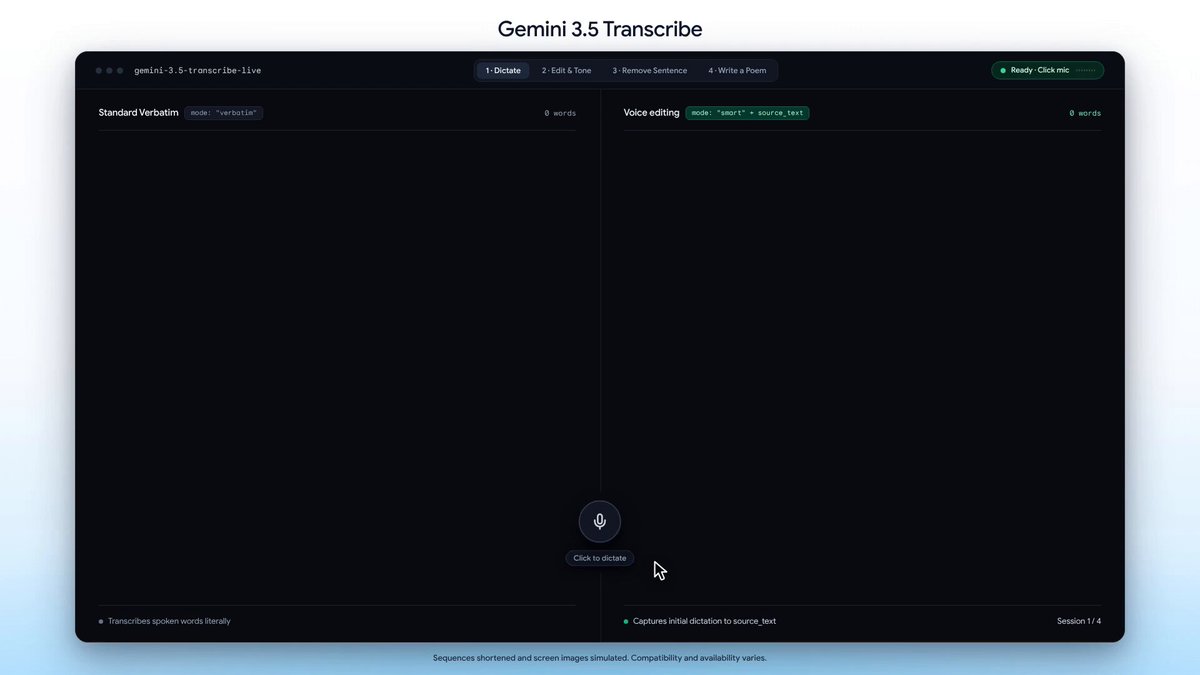
Google brings voice-based text editing to the Gemini API

Google brings voice-based text editing to the Gemini API

Google says Gemini 3.5 Transcribe's voice editing capabilities are coming to the Gemini API. The announcement connects the feature to technology used in Rambler on Gboard and the Gemini app on macOS, and describes editing, rephrasing, and translating existing text through speech. For application developers, the notable change is access to a richer editing interaction than basic dictation. The collected post does not specify latency guarantees, language coverage, or pricing for the API capability.

08

Gemini 4 Hydrogen reaches the Gemini app and Search

Gemini 4 Hydrogen reaches the Gemini app and Search

Google announced that Gemini 4 Hydrogen is live in the Gemini app and Search, describing it as a model designed for speed and everyday work. The post emphasizes efficient execution across agentic workflows rather than presenting a specific benchmark result. Availability in widely used consumer surfaces makes the update relevant beyond model researchers. The collected announcement does not quantify response times, describe regional rollout limits, or provide an independent comparison with other models in the family.

09

Luma showcases an MCP creative workflow in ChatGPT and Claude

Luma showcases an MCP creative workflow in ChatGPT and Claude

Luma showcased One Last Change, a short film by Ian Lihui Wang built around escalating requests for a water-bottle commercial. The company says the film was made with Luma MCP, now available in ChatGPT and Claude. The example illustrates how conversational assistants can become entry points to specialized creative tools. It is a workflow demonstration rather than evidence that a complete production can run unattended or that output quality is consistent across arbitrary creative briefs.

HF HuggingFace

7 stories
01

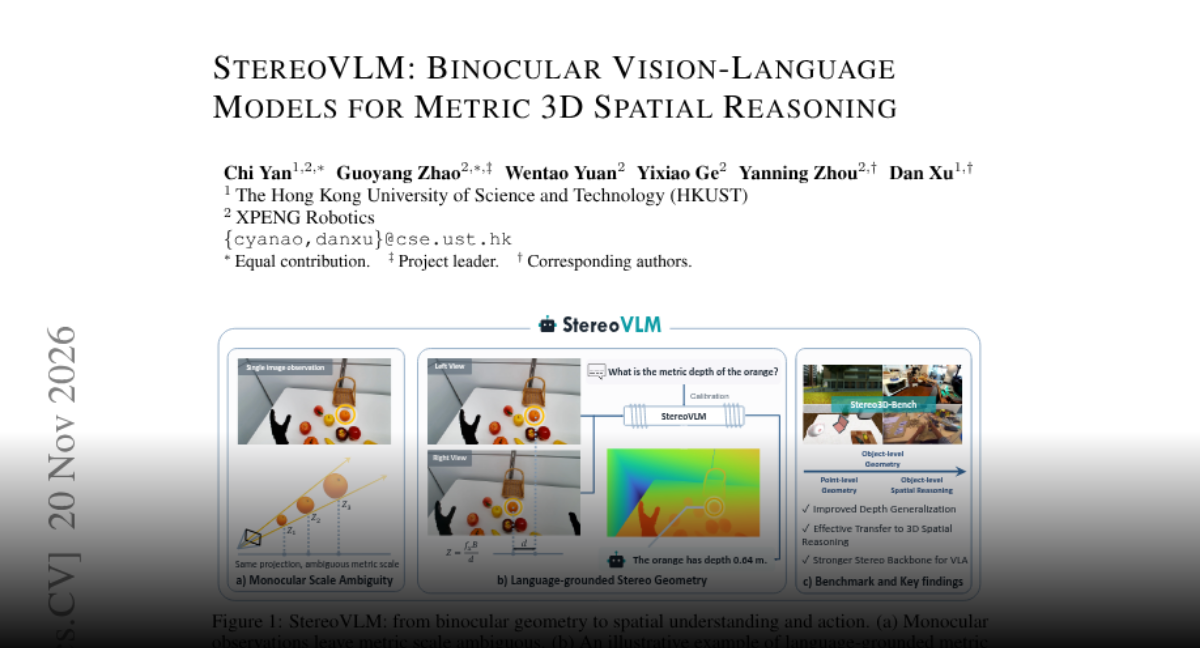
StereoVLM grounds spatial reasoning in calibrated binocular vision

StereoVLM grounds spatial reasoning in calibrated binocular vision

StereoVLM introduces a binocular vision-language model that learns metric spatial reasoning from calibrated stereo observations. Its training progresses from correspondence and disparity to depth and semantic reasoning, with a new Stereo3D-Bench evaluation. The authors report 95.17 percent depth accuracy and improvements on spatial tasks and RoboCasa manipulation. Their intervention experiments suggest valid cross-view geometry contributes to performance. This makes the work relevant to embodied systems that need grounded distances rather than plausible visual descriptions alone.

02

MemOnce compresses reusable memory for long-context models

MemOnce compresses reusable memory for long-context models

MemOnce proposes a memory encoder-decoder that stores a small subset of final-layer states and reconstructs attention caches when needed. A sparse retrieval mechanism computes memory indices once across layers, targeting the cost of continual interactions. The authors report that adapting Qwen3.5-4B reduces memory-state cache by 1,313 times and prefill latency by 6.9 times at a million-token context. These are experimental results for the reported setup, with deployment value depending on retained task quality and workload characteristics.

03

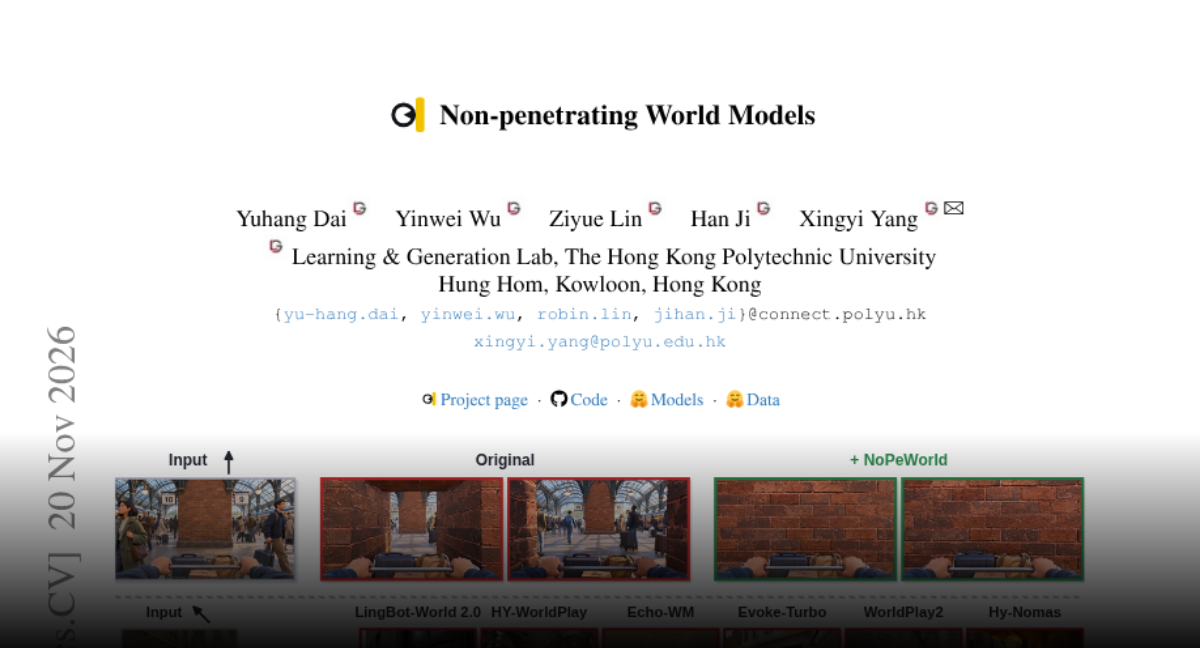
NoPeWorld targets collisions in video world models

NoPeWorld targets collisions in video world models

NoPeWorld tackles object penetration in interactive video world models using a small prediction head on frozen diffusion-transformer hidden states. It detects unsafe candidate actions and replaces them with alternatives intended to preserve the original action's purpose. Across six video world models, the authors report reducing average physical violations from 74 percent to 16 percent. The accompanying NoPeBench, code, and weights make this a concrete research direction for improving physical consistency, while the remaining violations show the problem is not solved.

04

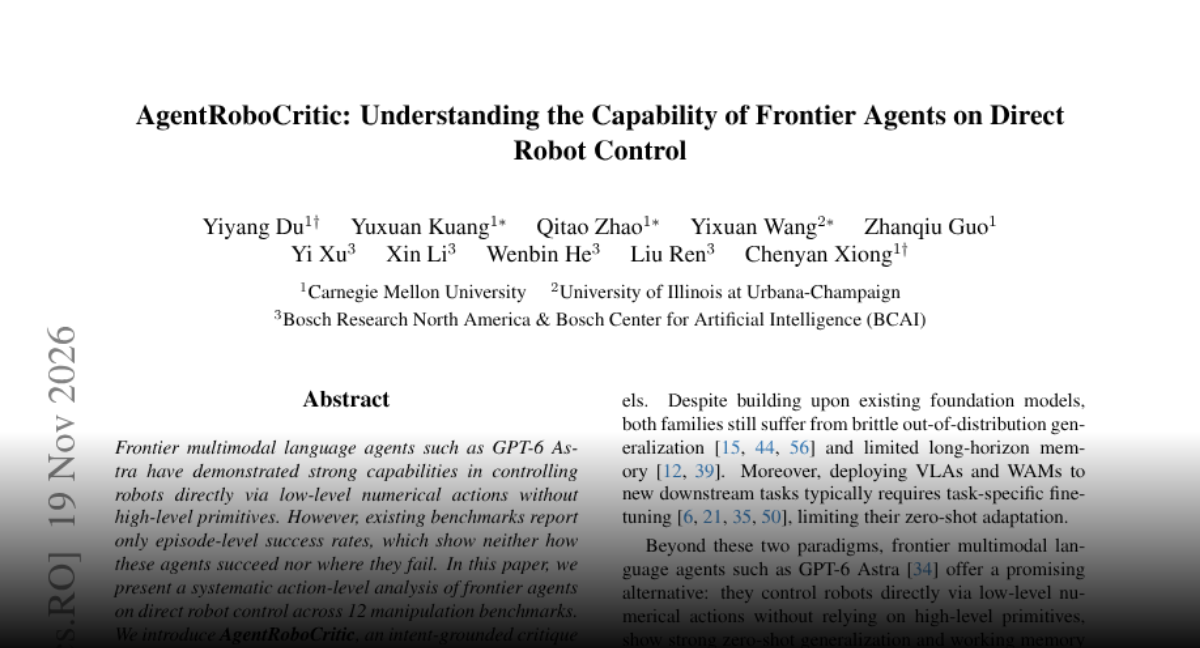
AgentRoboCritic examines robot-control failures action by action

AgentRoboCritic examines robot-control failures action by action

AgentRoboCritic analyzes frontier agents' direct robot control across twelve manipulation benchmarks, asking the policy to state an intent alongside each numerical action. A critic then evaluates outcomes and failure modes against that intent. The study identifies recovery and semantic-grounding strengths alongside grasping and alignment bottlenecks. It releases 12,844 annotated actions and an open critic, with reported failure-mode accuracy improving from 32.58 percent to 74.24 percent. The contribution is diagnostic visibility beyond a single episode-success score.

05

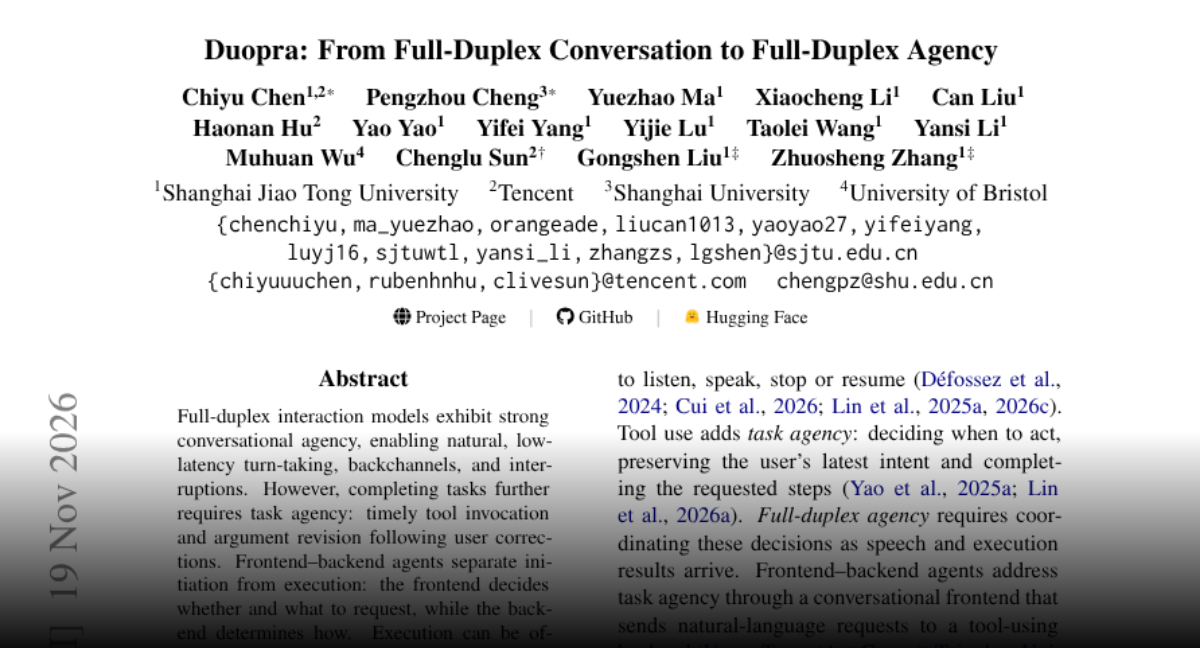
Duopra trains voice interaction and tool execution together

Duopra trains voice interaction and tool execution together

Duopra extends full-duplex conversation toward task execution by training timely tool calls and revisions alongside conversational control. Its three-stage process combines supervised protocol training, reinforcement learning, and repair of talker conditioning. With the same backend, the authors report Pass@1 rising from 4.7 percent to 44.7 percent in their streaming evaluation. The study argues that many failures occur before a tool runs, making faithful request initiation as important as the backend's ability to complete a task.

06

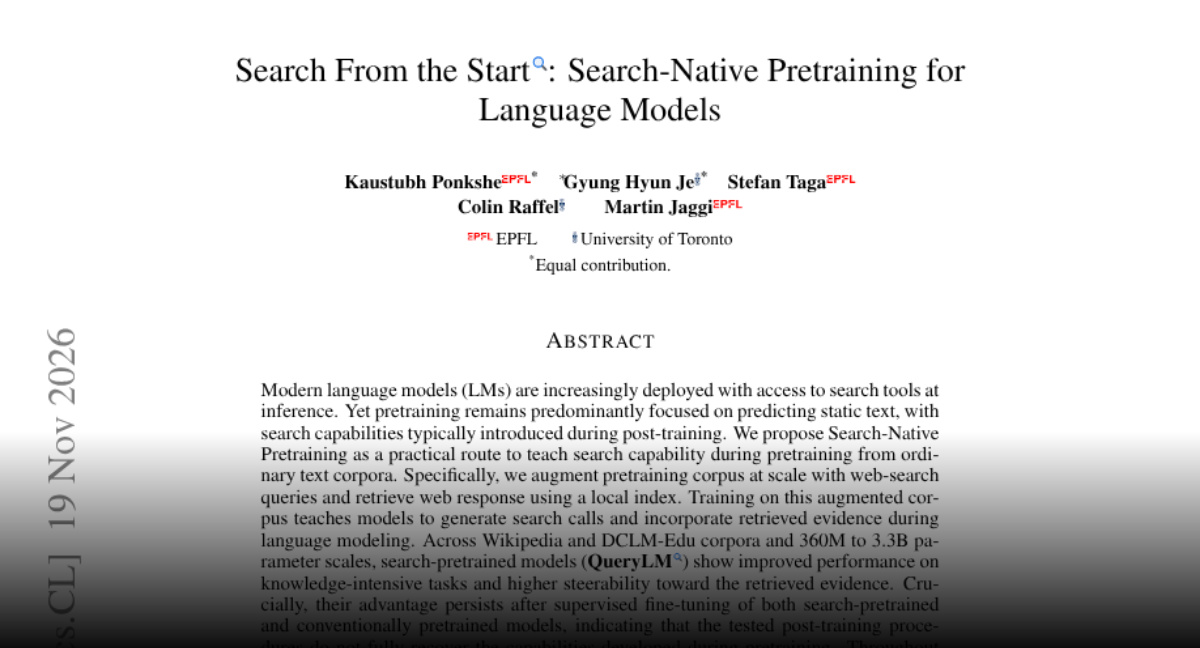
QueryLM learns search during pretraining

QueryLM learns search during pretraining

Search-Native Pretraining augments ordinary text corpora with search queries and retrieved responses, teaching models to call search and use evidence before post-training. Across experiments from 360 million to 3.3 billion parameters, the authors report improved knowledge-task performance and stronger responsiveness to retrieved material. A 1.4-billion-parameter QueryLM matches or beats a compute-matched 3.3-billion baseline on tested knowledge-intensive tasks. Released checkpoints and data support examination of whether tool use should be learned earlier in the model pipeline.

07

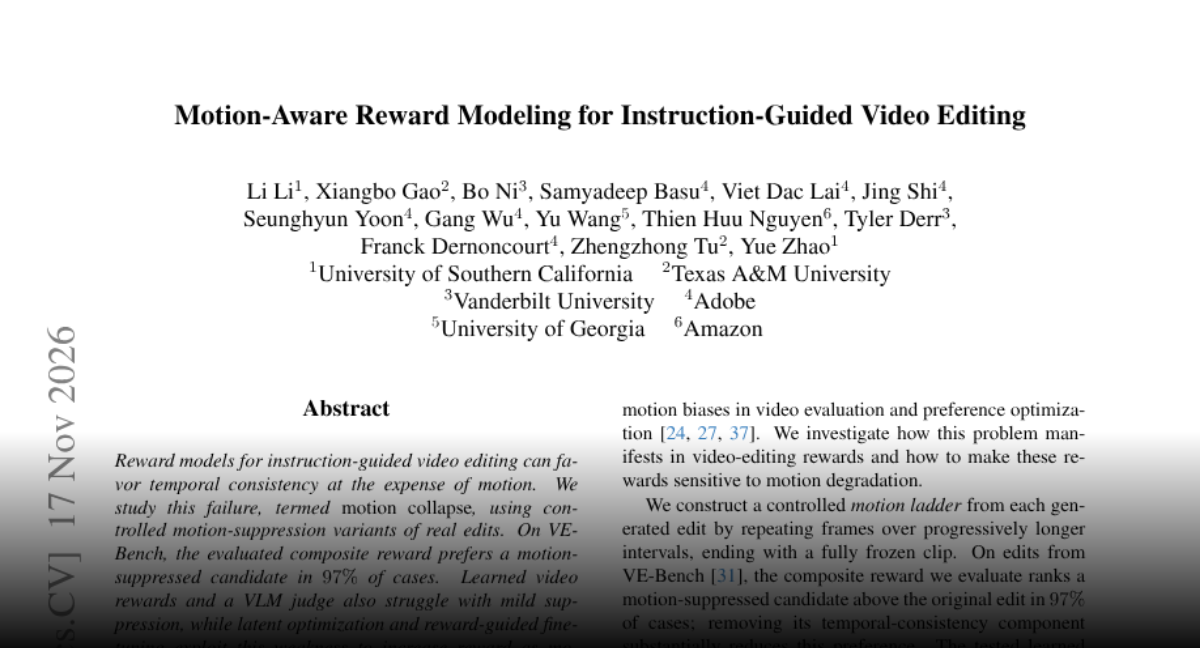
Motion-aware rewards address frozen-looking video edits

Motion-aware rewards address frozen-looking video edits

A video-editing study finds that reward models can prefer suppressed motion while appearing to reward temporal consistency. On its controlled VE-Bench comparison, an evaluated composite reward favored motion-suppressed candidates in 97 percent of cases. The proposed reward adds frame-difference inputs and training against suppressed or fabricated motion, reducing that preference to zero in the reported test. The result highlights a specific reward-design failure: optimizing a convenient quality signal can remove the movement users wanted to preserve.