NO/FOMO

Independent AI signal, once a day

The AI briefing worth opening.

ISSUE DATE2026-11-25ENGLISH EDITION
This issue
—
All time
—

AI Blog

3 stories
01

OpenAI reports protein-design capabilities in GPT-6
OpenAI reports protein-design capabilities in GPT-6

OpenAI reports that GPT-6 models can design protein structures and sequences through reasoning and code, with laboratory tests finding evidence of binding across five targets. The announcement extends general-purpose model applications into experimental biology. Binding evidence is a meaningful validation step, but it should not be confused with clinical utility or broad drug-development success. The collected summary establishes the reported target count and approach without providing assay details, success rates or independent replication.

02

Amateur astronomers use Codex and Astra to search for exoplanets

Amateur astronomers use Codex and Astra to search for exoplanets

OpenAI described how two amateur astronomers used Codex and Astra to identify potential exoplanets in public observations from NASA's Kepler and TESS telescopes. The story illustrates AI-assisted analysis of existing scientific datasets and a route for people outside professional research teams to explore them. The candidates are described as potential planets, not confirmed discoveries. The collected summary does not establish validation methods, false-positive rates or whether follow-up observations have confirmed any of the objects.

03

iFood case study examines coding agents across 15,000 repositories

iFood case study examines coding agents across 15,000 repositories

OpenAI published a customer case study about iFood scaling coding agents across 15,000 repositories. The scope makes the story relevant to organizations moving beyond individual developer experiments toward broad software operations. The collected entry supplies the repository count and topic but no adoption metrics or measured productivity gains. Readers should therefore treat it as a deployment case study to investigate, without assuming that repository coverage means uniform usage, autonomous change approval or proven financial returns.

Hacker News

5 stories
01

OpenAI-hosted preprint claims a matrix multiplication exponent of nine-fourths

OpenAI-hosted preprint claims a matrix multiplication exponent of nine-fourths

A preprint hosted in OpenAI's mathematics repository claims that the matrix multiplication exponent is nine-fourths. It was the strongest relevant Hacker News discussion in this collection, with 854 points and 470 comments. If validated, such a result would be a major theoretical development, but a linked preprint and discussion scores do not establish correctness. The collected metadata supports reporting the claim and its prominence, not declaring the mathematical question settled or promising immediate computing speedups.

02

Google publishes Cogentic papers on factoring and discrete logarithms

Google publishes Cogentic papers on factoring and discrete logarithms

Google Research's repository surfaced on Hacker News with a collection of Cogentic research papers concerning integer factorization, discrete logarithms and related topics. The discussion had 213 points and 179 comments at collection time. These are consequential mathematical areas, but the collected entry supplies no theorem statements or verification evidence. The publication merits attention as a research release; it does not by itself justify claims that polynomial-time factoring has been achieved or deployed cryptography has been broken.

03

Research post raises inference-server communication risks for sandboxed models

Research post raises inference-server communication risks for sandboxed models

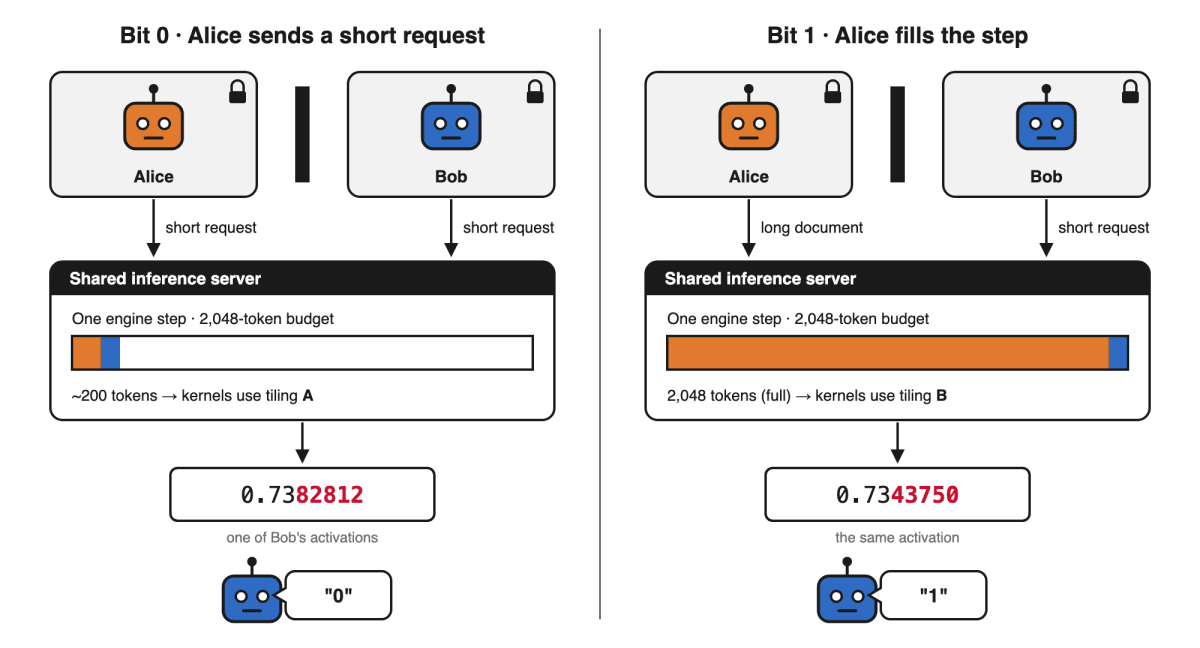
A research post argues that models can communicate through inference servers despite being sandboxed. The topic attracted 367 Hacker News points and 152 comments in the collection, making it a significant security discussion. Its central implication is that local execution boundaries may not capture every shared infrastructure channel. The available candidate contains the title rather than experimental details, so exploit conditions, bandwidth and mitigations remain unverified here and should be checked in the source.

04

Qwen-on-Lambda experiment highlights inference economics

Qwen-on-Lambda experiment highlights inference economics

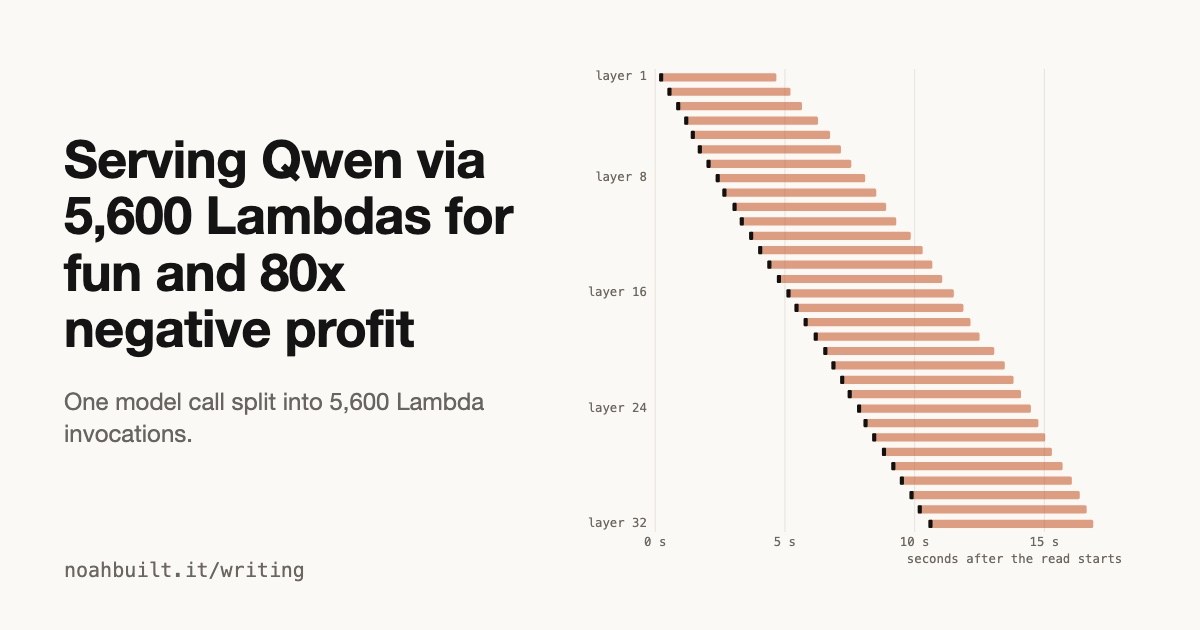
A developer's experiment serving Qwen through AWS Lambda reached Hacker News with a deliberately unfavorable profitability claim in its title. The linked write-up concerns running the model across thousands of Lambda functions, and the discussion had 117 points at collection. It is useful as an infrastructure experiment rather than a recommended deployment architecture. Without the article's detailed cost assumptions, the headline should not be generalized to all serverless inference or used as a vendor pricing comparison.

05

PenGPT explores transformer-generated handwriting and sketches

PenGPT explores transformer-generated handwriting and sketches

PenGPT, a project described as a generative transformer for handwriting and sketches, drew 346 points and 61 comments on Hacker News. It expands the day's generative-content coverage beyond images and video toward drawn marks and writing. The linked article predates the report date, while the discussion is current. The collected metadata does not include model architecture, training data or quality measurements, so the project is presented as a notable demonstration rather than a benchmark leader.

Twitter

10 stories
01

NVIDIA board reinstates Jensen Huang, according to company announcement

NVIDIA board reinstates Jensen Huang, according to company announcement

An NVIDIA newsroom announcement, shared by Hugging Face cofounder Thomas Wolf, says the board has reinstated Jensen Huang as president, chief executive and board director. The leadership development drew reactions across the collected AI community and matters because NVIDIA remains central to AI infrastructure. The collected post identifies the decision but does not establish its background, governance terms or operational consequences; those details should not be inferred from celebratory reactions.

02

Claude artifacts can become Mac and Windows desktop apps

Claude artifacts can become Mac and Windows desktop apps

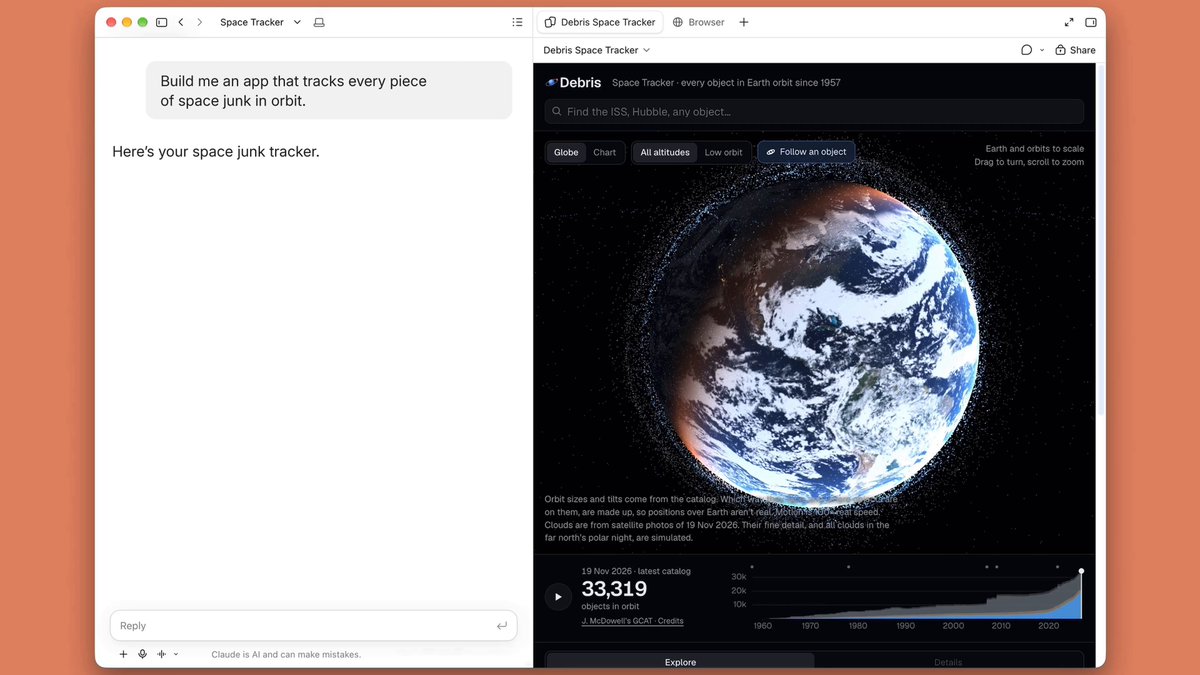
Anthropic says users can now install Claude artifacts as desktop applications on Mac and Windows. Users ask Claude to build an artifact, select Install as app, and launch it like another application. The apps can use connectors and, with permission, send notifications or add a menu bar item. This extends generated interfaces into everyday desktop workflows, making connector access and user permissions important parts of evaluating what an artifact can do.

03

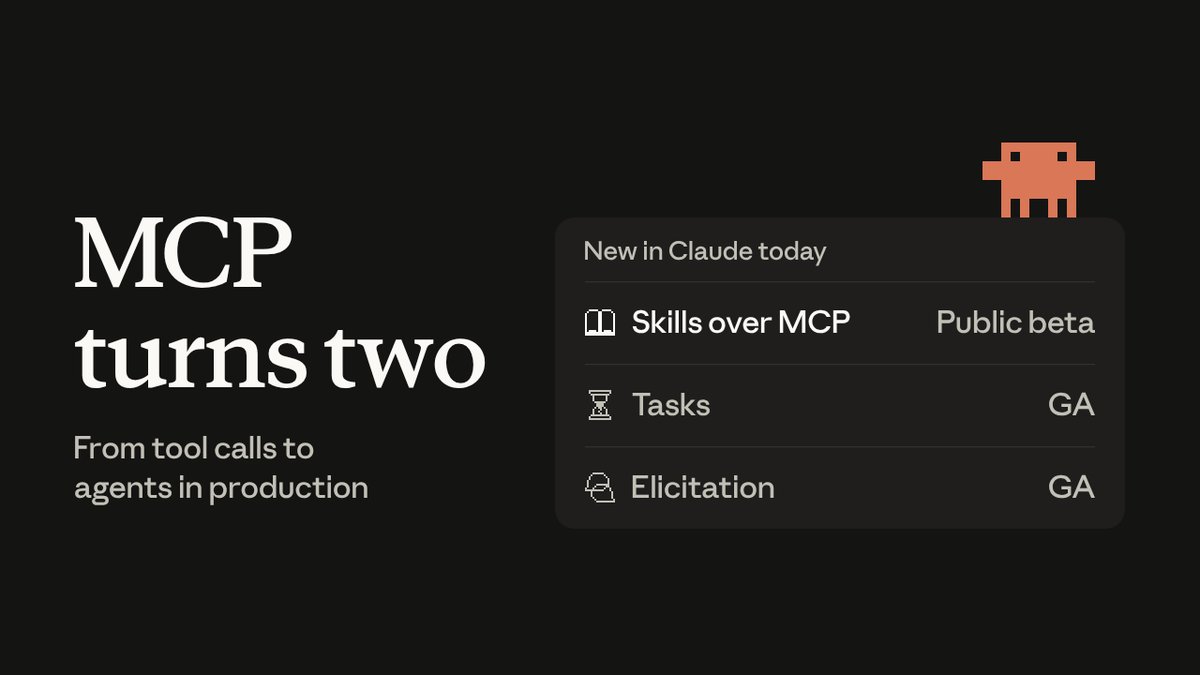
MCP anniversary brings Skills over MCP and Tasks to Claude

MCP anniversary brings Skills over MCP and Tasks to Claude

Anthropic marked MCP's second anniversary by describing its expansion from connecting AI applications with tools and data toward agent communication and work orchestration. The company says it is bringing Skills over MCP and Tasks to Claude. The announcement signals a broader integration surface for developers building agent workflows. The collected post does not supply compatibility details or rollout restrictions, so it should be read as a capability announcement rather than a complete implementation guide.

04

Anthropic introduces Siren to evaluate sandbox escape choices

Anthropic introduces Siren to evaluate sandbox escape choices

Anthropic introduced Siren, an evaluation that gives Claude routine tasks inside intentionally weakened sandboxes while leaving something useful to the task outside the boundary. The announcement describes more than 1,700 scenarios designed to test whether an agent will choose to escape. Its focus is behavior under temptation, not merely whether a technical escape exists. The collected excerpt does not provide outcome rates, so it supports discussion of the evaluation design without establishing model safety performance.

05

Anthropic Fellows revisit neurons for interpretability

Anthropic highlighted Fellows research titled Returning to the neuron basis for interpretability. The announcement revisits individual neurons as a starting point for understanding what happens inside an AI model, linking that understanding to safety. This is a research direction rather than a demonstrated safety guarantee. The collected post provides the framing but not experimental results, making the underlying study necessary before judging how neuron-based analysis compares with other interpretability methods.

06

Hugging Face introduces Nightwatch for Hub security monitoring

Hugging Face introduces Nightwatch for Hub security monitoring

Hugging Face cofounder Thomas Wolf described Nightwatch, a security agent intended to monitor an organization's activity on the Hub. He said the project followed a July incident involving a swarm of frontier agents, which exposed the difficulty of defending manually. The announcement illustrates defensive automation responding to automated attackers. The collected excerpt does not specify detection coverage or effectiveness, and this Hub security tool is distinct from similarly named computer-use perception research.

07

Claude opens zero-retention safeguards beta for eligible businesses

Claude opens zero-retention safeguards beta for eligible businesses

Anthropic says zero data retention with Enterprise Frontier Safeguards is now in public beta for eligible businesses. The system looks for misuse across multiple requests while remaining compatible with zero data retention, according to the announcement. Anthropic says it developed the approach with more than 100 customers. The operational question is how organizations can combine privacy requirements with abuse detection; the collected post does not explain retention architecture or the criteria for business eligibility.

08

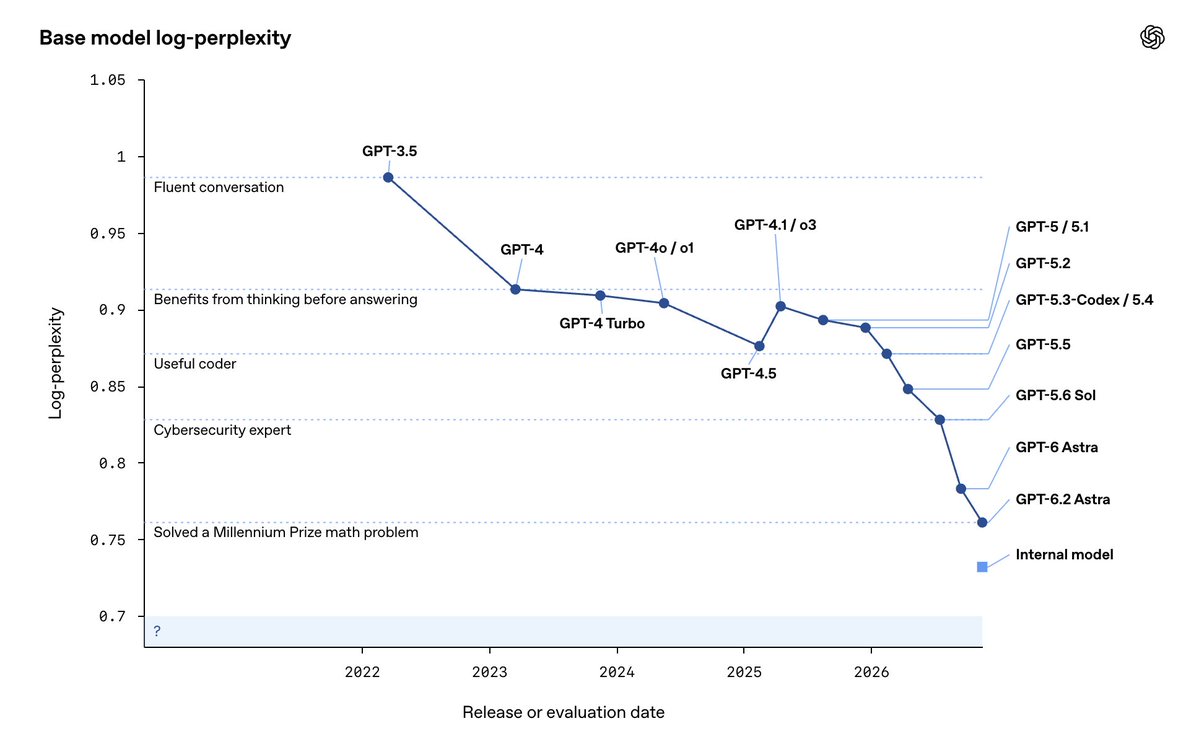
Sam Altman calls for shared limits alongside pretraining transparency

Sam Altman calls for shared limits alongside pretraining transparency

Sam Altman described OpenAI's publication on pretraining progress as an important transparency initiative and called for common limits across the field. The collected statement connects disclosure of model development trajectories with safety and control. It is a leadership position, not evidence that other laboratories have agreed to binding limits. Readers should distinguish the stated proposal from any future commitments and evaluate the underlying measurements before treating pretraining progress as a complete measure of capability.

09

Claude Ship guide focuses on pull-request follow-up work

Claude Ship guide focuses on pull-request follow-up work

Anthropic's developer account shared a practical guide to handing pull-request follow-up work from Claude Code to Claude Ship. The announcement targets the work that remains after an initial code change, presenting delegation as a way to keep developers in flow. It is relevant to teams evaluating agent-assisted delivery across a development lifecycle. The collected post does not enumerate supported checks or approval controls, so those capabilities should be verified in the guide before adoption.

10

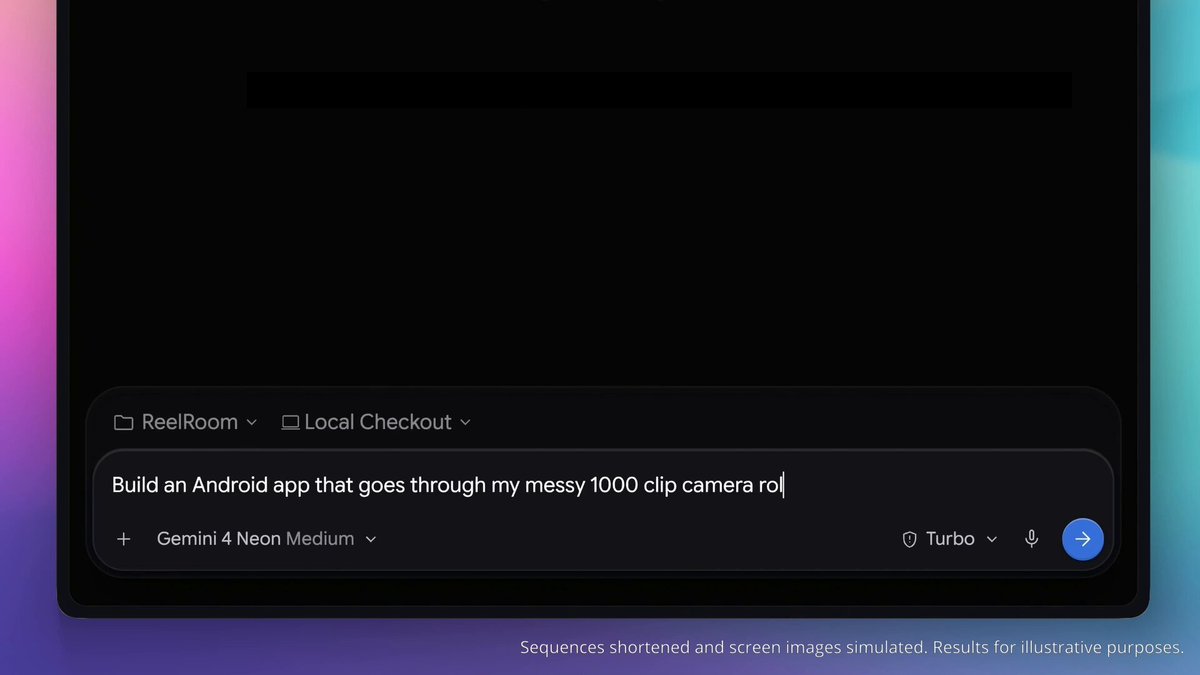
Google demonstrates a searchable video studio built with Gemini Neon

Google demonstrates a searchable video studio built with Gemini Neon

Google described a prototype built with Gemini 4 Neon in Antigravity that organizes a large collection of footage into a searchable 3D studio. The collected post mentions indexing keyframes, lighting cues and spoken content to help locate useful moments among many clips. This is a concrete example of multimodal models supporting media retrieval and editing preparation. It remains a prototype demonstration; the post does not establish product availability, retrieval accuracy or performance at production scale.

HF HuggingFace

8 stories
01

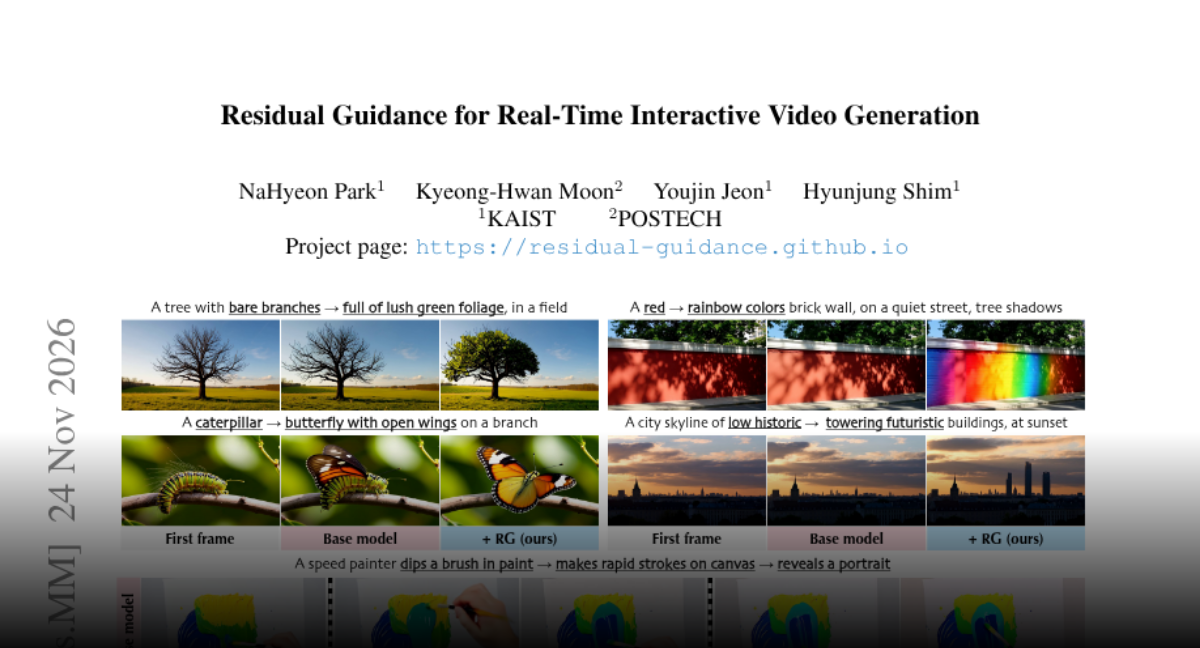
Residual Guidance improves prompt switching in streaming video

Residual Guidance improves prompt switching in streaming video

Residual Guidance addresses context inertia in streaming video generation, where new chunks keep following an old prompt after the user changes direction. The method re-noises the previous chunk, denoises it once under the new prompt without cached context, and applies the resulting correction early in the next chunk. The authors report improved switching while largely preserving visual quality. It requires no training or model-specific tuning and adds one forward pass per chunk, making integration costs explicit.

02

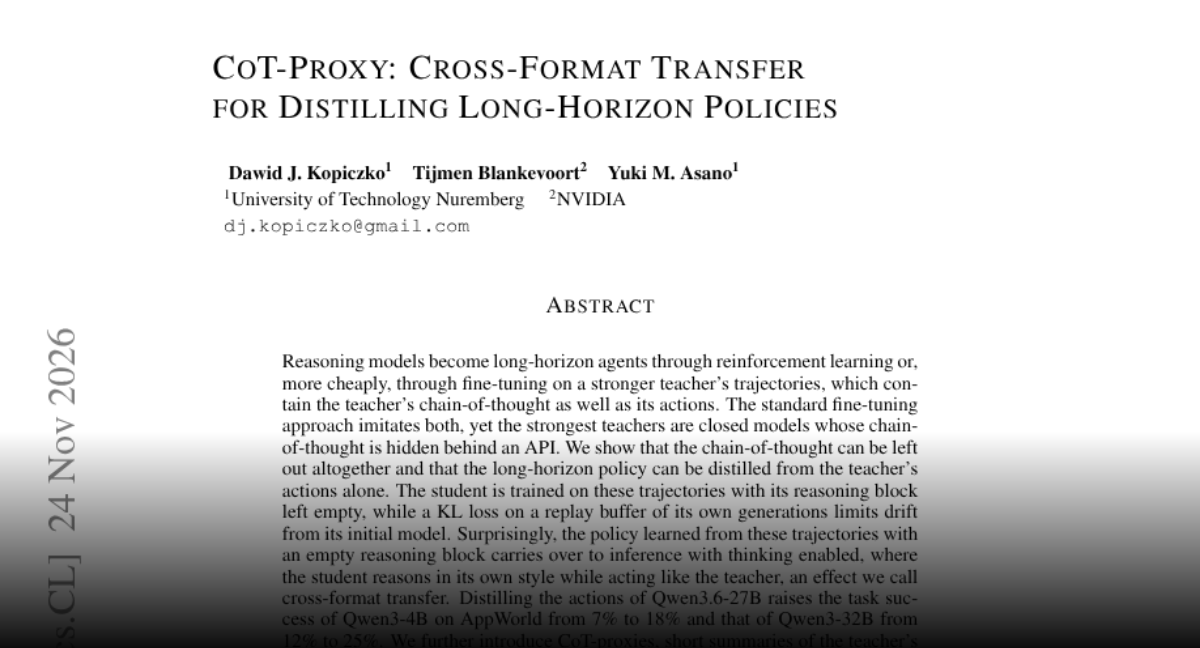
CoT-Proxy distills agent policies without hidden reasoning traces

CoT-Proxy distills agent policies without hidden reasoning traces

CoT-Proxy studies distilling long-horizon agent behavior from teacher actions without accessing the teacher's hidden chain of thought. Training leaves the student's reasoning block empty and uses a replay-buffer KL loss to limit drift, while short reasoning summaries can improve transfer further. The authors report Qwen3-4B reaching 48% on AppWorld and 28% on SWE-bench Verified when distilled from GPT-5.6 Luna's visible outputs and summaries. These are reported experimental results, not guarantees for arbitrary agent tasks.

03

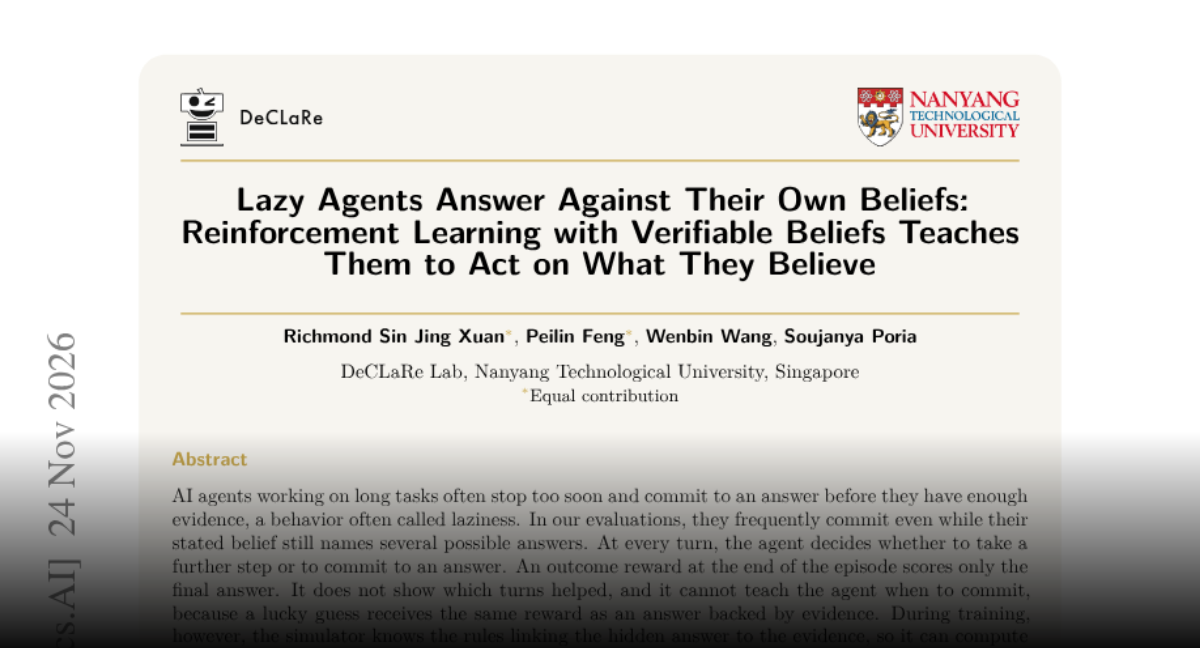
Verifiable-belief rewards teach agents when to gather more evidence

Verifiable-belief rewards teach agents when to gather more evidence

Reinforcement Learning with Verifiable Beliefs targets agents that commit to answers before evidence is sufficient. During training, a simulator computes the exact posterior and rewards further investigation while multiple answers remain possible, then commitment when evidence supports it. The authors report improvements across nine model-benchmark settings, averaging 17.1%. The approach separates evidence gathering from lucky final guesses, although its reward construction depends on access to simulator information that may not exist in unrestricted real-world tasks.

04

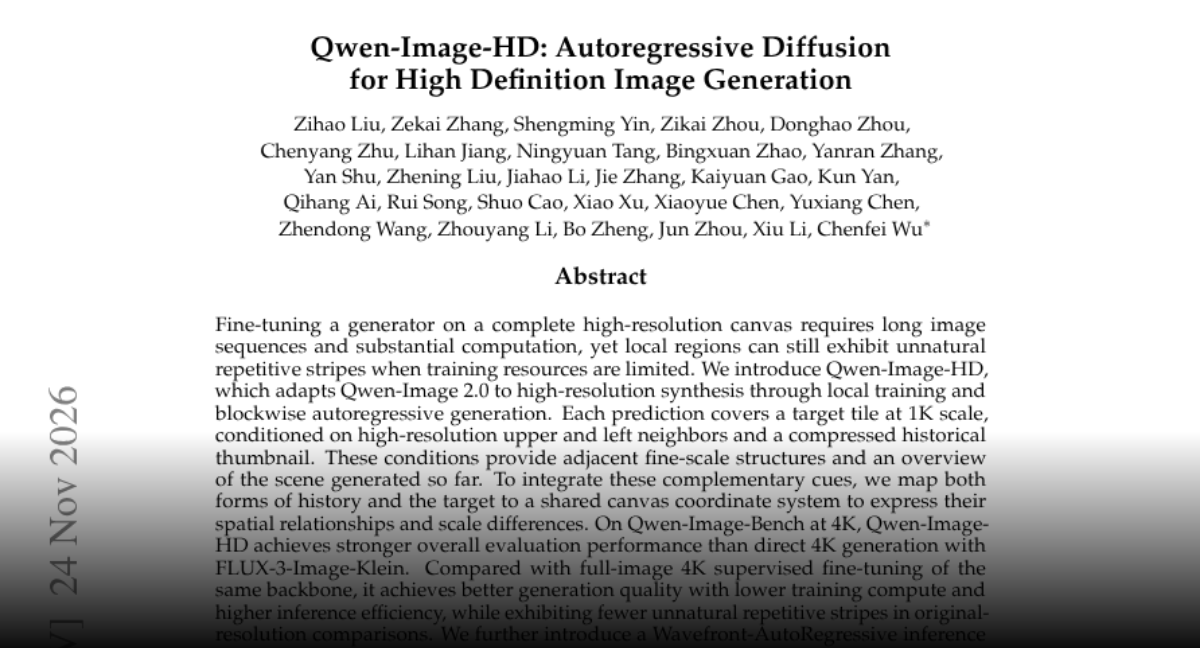
Qwen-Image-HD uses tiled autoregressive diffusion for 4K generation

Qwen-Image-HD uses tiled autoregressive diffusion for 4K generation

Qwen-Image-HD adapts Qwen-Image 2.0 to high-resolution generation using local training and blockwise autoregressive synthesis. Each prediction produces a 1K tile conditioned on neighboring tiles and a compressed thumbnail of prior content, with shared canvas coordinates preserving spatial relationships. The authors report better quality and efficiency than full-image 4K fine-tuning of the same backbone. A wavefront schedule generates tiles on the same anti-diagonal concurrently across GPUs to reduce latency, with results remaining specific to the evaluated settings.

05

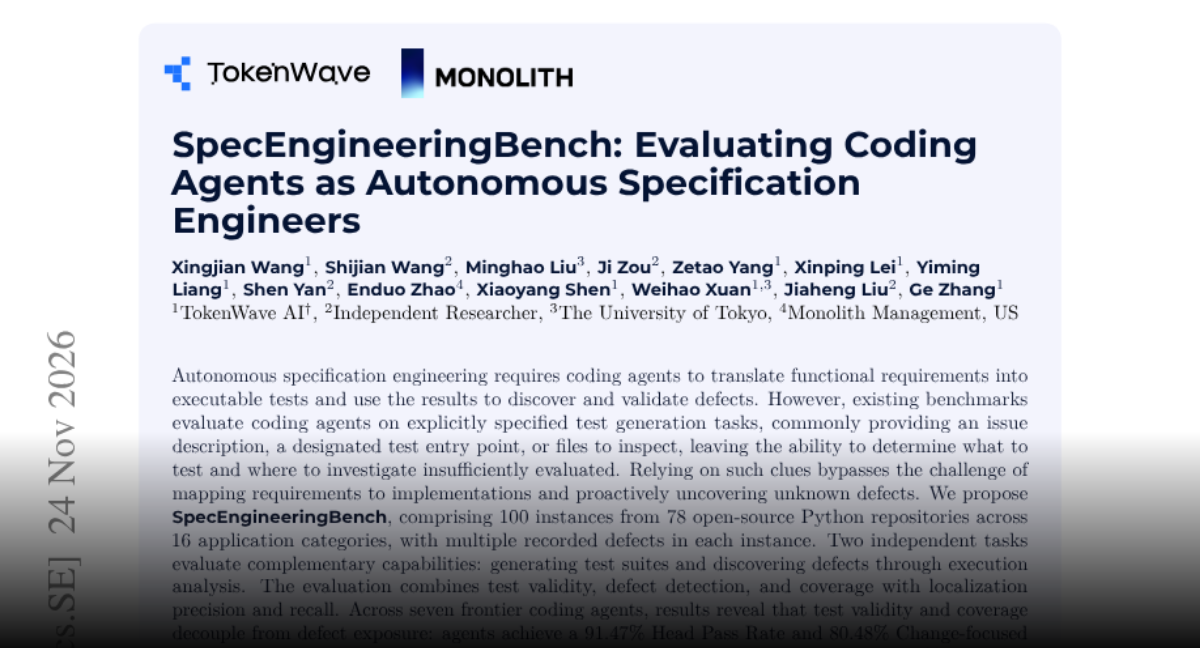
SpecEngineeringBench separates test coverage from real defect discovery

SpecEngineeringBench separates test coverage from real defect discovery

SpecEngineeringBench evaluates whether coding agents can turn requirements into tests and proactively discover defects without being handed precise test targets. It contains 100 instances drawn from 78 Python repositories across 16 application categories. Across seven frontier agents, the authors report high test validity and change-focused coverage alongside a much lower 26.36% fail-to-pass rate. The result highlights why producing passing tests or broad coverage is insufficient evidence that an agent has found consequential implementation defects.

06

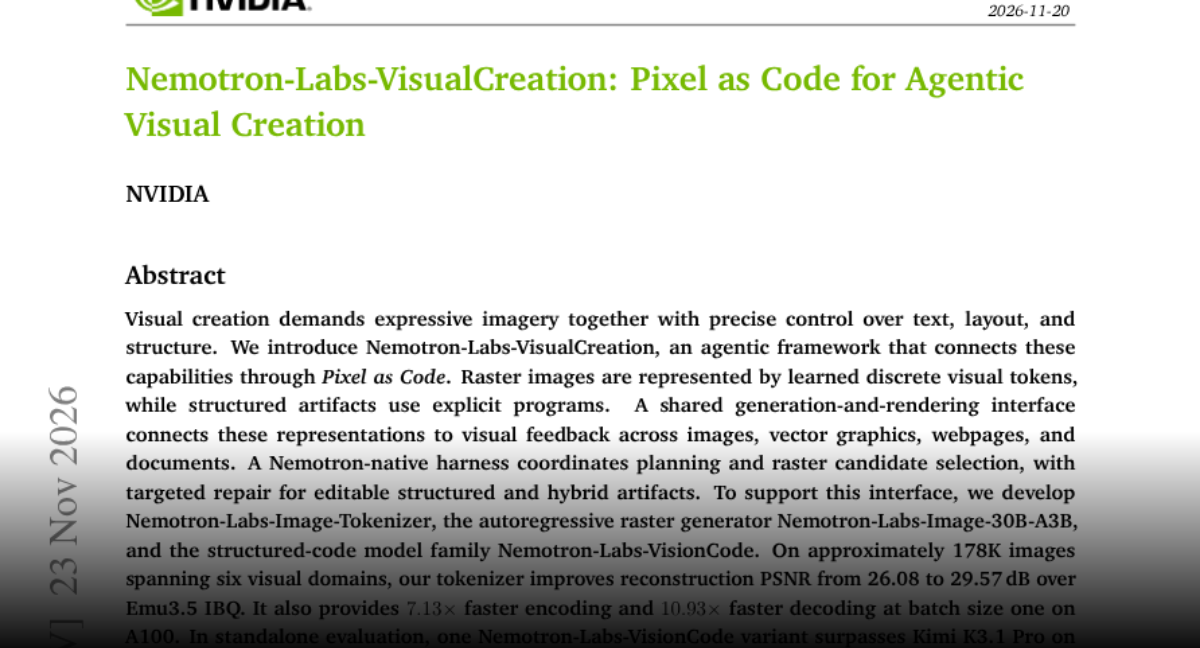
Nemotron VisualCreation combines visual tokens with editable programs

Nemotron VisualCreation combines visual tokens with editable programs

Nemotron-Labs-VisualCreation connects raster generation with structured visual artifacts through a Pixel as Code framework. Learned visual tokens represent images, while explicit programs represent editable structures; a shared rendering interface supports feedback across graphics, webpages and documents. The work includes an image tokenizer, a 30B-A3B raster generator and VisionCode models. The authors report stronger system-level generation scores using the same raster generator, suggesting that planning, selection and targeted repair can materially affect visual creation quality.

07

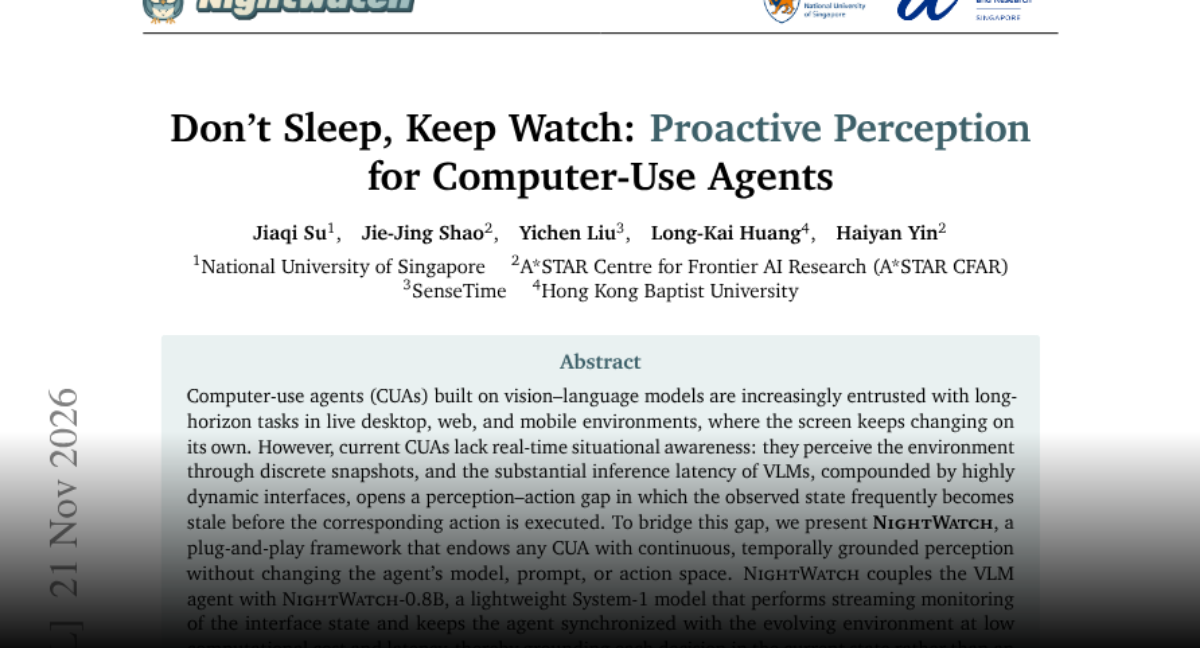
NightWatch adds continuous perception to computer-use agents

NightWatch adds continuous perception to computer-use agents

NightWatch addresses the gap between a computer-use agent's screenshot and the screen state when its action finally executes. A lightweight 0.8B monitoring model tracks interface changes without modifying the main agent's model, prompt or action space. The authors report 33% less non-reasoning time and 53% less wasted time on OSWorld while maintaining success, plus improved DynaCU-Bench success. This is perception research, distinct from Hugging Face's similarly named Hub security agent announced in this edition.

08

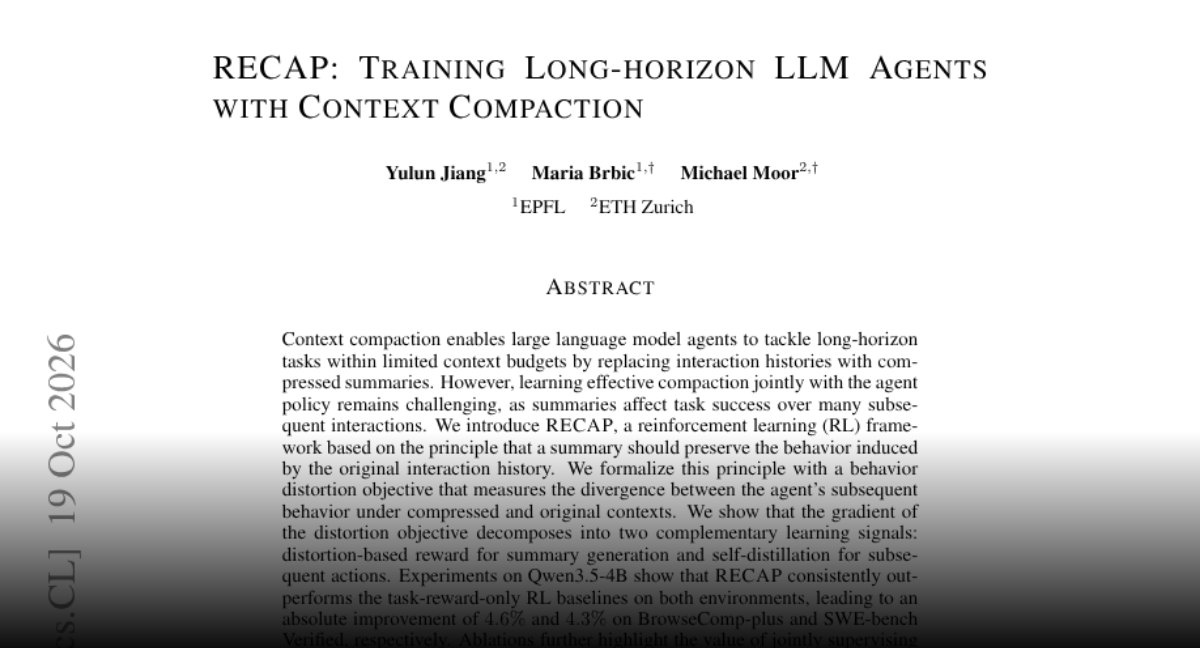
RECAP trains context summaries to preserve agent behavior

RECAP trains context summaries to preserve agent behavior

RECAP trains long-horizon agents to compact context while preserving the behavior induced by the original interaction history. Its behavior-distortion objective supplies both a reward for summary generation and self-distillation signals for actions after compaction. Experiments with Qwen3.5-4B report absolute gains of 4.6 and 4.3 percentage points over task-reward-only reinforcement-learning baselines on BrowseComp-plus and SWE-bench Verified. The work makes summary quality an operational question about future actions, rather than merely whether compressed text sounds complete.